Business Intelligence
Exploring Semantic Layers in Business Intelligence
Semantic layers bridge raw data and business users, enhancing decision-making and AI integration while ensuring data governance and accuracy.

Semantic layers simplify complex data into business-friendly terms, enabling better analysis and decision-making. They act as a bridge between raw data and business users, improving data consistency, accuracy, and usability.
Key Takeaways:
- What it does: Translates raw data into understandable business terms using SQL like "Monthly Revenue."
- Why it matters: Improves data governance, reduces silos, and accelerates query performance by up to 60%. This is often achieved by optimizing a query for faster BI.
- Core components:
- Data Objects: Maps technical data to relatable terms like Customer or Revenue.
- KPI Framework: Automates and standardizes calculations like YoY comparisons.
- Security Rules: Enforces compliance with role-based access and data masking.
- AI Integration: Enhances data quality by automating validation, detecting anomalies, and enabling natural language queries.
- Platform Examples:
Quick Comparison:
| Platform | Key Strength | Best For | Unique Edge |
|---|---|---|---|
| AtScale | Works with any system | Enterprise teams | 100x faster queries |
| Looker | Strong version control | Data-driven teams | Git-based deployment |
| dbt | Open-source flexibility | Technical teams | Community support |
Semantic layers are transforming business intelligence by making data accessible, accurate, and AI-ready. Whether you’re streamlining KPIs, integrating AI, or improving governance, they’re essential for modern analytics.
What is a Semantic Layer?
::: @iframe https://www.youtube.com/embed/sDoOs9Mdhts :::
Main Elements of Semantic Layers
A semantic layer has three key components that simplify complex data into insights that are easier to understand and use. These elements are crucial for powering features in AI-driven platforms like Looker.
Data Objects and Definitions
Semantic objects turn database structures into relatable business terms, such as Customer or Revenue [1][3]. By mapping technical database elements to everyday language, these objects provide context and create logical hierarchies for deeper analysis. They form the backbone for AI systems that identify patterns, as discussed in Section 5.
KPI Calculation Framework
AI-powered platforms ensure consistent metric calculations by automating and validating formulas [1][3]. This framework standardizes KPIs across tools, managing tasks like currency conversions, year-over-year (YoY) or quarter-over-quarter (QoQ) comparisons, and conditional calculations. These automated processes are tightly linked to the quality control features highlighted in Section 3.
Security and Data Rules
Advanced controls manage compliance with role-based access, row-level filtering, and real-time data masking. For example, in healthcare, doctors can only view records for their assigned patients, while sensitive data like Social Security Numbers (SSNs) remains hidden [3]. These controls automatically enforce HIPAA regulations through detailed access logs and masking workflows [3]. Such governance measures are critical for enabling safe use of text-based queries and predictive models, as discussed later.
Setting Up Semantic Layers with AI Tools
Looker and dbt Integration
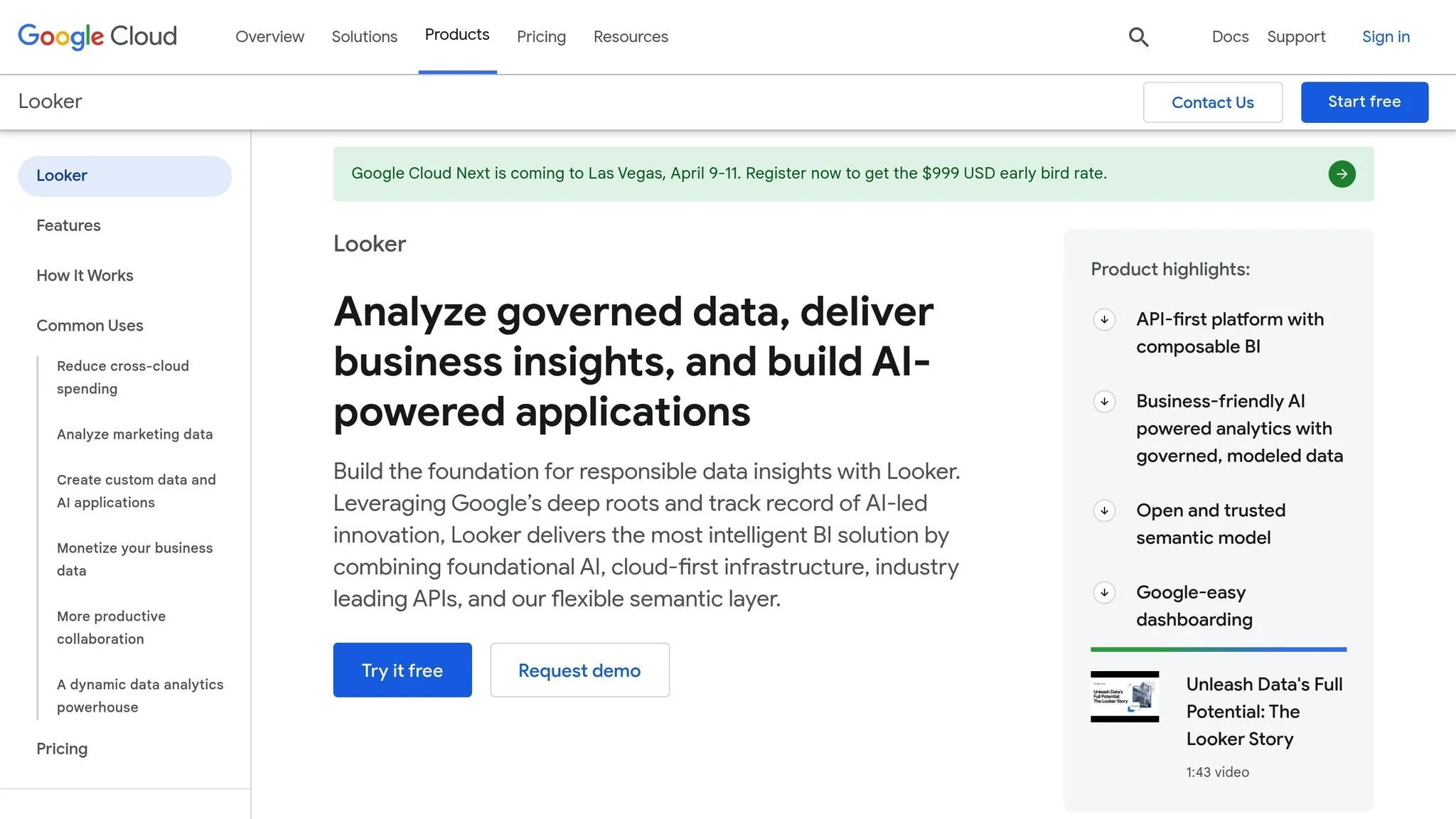
Combining Looker's LookML with dbt's semantic layer capabilities is a powerful way to enhance modern analytics stacks. This setup enables efficient data modeling and analysis. Here's how it typically works:
- Transform raw data: Use dbt to convert raw data into analytics-ready models in your data warehouse or data lake.
- Define metrics and dimensions: Leverage dbt's semantic layer to set up clear definitions.
- Build exploration interfaces: Use LookML to create user-friendly definitions and interfaces for data exploration.
This setup improves data consistency by 68% [1].
Platform Selection Guide
Choosing the right semantic layer platform depends on factors like scalability, integrations, and ease of use. Here's a quick comparison:
| Platform | Key Strength | Best For | Edge |
|---|---|---|---|
| AtScale | Works with any system | Enterprise teams | 100x faster queries [8] |
| Looker | Strong version control | Data-driven teams | Git-based deployment [7] |
| dbt | Open-source flexibility | Technical teams | Community support |
AtScale is ideal for enterprises, offering automated data modeling and built-in security [8]. Looker stands out with Git integration for version control [7].
AI Data Quality Control
AI-powered semantic layers bring a new level of data quality management. These tools reduce data preparation time by 30-40% [2] and boost AI model accuracy by up to 25% [4]. Key features include:
- Automated Validation: Continuous checks to ensure data aligns with business rules.
- Pattern Recognition: Detects anomalies in datasets.
- Real-time Monitoring: Sends instant alerts for any inconsistencies.
To maintain compliance and reliability, integrate these features with your current data governance policies. These automated tools also align with the governance rules discussed in Section 4.
sbb-itb-284a532
Enterprise Implementation Steps
Data Governance Rules
Strong governance frameworks can improve how departments use data by 30% [7]. A centralized governance team clarifies roles and aligns department needs, cutting reporting inconsistencies by 30% [3] through standardized processes. These frameworks build on the essential features of modern business intelligence tools like security measures, creating a solid foundation for managing data.
Here’s how organizations typically organize their framework:
| Component | Purpose | Impact |
|---|---|---|
| Data Dictionary | Standardized terminology | 90% fewer conflicting definitions [2] |
| Quality Monitoring | Ensures data integrity | Boosts accuracy and reliability [2] |
Speed and Efficiency Tips
Building on the AI-driven quality controls discussed in Section 3, these strategies can further improve platform performance. Optimizing performance plays a major role in driving user adoption. Following business intelligence best practices ensures these technical optimizations translate into business value.
Some effective techniques include:
- Intelligent Caching: By storing frequently accessed data, modern semantic layers ease database load and improve response times [6].
- Query Optimization: Using materialized views, query optimization can reduce response times by 40-60% [2].
Growth and Updates
Structured update cycles, similar to automated testing in AI quality systems, are essential for efficient updates. Organizations that adopt regular update cycles have been able to cut report development time by 70% [3].
Key practices for effective updates include:
- Quarterly reviews of definitions
- Automated testing for consistency
- Version control to manage changes
- Incorporating user feedback into updates
For example, a financial services company that adopted these practices saw a 200% increase in BI tool adoption [9]. Their success was driven by thorough documentation and collaboration across teams.
To keep up with growing data ecosystems, organizations should prioritize scalable architecture while maintaining high performance.
New Developments in Semantic Layers
Recent advancements are pushing the boundaries of semantic layers, enhancing their analytical capabilities while ensuring proper governance. These updates are reshaping how businesses interact with and utilize data.
Text-Based Data Queries
Natural language processing (NLP) has transformed how users interact with data through semantic layers. For example, Tableau's Ask Data feature allows users to query data in plain, conversational language instead of relying on complex technical syntax [1]. Organizations report a 40% reduction in data analysis time for non-technical users, showcasing the efficiency of this approach [5].
Modern NLP uses in BI and analytics bring these features to semantic layers:
- Context-aware interpretation of business queries, including handling synonyms and casual phrases
- Automatic generation of SQL queries
- Natural language explanations of analytical results
This shift aligns perfectly with self-service analytics use cases and tools, making data more accessible to a broader audience.
Pattern Detection Systems
AI-driven pattern detection within semantic layers is proving invaluable for spotting anomalies and analyzing trends. Looker, for instance, uses this technology to flag unusual patterns in time-series data [6].
Here’s a snapshot of its key features and benefits:
| Feature | Business Impact | Additional Note |
|---|---|---|
| Automated Anomaly Detection | Quicker identification of issues | Accuracy improved by 25-30% [2] |
| Multi-source Pattern Recognition | Broader insights from diverse data sources | Enhances cross-data analysis |
| Predictive Trend Analysis | Early warnings for potential trends | Boosts detection reliability |
Forecast Model Support
Semantic layers now support the development of forecast models by leveraging governed data definitions [3]. These definitions build upon the KPI frameworks discussed earlier, ensuring consistency and reliability. Some standout improvements include:
- Automatic time intelligence for handling date-related data
- Standardized KPI definitions to ensure uniformity across models
- Governed data access to maintain data security and consistency
Gartner predicts that 35% of organizations will implement or enhance their semantic layer technology by 2025 [10]. This growing adoption highlights the increasing importance of semantic layers as a foundation for AI-powered business intelligence.
Summary
Why Semantic Layers Matter
As AI transforms data analytics, the role of these layers becomes even more critical.
Semantic layers in business intelligence offer clear, measurable advantages. They streamline data processes and directly support AI-driven tools for pattern detection and forecasting. This connection to improved data quality and predictive accuracy, as outlined in Sections 3 and 5, highlights their impact.
Steps to Get Started
To implement semantic layers effectively, organizations should take a phased approach:
1. Assessment Phase
Understand your current data landscape by identifying existing sources, pinpointing bottlenecks, and gathering input from key stakeholders about their specific data needs.
2. Platform Selection
Choose a platform that aligns with your goals. Look for options that integrate seamlessly with your systems, support scalability, and meet security standards.
3. Implementation Strategy
Start small. Launch departmental pilots before scaling up to the entire organization. Netflix's gradual rollout model is a great example of how this can work [5].
Throughout the process, use governance frameworks (see Section 4) to assign clear responsibility for data definitions and ensure regular updates. Modern semantic layers can also tap into AI tools, offering features like automated quality checks and natural-language analytics to improve data quality to improve both data accuracy and user experience.
FAQs
What are the benefits of AtScale?
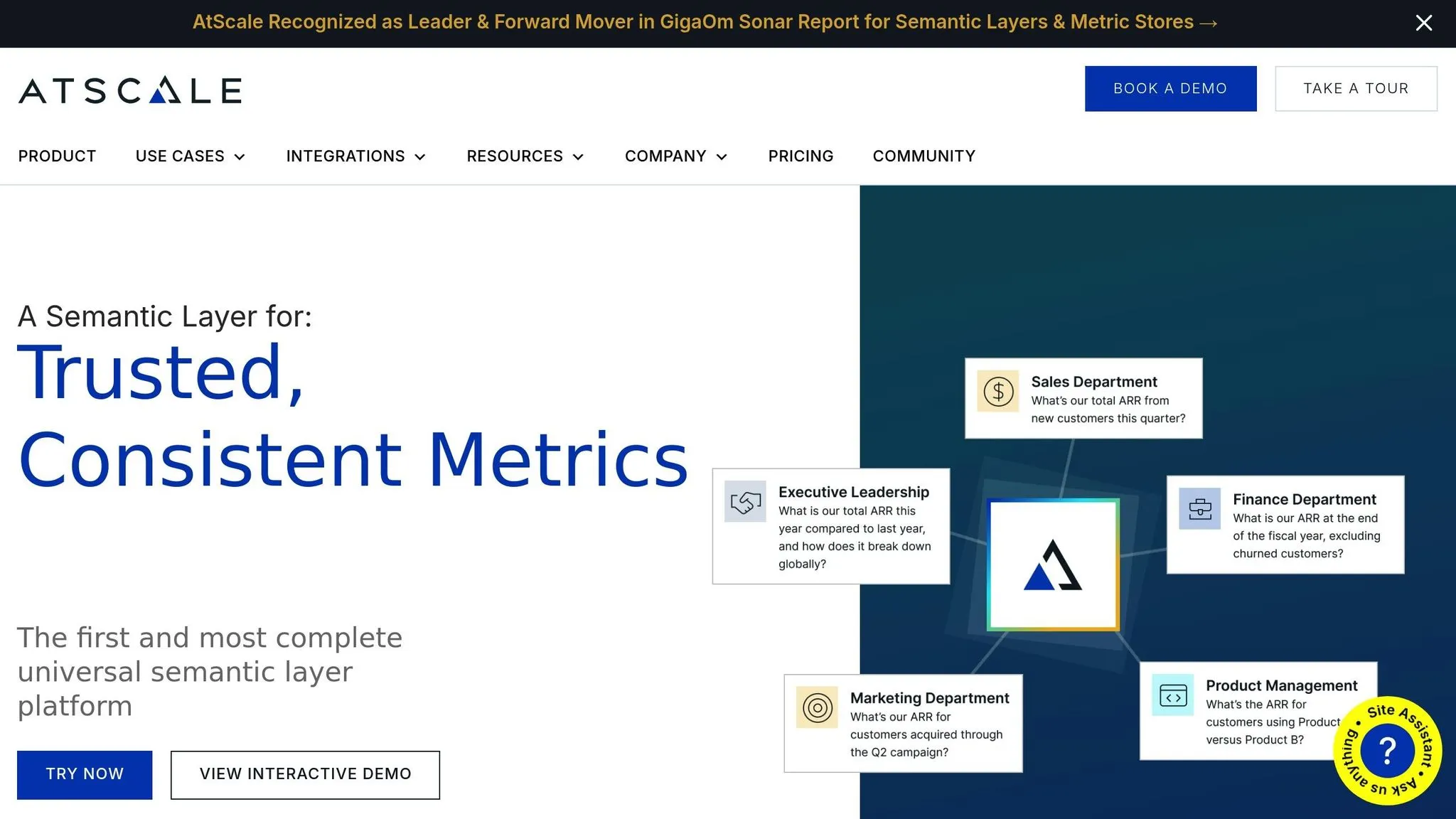
AtScale offers three main advantages that improve efficiency and analytics capabilities, earning it a 4.4/5 rating on Gartner Peer Insights [2].
Performance Optimization
With its Autonomous Data Engineering and Intelligent Aggregation technologies, AtScale streamlines AI-ready data pipelines. This ensures real-time analytics while cutting down on computational costs [11].
Universal Connectivity
AtScale provides a unified semantic layer that connects multiple data sources and BI tools [1]. This ensures consistent metrics and KPIs across various analytics platforms.
Security and Governance
AtScale strengthens data security and governance using role-based controls and other advanced features:
| Feature | Business Impact |
|---|---|
| Role-based Access | Ensures access is limited to necessary permissions |
| Data Masking | Protects sensitive information from unauthorized access |
| Audit Trails | Supports compliance and risk management |
| SSO Integration | Enhances enterprise security with single sign-on |
Before implementing AtScale, organizations should confirm infrastructure compatibility [7]. This step aligns with the AI-driven quality controls covered in Section 3.