Business Intelligence
Natural Language BI: The Ultimate Guide
Natural Language BI makes data accessible to everyone by turning plain-English questions into real SQL, visualizations, and governed insights.

Natural Language BI lets you ask questions about data in plain English and get instant answers through charts, tables, or written explanations. Instead of relying on AI BI tools vs. traditional BI platforms, anyone in your organization can quickly pull insights from data without learning SQL. For example, you can ask, "What were Q4 2024 revenues by region?" and get a clear response without delays.
Key Benefits:
- Faster Decisions: No waiting for reports - get answers in seconds.
- Accessibility: Non-technical users can analyze data without coding.
- Real-Time Insights: Connects directly to live data systems like Snowflake or BigQuery.
- Handles Complexity: Works with structured data (sales figures) and unstructured data (emails, social media).
How It Works:
- Natural Language Understanding (NLU): Translates your question into SQL or Python queries.
- Semantic Layer: Ensures consistency by mapping business terms to data definitions.
- Visual & Narrative Outputs: Automatically creates charts and written summaries for clarity.
Challenges:
- Ambiguity: Clear definitions (e.g., "revenue" vs. "net revenue") are crucial.
- Data Governance: Secure access controls are needed to protect sensitive data.
Why It Matters:
Companies like JPMorgan Chase and Toyota have implemented Natural Language BI to save time and improve efficiency. For example, JPMorgan reduced executive data analysis time by 40%, while Toyota sped up insights across 35 subsidiaries by 21x.
Natural Language BI is transforming how businesses interact with data, making analytics faster, simpler, and accessible to everyone.
Core Features of Natural Language BI
Natural Language BI revolves around three key capabilities that turn everyday questions into actionable insights. Together, these features break down the barriers between natural language queries and complex data analysis, making it easier for users at all levels to gain meaningful insights. Let’s take a closer look at each.
Semantic Layers and Business Metrics
A semantic layer acts as a translator, converting business terms into raw data while ensuring consistency in responses. For example, if someone asks about "revenue" or "active customers", the semantic layer guarantees that these terms are uniformly defined across the organization.
Without this crucial layer, analysts often spend 80% of their time just trying to interpret data syntax [6]. Studies show that incorporating a semantic layer into generative AI workflows increases answer accuracy from 16% to 54%, making results three times more reliable than directly querying databases [6].
"A semantic layer provides a bridge between the language of business and the language of data." - Mark Palmer, Board Member, AtScale [6]
Companies like Toyota North America have embraced semantic layers to great effect. By deploying this system across 35+ subsidiaries, they’ve accelerated data insights by a staggering 21 times while cutting infrastructure costs [6]. Similarly, Tyson Foods introduced a self-service semantic layer for its 144,000 employees, spanning platforms like Google BigQuery, Hadoop, and AWS Redshift. This setup allows them to quickly adapt to supply chain changes [6].
Converting Language to SQL and Python
Once consistent business definitions are in place, the next step is translating natural language queries into executable code. For example, when you type a question like "Show me Q4 2025 sales by region", the system uses a structured process to generate SQL or Python code.
Here’s how it works: First, RAG (Retrieval-Augmented Generation) pulls relevant context - like metadata, synonyms, and company-specific terminology - from a knowledge store [5][7]. Then, a large language model (LLM) maps your query to the semantic layer’s definitions. Finally, a transpiler converts the query into deterministic SQL or Python code that interacts with live data warehouses [5][7]. This approach ensures accuracy by relying on pre-defined structures rather than arbitrary code generation.
To enhance speed and reduce computing costs, a caching layer optimizes performance, delivering sub-second responses [5][9].
Platforms like Querio use this architecture to connect directly with systems like Snowflake, BigQuery, and Postgres. The result? Transparent, inspectable SQL and Python code that data teams can trust - no black-box answers here.
Charts, Narratives, and Dashboards
Getting the right answer is only part of the equation. Natural Language BI systems also identify data types - like dates, categories, or numerical values - and automatically choose the best visualizations. For example, a query about trends over time might generate a line chart, while a regional comparison could produce a bar chart or map [8][10].
These systems go a step further by creating narratives that explain data insights in plain language, making the information accessible to everyone. These narratives can be embedded into dashboards, scheduled reports, or even integrated into other applications.
Whether you need a quick chart for a meeting, a detailed executive dashboard, or embedded AI analytics for a broader audience, Natural Language BI tailors its output to suit the situation - all while ensuring the data remains consistent and governed.
Benefits and Challenges of Natural Language BI
::: @figure 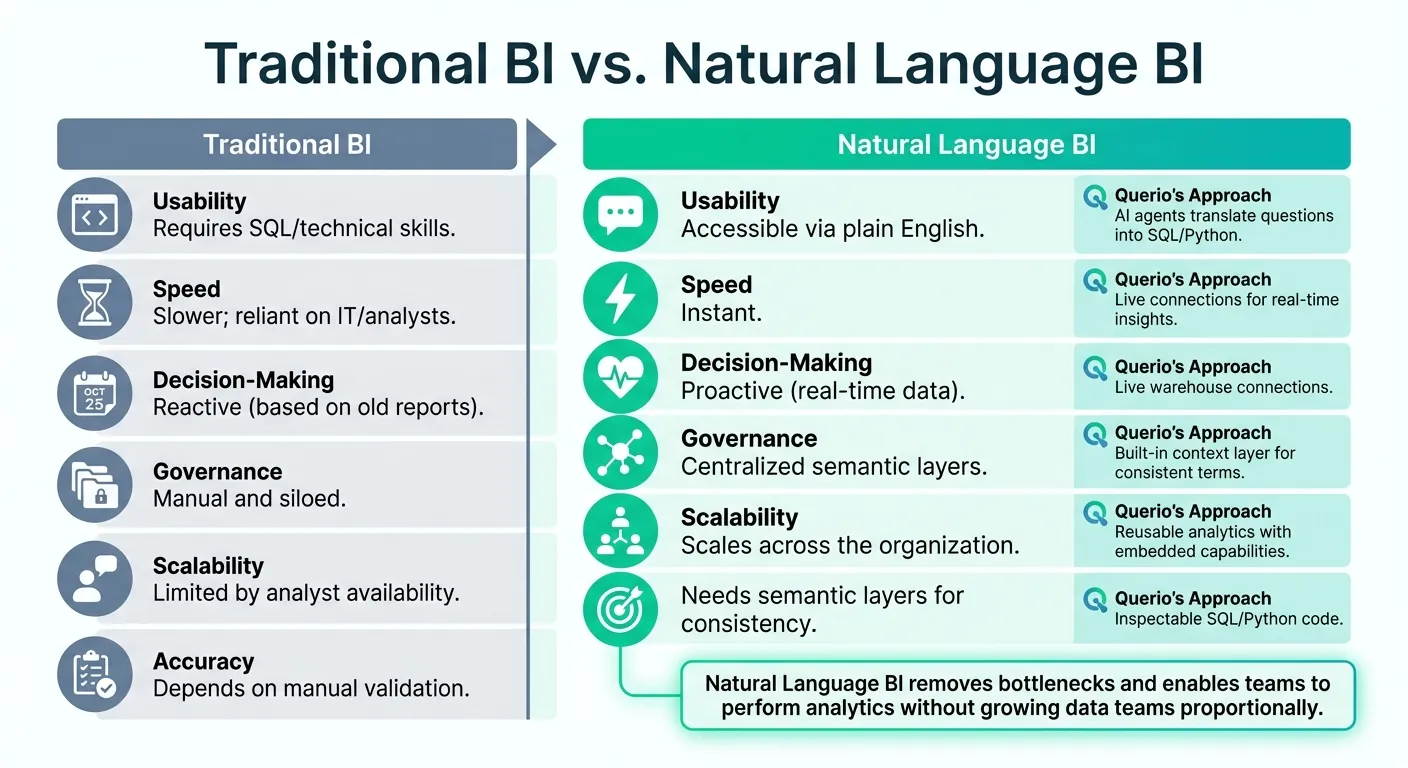 {Traditional BI vs Natural Language BI: Key Differences and Capabilities}
:::
{Traditional BI vs Natural Language BI: Key Differences and Capabilities}
:::
Natural Language BI brings a fresh approach to data analytics, offering exciting opportunities for businesses while also presenting unique challenges that need thoughtful solutions.
Benefits of Natural Language BI
Natural Language BI makes data accessible to everyone in an organization. Teams in marketing, sales, and HR can ask questions in plain English - no need for SQL skills or technical know-how. This eliminates IT bottlenecks, turning what used to take days into answers delivered in seconds.
By automating routine tasks like pulling reports or retrieving data, Natural Language BI frees up data teams to focus on more strategic work. Instead of spending time on repetitive queries, analysts can dive into deeper modeling and analysis, creating a dynamic workflow where AI handles the grunt work, and humans focus on insight and strategy [12].
The ability to query data in real time also speeds up decision-making. Leaders can act quickly on market shifts instead of relying on outdated reports or dashboards [11]. Plus, Natural Language BI can process unstructured data - like customer emails or social media posts - opening the door for better collaboration across departments.
Challenges and How to Address Them
One of the biggest hurdles is ambiguity in user queries. For example, if someone asks about "revenue", it might not be clear whether they mean gross revenue, net revenue, or revenue by product line. This lack of clarity can lead to inconsistent or inaccurate results.
Data governance is another tricky area. Organizations need to ensure that users can only access the data they are authorized to see, even when queries are made in natural language. Consistent and trustworthy AI output is critical to building user confidence.
To tackle these challenges, start by standardizing data naming conventions. For instance, always use "customer_id" instead of mixing terms like "cust_id" or "client_id." Simplify data sources by hiding unnecessary fields and setting clear defaults for data types and aggregations - this reduces the chances of AI getting confused [10]. Regular feedback loops are also essential. Allow users to flag ambiguous results and refine definitions over time, improving the system's accuracy and reliability.
Traditional BI vs. Natural Language BI
Here’s a quick comparison of how traditional BI stacks up against Natural Language BI, along with how Querio’s approach bridges the gap:
| Feature | Traditional BI | Natural Language BI | Querio's Approach |
|---|---|---|---|
| Usability | Requires SQL/technical skills | Accessible via plain English | AI agents translate questions into SQL/Python |
| Speed | Slower; reliant on IT/analysts | Instant | Live connections for real-time insights |
| Decision-Making | Reactive (based on old reports) | Proactive (real-time data) | Live warehouse connections |
| Governance | Manual and siloed | Centralized semantic layers that standardize SaaS metrics | Built-in context layer for consistent terms |
| Scalability | Limited by analyst availability | Scales across the organization [12][11] | Reusable analytics with embedded capabilities |
| Accuracy | Depends on manual validation | Needs semantic layers for consistency | Inspectable SQL/Python code |
Traditional BI often creates bottlenecks due to its reliance on technical expertise, limiting scalability to the number of available analysts. Natural Language BI removes these barriers, enabling teams across the organization to perform analytics without needing to grow their data team proportionally [12][11].
This comparison highlights how AI-powered BI tools are reshaping the way organizations approach data, making analytics faster, more accessible, and more effective.
How to Integrate Natural Language BI
Integrating Natural Language BI isn’t just about adopting new tools - it’s about setting up the right data infrastructure and creating a clear semantic layer. This ensures your system can handle plain-English queries while maintaining data accuracy, security, and consistency.
Checking Your Organization's Readiness
Before diving into Natural Language BI, take a hard look at your data infrastructure. Is it modern and centralized? Tools like Snowflake, BigQuery, or Postgres are excellent starting points. Organize your data using a star schema with clear relationships between tables to make querying seamless [13]. If your data is scattered across spreadsheets or outdated systems, consolidation is a must.
Next, tighten up your access controls. Implement Row-Level Security (RLS) and Column-Level Security (CLS) to ensure users only see the data they’re authorized to access [10]. Audit your data quality and simplify naming conventions - rename technical terms like "ProdID" to something intuitive, like "Product Name." Finally, focus on identifying 10–20 key metrics that will drive your Natural Language BI efforts, such as revenue, customer churn, or user engagement [14].
Once your data foundation is solid, it’s time to build the semantic layer.
Building a Semantic Layer
The semantic layer is the bridge between raw data and business users. It translates complex database structures into terms that make sense to everyone. Emily Winks, a Data Governance Expert at Atlan, explains it best:
"A semantic layer is a translation layer between raw data and business users that maps technical database structures to user-friendly business concepts." [14]
Start by standardizing naming conventions and cleaning up your data - get rid of unused tables or unnecessary columns [13][10]. Enhance your metadata with clear descriptions, synonyms, and sample values. This helps the AI understand how users might phrase their questions. Focus on defining a small set of core metrics, such as Monthly Recurring Revenue, Customer Acquisition Cost, or Active Users, to ensure consistent and reliable reporting [14].
A well-designed semantic layer can dramatically improve the performance of generative AI. Research shows it can increase AI accuracy from 16% to 54% while cutting hallucinations by more than half [6][14]. With tools like Querio’s built-in context layer, you can define joins, metrics, and business terms once, ensuring that every query, dashboard, and embedded analytic delivers consistent and trustworthy results.
Future of Natural Language BI
Natural Language BI is evolving rapidly, setting the stage for deeper integration of natural language as the go-to way to interact with data.
More and more, users are turning to natural language as the easiest way to engage with data. Soon, BI platforms will flip the traditional model on its head. Instead of manually building dashboards, teams will simply ask questions in plain English and instantly generate visualizations and insights [2][3]. This shift promises to make analytics faster, easier, and open to everyone - not just data experts.
Natural Language as the Standard Interface
The days of navigating clunky menus or dragging fields into pivot tables are fading fast. Natural language querying is quickly becoming the default entry point for exploring data [2][3]. Imagine typing or saying something like, "What’s our monthly revenue by region for the past year?" and getting an immediate response, powered by real SQL or Python in the background. This user-friendly approach makes even complex analysis accessible to non-technical users [2]. Platforms like Querio are already embracing this model, treating natural language as a core feature rather than an afterthought.
Smarter Understanding of Business Context
Future BI platforms won’t just interpret grammar; they’ll grasp the nuances of specific industries, roles, and organizations. For example, they’ll understand that "churn" means one thing for a SaaS business and something entirely different for retail. They’ll also recognize terms like "active user" based on definitions your team has agreed upon. Querio’s built-in context layer allows data teams to define these terms, joins, and metrics once, ensuring every query - whether it’s from sales, finance, or operations - returns consistent, reliable results. As AI models improve, they’ll also remember previous questions, adapt to user preferences, and suggest smarter follow-ups, making the experience feel more like chatting with a well-informed colleague. This kind of contextual understanding paves the way for analytics that are not only hands-free but also proactive.
Voice Interfaces and Proactive Insights
The future of analytics isn’t just about asking questions - it’s about receiving insights without lifting a finger. Voice interfaces will allow executives to ask, "What’s our current on-time delivery rate in California?" during a meeting and hear the answer, complete with visuals displayed on-screen [1][2]. Field workers and call center agents could access insights on mobile devices without typing a word. Conversational chat will also support multi-step queries, enabling users to refine their questions with follow-ups like, "Drill into the West region", "Filter to enterprise customers", or "Compare with last year" [1][3]. These advancements will require thoughtful design to handle clarifications, ensure privacy for sensitive information, and maintain context across sessions - all while enforcing role-based access [1][4]. Together, these features will make BI platforms more responsive and intuitive, built on solid data foundations.
As natural language becomes the standard, companies that prioritize clean data, well-structured semantic layers, and robust governance today will be ready to harness the full potential of tomorrow’s AI-powered analytics.
Conclusion
Natural Language BI is changing the way we interact with data. Instead of waiting for reports or mastering SQL, anyone can now ask questions in plain English and get answers in moments. This approach opens the door for product managers, marketers, finance teams, and executives - not just data experts - to access insights, turning data bottlenecks into opportunities for growth. It’s a shift that’s making enterprise-wide access to analytics faster and more efficient.
However, the key to making this work lies in a strong data foundation. With reliable data structures, AI-generated queries can produce trustworthy insights. Companies investing in this groundwork today are positioning themselves to thrive as Natural Language BI continues to evolve.
Querio is leading the charge by connecting directly to platforms like Snowflake, BigQuery, and Postgres using read-only credentials. It translates natural language into real SQL and Python, integrates seamlessly with Slack, and operates with a unified context layer. For deeper analysis, its AI-powered Python notebook environment offers the flexibility and depth advanced users need.
The results speak for themselves.
"Querio has revolutionized how we handle data. What used to be a weeks-long process now takes minutes, and our teams feel empowered to make data-driven decisions on their own. The impact on our efficiency and accuracy is unparalleled." - Jennifer Leid
Whether your goal is to save your product managers hours each week or to make data accessible across your organization, Natural Language BI delivers tangible results. By embracing this technology, businesses can transform complex datasets into actionable insights. The future of analytics is here: conversational, intuitive, and within everyone’s reach.
FAQs
::: faq
How does Natural Language BI ensure data security and governance?
Natural Language BI comes equipped with powerful security and governance measures to safeguard sensitive company data. It uses role-based access controls (RBAC) to ensure users only see the tables, columns, and rows they’re permitted to access. Data is encrypted both in transit and at rest, while features like IP allow-listing add another layer of protection against unauthorized access. To keep things transparent, every query and its resulting dataset are logged, providing a complete audit trail for compliance and review purposes.
On the governance side, Natural Language BI integrates effortlessly with existing systems. A semantic layer connects business terms to data models, ensuring consistent definitions for metrics like revenue across the board. The platform also supports data classification rules, approval workflows for adding new sources, and compliance checks to uphold standards such as SOC 2 and GDPR. By embedding these controls directly into its conversational interface, Natural Language BI allows users to access quick, self-service insights while maintaining strict security and governance protocols. :::
::: faq
What challenges might arise when implementing Natural Language BI, and how can they be solved?
Implementing Natural Language BI (NL-BI) comes with its fair share of challenges, but the right strategies can make these hurdles manageable. One of the key issues is understanding industry-specific terms and metrics. Without enough domain-specific data, models may struggle to interpret these nuances. A practical solution? Fine-tuning models with internal, curated datasets that reflect the unique language and metrics of your industry.
Another common challenge is ambiguity in natural language. Words can mean different things depending on their context, which can confuse the system. Advanced AI techniques, such as transformer-based models and context-aware systems, are instrumental in deciphering user intent and minimizing misunderstandings.
Then there’s the issue of handling typos, slang, or incomplete queries. These quirks of human input require robust data-cleaning and preprocessing workflows to deliver accurate results. On top of that, organizations often encounter barriers related to usability and adoption. Users need interfaces that are intuitive and provide clear, tangible benefits. Pilot projects showcasing measurable outcomes - like faster decision-making or a lighter workload for analysts - can help demonstrate the system’s value and encourage adoption.
Lastly, ensuring data quality, governance, and security is non-negotiable. Strong governance frameworks, role-based access controls, and scalable infrastructure are vital for building trust and ensuring the reliability of NL-BI systems.
By blending technical innovations with user-focused design and aligning solutions with business goals, organizations can tackle these challenges and make the most of Natural Language BI. :::
::: faq
How does a semantic layer improve the accuracy of AI insights?
A semantic layer acts as a translator between complex technical data structures and the straightforward business language that users rely on. It takes raw data and converts it into familiar terms like Customer Lifetime Value or Monthly Recurring Revenue, ensuring AI tools can accurately interpret user queries. This reduces errors and prevents mismatched results.
By providing a consistent, business-oriented framework, the semantic layer ensures metrics are calculated uniformly across teams and dashboards. This clarity allows AI to better align user intent with the correct data, leading to more precise insights. The result? Faster, more dependable answers to questions like “What were our Q4 sales by region?” or “How is churn trending this month?” - all based on validated and standardized data. :::