Business Intelligence
ThoughtSpot vs Looker: Which Enterprise BI Ages Better?
Fast search-led analytics wins early, but a governed semantic model preserves metric consistency and AI trust over time.

If I had to give one short answer, it’s this: Looker usually holds up better over 2–3 years for governed enterprise BI, while ThoughtSpot usually wins on ease of use at the start.
If you care most about stable metrics, Git-based change control, and keeping AI answers tied to approved business logic, I’d lean Looker. If you care most about getting large non-technical teams into self-serve analytics with less friction, I’d lean ThoughtSpot.
Here’s the plain-English version of the tradeoff:
-
Looker is stronger for:
- Shared metric definitions
- Version control in Git
- Permission logic that scales across teams
- AI answers tied to a governed semantic model
- Lower report rebuild work after metric changes
-
ThoughtSpot is stronger for:
- Search-led analytics
- Fast first-use experience
- Broad self-serve access for business users
- Lower setup friction early on
-
The main long-term risks and hidden costs are:
- Metric drift
- Permission sprawl
- Manual cleanup as teams grow
- More rebuild work after warehouse or model changes
What I’d watch most: when one metric changes, how many dashboards, searches, and embedded views need manual cleanup? If the answer is “a lot,” the platform may age poorly for your team.
Best AI Tools for Data Analysts & BI Teams in 2026: The Complete Guide
::: @iframe https://www.youtube.com/embed/f5n7l7ZRU8c :::
Quick Comparison
| Criteria | ThoughtSpot | Looker |
|---|---|---|
| Core approach | Search-first analytics | Semantic-model-driven BI |
| Best for | Broad self-serve use | Governed enterprise BI |
| Metric consistency over time | More dependent on asset upkeep | More stable through LookML |
| Version control | Limited | Git-native |
| Permissions at scale | Works well, but needs care as use grows | Stronger centralized control |
| AI grounding | Search-led answers | Tied to governed semantic context |
| Warehouse support | Snowflake, BigQuery, Redshift, Postgres | Snowflake, BigQuery, Redshift, Postgres |
| 3-year cost pressure | Often tied to seats and usage | Often tied to LookML staffing |
| Better long-term fit for embedded and governed analytics | Mixed | Stronger fit |
In short, I’d say this article points to a simple split: ThoughtSpot helps more people get answers fast, while Looker cuts down on long-run rework. If your BI team expects metric changes, stricter controls, and more AI use in 2026 and beyond, that difference matters a lot.
ThoughtSpot vs Looker: side-by-side comparison
::: @figure 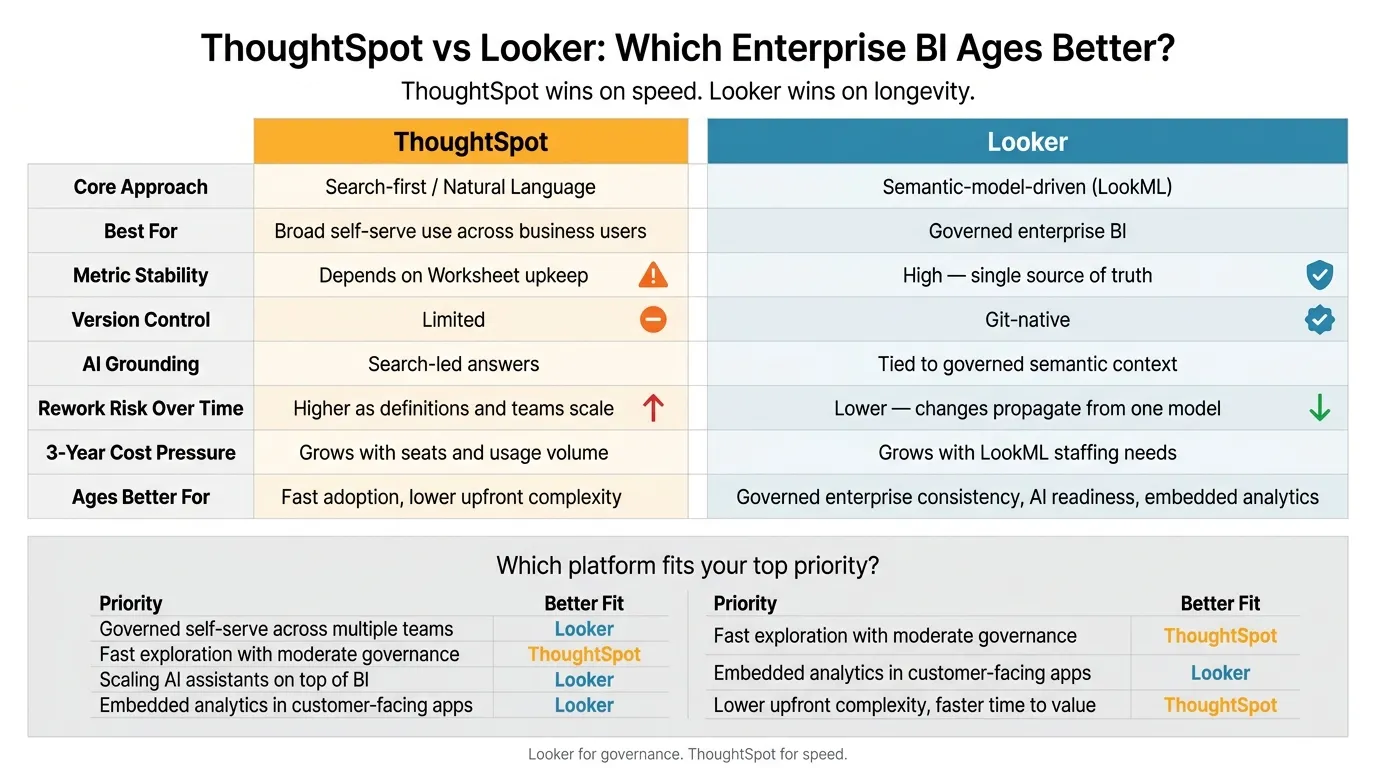 {ThoughtSpot vs Looker: Enterprise BI Comparison 2024}
:::
{ThoughtSpot vs Looker: Enterprise BI Comparison 2024}
:::
ThoughtSpot often wins on first-use speed. Looker tends to hold up better over time because its semantic layer keeps metric definitions, permissions, and AI context more stable as teams grow.
The core tradeoff is pretty simple: ThoughtSpot is built for fast, search-led exploration. Looker is built for governed reuse of metrics over time. That difference shows up most clearly in governance, AI readiness, and long-term upkeep.
Here’s the short version of where each platform adds value and where it can create extra work.
| Feature | ThoughtSpot | Looker |
|---|---|---|
| Core model | Search-first / natural language | Semantic-model-driven (LookML) |
| Governance | UI-based modeling via Worksheets | Code-based, Git-controlled LookML |
| AI assistant | AI assistant built for search-led answers | AI assistant grounded in governed semantic context |
| Self-serve UX | Fast adoption for non-technical users | Moderate - governed Explores |
| Version control | Limited | High - Git-native |
| Warehouse support | Snowflake, BigQuery, Redshift, Postgres | Snowflake, BigQuery, Redshift, Postgres |
| Metric stability | Depends on Worksheet accuracy | High - single source of truth |
| Rework risk | Higher as definitions and teams scale | Lower - changes propagate from one model |
| Ages better for | Broad self-serve use across many business users | Governed enterprise consistency |
Where ThoughtSpot holds up better
ThoughtSpot’s main strength is lower friction for first-time users. If someone wants answers fast and doesn’t want to learn a modeling layer first, ThoughtSpot makes that easier.
For companies that care more about broad self-serve use across many business users than tight metric control, ThoughtSpot usually feels easier right away. That lower learning curve can make a big difference early on.
Where Looker holds up better
Looker’s edge is reusable definitions. With LookML, teams get one place to define metrics, manage changes, and keep reports aligned as the business shifts.
That same model also carries into AI workflows. So if your team wants AI answers that stay tied to approved business logic, Looker gives you a stronger base.
The next question is how each model behaves when metrics, warehouses, and permissions change, or how they compare to other BI platforms like Querio.
How each platform handles change over time
Metric-definition changes and report rework
The first place this shows up is when the business changes the rules.
Say the finance team updates the definition of "active customer." In Looker, that change is made once in LookML and tracked in Git. From there, downstream dashboards update from the same model. In ThoughtSpot, that same update has to be kept in sync across Worksheets and the semantic layer. This highlights why a semantic layer for SaaS is critical for maintaining metric consistency. In plain English, more of the long-term upkeep sits with the team managing those assets.
That setup can cut down on dashboard drift and report rework.
The same thing comes up when the data stack changes underneath you.
Warehouse migrations across Snowflake, BigQuery, Redshift, and Postgres
Both platforms connect to Snowflake, BigQuery, Redshift, and Postgres.
Looker’s code-based model makes connection and schema updates easier to review and roll back. If you're running a pilot, it helps to test one core metric all the way through:
- Dashboards
- Scheduled reports
- Embedded views
That gives you a clearer picture of what happens after a model change, not just whether the query runs.
Once the model shifts, permissions tend to become the next source of long-term rework.
Permission complexity as teams and customers scale
Looker puts metrics and access rules in LookML, so teams can reuse the same definitions and permission logic across dashboards and embedded apps. That helps reduce the kind of spreadsheet-driven definition drift that creeps in when each team does its own thing.
The tradeoff is pretty simple: Looker maintenance requires LookML skills. If a team doesn’t have that in-house, they may need dedicated modelers.
ThoughtSpot also supports RBAC, RLS, and audit trails, and it can work well for a curated search experience across large user groups. For teams with heavy compliance needs, Looker’s Enterprise Edition adds VPC Service Controls and Customer-Managed Encryption Keys.
Next comes the bigger long-range issue: how each platform shapes self-serve adoption, AI readiness, and total cost of ownership.
Long-term fit: self-serve, AI readiness, and total cost of ownership
Governed self-serve and onboarding new business teams
After you fix broken permissions, the next thing to watch is simple: can new teams get answers on their own without forcing someone to rebuild metric logic every time?
This is where things often get messy. Customer success, sales ops, and finance may all need the same metric definitions. But as more teams start building reports, somebody still has to keep those definitions lined up. If that slips, each team ends up with a slightly different answer to the same question.
Looker usually takes more time to get off the ground, but its shared model keeps definitions in sync as more teams come online[1]. That’s what helps limit metric drift as the company grows.
The big decision comes down to your main bottleneck when you compare business intelligence software:
- If adoption is the issue, ThoughtSpot’s lower-friction interface makes it easier for teams to jump in.
- If governance is the issue, Looker’s semantic layer is the stronger long-term bet.
AI readiness: search-first answers vs. governed semantic context
That same governance setup doesn’t just help with onboarding. It also shapes whether AI answers stay reliable.
AI answer quality drops when metric definitions drift. A chat tool that hits raw tables directly can give you an answer that looks right but isn’t. That creates a problem fast, especially when the result clashes with governed dashboards because joins and definitions were never locked down.
Looker’s AI approach is tied to LookML and verified queries that pin known-good answers for conversational AI[1]. That grounding matters when your assistant sits on top of Snowflake, BigQuery, Redshift, or Postgres. The point isn’t just that LookML exists. The point is that AI tools hold up better when they inherit approved metrics, joins, and definitions.
ThoughtSpot is built for fast search and quick analysis. That can be a strong fit for teams that want speed. But answer quality still depends on how carefully the underlying definitions are maintained.
3-year TCO: software, implementation, maintenance, and rework
If self-serve onboarding and AI quality both depend on the semantic layer, the next step is looking at what that layer costs over time.
Software price is only one piece of it. Over three years, the bigger expense is often staff time spent on modeling, training, and keeping definitions, permissions, and AI context aligned as the warehouse and user base expand.
| Cost Driver | Looker | ThoughtSpot |
|---|---|---|
| Ongoing maintenance | Requires specialized LookML modelers; ongoing salary expense[1] | Usage- and seat-based scaling |
| Metric consistency | Strong semantic layer helps reduce metric drift[1] | More rework if definitions are not tightly governed |
| 3-year cost pressure | Higher if you need dedicated LookML ownership[1] | Higher as data volume and seats grow |
Looker’s main recurring cost is usually LookML talent. ThoughtSpot’s cost tends to move more with seats and usage.
Conclusion: which platform ages better for your team
After metric changes, warehouse moves, and permission growth, the real question is simple: which platform leads to less cleanup later on?
Looker ages better for most governed enterprise BI teams because LookML centralizes metrics, permissions, and AI context. ThoughtSpot wins when adoption speed matters more than long-term governance.
If your main goal is getting people in and using the tool fast, ThoughtSpot is often the better fit. But there’s a catch. Your team still needs the discipline to keep the underlying definitions clean, because governance takes more manual upkeep over time.
Use the table below to match your top long-term priority with the better fit.
| Priority | Better long-term fit |
|---|---|
| Governed self-serve across multiple business teams | Looker |
| Fast exploration with moderate governance needs | ThoughtSpot |
| Scaling AI assistants on top of BI | Looker |
| Embedded analytics in customer-facing apps | Looker |
| Lower upfront complexity, faster time to value | ThoughtSpot |
Looker repays the upfront modeling cost when rework is expensive. ThoughtSpot comes out ahead when speed matters more than governance.
FAQs
::: faq
How much LookML expertise does Looker require?
Looker depends on dedicated LookML know-how because its proprietary, code-based modeling layer sits underneath reporting and AI-driven insights.
Most teams should plan for a 4 to 12-week initial setup, plus steady maintenance after that to keep metrics in sync with warehouse changes. If no one on the team can own and update that code, Looker’s governance upside can turn into a bottleneck fast. :::
::: faq
When does ThoughtSpot’s early ease of use start creating rework?
ThoughtSpot can feel easy at first. But that ease often leads to rework when the first pass at semantic modeling is too thin or just not set up well.
The catch is simple: its search experience leans on that upfront configuration. So when warehouse schemas change, teams have to keep core metrics and dimensions in sync.
If there isn’t a solid, version-controlled semantic layer in place, that work often becomes a manual sync treadmill. And that’s when metric drift starts to creep in, pulling the data team into heavy maintenance work just to rebuild trust. :::
::: faq
Which platform is better for AI answers teams can trust?
It comes down to what your team cares about more: tight control or clear, inspectable workflows.
Looker tends to fit enterprises that want AI tied to a central semantic layer. Querio fits teams that want warehouse-native AI analytics with SQL and Python they can inspect and edit, plus a context layer that keeps metric definitions consistent without relying on a proprietary modeling language. :::