Business Intelligence
Top 6 AI-native business intelligence tools for 2026
Six AI-native BI platforms that deliver natural-language queries, live data access, and governed analytics.

AI-native business intelligence (BI) tools are transforming how businesses analyze data by enabling plain English queries, faster insights, and broader accessibility. Unlike traditional BI systems, these tools use artificial intelligence at their core to eliminate reliance on manual SQL queries or data experts. This shift helps organizations overcome common BI challenges, such as slow reporting and low scalability, while improving decision-making speed and outcomes.
Here are the top six AI-native BI tools in 2026:
- Querio: Converts plain English into SQL/Python with live data querying and multi-turn conversations. Pricing starts at $10/month per user.
- ThoughtSpot: Offers natural language search and AI-driven recommendations, ideal for large enterprises. Pricing starts at $100,000 annually.
- Fabi: Blends SQL, Python, and no-code analytics with transparent AI logic. Starts at $39/month per builder.
- Basedash: Simplifies real-time analytics directly on production databases. Pricing begins at $250/month.
- Databricks AI/BI Genie: Designed for Databricks users, it handles complex queries and federated data sources with usage-based pricing.
- Julius AI: Focused on individual analysts, it handles advanced statistical analysis with plans starting at $20/month.
These tools excel in areas like live data integration, natural language querying, and collaboration, making them essential for businesses aiming to leverage data effectively in 2026.
I Tested 53 AI Tools for Data Analysis - THESE 5 ARE THE BEST!
::: @iframe https://www.youtube.com/embed/RYTjU_x6fAQ :::
sbb-itb-284a532
1. Querio
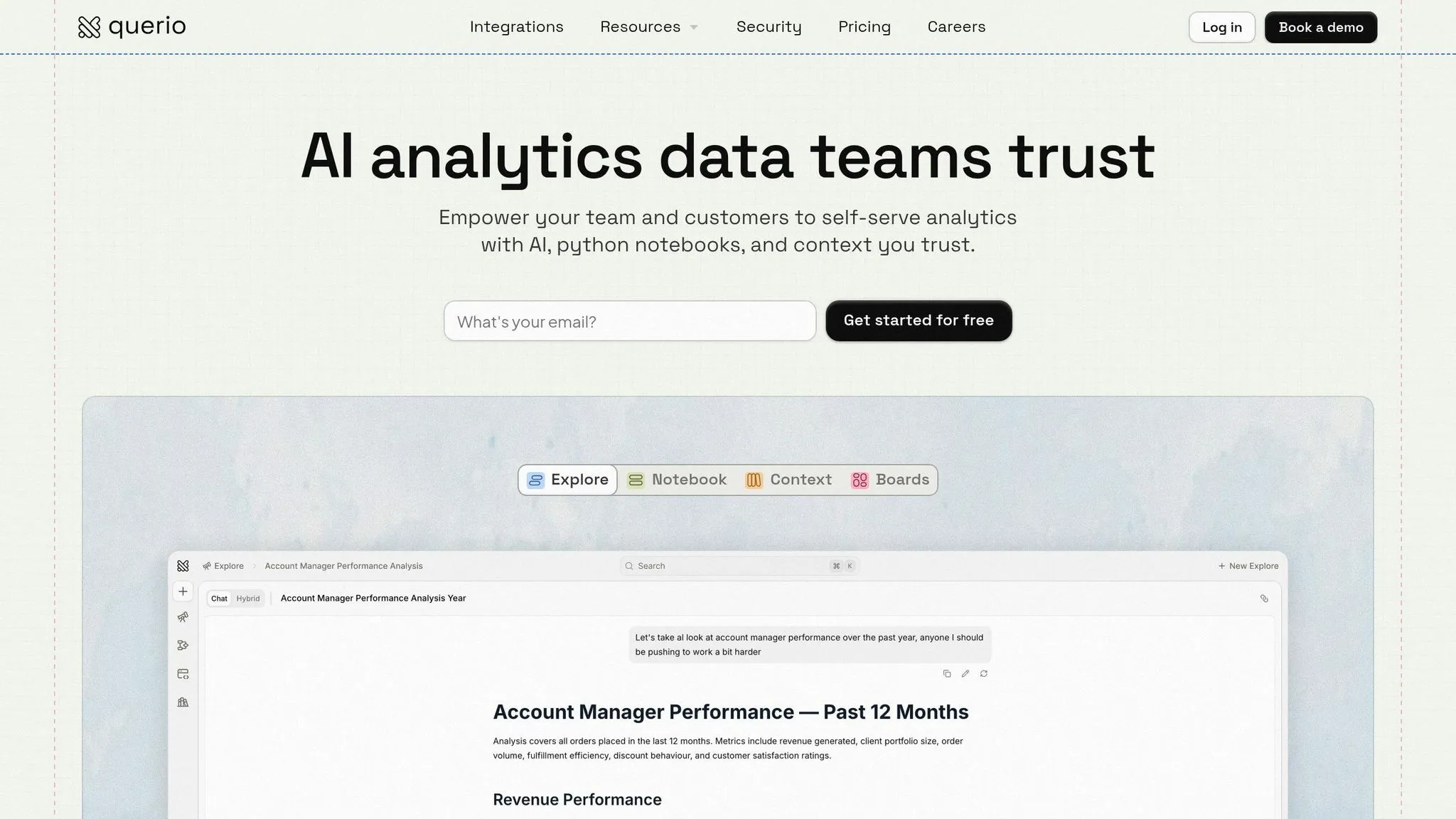
Querio transforms plain English queries like "What were Q1 sales by region for top products?" into accurate SQL and Python code, delivering instant visualizations. All insights come with fully inspectable SQL and Python code, ensuring transparency and auditability [2]. Its AI capabilities also enable interactive, multi-turn conversations for deeper data exploration.
AI-driven natural language querying
Querio supports natural, context-aware conversations. You can start with a query and refine it with follow-ups like "Compare that to last year" or "Show customer churn trends vs. campaign spend." The platform keeps track of the context, making complex data analysis straightforward. During enterprise testing, Querio achieved 95% accuracy on intricate queries, turning hours of manual SQL work into minutes [5][6]. For instance, a mid-sized e-commerce company used Querio to cut analytics query times drastically and improve revenue forecasting accuracy by 25% through natural language-driven sales trend analysis [4][5].
Live data warehouse compatibility
Querio integrates seamlessly with major data warehouses like Snowflake, BigQuery, Redshift, ClickHouse, and PostgreSQL. It runs queries directly on live data, delivering results in sub-seconds without requiring data copies. This approach reduces latency by up to 80% compared to traditional extract-based tools. For example, a retail team processed live stock levels across 10TB datasets to predict stockouts instantly, enabling real-time inventory decisions [4][7].
Collaboration and governance
The platform allows teams to share queries, co-edit AI-generated reports, and integrate results into tools like Slack or Microsoft Teams. Git-backed, version-controlled notebooks ensure everyone works with consistent metrics and definitions. Security features include row-level access controls, audit logs, and AI safeguards to prevent sensitive data exposure. A Fortune 500 finance team used these tools to analyze profit and loss statements while maintaining SOC 2 Type II compliance and 99.9% uptime [3][8].
Integration and deployment options
Querio is easy to deploy, taking less than 30 minutes with SSO and cloud hosting options on AWS, Azure, or GCP. It connects with popular BI tools like Tableau and Power BI via APIs and supports embedding interactive analytics widgets into custom apps using iframes. In one case, Querio was embedded into Streamlit dashboards, scaling to over 1,000 simultaneous users without performance issues. Pricing starts with a free tier (100 queries/month), moves to a Pro plan at $49 per user per month, and offers Enterprise plans starting at $10,000 per month for advanced governance features [6][9].
2. ThoughtSpot
ThoughtSpot provides a search-driven interface where users can type plain-English questions like "What's revenue by region last quarter?" to instantly generate charts and tables [10][11]. Its Sage AI Copilot keeps track of context across follow-up questions. For example, after asking about Texas sales, you can simply type "What about California?" and it will deliver relevant results without needing to restate the full query [10].
AI-driven natural language querying
ThoughtSpot enhances its user-friendly search with powerful AI capabilities, making it easier to process complex data queries. This feature is particularly useful in today’s fast-paced decision-making environments. In testing, the platform achieved 80% accuracy - correctly answering 16 out of 20 complex queries - within 3–5 seconds on a dataset containing 2.3 million rows [11]. For added transparency, its "Matching Panel" shows how queries align with specific data columns [12]. The Sage AI Copilot also suggests additional queries based on your current context, helping uncover insights you might not have considered [10].
Live data warehouse compatibility
ThoughtSpot’s "Embrace" layer allows users to query live data directly from platforms like Snowflake, BigQuery, Redshift, Databricks, and Azure Synapse - without requiring data replication [10]. This means you can perform a single search across multiple enterprise data sources - including CRM systems like Salesforce, ERP platforms, and marketing tools like Google Analytics - without prior data consolidation [10]. Designed to handle billions of rows, the platform features "Liveboards", which are dynamic dashboards that refresh automatically in real time [10][11].
Collaboration and governance
Collaboration is streamlined through Liveboards, and "SpotterViz" enables teams to create dashboards instantly [11][12]. For security, admins can control metadata shared with the LLM, and prompt persistence is disabled [12]. However, organizations should allocate up to two weeks for initial data modeling, as the AI's performance depends heavily on the quality of the semantic model [11]. The "Coach" tool allows admins to refine synonyms and provide feedback, ensuring the AI delivers accurate answers [11][12]. Pricing starts at $1,250/month for 5 users with the Team Edition, while the Pro tier costs $2,500/month for 10 users, including SpotIQ and advanced governance tools [11].
3. Fabi
Fabi introduces "Smartbooks", a workspace that merges SQL, Python, and no-code tools, offering a seamless experience for collaborative analytics. This platform stands out for its focus on code transparency and its AI-powered capabilities. At its heart is the AI Analyst Agent, which transforms plain English queries into executable SQL or Python code. Whether it's running sentiment analysis or conducting statistical tests, Fabi automates these processes, making advanced analytics accessible to everyone.
AI-driven natural language querying
Fabi's "glass box" transparency ensures that users can see, verify, and modify the SQL or Python code behind every result. For example, a business user could ask, "What's our customer churn rate by region?" and immediately receive actionable insights. Meanwhile, data teams can dive into the methodology behind those findings. As Siddharth Patil, EVP of Data Science at Lyft, puts it:
"Fabi.ai is the future of data analysis. They're bringing an entirely new level of productivity to data practitioners and organizations are going to have access to entirely new insights previously out of reach" [13].
This focus on transparency and usability extends into Fabi's integration and deployment features.
Integration and deployment options
Fabi seamlessly connects to leading cloud data warehouses like Snowflake, BigQuery, Amazon Redshift, Databricks, ClickHouse, and MotherDuck, as well as traditional databases such as MySQL and PostgreSQL. It also integrates with SaaS tools like Salesforce, Stripe, HubSpot, and Google Sheets, enabling direct spreadsheet analysis. Insights are delivered where teams already work, with AI-generated summaries and reports automatically shared via Slack, email, or updated Google Sheets. The best part? Setup is quick - just a matter of minutes - and eliminates the need for complex ETL pipelines and modern analytics stacks.
Collaboration and governance
Fabi brings software development practices to analytics by integrating with GitHub for version control of analytical logic. It also meets SOC 2 Type II compliance standards and is ready for GDPR and CCPA requirements [13]. Teams can collaborate in Smartbooks, using reactive cells for real-time updates, while the Fabi MCP Server allows the AI Analyst to work within preferred chat tools. Gary Sahota, Co-founder at Tether Data, highlights the platform's impact:
"Fabi.ai is a gamechanger for any organization that spends time on exploratory analysis & ad-hoc reporting. It makes supporting the business with data so much more efficient" [14].
For those curious to try it out, Fabi offers a free tier to get started.
4. Basedash
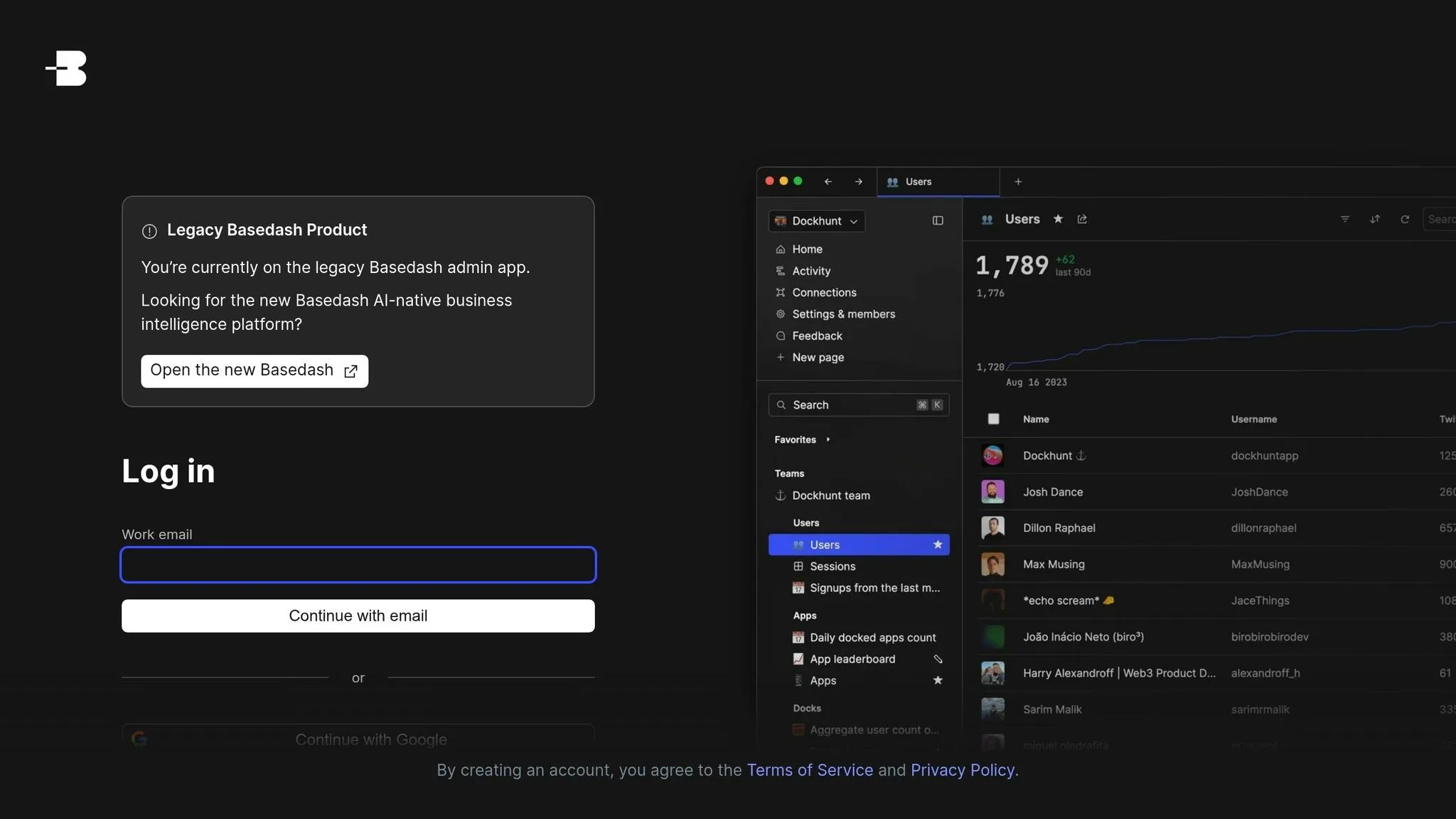
Basedash simplifies business intelligence by directly querying production databases in real time. This eliminates the need for complex data warehouses or lengthy ETL processes. Designed for teams seeking immediate answers, the platform uses AI to generate SQL from natural language, choose the best visualizations, and deliver results instantly. Its speed and efficiency make it a go-to tool for fast, actionable analytics.
AI-driven natural language querying
Basedash uses conversational AI to make querying data feel intuitive. It remembers the context of previous queries, enabling smooth follow-ups. For instance, after asking about monthly revenue trends, you can simply say, "break that down by region", and the AI will refine the query accordingly. To ensure consistency, the platform relies on centralized governance, which standardizes metrics and terminology across the organization. The AI also picks the most suitable chart type - like line charts for trends or bar charts for comparisons - based on the data and user intent.
Live data warehouse compatibility
With its ability to connect directly to production databases, Basedash delivers real-time insights without the need for a separate data warehouse. This approach eliminates the delays and costs associated with syncing data, giving teams immediate access to the latest information. It’s especially useful for operational analytics, where timing is critical.
Collaboration and governance
Basedash enhances collaboration with its two-way Slack integration. Users can query @Basedash directly within Slack threads and receive charts right in their conversations, keeping analytics accessible and integrated into everyday workflows. The platform’s centralized governance ensures that any updates to metric definitions or business rules are automatically applied to all queries and dashboards. This guarantees accuracy and consistency across the organization, even as data evolves.
5. Databricks AI/BI Genie
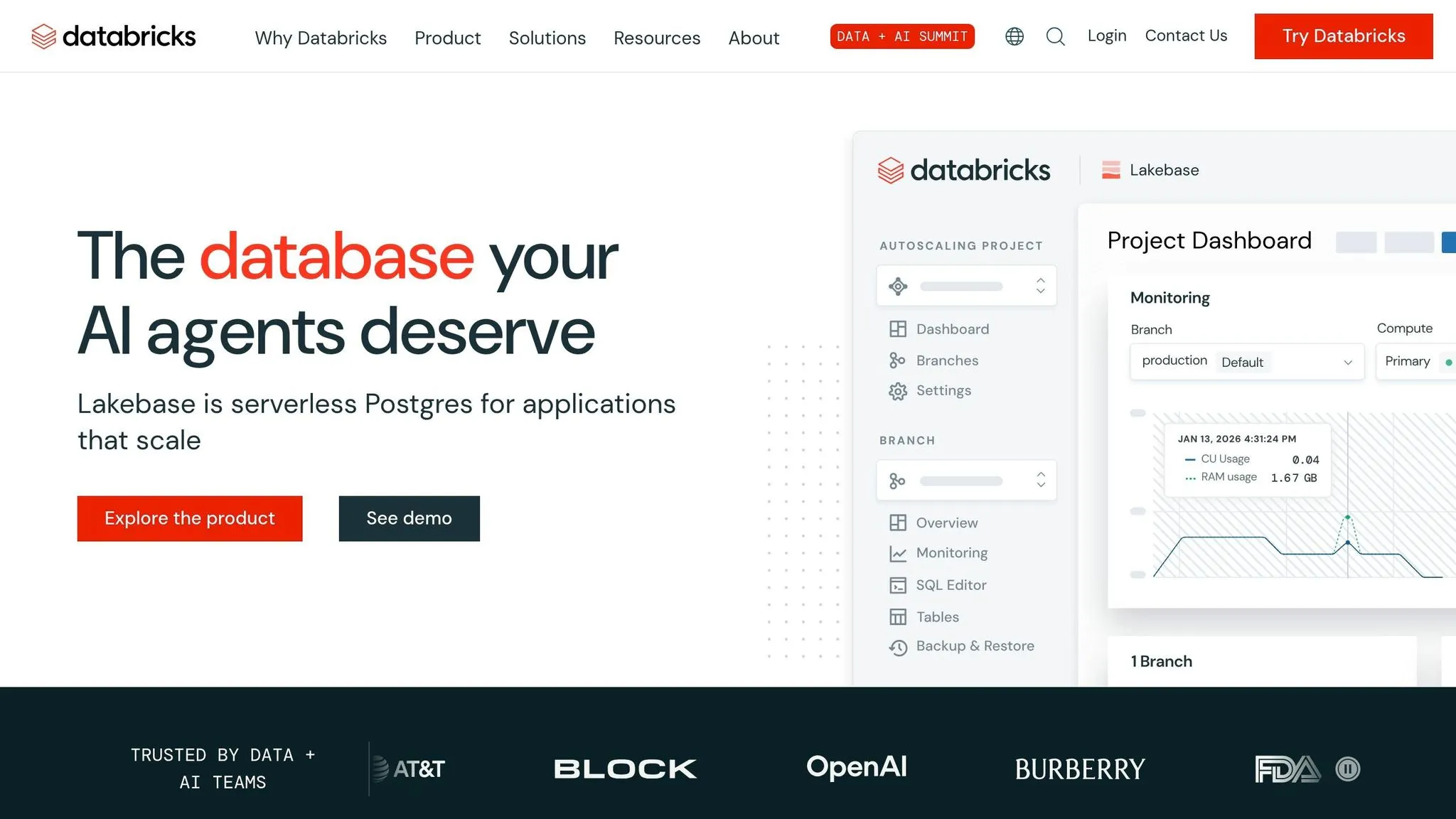
Databricks AI/BI Genie brings agentic reasoning into the mix, enabling users to ask complex "why" and "how" questions that go far beyond simple data queries. Built directly on the Databricks lakehouse platform, it handles massive datasets while ensuring enterprise-grade security through Unity Catalog. During its preview phase, Genie was adopted by over 4,000 customers, thanks to its ability to make data access easier across organizations - without the need for per-seat licensing fees.
AI-Powered Natural Language Querying
Genie uses compound AI to translate natural language queries into SQL while also interpreting the intent behind the questions. Its "Genie Research" mode is designed for tackling more complex problems. It creates research plans, evaluates multiple hypotheses simultaneously, and generates detailed, citation-backed reports. For instance, Shahmeer Mirza, Senior Director of Data, AI/ML, and R&D at 7-Eleven, used Genie in early 2026 to empower regional managers to compare sales across territories in plain English.
"The idea of being able to just ask Genie, rather than hunt for the right analyst and hope they get the answer right, has been very exciting for the business", Mirza shared.
Genie’s Knowledge Store enhances its understanding of business-specific contexts by integrating organizational semantics, metric definitions, and sample queries. Its automated "knowledge mining" feature analyzes query history to suggest actionable follow-ups, reducing the workload on data teams. To ensure accuracy, the "Inspect" feature validates SQL queries before delivering results. Genie can even scan up to 100 million rows for entity matching, correcting typos and improving query reliability.
Compatibility with Live Data Warehouses
Genie converts natural language inputs into read-only SQL queries that run on Databricks SQL warehouses. Through Lakehouse Federation, it can query data from Databricks, external platforms, and on-premises systems, all under strict governance. The "Genie File Upload" feature allows non-technical users to combine local spreadsheets (like Excel or CSV files) with datasets managed in Unity Catalog for quick, ad-hoc analyses - no coding required.
Collaboration and Governance
By integrating seamlessly with Unity Catalog, Genie enforces existing data access policies, including row filters and column masks. Felix Baker, Head of Data Services at SEGA Europe, used Genie to enable decision-makers to ask real-time questions about consumer behavior without relying on data experts.
"We're using Databricks Genie to help decision-makers ask ad hoc questions in real time about consumer behavior without having to depend on our data experts to construct dashboards and queries", Baker explained.
Genie tracks every query, who made it, and how responses were rated, ensuring full activity monitoring and audit trails. The "Ask for Review" feature allows teams to flag AI-generated responses for further verification, encouraging collaboration between business users and data teams. This robust governance ensures smooth integration into everyday business workflows.
Integration and Deployment Options
Genie provides programmatic APIs and SDKs for embedding conversational analytics into existing business applications. It integrates natively with tools like Microsoft Teams, Slack, and Glean, making analytics accessible within daily workflows. Its compatibility with Microsoft Copilot Studio also enables users to leverage Genie’s capabilities within the Microsoft 365 ecosystem. The Databricks One interface simplifies access for non-technical users, offering a user-friendly way to discover dashboards and Genie spaces. Additionally, support for the Model Context Protocol (MCP) ensures secure interactions with external tools like Jira, Confluence, GitHub, Google Drive, and Notion. Usage is billed through standard Databricks Unit (DBU) rates, making it easy for organizations to scale as needed.
6. Julius AI
Julius AI has grown to serve over 2 million users as of early 2026, providing essential features of modern business intelligence tools that don't require extensive coding knowledge. What sets this platform apart is its ability to interpret plain English commands and automatically generate Python, R, or SQL code for complex tasks. Powered by a Python-based engine, it performs rigorous calculations like ARIMA time series analysis, regression modeling, and customer churn prediction - delivering precise results instead of mere approximations [15]. This capability makes Julius AI a go-to solution for professionals seeking reliable, data-driven insights in fast-paced environments.
AI-Driven Natural Language Querying
Julius features an "Advanced Reasoning" mode designed for multi-step analytical workflows. Users can transform raw data into polished visualizations simply by typing conversational prompts. The platform has earned high praise, receiving a 9.25/10 consensus score on Tooliverse based on 2,558 verified reviews. One reviewer remarked:
"Julius is like having a senior data analyst sitting right next to me. It handled my messy CSV perfectly." – DataVizPro, iOS App Store [15]
To handle complex datasets smoothly, Julius provides sandboxed execution environments with dedicated RAM ranging from 2GB to 64GB [15]. It also excels in real-time data integration, enhancing its utility for dynamic analytical needs.
Live Data Warehouse Compatibility
Julius integrates seamlessly with popular data warehouses like Snowflake, BigQuery, PostgreSQL, MySQL, SQL Server, and Databricks. Its "Semantic Schema Learning" feature automatically identifies relevant tables within extensive databases [15]. While it doesn’t include a built-in governed semantic layer, users can address this by using data dictionaries or connecting DBT to maintain consistent metric definitions [16].
Collaboration and Governance
The platform supports teamwork through a collaborative workspace where users can share files, notebooks, and data connections. Its "Custom Agents" feature allows teams to train AI assistants on specific company schemas and business logic, enabling context-aware analyses. Julius also adheres to compliance standards like SOC 2 Type 2, TX-RAMP, GDPR, and CCPA, making it a secure choice for enterprise use. Automated audit logging is included for added transparency in enterprise deployments.
Integration and Deployment Options
Julius offers flexible integration options to fit diverse workflows. Beyond web access, it integrates with Slack via a dedicated agent, enabling channel-based analysis directly within daily operations. For enterprises, deployment options include Private VPC, SSO/SAML integration through Okta and Azure, and automated audit logging. Pricing is tiered: a free plan includes 5 messages and 2GB RAM, the Business plan costs $450 per month with three seats, native database connectors, and collaboration tools, while the Pro plan at $45 per month provides unlimited messages, 32GB RAM, and unlimited file storage [15].
Comparison Table
::: @figure 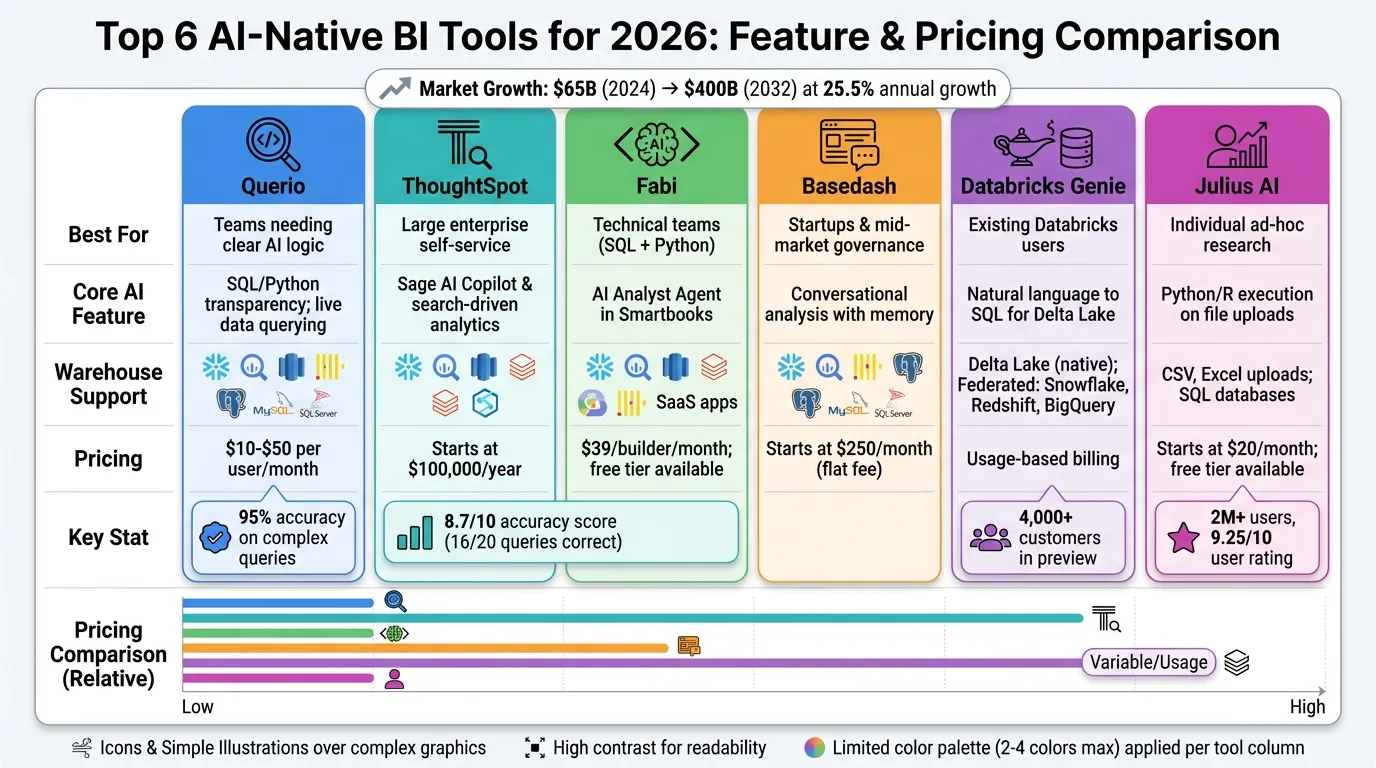 {AI-Native Business Intelligence Tools Comparison: Features, Pricing, and Best Use Cases 2026}
:::
{AI-Native Business Intelligence Tools Comparison: Features, Pricing, and Best Use Cases 2026}
:::
Choose an AI-focused BI tool that aligns with your team's size, technical skills, and budget. The table below simplifies the key features and benefits of each platform based on the detailed analysis provided earlier.
| Tool | Best For | Core AI Feature | Warehouse Support | Pricing Note |
|---|---|---|---|---|
| Querio | Teams needing clear AI logic | SQL/Python transparency; live data querying | Snowflake, BigQuery, Redshift, ClickHouse, Postgres, MySQL, SQL Server | $10 to $50 per user/month |
| ThoughtSpot | Large enterprise self-service | Sage AI Copilot & search-driven analytics | Snowflake, BigQuery, Redshift, Databricks, Azure Synapse | Starts at $100,000/year |
| Fabi | Technical teams (SQL + Python) | AI Analyst Agent in Smartbooks | Snowflake, BigQuery, Redshift, Databricks, ClickHouse, SaaS apps | $39/builder/month; free tier available |
| Basedash | Startups & mid-market governance | Conversational analysis with memory | Snowflake, BigQuery, ClickHouse, Postgres, MySQL, SQL Server | Starts at $250/month; single flat fee |
| Databricks Genie | Existing Databricks users | Natural language to SQL for Delta Lake | Delta Lake (native); Federated: Snowflake, Redshift, BigQuery | Billed based on usage |
| Julius AI | Individual ad-hoc research | Python/R execution on file uploads | Primarily file uploads (CSV, Excel); supports SQL databases | Starts at $20/month; free tier available |
ThoughtSpot scored an impressive 8.7/10 for natural language query accuracy, correctly answering 16 out of 20 queries in testing - making it the most accurate platform for natural language queries [11]. However, its steep pricing, starting at $100,000 annually, positions it primarily for large enterprises with significant analytics budgets.
For teams deeply embedded in the Databricks ecosystem, Databricks Genie offers seamless integration with Delta Lake and a usage-based pricing model, ensuring costs scale with actual needs. On the other hand, Julius AI is ideal for individual analysts and researchers, focusing on file uploads rather than live warehouse connections, with plans starting at just $20/month.
This breakdown underscores the strengths of each tool, helping you make informed decisions as you shape your analytics approach.
Conclusion
The analytics landscape in 2026 has evolved dramatically, moving from static dashboards to autonomous AI systems that deliver direct, actionable insights. The global data analytics market is expected to surge from $65 billion in 2024 to over $400 billion by 2032, growing at an impressive annual rate of 25.5% [18]. This rapid growth underscores the increasing demand for tools that make data accessible while ensuring strong governance practices.
Each platform in this space is designed to tackle specific challenges in today’s data-centric world. Querio leads with its "Glass Box" approach, providing fully inspectable SQL and Python code for every AI-generated insight, ensuring auditability [2]. Other tools also bring unique capabilities to the table: ThoughtSpot offers natural language search for enterprise users, Fabi integrates conversational AI with Python notebooks for technical teams, Basedash provides AI-native simplicity with flat-rate pricing starting at $250/month, Databricks AI/BI Genie is tailored for lakehouse environments with Unity Catalog integration, and Julius AI acts as a personal data analyst for individual researchers.
One key feature that sets the best tools apart is the governed semantic layer, which enforces consistency across metrics [17][2]. This is critical as mature AI-augmented BI systems can triple the number of employees actively using data to make decisions [1]. However, success hinges on establishing clear and consistent definitions from the start. As CodeBrewTools aptly puts it:
"The transition to Agentic Business Intelligence is the most significant shift in the data industry since the move to the cloud" [17].
FAQs
::: faq
What makes a BI tool “AI-native”?
An AI-native BI tool is crafted specifically to integrate effortlessly with data, leveraging natural language processing, autonomous agents, and real-time insights. Unlike older systems that simply tack on AI capabilities, these tools are built around clearly defined business metrics and rules. This foundation helps provide analytics that are both easier to understand and more precise. :::
::: faq
How do I know if Querio can query my data warehouse live without copying data?
Querio integrates seamlessly with live data sources like Snowflake and BigQuery, enabling real-time analysis without the need to copy or duplicate data. It takes natural language queries and converts them into SQL or Python code, providing users with secure, clear, and precise access to their data. Additionally, Querio’s governance tools ensure data integrity is preserved throughout live querying processes. :::
::: faq
What governance features should I require before rolling out AI BI to the whole company?
Before rolling out AI-powered business intelligence (BI) across your organization, it's crucial to have governance measures in place. Focus on key aspects like data transparency, inspectable code (such as SQL or Python), and strict compliance with business definitions and access controls. These steps are essential to prevent metric inconsistencies and ensure that the insights generated remain dependable and trustworthy for informed decision-making. :::