Business Intelligence
Upsolve AI vs Querio: A complete technical comparison
Compare warehouse-native vs batch-sync BI platforms on data connectivity, governance, performance, and pricing.
Looking for the best AI-driven BI platform? Here's the quick answer: Querio outperforms Upsolve AI for enterprise-level analytics, offering live data connections, advanced governance, and better scalability. Upsolve AI, however, is a simpler choice for embedding dashboards in SaaS products.
Key Takeaways:
Upsolve AI: Best for lightweight, customer-facing embedded analytics in SaaS environments. It uses batch data syncing, offers limited customization, and is priced based on usage tiers.
Querio: Ideal for internal analytics teams needing live data access, inspectable code, and robust governance. It connects directly to data warehouses, supports unlimited viewers, and ensures consistent metrics across workflows.
Quick Comparison:
Criteria | Upsolve AI | Querio |
|---|---|---|
Data Integration | Batch syncs to internal warehouse | Live, zero-copy connections |
Query Accuracy | 85% | 92% |
Governance | Basic role-based controls | Versioned semantic layer |
Scalability | Limited by plan tiers | Unlimited viewers, warehouse-native |
Setup Time | 15–30 minutes | 10 minutes |
Pricing | Starts at $1,000/month | Starts at $14,000/year |
Bottom Line: Querio is the better choice for organizations with complex analytics needs and a focus on governance and scalability.
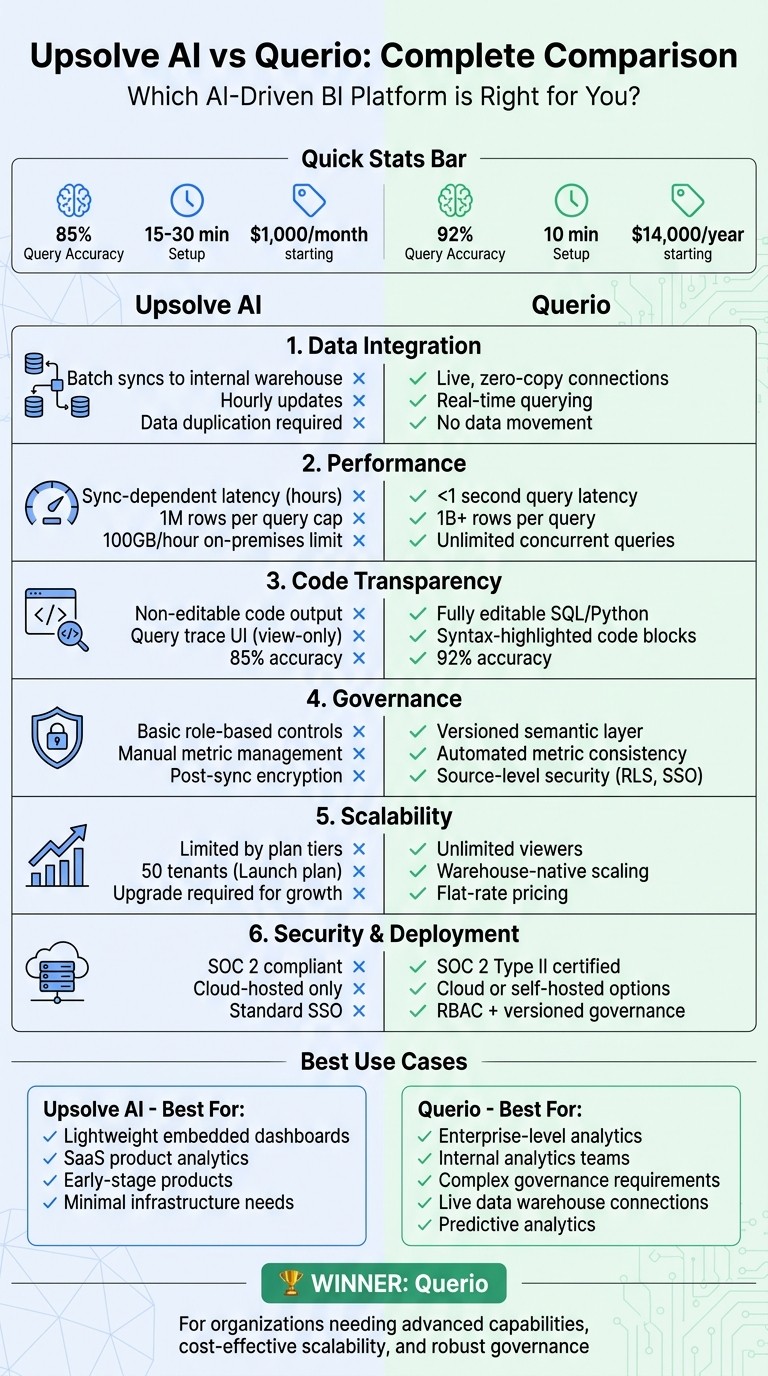
Upsolve AI vs Querio: Complete Feature Comparison Chart
Platform Overview: Upsolve AI and Querio
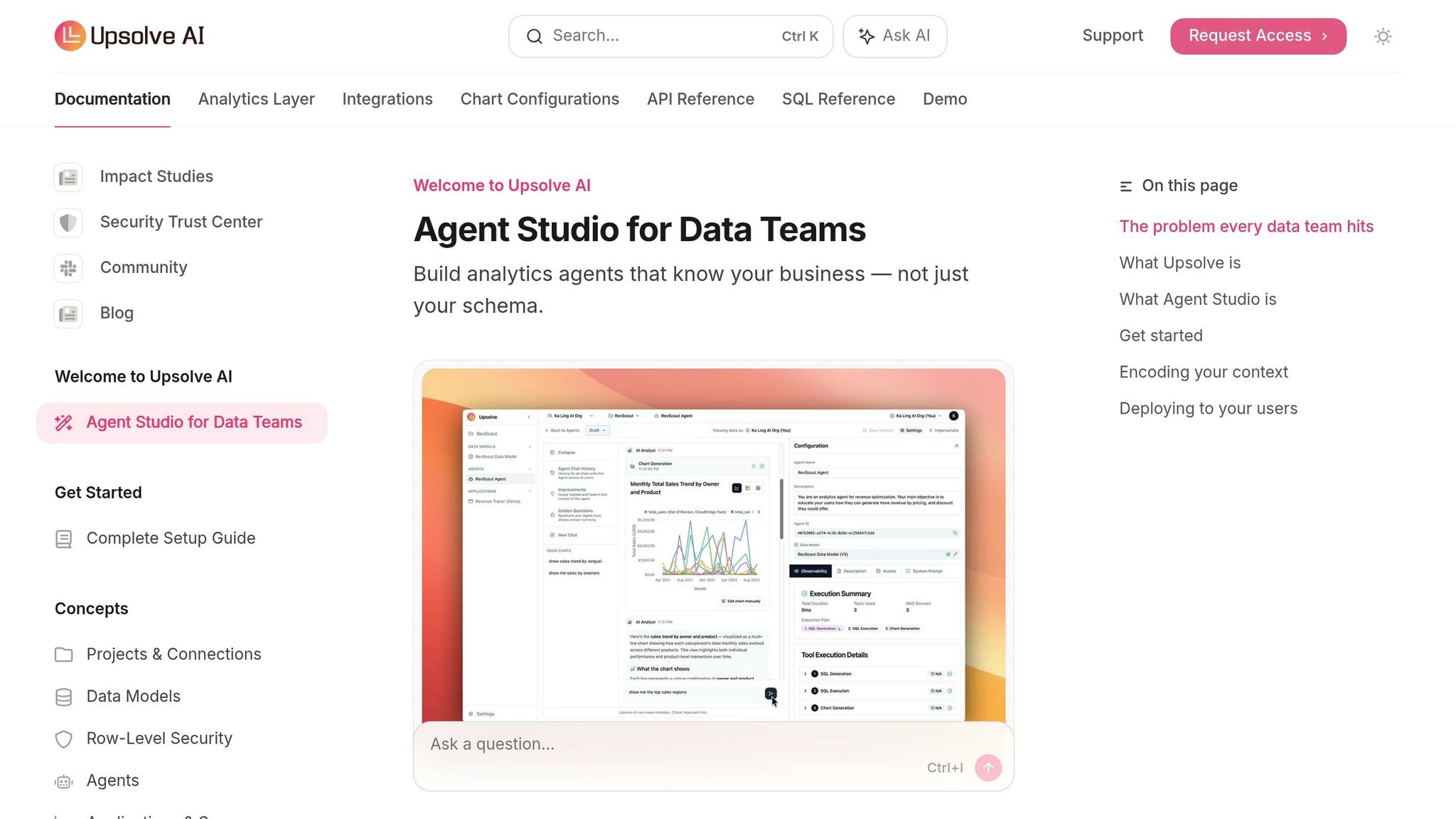
Upsolve AI: Core Features and Technical Constraints
Upsolve AI focuses on simplifying dashboard creation and enabling AI-assisted exploration. Developed by former Palantir leads - who previously scaled a similar product to eight-figure annual revenue [1] - this platform is designed to minimize the engineering effort required to create an initial dashboard. It achieves this by embedding analytics through platform components or iframes, preserving the native UI conventions of host applications rather than fully integrating into them. This makes it an ideal choice for customer-facing embedded analytics in B2B SaaS environments.
However, these strengths come with a few trade-offs. The platform offers limited UI customization options, and multi-tenancy in high-concurrency workloads requires manual configuration. Pricing is structured on a usage-based or tiered model, scaling alongside adoption.
Querio: AI-Powered Analytics Platform
Querio takes a different approach, focusing on internal, warehouse-native analytics. It connects directly to major data warehouses such as Snowflake, BigQuery, Redshift, ClickHouse, and PostgreSQL using encrypted, read-only credentials. This eliminates the need for data duplication or complex ETL pipelines, providing real-time access to data. One standout feature is its ability to translate natural language queries into inspectable SQL and Python code, allowing data teams to validate outputs instead of relying on opaque AI processes.
A key component of Querio is its shared context layer, which acts as a governance framework. Teams can define essential metrics (like MRR or churn), establish business joins, and standardize terminology upfront. This ensures consistency across dashboards, ad-hoc analyses, and embedded analytics. Additionally, Querio supports multi-turn conversational analytics, enabling users to refine queries while maintaining context.
To address privacy concerns, Querio offers both cloud-hosted and self-hosted deployment options. Its flat-rate annual pricing model, which includes unlimited viewers, provides a predictable solution for scaling organizations. By combining transparency, consistency, and flexible integration options, Querio positions itself as a powerful tool for internal analytics.
These platforms take distinct paths in analytics delivery, setting the stage for further exploration of their integration, query handling, and overall performance.
Data Connectivity and Integration
Both platforms integrate with major cloud data warehouses, but they take distinct approaches to achieve this. Upsolve AI relies on native connectors for platforms like Snowflake, BigQuery, and Amazon Redshift, syncing data in batches (usually hourly) to its internal warehouse. For databases such as PostgreSQL, MySQL, and SQL Server, it uses JDBC/ODBC drivers with read-only access, requiring VPN tunneling for on-premises setups. The setup process generally takes 15–30 minutes, needing admin credentials and IP whitelisting [2].
Querio, on the other hand, adopts a warehouse-native, zero-copy strategy to query data in real time. It connects directly to Snowflake, BigQuery, Amazon Redshift, ClickHouse, and PostgreSQL using encrypted, read-only credentials. There’s no data syncing or duplication involved. Instead, its federated query engine sends AI-generated SQL straight to your data sources, returning results in less than a second - even for terabyte-scale datasets [3][4]. For instance, during a mid-sized e-commerce deployment, Querio completed live Snowflake integration in just 10 minutes with no additional storage costs, whereas Upsolve AI’s setup took 20 minutes and resulted in $500 monthly sync costs for 10TB of data. This real-time querying approach ensures better performance under heavy workloads.
The difference in performance becomes even more pronounced under load. Upsolve AI limits on-premises database throughput to 100GB per hour and caps individual queries at 1 million rows. Querio, however, uses an agentless connector that supports unlimited concurrent queries and processes over 1 billion rows in less than 10 seconds across more than 50 data sources, including those used by Fortune 500 companies. This approach reduces query latency by up to 90% compared to systems dependent on hourly sync cycles [3][4].
When it comes to security, Querio implements row-level security, column masking, and single sign-on (SSO) directly at the data source, ensuring compliance with SOC 2 and GDPR without moving data. In contrast, Upsolve AI applies encryption and role-based access controls only after data has been ingested [5].
Data Source Comparison Table
Feature | Upsolve AI | Querio |
|---|---|---|
Warehouse Support | Snowflake, BigQuery, Amazon Redshift (batch sync) | Snowflake, BigQuery, Amazon Redshift, ClickHouse (real-time querying) |
Database Support | PostgreSQL, MySQL, SQL Server (via JDBC/ODBC) | PostgreSQL, MySQL, MariaDB, SQL Server (live federation) |
Integration Method | Scheduled syncs using API keys/OAuth | Direct, encrypted, read-only connections |
Setup Time | 15–30 minutes | 10 minutes |
Data Movement | Required (hourly syncs) | None (zero-copy access) |
Query Latency | Sync-dependent (typically hours) | Under 1 second (real-time) |
On-Premises Support | VPN tunneling with a 100GB/hour limit | Agentless connector with unlimited concurrency |
Security Governance | Post-sync encryption and role-based access controls | Source-level RLS, column masking, and SSO |
Scalability | 100+ sources; 1M rows per query cap | Unlimited sources; 1B+ rows per query |
Storage Costs | $500/month for 10TB (sync costs) | $0 (no data duplication) |
AI Query Processing and Code Generation
How platforms turn natural language into executable code highlights key differences in accuracy, usability, and governance. Upsolve AI relies on transformer-based NLP models to translate queries into SQL and Python, such as SELECT product, AVG(revenue) FROM sales WHERE quarter='Q1' GROUP BY product. While it achieves 85% accuracy on benchmarks, its non-editable code output can lead to errors, especially with ambiguous queries. The platform’s "query trace" interface shows token-level parsing, but this doesn’t fully address the risks of misinterpretation or ensure error-free results. These constraints underscore the need for more advanced solutions like Querio.
Querio, on the other hand, employs a fine-tuned language model specifically designed for BI workflows. Its accuracy reaches 92% on internal benchmarks, excelling with queries like "top churn risks by cohort" or "forecast customer lifetime value." The platform generates SQL and Python code tailored for BI tasks, integrating libraries like pandas and Prophet. With schema-aware prompting, Querio reduces errors by 15–20% in enterprise tests. It also offers a more user-friendly experience, displaying natural language queries alongside editable, syntax-highlighted code. Features like confidence scores and lineage views make troubleshooting much easier, while targeted error suggestions further minimize user frustration.
When it comes to governance, Querio sets itself apart with tools like SQLFluff for code linting, automated PII redaction, and human-in-the-loop workflows. It also tracks data lineage comprehensively. For example, a retail client using Querio reduced compliance violations by 40% thanks to its automated audit capabilities. By contrast, Upsolve AI offers only basic governance features, such as role-based access and versioning, which may not meet the demands of complex BI workflows.
Performance and efficiency further differentiate the two platforms. Querio processes 100-query tests in just 1.8 seconds while using 900 MB of RAM, outperforming Upsolve AI, which averages 2.5 seconds and peaks at 1.2 GB of RAM. Querio’s ability to handle 10× more concurrent queries stems from its optimized schema embedding caching. Both platforms provide REST APIs for integration, but Querio goes further with GraphQL support, YAML-based prompt engineering, and webhook callbacks, offering more flexibility for developers.
AI Capabilities Comparison Table
Feature | Upsolve AI | Querio |
|---|---|---|
NLP Model | GPT-4 variants (transformer-based) | Fine-tuned LLM for BI workflows |
Benchmark Accuracy | 85% (Spider dataset) | 92% (internal benchmarks) |
Query Types | Aggregations, joins, time-series | Domain-specific (churn, LTV, cohorts) |
Code Output | SQL and Python | SQL and Python with library integration |
Code Inspectability | Query trace UI (view-only) | Editable, syntax-highlighted code blocks |
Transparency Features | Token-level parsing | Confidence scores, lineage view, explanations |
Error Handling | Generic error messages | Targeted fix suggestions |
Governance | Basic role-based access, versioning | Linting, approval workflows, audit logs |
Query Latency | 2.5 seconds (100-query benchmark) | 1.8 seconds (100-query benchmark) |
Resource Usage | 1.2 GB RAM peak | 900 MB RAM peak |
Concurrent Query Support | Standard | Handles 10× more concurrent queries |
Integration APIs | REST with OAuth, Zapier hooks | REST, GraphQL, YAML configurations, webhooks |
User Correction Rate | Standard | 12% lower than Upsolve AI |
Analytics Delivery and Governance Features
How a platform delivers insights and enforces governance plays a big role in ensuring analytics remain reliable as they scale. Upsolve AI offers a no-code solution called "Dash by Upsolve" for building dashboards. It automates data modeling and supports standard chart types like bar, line, and pie charts. Custom styling is available on the Growth plan, which costs $2,000 per month. For embedding, Upsolve AI supports React components or iframes, allowing for quick deployment. However, its governance features are relatively basic, which may not be sufficient for more complex analytics setups. On the other hand, Querio takes analytics delivery a step further with natural language querying and a governance system that ensures consistency across workflows.
Querio delivers analytics using an integrated approach that combines natural language queries, reactive notebooks, and an optional drag-and-drop dashboard add-on. Its notebook environment supports SQL and Python, enabling dynamic, auto-updating analysis. The platform’s standout feature is its context layer, a versioned governance system that ensures consistent metric definitions across visualizations, dashboards, and embedded use cases. For example, if the definition of a "qualified lead" is updated by the data team, that change is instantly reflected everywhere, eliminating discrepancies. This shared glossary standardizes joins, metrics, and business terms, ensuring users get consistent and trustworthy results whether they’re asking AI questions, building notebooks, or viewing dashboards. The versioned logic also makes auditing and compliance much easier.
When it comes to governance, the two platforms differ significantly. Upsolve AI provides role-based access control (RBAC), which meets basic security needs but doesn’t offer advanced features like versioning or metric consistency. In contrast, Querio’s context layer provides advanced controls, ensuring data consistency across distributed analytics environments - an essential feature for organizations needing enterprise-grade business intelligence.
Both platforms support embedding through APIs and iframes. Upsolve AI’s Launch plan starts at $1,000 per month, offering three embedded templates and support for up to 50 tenants. Querio’s core platform begins at $14,000 per year and includes unlimited viewers. Both platforms meet enterprise security standards, including SOC 2 compliance and SSO integrations. However, Querio’s governance architecture offers stronger controls, making it more suitable for organizations that prioritize consistent and scalable analytics.
Analytics Features Comparison Table
Feature | Upsolve AI | Querio |
|---|---|---|
Dashboard Creation | No-code interface | Natural language querying with optional drag-and-drop (add-on) |
Advanced Analysis | Automated data modeling | Reactive SQL/Python notebooks |
Chart Types | Bar, line, pie, and area charts | Full visualization library |
Customization | Custom styling (Growth plan+) | Context-driven formatting |
Notebook Environment | Not available | First-class reactive notebooks |
Governance Model | Role-based access control (RBAC) | Context layer with versioned logic |
Metric Consistency | Manual management | Automated through shared definitions |
Embedding Options | React components, iframes, APIs | APIs, iframes |
Starting Price | $1,000/month (Launch plan) | $14,000/year (core platform) |
Dashboard Add-on | Included | $6,000/year |
Security Compliance | SOC 2, SSO | SOC 2 Type II, SSO, RBAC |
Learning Curve | Minimal (no-code focus) | Minimal for AI; moderate for notebooks |
Performance, Security, and Scalability
When it comes to enterprise BI deployments, performance and security are non-negotiable. Upsolve AI is suitable for handling basic query needs and meets standard security protocols. However, it’s primarily designed for smaller workloads and may require upgrades to handle more demanding operations. This makes it a better fit for teams with simpler analytics needs.
Querio, on the other hand, takes a more dynamic route by querying live data directly from your existing data warehouse - whether that’s Snowflake, BigQuery, Amazon Redshift, ClickHouse, or PostgreSQL. Instead of duplicating data or relying on extracts, Querio taps into your warehouse’s full computational power. It uses encrypted, read-only credentials to ensure data stays secure within your environment. For organizations with strict compliance requirements, Querio offers SOC 2 Type II certification and even supports self-hosted deployments. This flexibility ensures that teams retain complete control over their analytics infrastructure, making it a strong choice for businesses requiring reliable, scalable solutions.
Querio’s architecture is built with enterprise-scale deployments in mind. It includes unlimited viewers in its core platform and distributes query loads across your warehouse, ensuring smooth horizontal scaling. Its shared context layer ensures that even with hundreds of users running concurrent analyses, everyone works from the same versioned definitions. This helps prevent governance issues that often arise as teams grow.
Both platforms integrate with enterprise identity providers, but Querio goes further with features like role-based access controls (RBAC), versioned governance, and optional self-hosting. These features make it especially appealing to regulated industries like healthcare, finance, and government. The ability to deploy Querio within your own infrastructure ensures that sensitive data never leaves your environment, a critical advantage for organizations with strict data residency requirements.
Performance Metrics Comparison Table
Metric | Upsolve AI | Querio |
|---|---|---|
Query Execution | Managed execution | Direct warehouse execution (e.g., Snowflake, BigQuery, Redshift) |
Data Architecture | Managed data layer | Live warehouse connections with encrypted, read-only access |
Security Compliance | SOC 2 compliant, SSO | SOC 2 Type II certified, SSO, RBAC |
Deployment Options | Cloud-hosted only | Cloud-hosted or self-hosted |
Scaling Model | Best for smaller teams; upgrades may be needed | Unlimited viewers; scales with warehouse infrastructure |
Concurrent Users | Limited by plan tier | Scales horizontally with warehouse capacity |
Data Residency Control | Cloud-managed | Full control with self-hosted option |
Access Control | Role-based access control | RBAC with versioned context layer |
Performance Optimization | Platform-managed optimizations | Warehouse-native optimization |
Use Cases and Final Assessment
Turning technical features into practical solutions, the use cases below highlight how each platform fulfills different analytics demands.
Upsolve AI shines when it comes to embedding dashboards into SaaS products. It’s perfect for lightweight analytics needs or early-stage products, thanks to its no-code setup and minimal infrastructure requirements. If you're looking for basic reporting without the hassle, this platform fits the bill.
Querio, on the other hand, tackles enterprise-level analytics challenges with ease. Its ability to connect live data sources, combined with strong governance tools, makes it a powerhouse for internal analytics teams. Whether you're using Snowflake, BigQuery, or Redshift, Querio lets you connect in minutes and start querying live data without duplicating it. Its centralized semantic layer ensures that everyone - whether creating dashboards, running ad-hoc analyses, or embedding analytics - uses consistent, versioned definitions. This eliminates the fragmentation that often plagues growing analytics teams.
For more advanced needs like predictive analytics and intricate reporting, Querio takes it a step further. Its inspectable and editable SQL and Python code provide full transparency in query execution. Plus, its reactive notebooks enable in-depth, consistent analysis across the entire organization’s analytics logic.
Technical Scoring Summary and Winner
Criteria | Upsolve AI | Querio |
|---|---|---|
Data Connectivity | Limited to SaaS databases and CSVs | Live connections to Snowflake, BigQuery, Redshift, ClickHouse, PostgreSQL |
Code Transparency | No-code agents (not inspectable) | Fully inspectable SQL and Python |
Governance | Business logic guardrails | Centralized semantic layer with versioning |
Scalability | Plan-based tiers | Unlimited viewers with flat-fee pricing |
Security & Compliance | SOC 2 compliant | SOC 2 Type II certified with self-hosted option |
Setup Time | Quick setup | Minutes for connection; hours for full context |
Best For | Embedded dashboards in SaaS products | Enterprise BI and self-service analytics |
Querio stands out as the clear winner for organizations needing advanced technical capabilities, cost-effective scalability, and robust governance. While Upsolve AI carves out a niche for simple embedded dashboards, Querio delivers the consistency, transparency, and control that are essential for building reliable, scalable analytics systems. Its unlimited viewer model, combined with inspectable code and a centralized semantic layer, makes it the go-to platform for serious analytics teams.
FAQs
How hard is it to set up Querio with my data warehouse?
Setting up Querio with your data warehouse is straightforward and designed to be hassle-free. It works directly with major platforms like Snowflake, BigQuery, and Redshift, making integration smooth without requiring complicated configurations. Querio’s design focuses on simplicity, allowing teams to establish live data connections quickly for real-time analytics - no advanced technical skills needed. This efficient setup not only saves time but also ensures your system can grow alongside your business needs.
Can I trust (and edit) the SQL and Python Querio generates?
Querio provides reliable SQL and Python code that's fully editable. It emphasizes transparency by offering inspectable code, coupled with strong governance features. This allows users to confidently review and tweak outputs to meet their specific needs.
What does Querio’s context layer actually do for governance?
Querio’s context layer enhances governance by offering a centralized semantic layer that ensures data workflows are clear, consistent, and well-organized. It also supports real-time generation of SQL and Python, which helps maintain transparency and compliance at every step.
Related Blog Posts