Business Intelligence
Is Genie Code Free in Databricks? Pricing and Cheaper Alternatives
Explains Genie Code pricing: 150 DBU monthly allowance, then LLM and warehouse compute charges, throughput limits, and cheaper alternatives.

No - Databricks Genie Code is not free in normal use. I’d sum it up like this: you get 150 DBUs per user per month, but after that you can pay for LLM usage and compute. So the bill can move with usage, team size, warehouse load, and how many questions people ask at once.
If I were deciding fast, here’s what I’d focus on:
- Databricks Genie Code: free only inside the 150-DBU monthly allowance
- After the allowance: you pay usage-based AI charges plus SQL/compute charges
- Throughput limits: about 20 questions per minute in the UI and 5 per minute via API
- Best fit: teams already deep in Databricks
- Lower-cost natural language to SQL tools mentioned: Querio, Snowflake Cortex, BigQuery AI tools, ThoughtSpot AI, and Hex AI
- Querio pricing: a free plan with unlimited users, and Core at $2,499/month with 10,000 AI credits a month
- Seat-based options: ThoughtSpot starts at $25/user/month and Hex at about $36–$75/editor/month
- BigQuery direct-query AI tools: often charge $0.04 to $0.50 per query
So if you want the short answer: Genie Code can be low-cost for a small pilot, but it stops being “free” once usage grows. And if your top goal is steady monthly spend, plan-based tools with spending caps, or seat-based tools, may be easier to plan around than Databricks’ two-part pricing model.
::: @figure 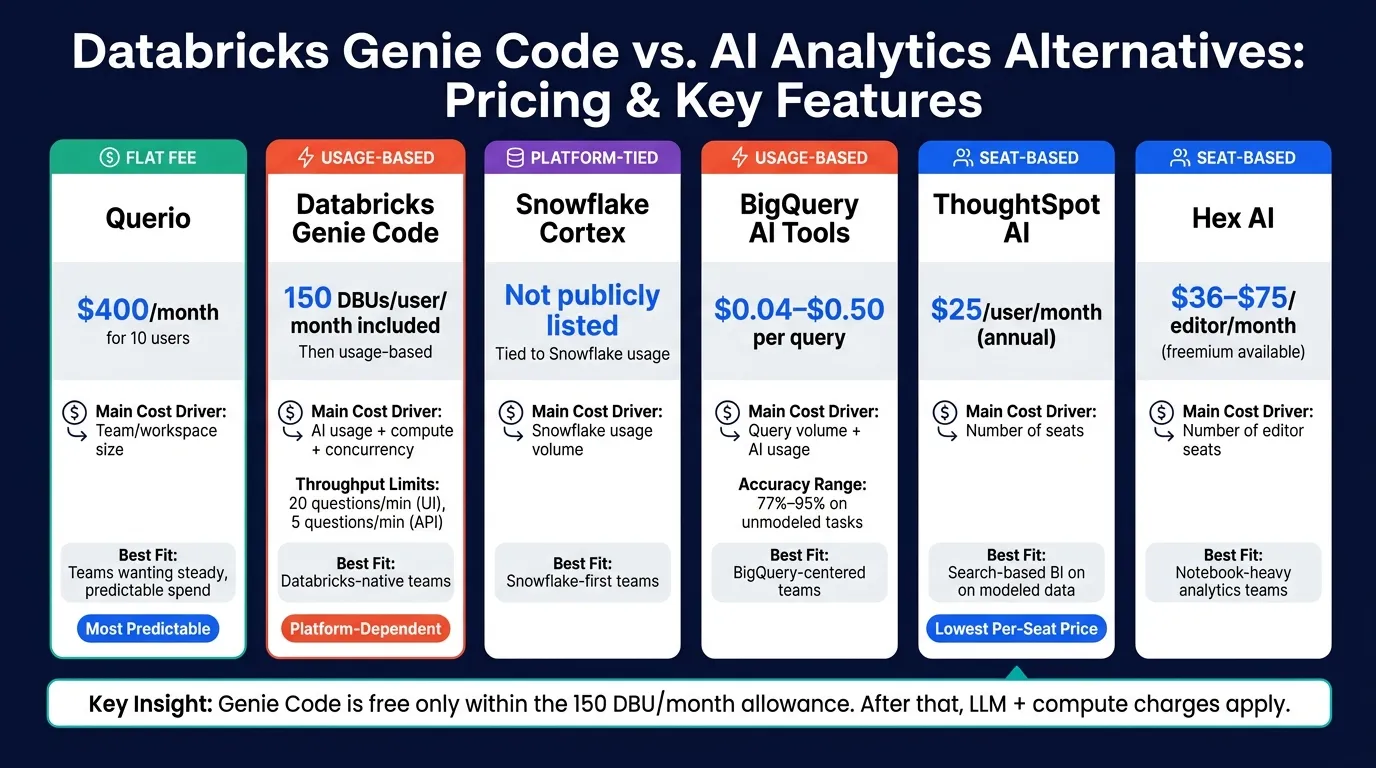 {Databricks Genie Code vs. Alternatives: Pricing & Features Compared}
:::
{Databricks Genie Code vs. Alternatives: Pricing & Features Compared}
:::
Chat Your Way to Cost Visibility with AIBI Genie
::: @iframe https://www.youtube.com/embed/Vti4_qGV_0g :::
sbb-itb-284a532
Quick Comparison
| Tool | Price style | Starting price | Main cost driver | Best fit |
|---|---|---|---|---|
| Querio | Plan fee with included AI credits | Free plan; Core $2,499/mo | AI credits used past the included allowance (spending caps available) | Teams that want steady spend |
| Databricks Genie Code | Allowance, then usage-based | 150 DBUs/user/month included | AI usage + compute + concurrency | Databricks-first teams |
| Snowflake Cortex | Tied to Snowflake usage | Not listed here | Snowflake usage volume | Snowflake-first teams |
| BigQuery AI tools | Mixed: custom or per query | $0.04–$0.50/query for some tools | Query volume + AI usage | BigQuery teams |
| ThoughtSpot AI | Seat-based | $25/user/month | Number of seats | Search-based BI on modeled data |
| Hex AI | Seat-based | $36–$75/editor/month | Number of editor seats | Notebook-heavy analytics teams |
My takeaway: if you already run Databricks, Genie Code may fit. If you care more about budget control, the cheaper path is often a plan-based or seat-based option.
1. Querio
Querio is a warehouse-connected AI analytics workspace that plugs into Snowflake, BigQuery, Amazon Redshift, ClickHouse, and PostgreSQL. Querio has a free plan with unlimited users, and Core is $2,499/month (or $25,000 a year billed annually). The big pricing difference to look at is that there is no per-seat pricing.
Pricing Model
Querio charges one plan fee with AI credits included: 500 a month on Free and 10,000 a month on Core. Extra credits cost $0.50 each on Free and $0.25 each on Core, and admins can set alerts and a spending cap. You still pay your data warehouse for query compute, but running SQL and Python, dashboard refreshes and automations use no Querio credits.
Governed natural-language-to-SQL approach
Querio sends questions through a shared semantic and context layer. In plain English, that means joins, metric definitions, and business terms get set up once by the data team and then reused across questions, notebooks, dashboards, and answers.
Every answer also includes SQL or Python that you can inspect and edit. So if an analyst wants to check the logic, they can.
Best-Fit Workloads
Querio works well for teams that want self-serve analytics for non-technical users without giving up metric consistency or SQL transparency. Its notebook workspace and governed context layer help keep work aligned, while spending caps keep the monthly cost predictable.
That makes Querio a solid baseline when you’re comparing it with how Databricks prices AI-assisted analytics.
2. Databricks Genie Code
Genie Code isn’t free after you burn through Databricks’ 150 DBUs per month. Once that allowance is gone, Databricks switches you to usage-based LLM billing under Genie Paygo, and you still pay the usual warehouse compute charges.
Pricing Model
"Genie costs have two parts. LLM usage charges and the existing compute cost. Compute is billed separately and unchanged by Genie Paygo." - Ashwin, Delivery Solution Architect, Databricks [1]
Cost Drivers
Genie runs SQL on the warehouse you attach to it. So your total cost comes down to a few plain factors: warehouse size, query runtime, concurrency, and overall usage volume [1].
That adds up fast for analytics teams in shared workspaces. If people are asking lots of ad hoc questions at the same time, spend can climb in a hurry.
Databricks also lists workspace-level throughput limits on the monthly allowance:
- About 20 questions per minute through the UI or embedded iframe [1]
- About 5 questions per minute through the Conversation API [1]
For high-volume apps, Databricks recommends putting a backend layer in place for caching, throttling, and retry logic so you can stay inside those limits [1]. In plain English, if usage starts to spike, you’ll need some guardrails instead of letting requests fly straight through.
Governed NL-to-SQL Approach
Genie Code uses Unity Catalog to control which data and objects it can reach, which makes it a good fit for governed Databricks analytics workflows [1]. That helps on the security side, but it doesn’t lower warehouse spend or LLM usage charges.
Best-Fit Workloads
Genie Code fits Databricks-native teams that want governed automation inside data workflows, not broad self-serve BI for business users.
If your team wants governed self-serve BI without Databricks-level complexity, the next sections look at warehouse-native options that can cost less.
3. Snowflake Cortex
Pricing Model
Compared with Genie Code's usage-based billing, Cortex stands out mainly as a Snowflake-native point of comparison. There isn't a flat public price listed here, so the main cost question isn't, "What does Cortex cost on its own?" It's how Cortex shows up inside your current Snowflake usage and whatever AI feature access you're already paying for.
For data leaders, that shifts the decision a bit. The real issue is whether Cortex cuts down complexity inside the Snowflake stack, or just moves spend to a different line on the same Snowflake bill.
Cost Drivers
The biggest cost factor is simple: does Cortex stay inside your current Snowflake workflow, or does it add more usage as query volume climbs?
If your team already lives in Snowflake day to day, that setup can feel natural. But Cortex only makes sense when your analytics work stays centered on Snowflake. If usage grows, costs can grow with it, especially as more teams run queries through the same setup.
NL-to-SQL Approach
For teams already using Snowflake with dbt or Looker, Cortex fits best when it supports governed AI BI inside an existing Snowflake stack.
In plain terms, it's a better fit for teams that want NL-to-SQL inside the system they already use, instead of adding a separate layer on top.
Best-Fit Workloads
Snowflake Cortex is best for Snowflake-centered analytics teams. If your team works across multiple warehouses, you'll usually want a more flexible, warehouse-connected layer instead.
So If your stack goes past Snowflake, including BigQuery or Postgres, that distinction matters. The next section looks at BigQuery-native assistants.
4. BigQuery Native AI Assistants
Pricing Model
BigQuery assistants usually land in two camps: governed semantic BI tools like Looker, and direct-query AI tools like InfiniSynapse or Bruin that plug into BigQuery without a prebuilt semantic model.
If you're sizing up Genie Code costs, this is the part that matters: does native BigQuery AI dodge the same usage-based pricing curve?
With Looker, pricing is custom and negotiated. Direct-query AI tools often start with a free tier, then charge per query. LLM costs usually run from $0.04 to $0.50 per query, depending on the model used [4].
Cost Drivers
The main costs come from a few places:
- BigQuery query bytes scanned
- Slots or reservations
- Gemini or Vertex AI usage
- Looker licensing
- Admin work needed to keep the layer up to date [4]
As usage grows, direct-query AI tools tend to scale in a more linear way because they bill per query instead of pushing teams into a big license jump.
Governed NL-to-SQL Approach
Looker maps natural language to pre-defined business logic in LookML. That gives it high accuracy when the question stays inside the modeled scope. If someone asks for something outside that scope, Looker stays inside the semantic model instead of guessing [4].
Direct-query AI tools work differently. They inspect schemas directly and repair SQL automatically without a prebuilt semantic model. Benchmarks put their accuracy at about 77% to 95% on unmodeled tasks [4]. That's a good fit for ad hoc investigation, but it's less predictable for governed KPI reporting.
| Dimension | Looker (Governed Semantic BI) | Direct-Query AI Tools (e.g., Bruin) |
|---|---|---|
| Accuracy | High within modeled scope [4] | 77%–95% on unmodeled tasks [4] |
| Setup Time | Weeks to months [4] | Minutes via connection string [4] |
| Modeling layer | LookML | None required |
| Pricing | Custom/negotiated [4] | Free tier + $0.04–$0.50 per query [4] |
| Best For | Governed KPI reporting | Ad hoc, cross-source investigation |
Best-Fit Workloads
Looker makes sense when your team needs consistent, governed metrics and most questions are already modeled. It's the safer path when the business wants one shared version of a KPI and little room for drift.
Direct-query AI tools make sense when analysts want to move fast inside BigQuery and don't want to wait weeks or months for a semantic layer to be set up first. That's often the better route for open-ended analysis, one-off questions, and cross-source digging.
That split matters most when you need governed KPI reporting on one side and fast exploratory analysis on the other.
The next comparison helps teams that want AI inside a broader BI layer instead of placing it straight in the warehouse.
5. ThoughtSpot AI
ThoughtSpot is the seat-based BI option in this comparison for teams that want governed self-serve analytics without usage-based billing.
Pricing Model
ThoughtSpot starts at $25 per user per month, billed annually [4]. Because pricing is seat-based, costs are easy to forecast. The tradeoff is simple: if you give licenses to people who only log in once in a while, your bill can climb fast [4].
Cost Drivers
The main cost lever is the number of seats you provision [4].
Governed NL-to-SQL Approach
ThoughtSpot uses a natural language BI model. Natural-language questions go through a proprietary search layer instead of SQL, and the system only answers questions that map to data already modeled in worksheets [4].
That guardrail can be useful. It helps keep users inside a trusted data model. But it also means ThoughtSpot has a hard edge: if a question sits outside that modeled scope, it returns no answer [4].
Initial setup usually takes weeks because your data needs to be modeled into worksheets first [4].
| Dimension | ThoughtSpot AI | Databricks Genie |
|---|---|---|
| Pricing | $25/user/month (annual) [4] | 150 free DBUs/month, then usage-based [1] |
| AI Scope | Modeled data within worksheets [4] | Databricks Lakehouse data [3] |
| Unmodeled Questions | Returns no answer [4] | Answers via LLM (potential for fabrication) [4] |
| Setup Time | Weeks [4] | Minutes to hours if data is already in the Lakehouse [4] |
| Query Language | Proprietary search layer [4] | SQL / Python [1] |
Best-Fit Workloads
ThoughtSpot works best when the goal is governed search over modeled warehouse data, not open-ended investigation. In plain English, it’s a better match for teams that want search-driven self-serve BI on modeled worksheets connected to live cloud warehouses like Snowflake, BigQuery, or Redshift [4].
It also makes sense when business users need to search trusted data without writing SQL [4]. Where it starts to struggle is ad hoc work or multi-source questions that fall outside the worksheet model. In those cases, unmodeled questions return no answer [4].
6. Hex AI
Hex is a notebook-based platform that brings together SQL, Python, no-code tools, and Magic AI for notebook-first analysis. For teams looking at Databricks Genie, it’s a paid option that deserves a close look.
Pricing Model
Hex uses a seat-based pricing model. Editor seats usually cost between $36 and $75 per editor per month [4]. It also has a freemium tier, which makes the platform easier to budget for than AI tools with usage-based billing.
Cost Drivers
The biggest cost factor is simple: how many editor seats you assign [4].
Governed NL-to-SQL Approach
Hex uses a notebook-first AI assistant workflow. Users can enter natural-language prompts, and Hex generates editable SQL or Python directly in notebook cells, so analysts can check the logic and change it as needed [4]. This workflow is a common way to auto-generate SQL for users while maintaining transparency. Hex also connects straight to live data warehouses like Snowflake, BigQuery, and PostgreSQL [3].
Best-Fit Workloads
| Dimension | Hex AI | Databricks Genie |
|---|---|---|
| Workflow | Notebook-first, collaborative analytics | Databricks Lakehouse analytics |
| Data sources | Connects directly to live data warehouses like Snowflake, BigQuery, and PostgreSQL [3] | Optimized for the Databricks Lakehouse |
| Best for | Multi-step exploratory analysis [4] | Databricks-native teams |
Hex works well for notebook-heavy teams that want multi-step analysis without leaving SQL or Python. On the flip side, non-technical users looking for a pure chat-based BI setup may find it a bit too technical. That tradeoff stands out when you compare notebook-first analysis with other text-to-SQL tools and Databricks-native governance and usage-based spend.
When Genie Code Is Worth the Cost and When It Is Not
Genie Code makes sense only if your team already runs on Databricks. In that case, the monthly DBU allowance can help cover early testing. But that does not mean Genie is free. As usage climbs, that cushion fades fast, and billing shifts to a mix of compute and LLM consumption.
That’s where the pricing gets tricky. Genie has two cost layers: LLM usage and warehouse compute. Once those kick in, your budget starts to depend less on the tool itself and more on how people use it. More questions, more concurrent users, more spend. Throughput caps also put a ceiling on scale: about 20 questions per minute in the UI and 5 per minute through the API[1][2].
If your team is outside the Databricks world, or you just want cleaner budget planning month to month, plan-based pricing is usually easier to deal with. You’re not tying spend to compute spikes, and spending caps limit usage swings. The tradeoff is pretty simple: variable Databricks spend versus more predictable plan pricing.
| Factor | Genie Code | Predictable Alternatives (e.g., Querio) |
|---|---|---|
| Billing model | LLM usage + compute[1] | Plan price with included AI credits, decoupled from compute |
| Primary cost driver | Query volume and concurrency[1] | AI credits used past the included allowance |
| Usage limits | About 20/min (UI), 5/min (API)[1][2] | Included credits, then per-credit billing with spending caps |
| Best fit | Teams already built on Databricks | Teams needing cost predictability |
| SQL governance | Unity Catalog governance[1] | Shared semantic/context layer |
So the fit comes down to what matters more to your team. If you’re already deep in Databricks and care most about governance, Genie Code can work well. If predictable monthly spend matters more, other AI tools that write SQL are often easier to plan around.
Conclusion
Genie Code is not free in production. Databricks includes 150 DBUs per user each month across Genie, Genie Spaces, and Genie Code, but once you go past that allowance, you still pay LLM and SQL warehouse charges [1].
That shifts the conversation. The main issue isn’t whether Genie Code works. It’s whether the pricing model lines up with how your team operates.
If your stack already runs in Databricks and your team relies on technical analytics workflows, Genie Code can be a solid match. It makes more sense for Databricks-native teams, though you should compare Querio vs Databricks to see which architecture fits your specific scale. It makes less sense when tight budget control matters more than deep platform tie-in.
If you’re on the fence, run a 30-day pilot on real workflows before rolling it out more broadly. That gives you a clean read on usage, cost, and team fit. A simple rule of thumb helps here:
- Use Genie for ad hoc questions
- Send repeat queries to dashboards or SQL
For teams that want spend they can map out ahead of time, Genie Code is tougher to justify than a warehouse-connected BI layer with included usage and a spending cap. Querio connects straight to Snowflake, BigQuery, Amazon Redshift, and PostgreSQL, with a free plan and Core at $2,499/month, and unlimited users on every plan. It also includes a governed semantic and context layer, inspectable SQL and Python, and spending caps on AI credits.
Genie Code is only free inside the monthly allowance. After that, it isn’t free.
FAQs
::: faq
What counts against the 150 DBU allowance?
Databricks includes 150 DBUs per month for use across Genie, Genie Spaces, and Genie Code. That monthly allowance covers the feature-level costs tied to conversational and ad hoc analytics.
It does not cover the SQL warehouse compute used to run queries. That part is billed separately based on your warehouse type, instance size, and query runtime. :::
::: faq
How quickly can Genie Code get expensive?
Genie Code can get expensive fast because you’re paying for two things at once: SQL warehouse compute and LLM usage. Each user gets 150 DBUs of free monthly usage for Genie and Genie Code, but once that credit runs out, the bill starts climbing.
The main cost driver is the underlying SQL warehouse. Databricks bills it based on runtime, query complexity, and concurrency. Put simply, the longer it runs, the harder the queries hit, and the more people use it at the same time, the more you pay.
Costs can also go up if you push past the default throughput limits and need more capacity. The same goes for custom caching and routing, which can add extra spend on top of the base usage. :::
::: faq
When is Genie Code worth paying for?
Genie and Genie Code are worth paying for when your team is all-in on Databricks and needs production-grade conversational analytics that go past the 150 DBU monthly free tier.
They fit best when your data already sits in Databricks and you want to lean on existing Unity Catalog governance for self-serve natural-language-to-SQL workflows. That setup keeps things simple: your data stays where it is, and your team can ask questions in plain English without building a whole new process around it.
Paid capacity also starts to matter in high-concurrency setups, especially at 20+ questions per minute. At that point, the free tier can run into performance limits, which can slow things down right when people need answers fast. :::