Business Intelligence
Benefits and Challenges of Self-Service Business Intelligence
Self-service BI speeds decisions and boosts data literacy while posing governance, security, and cost challenges—practical ways to balance access and control.

Self-service business intelligence (BI) lets non-technical teams access and analyze data without relying on IT, speeding up decision-making. It addresses common problems like IT bottlenecks, fragmented data, and inconsistent metrics while fostering data access across departments. However, it also comes with challenges like maintaining data governance, ensuring user adoption, and managing security risks.
Key Takeaways:
- What It Solves: Reduces IT dependency, unifies data access, and improves decision-making speed.
- Benefits: Faster insights, reduced IT workload, real-time data access, and improved data skills across teams.
- Challenges: Maintaining data quality, training users, avoiding dashboard overload, and ensuring security.
AI-powered tools like Querio simplify self-service BI by enabling plain English queries, ensuring consistent metrics with a semantic layer, and providing role-based access controls for security.
Self-service BI transforms how businesses use data but requires careful planning to avoid pitfalls like inconsistent metrics and security concerns. Tools like Querio help bridge the gap, making data accessible yet controlled.
Self service BI as a two-edged sword
::: @iframe https://www.youtube.com/embed/IzwlSM2ExEI :::
Problems That Self-Service BI Solves
Self-service BI tackles common challenges like delays, fragmented access, skill gaps, and inconsistent metrics, enabling users to work with timely and unified data.
Slow Decisions and IT Bottlenecks
Traditional BI systems often leave business users dependent on IT teams or data analysts for reports, dashboard updates, and answers to data-related questions. Imagine a marketing manager waiting days - or even weeks - for a campaign performance report. These delays can lead to missed opportunities to adjust strategies in real time.
This reliance on IT creates a bottleneck. IT teams become overwhelmed with requests, while business users are stuck waiting, unable to act quickly. Self-service BI eliminates this bottleneck by giving users direct access to the data they need, allowing for faster, more proactive decision-making.
But delays aren’t the only issue - fragmented data access also hinders effective decision-making.
Limited Data Access for Business Teams
In many organizations, data is scattered across multiple systems. Sales data might live in one platform, marketing metrics in another, and financial figures somewhere else entirely. For business users, accessing the full picture often feels impossible, with critical data locked behind technical barriers or siloed in disconnected tools.
This problem is worsened by complex interfaces and the need for SQL knowledge, which can intimidate non-technical users. As a result, valuable data often goes untapped, and decision-makers are left relying on intuition or outdated reports.
Data silos make things even worse. When different departments manage their own isolated data sources, achieving a comprehensive, cross-functional view becomes nearly impossible. Self-service BI solves this by offering a unified interface that connects data from multiple sources. This allows business teams to explore insights across departments, making decisions faster and with greater confidence.
Fragmented access doesn’t just limit insights - it also leads to underutilized technology when employees lack the skills to make the most of available tools.
Low Data Literacy and Underused Investments
Organizations often spend heavily on data infrastructure, but these investments can fall flat if only a small, technical group knows how to use the tools. This reinforces a culture where data remains underutilized and employees stick to outdated methods or manual processes.
Self-service BI changes this dynamic by making data tools more accessible and intuitive. With features like user-friendly interfaces and natural language queries, employees of all skill levels can engage with data. Over time, this fosters a workplace where data literacy becomes the norm, maximizing the return on technology investments and boosting overall efficiency.
While skill gaps can prevent effective data use, inconsistent metrics and poor governance can create chaos even when data is accessible.
Inconsistent Metrics and Data Chaos
When report generation is left unchecked, different teams often produce conflicting metrics. For example, one department might calculate quarterly revenue differently than another, leading to discrepancies in reports. Variations in calculation methods, time frames, or data sources can cause confusion and erode trust in the data.
This lack of consistency forces teams to spend time reconciling differences instead of focusing on strategic decisions. Executives, meanwhile, may lose confidence in the insights provided, questioning whether the data can be trusted at all.
The root of this issue often lies in poor data governance. Without clear guidelines on how metrics should be calculated, which data sources are authoritative, or who maintains data quality, users end up creating their own versions of the "truth." Self-service BI platforms with strong governance features address this by establishing a unified framework for data management. Teams can define standard metrics, set consistent methodologies, and create shared glossaries of terms. This ensures that, for example, a marketing manager and a finance analyst will see the same revenue figures, even when generating separate reports.
Benefits of Self-Service BI
Self-service BI transforms how organizations handle data, speeding up decisions and making data a shared resource across the company.
Faster Decisions with Real-Time Data
Traditional BI systems often lag behind, delivering outdated reports that slow decision-making. Self-service BI changes the game by giving users live access to current data. This allows teams to analyze what's happening right now instead of relying solely on past trends.
For example, marketing managers can adjust campaign budgets based on today’s performance metrics. Sales directors can spot new trends and tweak strategies immediately. A retail manager noticing a sudden spike in product returns can investigate the cause right away, avoiding larger inventory headaches. Similarly, finance teams monitoring cash flow in real time can catch payment delays as they happen, rather than discovering them at the end of the month.
The impact goes beyond individual decisions. Organizations leveraging real-time insights can test ideas, measure outcomes, and refine strategies in days instead of months. This agility not only accelerates progress but also eases the burden on IT teams, making self-service BI more accessible across the board. This accessibility is often driven by personalized insights tailored to specific business roles.
Less Dependency on IT Teams
Self-service BI empowers business users to answer their own data questions, reducing their reliance on IT for routine reports. This shift allows IT teams to focus on more strategic tasks. Companies adopting self-service BI often report a 60% drop in IT report requests [1], which translates to significant cost savings and increased efficiency.
"Less dependency on IT for routine analysis means technical teams can focus on strategic data governance, data quality initiatives, and advanced analytics projects rather than endless reporting requests." - SR Analytics
Gartner predicts that the number of data and analytics experts in business units will grow three times faster than those in IT departments [1]. This evolution pushes companies to rethink how they structure their teams, elevating IT’s role from reactive support to proactive oversight. By focusing on data quality and system integrity, IT teams help maximize technology investments while enabling broader analytics adoption.
Better Scalability and Agility
As organizations grow, traditional BI systems often become bottlenecks, unable to keep up with increasing data demands. Self-service BI eliminates this issue by allowing more users to work independently without overwhelming IT support. New employees across departments can access the data they need from day one, making onboarding smoother and more efficient.
This scalability also brings agility. When market conditions shift, teams can quickly analyze and respond to new challenges without waiting for IT to process lengthy requests. This flexibility is critical in today’s fast-paced business environment, where the ability to adapt quickly can make all the difference.
Improved Data Literacy and Culture
Self-service BI doesn’t just democratize data access - it helps build a culture where data literacy is the norm. By enabling employees to explore data independently, these tools make analytics an everyday skill rather than a specialized function.
Over time, people who once relied on periodic reports begin integrating data into their daily workflows. Features like natural language processing in BI and user-friendly interfaces make it easier for non-technical users - like HR managers - to pull insights without needing advanced technical skills. As more employees engage with data, they sharpen their analytical thinking, challenge assumptions, and communicate insights more effectively, boosting the overall value of technology investments.
When everyone in the organization works with the same consistent data, collaboration between departments improves. Shared metrics create a common language, bridging gaps and fostering a unified, data-driven mindset. As data skills grow across teams, the insights generated often lead to fresh ideas and better decision-making.
Competitive Advantage and Innovation
Quick, informed decisions give companies a leg up on the competition. Self-service BI speeds up the journey from question to insight to action, enabling businesses to stay ahead of market changes.
In industries like SaaS, fintech, and e-commerce, responding to trends in real time can be a game-changer. A fintech firm analyzing transaction patterns live can detect fraud faster than competitors relying on periodic reviews. Similarly, an e-commerce retailer using up-to-the-minute customer data can fine-tune recommendations on the fly, improving sales.
sbb-itb-284a532
Challenges of Self-Service BI
Self-service BI can be a game-changer, but it’s not without its share of obstacles. If these challenges aren’t addressed, they can weaken the system’s effectiveness and cause frustration for users. Let’s break down some of the most common issues.
Data Governance and Quality Issues
One of the biggest hurdles with self-service BI is maintaining consistency in data. When teams create reports independently, definitions for the same metric can vary wildly. For instance, one department might track customer churn on a monthly basis, while another calculates it quarterly. These conflicting definitions can lead to confusion and diminish trust in the data.
Without proper governance, users might also rely on outdated or inaccurate data sources. This not only causes delays in decision-making but also results in conflicting metrics across the organization. Inconsistent data practices can undermine confidence in the system and limit its adoption.
User Adoption and Training Gaps
Even the most powerful BI tools are useless if employees don’t know how to use them. Self-service BI platforms can feel overwhelming, especially if they have a steep learning curve or a complicated interface. Some employees may even resist using them, fearing that greater data transparency could expose their performance.
Without thorough training and ongoing support, employees may revert to old habits - like relying on IT for reports or sticking to manual processes. This lack of adoption means the organization won’t see the full return on its BI investment.
Dashboard Sprawl and Reporting Chaos
The ease of creating dashboards in a self-service BI setup can quickly become a double-edged sword. When multiple teams develop their own reports using different data sources or methods, it’s hard to maintain a single, unified version of the truth.
This leads to a flood of conflicting dashboards, making it harder for users to find reliable insights. Reconciling these differences wastes time and creates inefficiencies. Plus, with more dashboards floating around, there’s a greater risk of exposing sensitive data to the wrong people.
Security and Compliance Risks
Opening up access to data without the right safeguards can lead to serious security risks. If role-based access controls and data protection measures aren’t in place, sensitive information - like customer financial records or employee salaries - could fall into the wrong hands.
Regulations like HIPAA, SOX, and CCPA in the U.S. require strict data handling protocols. Failing to enforce these can result in hefty fines and damage to the organization’s reputation. Striking the right balance between data accessibility and security is critical to avoid these pitfalls.
Cost and Performance Management
Unmonitored self-service BI usage can lead to unexpected costs and performance issues. For example, users running complex queries without understanding their impact can drive up expenses. Similarly, poorly optimized dashboards and frequent data refreshes can slow down system performance, frustrating users.
Without clear policies and proper oversight, organizations may struggle to keep BI costs under control. Setting guidelines for optimizing a query and resource usage is essential to ensure the system remains efficient and cost-effective.
Best Practices for Self-Service BI with Querio
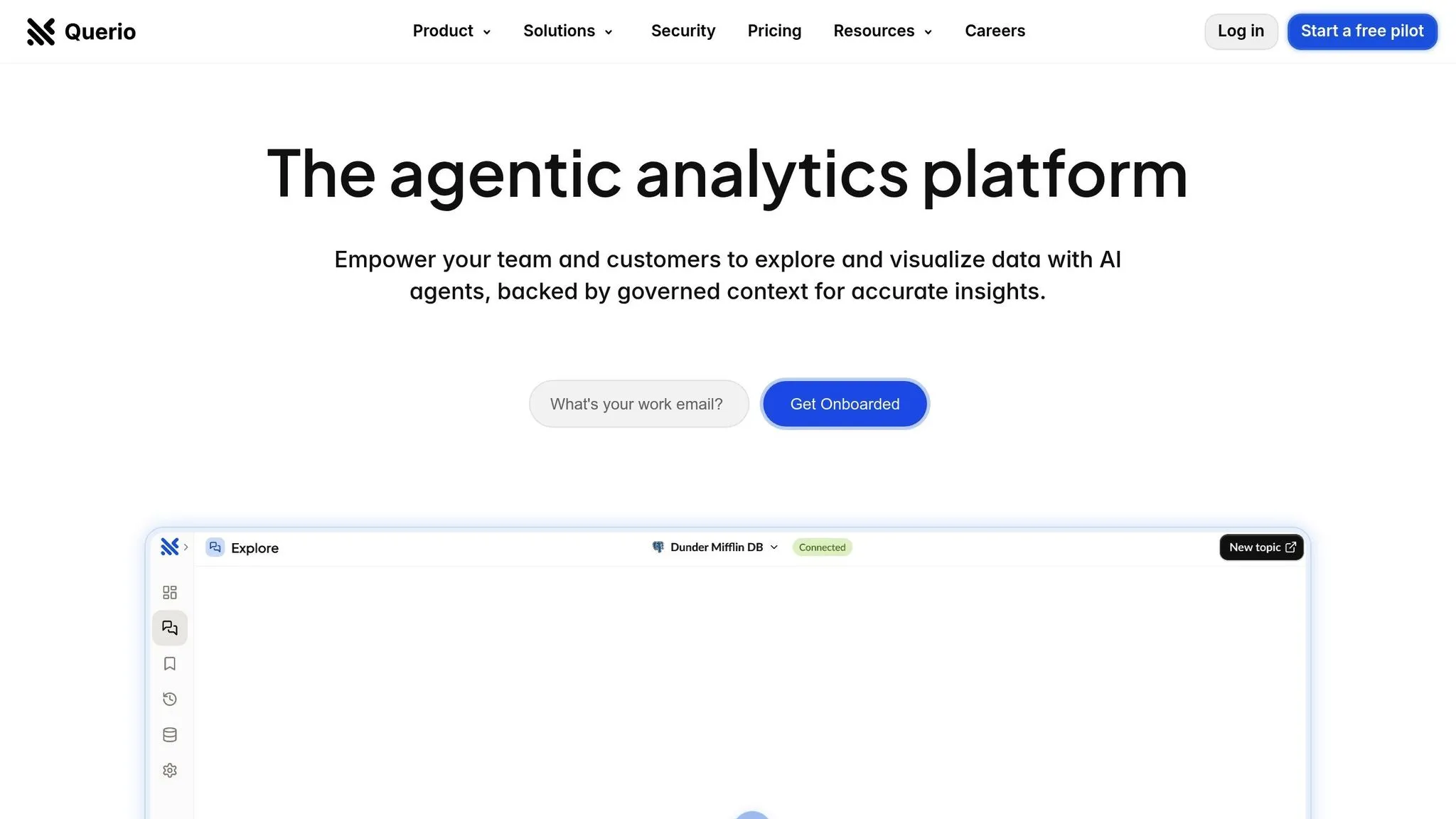
The challenges of implementing governed self-service BI might seem daunting, but they’re far from insurmountable. With the right strategies and tools, organizations can fully embrace the benefits of self-service BI while minimizing risks. Querio’s features are designed to tackle these challenges head-on, enabling smarter and more efficient data use. Here’s how you can make the most of self-service BI with Querio.
Centralize Governance with a Semantic Layer
One of the biggest hurdles in self-service BI is avoiding inconsistent metrics. The solution? Establishing a single source of truth for your data. Querio’s semantic layer in business intelligence acts as this central hub, where data teams can define table joins, metrics, and glossary terms. This ensures that every query and dashboard is built on the same foundation.
With this approach, everyone - across all departments - gets the same results when using shared metrics. It also lightens the load on IT teams, as they no longer have to handle constant questions about data definitions or table relationships.
By governing data at its source, you create a system users can trust. When employees know the insights they’re generating are accurate, adoption becomes much smoother, and confidence in the platform grows.
Use AI-Driven Natural Language Queries
Querio’s AI-powered natural language queries make accessing data through natural language as simple as asking a question in plain English. For example, you could type, “What were our top-selling products last quarter?” and instantly get a clear visualization.
This feature makes data exploration easy and accurate. Since all queries are processed through the governed semantic layer, users can explore freely without worrying about pulling incorrect data or making technical errors.
Natural language queries also drastically reduce onboarding time. New employees can start asking meaningful questions right away without weeks of training. Whether it’s a marketing coordinator or a senior executive, everyone can participate in data-driven decision-making without barriers.
Create Reusable Dashboards and Reports
To combat the issue of dashboard overload, focus on building reusable and standardized dashboards that cater to multiple stakeholders. Querio’s drag-and-drop dashboard builder simplifies the creation of KPI trackers and visual reports that can be shared across teams.
Once a dashboard is set up, it can refresh automatically and deliver updates via email or Slack. This functionality keeps teams informed without requiring them to log into the platform. Scheduled reports also cut down on redundant dashboard creation, streamlining workflows and ensuring consistency.
Standardized dashboards ensure that everyone is aligned on the same metrics and visualizations. This alignment improves collaboration across departments and eliminates confusion caused by conflicting reports.
Enforce Role-Based Access Control
Opening up access to data doesn’t mean giving unrestricted access to everyone. Querio’s role-based access control allows you to define exactly who can view or interact with specific datasets, ensuring sensitive information stays protected.
For instance, HR data like employee salaries can be limited to authorized personnel, while sales metrics remain accessible to the revenue team. This granular control is critical for maintaining compliance with regulations and safeguarding sensitive data.
Querio also connects directly to your data warehouse - whether it’s Snowflake, BigQuery, or Postgres - using encrypted, read-only credentials. This setup minimizes the risk of data breaches while maintaining a secure environment.
Optimize Costs and Performance
Managing costs and performance is a key challenge in self-service BI. Inefficient queries can lead to unnecessary expenses and slow down your system. Querio addresses this by providing tools to monitor query concurrency, result sizes, and warehouse spending.
For example, you can set limits on the number of concurrent queries a user can run or cap result sizes to prevent someone from accidentally pulling millions of rows into a dashboard. These safeguards ensure a smooth BI experience without blowing your budget.
Querio’s transparent pricing model - free of hidden query fees - makes it easier to predict costs and scale your BI operations as your business grows.
Empower Advanced Users with AI Python Notebooks
While natural language queries are perfect for everyday needs, some analyses require more advanced tools. Querio’s AI-powered Python notebooks offer flexibility for power users to perform deep-dive analyses, build custom models, and run complex calculations - all within the governed environment.
These notebooks support both SQL and Python, with AI assistance to streamline coding and debugging. This allows advanced users to harness machine learning and perform sophisticated analytics without exporting data to external tools, keeping everything secure and centralized.
Because these notebooks integrate seamlessly with the semantic layer, they maintain data consistency and governance, avoiding the creation of silos or data quality issues. This ensures that even the most advanced analyses align with your organization’s data standards.
Conclusion: Getting the Most from Self-Service BI
Self-service BI reshapes how organizations interact with data, striking a balance between empowering users and maintaining data governance. The advantages are undeniable: quicker decisions, fewer IT bottlenecks, greater adaptability, and a stronger reliance on data. However, issues like inconsistent metrics, security vulnerabilities, and poor user adoption can become significant obstacles if not addressed properly.
Tackling these hurdles requires a structured approach. Start by creating a single source of truth for your data, implementing role-based access controls, and providing user-friendly tools. When users trust the data they access and feel confident using the tools, adoption naturally follows.
Querio’s platform is designed to meet these needs. It connects directly to your data warehouse using encrypted, read-only credentials, reducing security risks while ensuring timely access to information. Features like natural language queries make data approachable for non-technical users, while AI-powered Python notebooks give advanced users the flexibility they need - all within a controlled and secure environment.
This streamlined setup bridges the gap between raw data and actionable insights, enabling faster, more informed decisions across the organization. With secure and immediate access to data, every team member can contribute to driving innovation and gaining a competitive edge. By approaching self-service BI thoughtfully, the challenges become manageable, and the rewards transformative.
FAQs
::: faq
How can organizations maintain strong data governance when using self-service BI tools like Querio?
To ensure effective data governance while using self-service BI tools, organizations need a well-defined governance framework. This framework should clearly outline roles, responsibilities, and processes to keep everything running smoothly.
A key element is implementing role-based access controls. This ensures that users can only access the data they need for their tasks, minimizing the risk of unauthorized access and protecting sensitive information.
Another crucial aspect is setting clear data quality standards. Reliable and accurate data is essential, and regular audits and monitoring can help catch any inconsistencies or errors. Equally important is user training - equipping team members with the knowledge to handle data responsibly not only encourages better practices but also boosts the adoption of governance measures across the board. :::
::: faq
How can businesses encourage user adoption and address resistance to self-service BI tools?
Encouraging people to embrace self-service BI tools takes a thoughtful mix of education, support, and planning. Start by providing thorough training sessions so users feel equipped to interpret data and confidently navigate the tools. Combine this with visible executive sponsorship, where leaders actively showcase data-driven decision-making. This not only sets an example but also builds trust and enthusiasm.
Choose easy-to-use platforms that work well for users of all skill levels. Launching with pilot projects that deliver quick wins can also help teams see the immediate benefits, sparking interest and momentum. Lastly, put clear data governance policies in place to ensure accuracy and consistency while giving users the freedom to explore and analyze data on their own. :::
::: faq
How does Querio ensure security and compliance for self-service BI in industries with strict data regulations?
Querio prioritizes security and compliance in self-service BI by implementing role-based access controls, data encryption, and detailed audit logs. These features work together to protect sensitive data, uphold privacy, and ensure accuracy - all while meeting stringent regulatory standards.
On top of that, Querio adheres to strong data governance frameworks, aligning with industry-specific regulations. This gives organizations the peace of mind to enable users with self-service BI tools, knowing that security and compliance remain uncompromised. :::