Business Intelligence
Top 5 AI-native business intelligence tools for 2026
Five AI-native BI platforms compared for natural language querying, live warehouse access, and governed analytics.

AI-native business intelligence (BI) tools are transforming how businesses analyze data by enabling natural language queries, real-time insights, and automated workflows. Unlike older BI platforms that added AI features later, these tools are built with AI at their core, making data analysis faster and more intuitive. Here are the top 5 AI-native BI tools in 2026:
- Querio: Converts natural language questions into SQL, offering transparency and real-time insights with direct data warehouse connections.
- ThoughtSpot: Simplifies querying with a search interface and features like anomaly detection and enterprise-scale capabilities.
- Basedash: Focuses on conversational querying with context retention, alert notifications, and flexible deployment options.
- Fabi: Combines natural language querying with advanced tools like Python notebooks and GitHub integration for deeper analysis.
- Lumenn AI: Delivers clear visual insights with features like SQL refinement, direct warehouse connections, and proactive data quality checks.
These tools cater to different needs, from transparent SQL generation to enterprise-grade scalability. Below is a quick comparison of their features.
Quick Comparison
| Tool | Key Feature | Data Warehouse Support | Enterprise Features |
|---|---|---|---|
| Querio | NLP to SQL with full transparency | Snowflake, BigQuery, Redshift, ClickHouse | SOC 2, GDPR, real-time alerts |
| ThoughtSpot | Search-based querying, anomaly detection | Snowflake, BigQuery, Redshift, Databricks | HIPAA, large-scale enterprise support |
| Basedash | Conversational memory, alerts | Snowflake, BigQuery, ClickHouse, MySQL | BYOK, SOC 2 compliance, flexible hosting |
| Fabi | Python notebooks, GitHub integration | Snowflake, BigQuery, Redshift, Databricks | Collaborative workflows, GDPR compliance |
| Lumenn AI | SQL refinement, proactive insights | Snowflake, BigQuery, AWS S3, PostgreSQL | RBAC, workspaces, data quality management |
Each tool offers unique strengths, so choose based on your team's priorities - whether it's transparency, scalability, or advanced analytics.
::: @figure 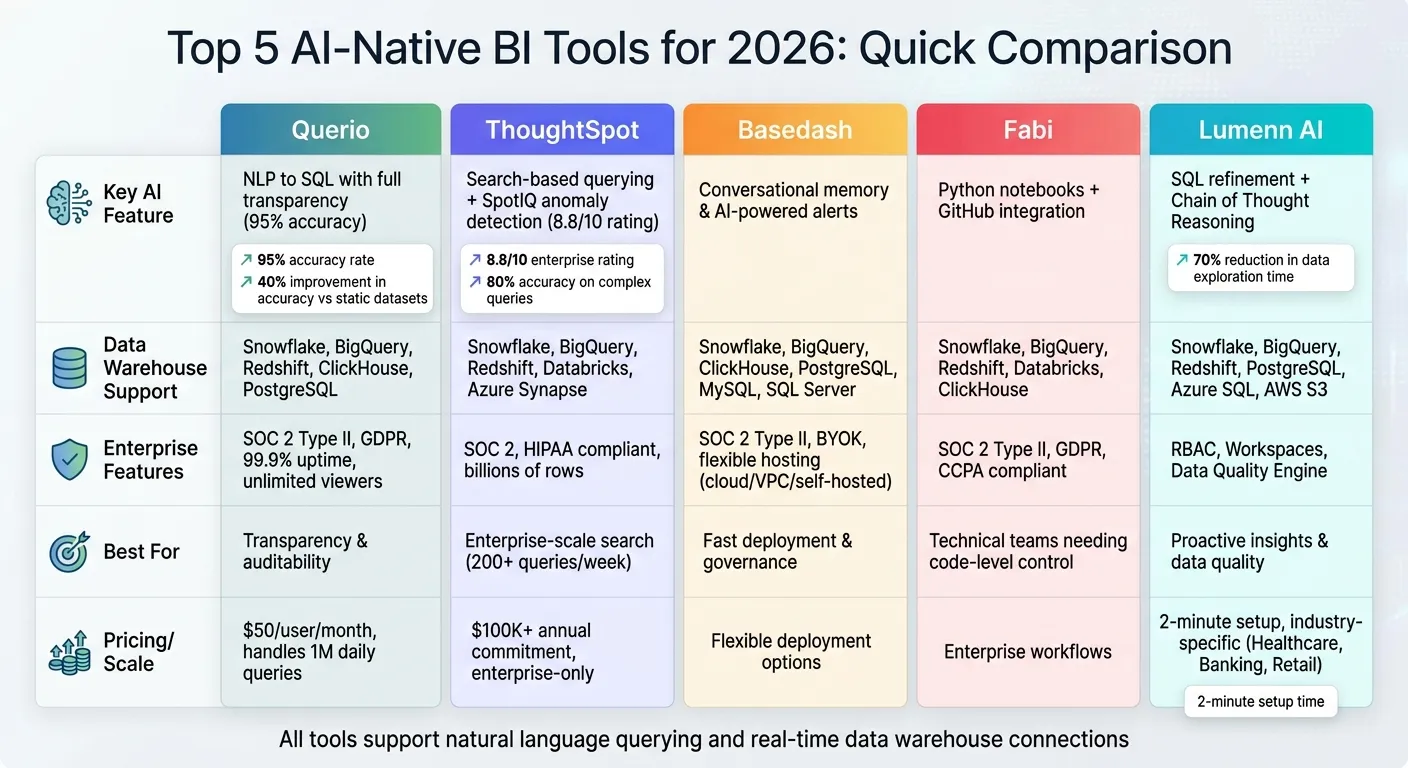 {Top 5 AI-Native BI Tools 2026: Feature Comparison Chart}
:::
{Top 5 AI-Native BI Tools 2026: Feature Comparison Chart}
:::
Building an AI Assistant for BI: The Good, the Bad, and the Ugly
::: @iframe https://www.youtube.com/embed/YjhiqFw8GCw :::
sbb-itb-284a532
1. Querio
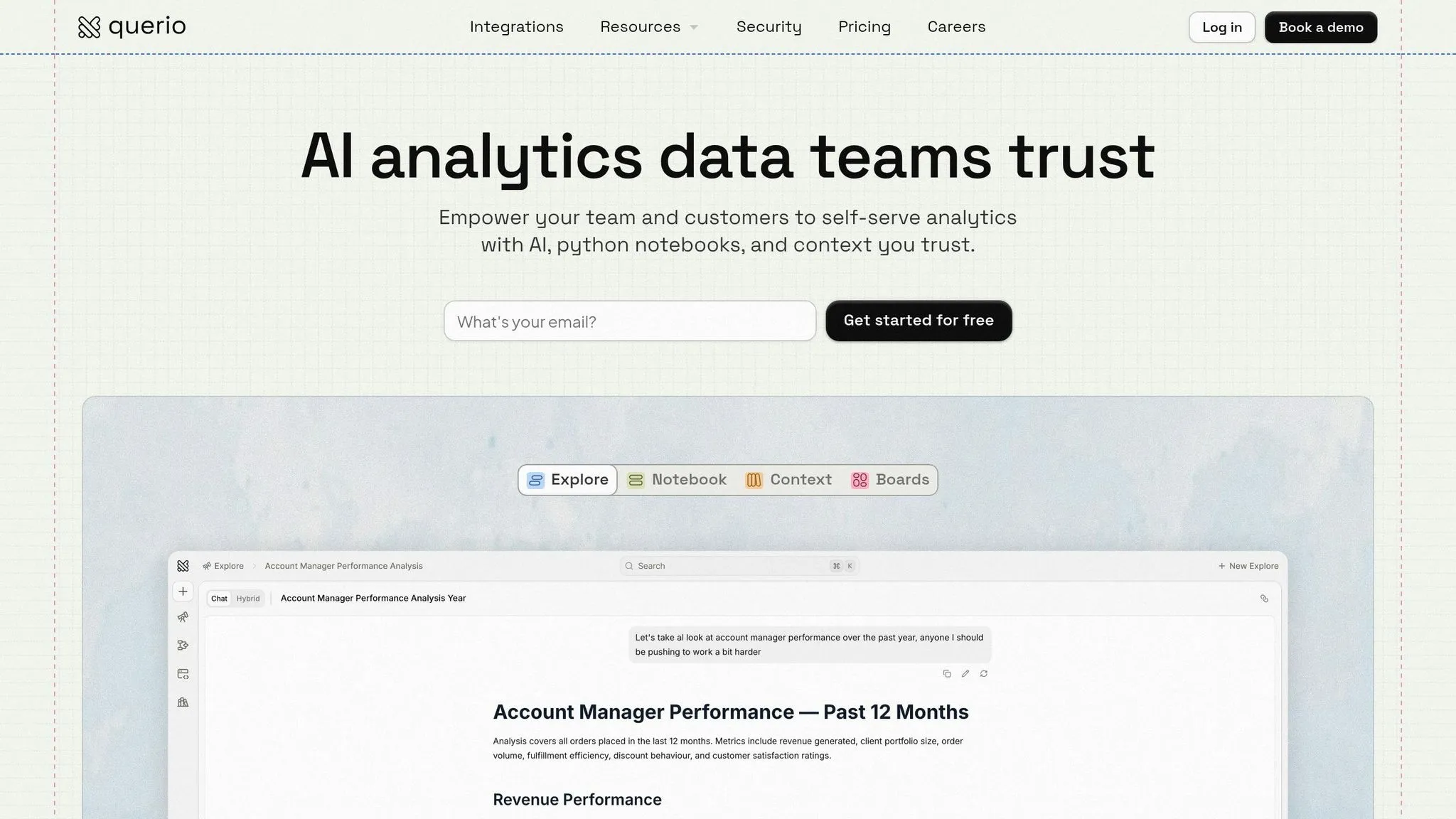
Querio allows users to ask questions in plain language and receive instant, accurate answers in the form of SQL-generated results. Unlike traditional BI tools that tack AI features onto existing dashboards, Querio is designed from the ground up as an AI-native platform. For instance, you could ask, "What were our top-selling products in Q1 2025 by region?" Querio instantly translates that into a SQL query, executes it in your live data warehouse, and delivers visual charts with narrative insights - no coding required.
AI-powered natural language querying
Querio delivers an impressive 95% accuracy rate, even when working with complex joins across over 100 tables, cutting down analysis time from hours to seconds [5][6]. Its "glass box" design ensures transparency by making every SQL or Python query fully visible and editable. Users can also engage in multi-turn conversations to refine their queries on the go. For example, you could follow up with, "Exclude California from the results", without starting over.
The platform includes a centralized semantic layer to maintain consistency. Key metrics like MRR or churn are defined once by data teams and applied uniformly across all queries, dashboards, and reports.
"Querio's NLQ democratizes BI, making 80% of business users self-sufficient" - Forrester expert Mike Gualtieri [4]
Seamless integration with live data warehouses
Querio connects directly to live data warehouses like Snowflake, Google BigQuery, Amazon Redshift, ClickHouse, and PostgreSQL using secure, read-only access. This eliminates the need for ETL pipelines, ensuring queries are run against the most up-to-date information. For example, a retail team tracking inventory changes can see hourly updates without waiting for overnight batch jobs, improving accuracy by 40% compared to static datasets [7][8]. This direct connection enables real-time reporting and automated insights.
Automated analytics and reporting
The platform's AI agents take automation to the next level by detecting anomalies, forecasting trends, and generating reports. A marketing team, for instance, used Querio to automate A/B test reporting, saving 20 hours per week and increasing ROI by 25% [9][10]. Querio can also send weekly sales summaries with visualizations or push real-time alerts to Slack when metrics hit critical thresholds. One fintech company reduced data exploration time by 70%, allowing analysts to focus on strategic insights instead of manual SQL writing [4].
Enterprise-ready scalability
Querio's serverless architecture ensures it can handle enterprise-scale demands. It processes up to 1 million daily queries without performance issues, as demonstrated by a Fortune 500 client. The platform supports datasets larger than 10TB and includes role-based access controls that meet SOC 2 Type II and GDPR compliance standards. Pricing starts at $50 per user per month, with custom plans for organizations with 500+ users. A New York City retailer implemented Querio in just one day, achieving 90% adoption by utilizing Slack and Teams bots that required no additional training.
2. ThoughtSpot
ThoughtSpot is part of the new wave of AI-native BI tools, designed to make data querying more accessible through a user-friendly search interface. With this platform, users can type plain-English questions like "What's revenue by region last quarter?" and instantly receive visualizations, no SQL expertise needed. Tools like Spotter and Sage AI Copilot enhance the experience by remembering conversational context, so follow-up queries like "Show me only the top three regions" flow seamlessly.
AI-driven natural language querying
Enterprise users have given ThoughtSpot an impressive 8.8/10 rating in 2026 [11]. One standout feature is its search interface, which eliminates the need for traditional BI training. The AI also suggests related queries based on partial matches and data context, helping users uncover insights they might not have initially considered. This makes it especially helpful for non-technical teams, significantly lowering the barrier to entry.
Support for live data warehouses
ThoughtSpot's Embrace technology connects directly to major data warehouses like Snowflake, BigQuery, Amazon Redshift, Databricks, and Azure Synapse. This means no need for data replication - Liveboards always display up-to-date information. The platform can handle billions of rows while maintaining strict Row-Level and Column-Level Security based on warehouse definitions, ensuring compliance with SOC 2 and HIPAA-ready data analysis standards.
Automated analytics and reporting
The platform’s SpotIQ engine automates statistical analysis, identifying trends, outliers, and anomalies without manual effort. For large organizations managing over 5,000 employees, ThoughtSpot helps data teams handle over 200 ad-hoc query requests weekly [11]. Its change analysis tool digs into the reasons behind unexpected shifts in metrics, while Liveboards let users apply filters and explore data interactively in real time.
Scalability for enterprise use
ThoughtSpot is geared toward large enterprises, requiring $100,000+ annual commitments with pricing available through sales contact only [11]. It supports thousands of concurrent users and includes multi-agent orchestration with role-based access controls. However, reviewers note that implementation can be complex, and the absence of a self-service trial means companies need dedicated resources and a strong commitment to get started [11][2].
3. Basedash
Basedash stands out among AI-native BI tools by focusing entirely on natural language interaction. Unlike platforms that integrate AI into pre-existing dashboards, Basedash is designed from scratch with chat as its core feature. Users can simply ask questions in plain English, and the AI takes care of generating SQL queries and choosing the right visualizations.
AI-driven natural language querying
One of Basedash's key strengths is its conversational memory, which allows it to retain context across multiple queries. This makes exploring data feel more like having a natural conversation. To ensure consistency, data teams can define business terms centrally, so metrics like activation rate or MRR are interpreted the same way across the organization. This governance layer reduces confusion and leads to more reliable insights.
Support for live data warehouses
Basedash connects directly to major data warehouses like Snowflake, BigQuery, ClickHouse, PostgreSQL, MySQL, and SQL Server. For businesses without an existing data setup, it offers a managed warehouse solution through Fivetran. With read-only access to production databases, it also adds an extra layer of security. This dual setup ensures businesses can access real-time analytics, whether they have a robust infrastructure or are starting from scratch.
Automated analytics and reporting
The platform's AI-powered alerts keep teams informed by sending notifications via Slack or email when metrics exceed predefined thresholds. Its Slack integration isn’t just for alerts - it allows teams to collaborate on insights in real time. By automating SQL generation and visualization selection, Basedash lets analysts spend less time on technical tasks and more on extracting actionable insights. This streamlined process shifts the focus to high-value analysis.
Scalability for enterprise use
Basedash offers flexibility with cloud, VPC, and self-hosting deployment options. For self-hosted setups, it supports Bring-Your-Own-Keys (BYOK), allowing AI inference to run through your own LLM API keys while keeping your data entirely within your infrastructure. The platform meets SOC 2 Type II compliance standards and includes features like SAML SSO, Role-Based Access Control (RBAC), and AES-256 encryption. By centralizing metrics and glossaries, Basedash ensures every AI-driven result is tied to trusted definitions, making it a powerful tool for modern business intelligence workflows.
4. Fabi
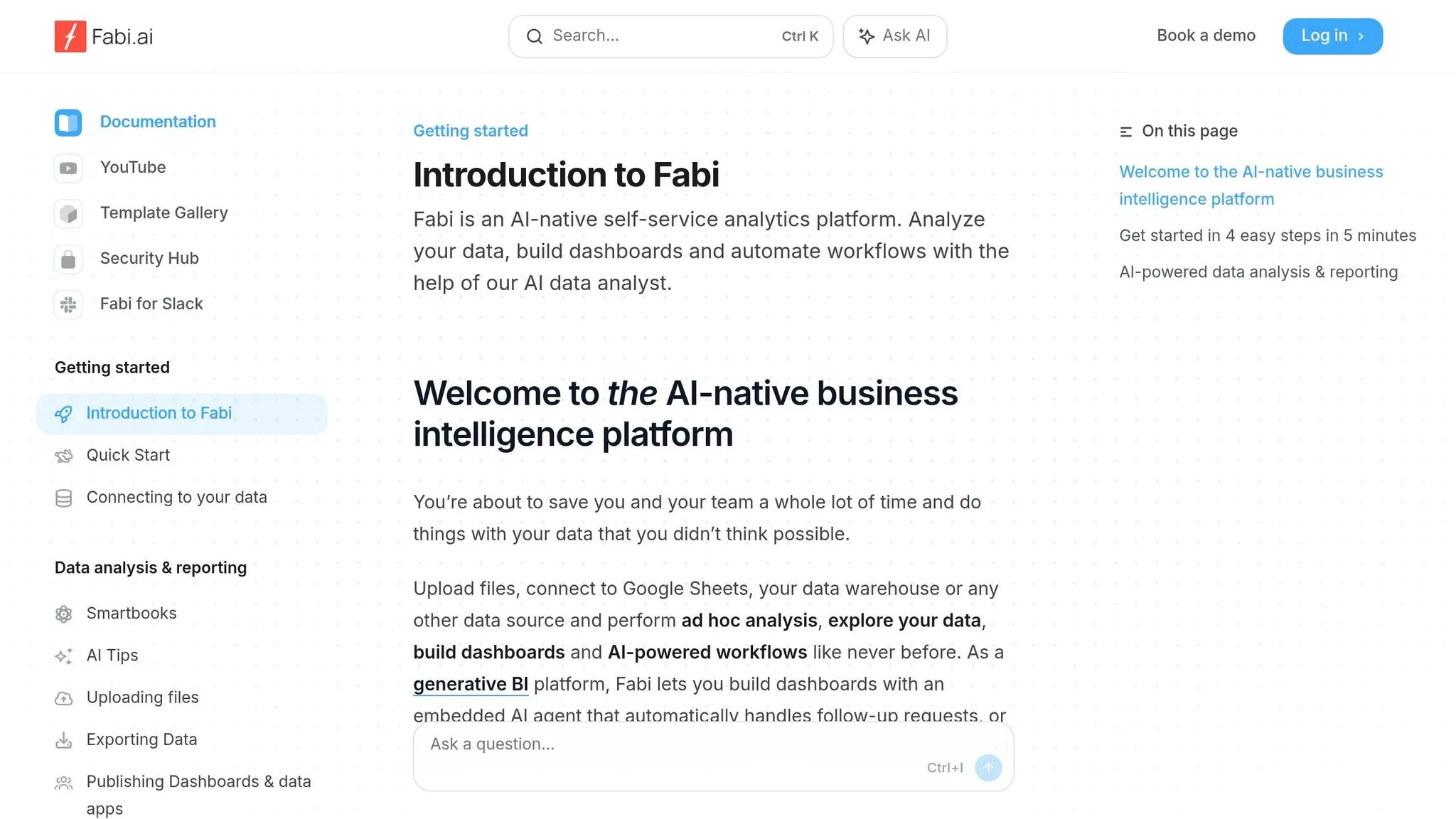
Fabi combines natural language querying, an SQL IDE, AI-assisted Python notebooks, and GitHub version control to deliver quick insights and advanced analytical capabilities.
AI-driven natural language querying
With Fabi, users can ask questions in plain English, and the platform automatically generates the necessary SQL or Python code to deliver answers. According to Gary Sahota, Co-founder of Tether Data, "Fabi is a gamechanger for any organization that spends time on exploratory analysis & ad-hoc reporting. It makes supporting the business with data so much more efficient." [12] However, for the best results, it’s crucial to have a well-structured database. Clear column names and table descriptions can significantly improve the accuracy of the queries [13]. This natural language query feature paves the way for users to dive into more complex, code-based analyses with Fabi’s additional tools.
Technical tools for deeper analysis
Fabi doesn’t stop at natural language queries. It also includes an integrated SQL IDE and AI-assisted Python notebooks, enabling users to transition smoothly from basic queries to more advanced data exploration. The inclusion of GitHub version control further enhances collaboration, allowing teams to track changes effortlessly. Siddharth Patil, EVP of Data Science at Lyft, shares, "Fabi is the future of data analysis. They're bringing an entirely new level of productivity to data practitioners and organizations are going to have access to entirely new insights previously out of reach." [12]
Scalability for enterprise use
Designed with enterprise needs in mind, Fabi adheres to SOC 2 Type II, GDPR, and CCPA standards [12]. It integrates seamlessly with existing BI tools, ensuring that teams can enhance their workflows without the need for disruptive changes. David Hyde, Director of Analytics at Sunobi, highlights, "Fabi brings the entire workflow together in one, simple and intuitive platform. It complements existing BI workflows." [12]
5. Lumenn AI
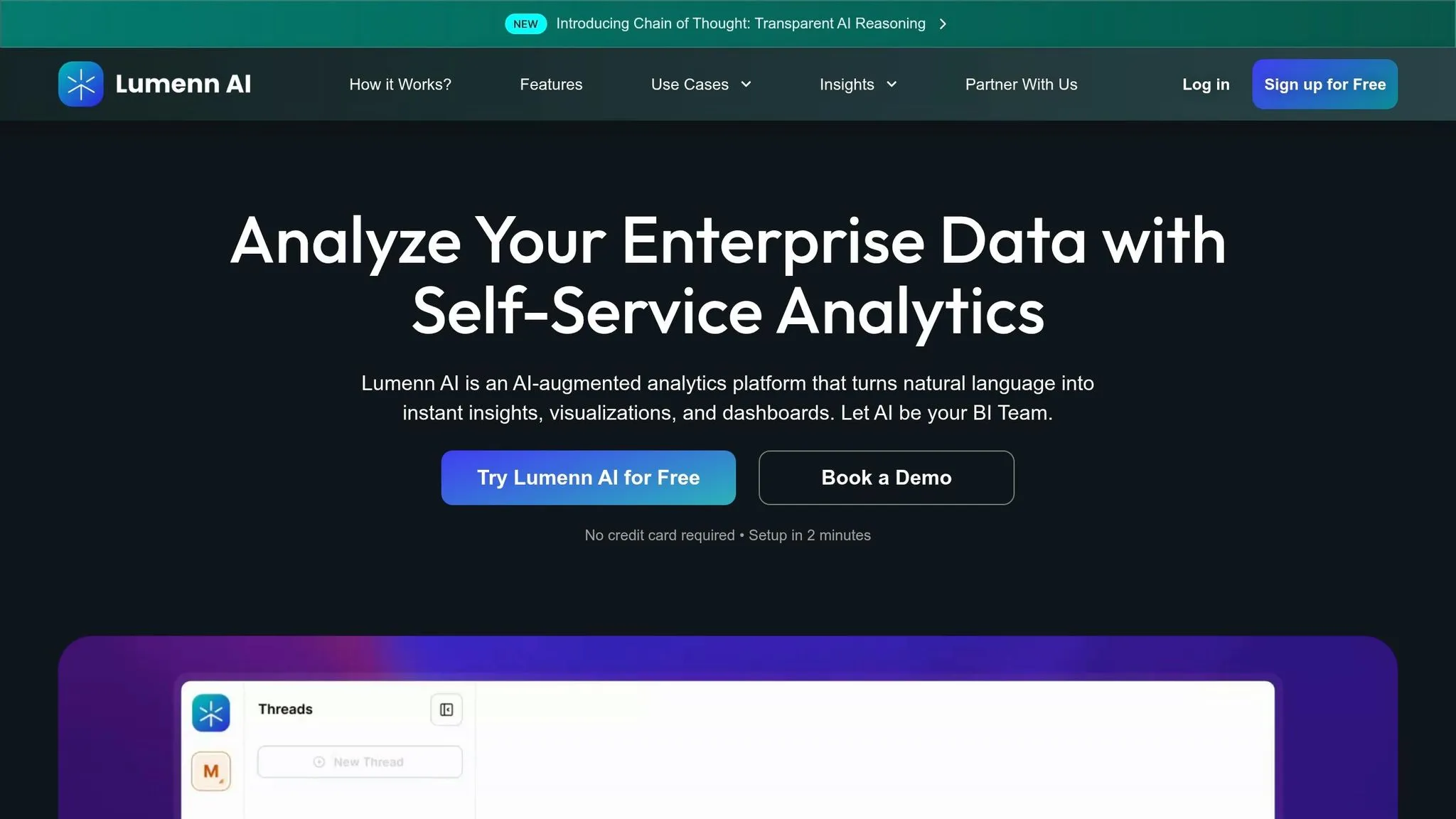
Lumenn AI stands out as the Best Information Technology & Services Business of the Year 2026 Award winner [15]. It connects directly to live data warehouses, translating complex queries into clear, visual insights - no SQL expertise required. It supports top-tier data sources like Snowflake, Google BigQuery, Amazon Redshift, PostgreSQL, Azure SQL, and AWS S3 [14][15]. With its focus on natural language querying, live data integration, and scalability, Lumenn AI offers a powerful solution for modern enterprises.
AI-driven natural language querying
Lumenn AI simplifies data analysis with an intuitive query system. Users can ask straightforward questions like "What caused the Q2 revenue drop?" and the platform’s generative engine transforms them into visual dashboards. The SQL Refiner feature lets users view the generated SQL and make adjustments using natural language [15][16]. To foster transparency, Lumenn AI employs Chain of Thought Reasoning, providing step-by-step explanations of how queries are processed [15]. Additionally, companies can upload a Data Dictionary to help the AI understand specific business terms and metrics [15].
Support for live data warehouses
Lumenn AI ensures secure, real-time insights through in-place querying, using read-only connections that keep data in its original location. Setup is quick - taking as little as 2 minutes [14][15]. Its AI Auto Analyst scans connected datasets to suggest relevant questions and uncover trends proactively [14][15]. This direct connection to live data sources allows businesses to make timely, informed decisions across various industries.
Scalability for enterprise use
Designed with modern microservices, Lumenn AI supports industries like Healthcare, Banking, Manufacturing, Retail, and Energy [15]. It includes enterprise-grade security features such as role-based access control (RBAC), encryption, and detailed audit logs [14]. The platform’s Workspaces feature helps separate team activities and use cases [15], while the Data Quality Engine automatically flags anomalies and duplicates to ensure reliable insights [14]. This scalability makes Lumenn AI a trusted choice for organizations needing real-time analytics in demanding environments.
Feature Comparison
When looking at AI-native BI tools, three key areas take center stage: how the AI functions, the data sources it connects to, and its ability to scale securely within your organization. The table below outlines how each platform measures up in these areas.
| Tool | Primary AI Capability | Data Warehouse Compatibility | Scalability & Governance |
|---|---|---|---|
| Querio | NLP to SQL/Python; Shared Context Layer | Snowflake, BigQuery, Redshift, ClickHouse, Postgres | Unlimited viewers; SOC 2 Type II; 99.9% uptime |
| ThoughtSpot | Sage AI Copilot; SpotIQ Anomaly Detection | Snowflake, BigQuery, Redshift, Databricks, Synapse | Billions of rows; SOC 2; HIPAA compliant |
| Basedash | Conversational memory; AI-powered alerts | Snowflake, BigQuery, ClickHouse, Postgres, MySQL | SOC 2 Type II; BYOK (Bring Your Own Keys) |
| Fabi | AI Analyst Agent; Automated Slack/Email delivery | Snowflake, BigQuery, Redshift, Databricks, ClickHouse | Collaborative Smartbooks; Automated workflows |
| Lumenn AI | SQL Refiner; Chain of Thought Reasoning | Snowflake, BigQuery, Redshift, PostgreSQL, Azure SQL, AWS S3 | RBAC; Workspaces; Data Quality Engine |
This comparison highlights how each tool aligns with essential business intelligence needs through its AI capabilities, data integration, and security features.
Querio stands out with its "glass box" approach, converting natural language into fully auditable SQL and Python code. This level of transparency is critical for regulatory compliance and makes debugging easier [3]. ThoughtSpot, on the other hand, excels in real-world performance, achieving an 80% accuracy rate (correctly answering 16 out of 20 complex natural language queries) in independent testing - ranking highest among leading BI tools [1].
When it comes to data compatibility, all five platforms connect with major cloud data warehouses. Querio includes support for ClickHouse, ideal for real-time analytics, while Lumenn AI takes it a step further by enabling direct querying of AWS S3 object storage. Both ThoughtSpot and Fabi integrate seamlessly with Databricks, a plus for teams running machine learning workflows alongside BI tasks.
Security and scalability are priorities across the board. Querio offers unlimited viewers, SOC 2 Type II compliance, and 99.9% uptime, making it an excellent choice for organizations looking to grow their analytics reach without breaking the bank.
Conclusion
When it comes to AI-native BI tools, Querio's focus on transparency and auditability makes it a standout option. For teams that prioritize openness, Querio delivers inspectable SQL and Python code for every insight - an essential feature for industries where regulatory compliance and debugging are critical. As industry experts highlight, this level of transparency eliminates the uncertainty often associated with "black box" analytics [17]. While other platforms have their strengths, Querio’s clarity and control align seamlessly with modern data governance needs.
Looking at other tools, ThoughtSpot shines in enterprise-scale search, achieving an impressive 80% accuracy for complex natural language queries during real-world tests - the highest among leading BI tools [1]. Basedash is recognized for its speed and governance capabilities, offering 750 SaaS connectors alongside support for data warehouses. Fabi appeals to technical teams with its AI-assisted Python notebooks, known as Smartbooks, allowing for deep code-level control. Meanwhile, Lumenn AI offers a fresh approach to AI-native BI. Even with these options, Querio’s emphasis on governed analytics and real-time insights makes it a top choice for organizations looking to stay ahead.
To evaluate these tools effectively, start with a small-scale pilot - run 10–20 critical queries against known dashboard results to test accuracy [18]. This step is essential, especially given Querio’s proven ability to deliver consistent and transparent insights. Before rolling out a solution organization-wide, ensure you have a centralized, versioned metrics framework to prevent "AI drift" [3].
Key factors to verify during the evaluation include the tool's ability to provide governed insights for all users, the presence of a robust semantic layer, and features like automated permission enforcement and full traceability of insights [18]. These elements help ensure the chosen platform integrates seamlessly with your business definitions and governance standards.
Ultimately, the right BI tool depends on your team’s priorities - whether that’s transparency, enterprise search, fast deployment, technical flexibility, or SQL-driven workflows. Begin with a free trial or pilot to identify the platform that best suits your needs. By prioritizing governed and transparent analytics, you’ll not only address today’s challenges but also position your organization for smarter decision-making in the future.
FAQs
::: faq
What makes a BI tool truly AI-native?
A BI tool can be considered AI-native when it's built from scratch to seamlessly connect with users. This involves supporting plain English queries, delivering automated insights, and functioning within governed, context-aware systems - rather than merely layering AI capabilities onto older, traditional platforms. :::
::: faq
How can I test Querio’s accuracy on our real data fast?
To see how well Querio works with your actual data, connect it to your live data warehouse - platforms like Snowflake or BigQuery are supported. Once connected, you can ask plain English questions about your data. Then, compare the insights and visualizations Querio provides against your expected outcomes or benchmarks. This method uses Querio's natural language engine to deliver quick and precise validation of your datasets. :::
::: faq
What governance features prevent AI from changing metric definitions?
To maintain the integrity of metric definitions, certain governance features play a critical role. These include:
- Robust Data Governance Protocols: Clear guidelines and frameworks ensure that metrics remain consistent and reliable over time.
- Strict Access Controls: By limiting who can make changes, organizations can prevent unauthorized alterations to critical metrics.
- Transparent Versioning: Every change is documented and traceable, creating a clear audit trail for accountability.
These practices work together to ensure that any modifications are properly authorized, thoroughly documented, and fully auditable. :::