Business Intelligence
The best generative business intelligence tools in 2026 ai native vs legacy platforms
AI-native, warehouse-connected BI tools outpace legacy platforms in speed, cost, accuracy, and governance.

Generative BI tools in 2026 are transforming how businesses analyze data. Instead of relying on manual dashboards, these tools use AI to deliver instant insights through natural language. The market is divided into AI-native platforms, purpose-built for AI, and legacy platforms, which have added AI features to older systems. Here's what you need to know:
- AI-native platforms like Querio connect directly to live data warehouses (e.g., Snowflake, BigQuery), offering faster insights, inspectable SQL/Python code, and consistent governance through semantic layers. They're optimized for AI and deliver better performance at lower costs.
- Legacy platforms like Power BI and Tableau struggle with AI integration. Their add-on features are slower, less accurate, and often require manual adjustments. They also face governance and scalability issues.
AI-native tools lead with 2.6x faster revenue growth and dominate 78% of new enterprise contracts, while legacy tools lag in performance and cost efficiency.
Quick Comparison
| Feature | AI-Native Platforms (e.g., Querio) | Legacy Platforms (e.g., Power BI, Tableau) |
|---|---|---|
| Architecture | AI-first, integrated design | AI added to existing frameworks |
| Data Access | Direct live connections | Requires data extracts and ETL processes |
| Governance | Semantic layer for consistency | Limited governance controls |
| Performance | Real-time insights, faster queries | Slower response times |
| Cost Efficiency | 40–60% lower cost-per-user | Higher incremental costs |
If you're comparing business intelligence tools in 2026, AI-native platforms deliver better accuracy, governance, and scalability for modern analytics needs.
::: @figure 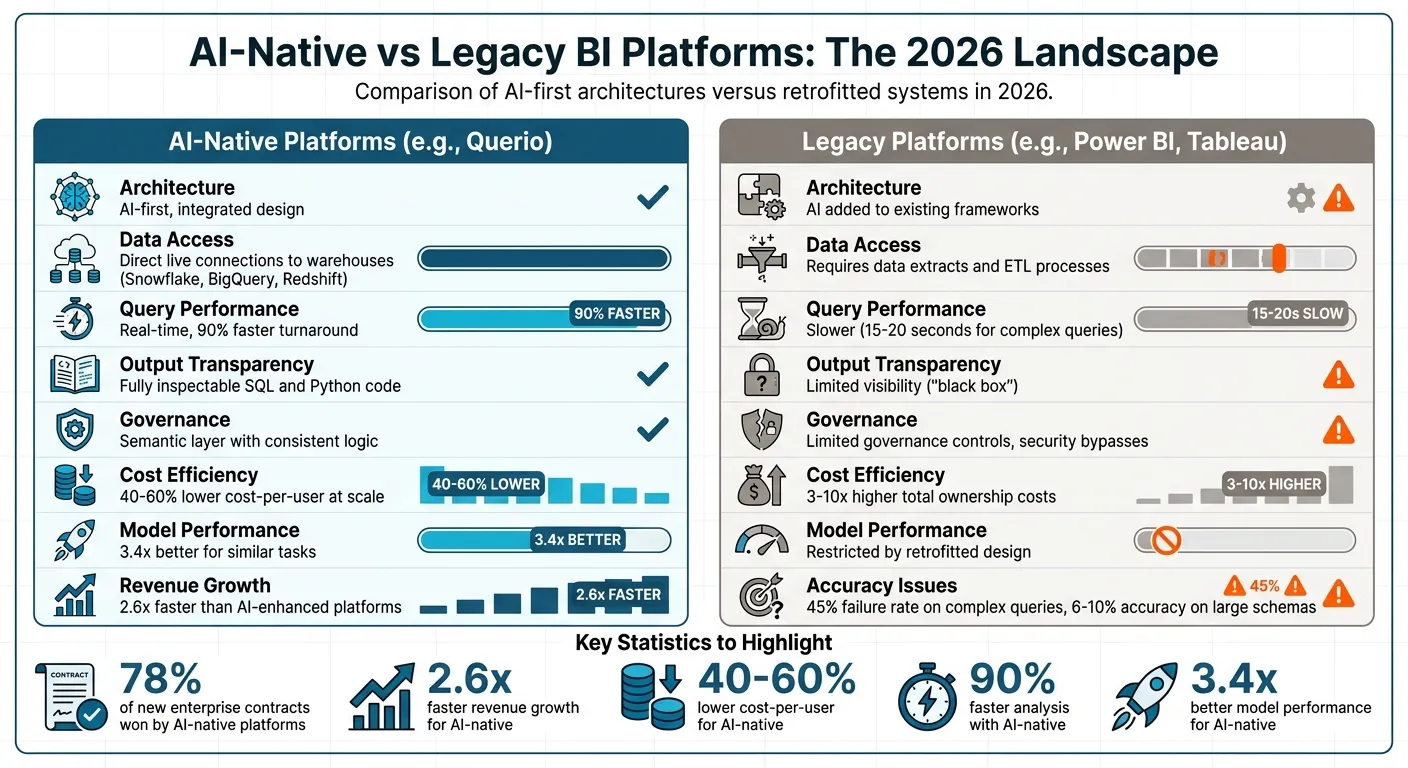 {AI-Native vs Legacy BI Platforms: Performance and Cost Comparison 2026}
:::
{AI-Native vs Legacy BI Platforms: Performance and Cost Comparison 2026}
:::
How AI is Shaping Business Intelligence in 2026
::: @iframe https://www.youtube.com/embed/w2SZ0Sh21g4 :::
sbb-itb-284a532
AI-Native Platforms: Designed for Generative AI from the Start
AI-native platforms stand apart from older, legacy tools because they are purpose-built with generative AI and machine learning in mind. From the ground up, these platforms are optimized for tasks like real-time data processing and natural language interactions.
One of their standout features is how they handle data. Instead of relying on traditional ETL pipelines or duplicating data, AI-native platforms connect directly to live data warehouses like Snowflake, BigQuery, and Redshift. This means your data stays securely in its original location while the AI processes it in real time. This setup not only enhances efficiency but also ensures greater clarity in how your data is handled.
Transparency is another key advantage. Unlike legacy systems, often criticized as "black boxes" for hiding their processes, AI-native platforms generate SQL or Python code for every natural language query. This code can be reviewed, audited, and adjusted by data teams, making it easier to verify and refine the logic behind the AI's outputs. This transparency is critical for maintaining trust and governance. For example, studies show that AI querying raw databases without added context achieves only 16.7% accuracy. Adding a semantic layer significantly boosts this performance.
Another defining feature is the unified semantic layer. This layer ensures standardized definitions across the organization. For instance, if someone asks about "Net Sales", the platform knows exactly what that term means in every context, delivering consistent and accurate results across departments.
Querio: AI-Native Analytics Workspace
Querio brings these principles to life as a scalable analytics workspace tailored for data teams in B2B SaaS companies. It directly integrates with modern data warehouses like Snowflake, BigQuery, Redshift, ClickHouse, and PostgreSQL, enabling users to ask questions in plain English.
What makes Querio stand out is its ability to generate fully inspectable code. Every query is translated into real SQL or Python that can be reviewed, audited, or even modified. This eliminates guesswork about how answers are derived. The platform also features an interactive workspace where analysts can fine-tune queries, build reusable logic, and collaborate effectively, all while maintaining version control over critical business definitions.
Querio's semantic layer ensures consistency in metrics, terminology, and joins across various uses, from ad-hoc analysis to dashboards and embedded analytics. With setup times ranging from just minutes to a few days - rather than weeks - and pricing that includes unlimited users on every plan, Querio bypasses the per-seat pricing models that often make legacy tools expensive for growing teams. For companies leveraging modern data warehouses and seeking scalable analytics solutions, Querio offers self-service access without sacrificing accuracy or governance.
Legacy Platforms: Traditional BI Tools with Added AI Features
Legacy BI tools, like Power BI and Tableau, have integrated AI features, but these additions often feel disconnected. For instance, Power BI's "Q&A" and "Copilot" function as separate entities with distinct capabilities, leaving users frustrated by the lack of consistency.
The core issue lies in the original design of these platforms. They were built for tasks like creating dashboards, generating reports, and manually analyzing data - not for seamless AI integration. As Bartek Pucek from The Thinking Company points out:
AI-native vs AI-enhanced is an architectural distinction, not a feature comparison. [3]
This explains why removing AI features doesn’t affect the core functionality of these tools - they're essentially add-ons rather than integral components.
Performance and Pricing Challenges
Performance is another sticking point. While simple visuals may load in 2–4 seconds, more complex calculations on large datasets can take 15–20 seconds in DirectQuery mode [5]. This lag stems from an infrastructure not optimized for real-time AI tasks.
Pricing models further highlight the limitations. For example:
- Power BI Pro starts at $10 per user per month, but accessing AI features like Copilot requires Premium Per User at $20 per user per month or Premium Capacity at $4,995 per month [5][4].
- Tableau Creator licenses cost $75 per user per month to include Einstein AI features [5][4].
These costs can make the total ownership price 3 to 10 times higher than the base price [7], reflecting the inefficiencies in performance and operations.
Limitations of AI-Enhanced Legacy Tools
The challenges don’t stop at performance and cost. Technical limitations significantly impact reliability. Testing of Tableau's "Ask Data" feature revealed it failed to answer 45% of complex natural language queries correctly [5]. For enterprise schemas with over 800 columns, natural language-to-sql accuracy plummets to just 6% to 10% [7]. These inaccuracies erode user trust.
Security and governance issues add another layer of concern. AI components in legacy tools may bypass established row-level security or permissions, exposing data users shouldn’t access [2]. This is particularly alarming in regulated industries where compliance is critical.
AI-generated outputs often demand manual intervention. For instance, in Power BI, about 70% of AI-generated report layouts require manual adjustments to be usable [5]. Moreover, AI hallucinations - where the system fabricates information - pose serious risks. Depending on data quality, hallucination rates range from 3% to 27% [7]. A notable example occurred in 2025 when Deloitte refunded $290,000 to the Australian government after GPT-4o fabricated academic references in a report [7]. This underscores the dangers of relying on AI in high-stakes environments.
Finally, legacy platforms struggle to adapt to the growing demand for autonomous, AI-driven BI. Their reliance on static dashboard architecture makes it difficult to implement dynamic, AI-led monitoring. This mismatch contributes to the alarming statistic that 60% to 80% of BI projects fail to deliver the anticipated value [7].
AI-Native vs Legacy Platforms: Key Differences
The primary distinction between AI-native and legacy platforms lies in their core design. AI-native platforms are built with AI integrated into every layer of their architecture, while legacy platforms treat AI as an add-on, layering it over an existing framework. This difference means that while legacy platforms can function without AI, AI-native platforms rely on it as an essential component [3].
This foundational difference impacts everything from performance to cost efficiency. AI-native platforms can deliver up to 40–60% lower cost-per-user at scale [3]. Below, we explore the technical aspects that set these platforms apart.
Architecture and Scalability
AI-native platforms, such as Querio, connect directly to cloud data warehouses through live, read-only connections. This eliminates the need for data extracts, ETL pipelines, or duplicate storage, significantly reducing infrastructure complexity and costs.
The benefits extend to performance. AI-native architectures provide 3.4x better model performance for equivalent tasks compared to AI retrofitted onto traditional systems [3]. Moreover, these platforms continuously improve with every interaction, refining their outputs over time [3].
Legacy platforms, on the other hand, often face increasing costs as usage grows. They typically charge incremental fees per user or capacity, whereas AI-native platforms scale with minimal additional costs, translating their architectural efficiency into tangible savings.
Accuracy and Governance
AI-native platforms also excel in accuracy and governance. Querio, for instance, generates fully inspectable SQL and Python code for every query, ensuring that results are always rooted in real data rather than probabilistic estimates. This level of transparency is especially critical in scenarios where precision is non-negotiable.
Legacy tools, however, can sometimes bypass established security protocols, which compromises governance. In contrast, AI-native platforms use a built-in semantic layer to define joins, metrics, and business terminology consistently across all use cases. This ensures uniform governance and reduces the risk of inconsistencies.
As the industry shifts toward conversational analytics, robust governance becomes even more essential. Gartner predicts that by 2028, 60% of analytics interactions will occur through natural language interfaces rather than traditional dashboards [3]. AI-native platforms are already designed to meet this evolving need.
Integration and Performance
The efficiency of integration and overall performance further highlights the advantages of AI-native platforms. These systems deliver analysis 90% faster by running queries directly against live warehouse data, avoiding the delays caused by data extraction and loading [3].
AI-native coding tools also boost developer productivity, enabling tasks to be completed 47% faster compared to using AI-enhanced editors [3]. This efficiency underscores the value of embedding AI into the core of the platform rather than tacking it on as an afterthought.
Comparison Table: AI-Native vs Legacy Platforms
Here's a side-by-side look at how AI-native platforms like Querio stack up against legacy systems:
| Feature | Querio (AI-Native) | Legacy Platforms |
|---|---|---|
| Architecture | AI-first design; requires AI to function | AI added to existing framework; works without AI |
| Data Access | Direct live connections to warehouses (e.g., Snowflake, BigQuery) | Relies on data extracts and ETL processes |
| Query Performance | Real-time; 90% faster turnaround | Slower due to extract-and-load delays |
| Output Transparency | Fully inspectable SQL and Python | Limited visibility into internal processes |
| Governance | Semantic layer with consistent logic | Often lacks unified governance controls |
| Scaling Cost | Minimal; 40–60% lower cost-per-user | Incremental costs per user or capacity increase |
| Revenue Growth | 2.6x faster than AI-enhanced platforms | Slower growth due to architectural limitations |
| Model Performance | 3.4x better for similar tasks | Restricted by retrofitted design |
Use Cases and Selection Criteria
The practical benefits of an AI-native approach become even clearer when applied to real-world scenarios.
In fintech, teams often need to perform complex, multi-step root cause analyses. Take this example: figuring out "Why did gross margin drop last quarter?" requires combining data from ERP, CRM, and warehouse systems. Traditional platforms struggle here, often relying on time-consuming manual data exports - a problem AI-native systems can solve seamlessly [12].
Logistics operations face a different hurdle: more than 80% of their data is unstructured. This includes shipping PDFs, scanned invoices, and images [9][10]. AI-native platforms excel at parsing these documents directly, automating tasks like ABC inventory analysis and cutting down on manual data entry.
In ecommerce, the need for flexible, non-linear data exploration is critical. For instance, when churn rates suddenly spike, teams must quickly analyze customer segments - like identifying which subscription tier is most affected - without waiting for pre-built dashboards. AI-native platforms make this possible, doubling adoption among non-technical users and reducing query times by as much as 60% [6].
When choosing a platform, robust governance should be a top priority. Look for tools with a governed semantic layer (such as one built using dbt) to ensure AI outputs are grounded in verified business definitions. This approach minimizes the risk of errors, such as hallucinations, that can occur when AI operates without structured context [6]. For industries managing sensitive data, it's crucial to confirm that the platform enforces row- and column-level security directly at the query layer - not just at the dashboard level [6][12].
Finally, evaluate your specific data needs. If your organization deals with a high volume of unstructured documents, prioritize platforms offering native PDF and image parsing capabilities. For teams with less technical expertise, benchmark performance is key - top-tier AI agents deliver up to 94.4% accuracy on financial tasks compared to 76% for generalist models [8][11]. The best platform will align with your priorities, whether those are advanced data handling, self-service analytics, or strong governance protocols.
Conclusion: Why AI-Native Platforms Lead in 2026
The numbers tell a compelling story: AI-native platforms aren't just a step ahead - they're redefining the game entirely. By 2026, these platforms secured a staggering 78% of new enterprise contract value in markets where they directly competed with traditional incumbents [3]. This isn't just an edge; it's a complete overhaul of how analytics operates.
What sets AI-native platforms like Querio apart is their purpose-built architecture. This design enables a data flywheel effect, where every user interaction enhances task completion rates by 15–20% per quarter - and that's without any changes to the underlying models [3]. Compare this to legacy systems, which are still rooted in manual workflows, and the difference becomes even clearer. AI-native platforms deliver 3.4x better model performance on comparable tasks [3]. It's not just better technology - it's a fundamentally different way of achieving results.
This architectural advantage isn't just about performance; it translates into measurable business outcomes.
"Querio is designed for teams that refuse to trust a 'Black Box.' Every insight generated is backed by inspectable SQL and Python code." – CodeBrewTools [1]
From an economic perspective, the benefits are just as striking. AI-native platforms drive 2.6x faster revenue growth compared to AI-enhanced alternatives [3]. They also operate at 40–60% lower cost-per-user at scale, making them far more efficient than legacy systems [3]. This isn't simply a better product - it's a complete transformation of the business model.
For companies choosing analytics solutions in 2026, the decision is clear: stick with outdated, manual systems or embrace modern, conversational analytics powered by live data. The warehouse-native, agent-driven approach isn't just a glimpse of the future - it's the new standard. This shift represents the culmination of a generative BI revolution, reshaping the way businesses interact with and understand their data.
FAQs
::: faq
What makes a BI tool truly AI-native?
A BI tool can be considered AI-native when AI isn't just an optional feature but the very core of its design. Essentially, if you took AI out of the equation, the tool wouldn't work at all. These tools leverage large language models to allow for natural language interaction and seamless data processing. This makes them far more intuitive and easier to use compared to platforms where AI is simply tacked on as an extra feature. :::
::: faq
How does a semantic layer improve accuracy and governance?
A semantic layer improves precision and oversight by unifying business metrics, logic, and data relationships in one place. This ensures that reports and dashboards deliver consistent and trustworthy analysis. Additionally, it bolsters governance by regulating access, protecting data integrity, and reducing metric drift - key factors in maintaining compliance and high data quality. :::
::: faq
What should I check before switching from a legacy BI stack?
Before moving to an AI-native platform, it's important to weigh a few critical factors. Start with live data access and how well the platform integrates with your existing systems - this ensures a smooth transition without disrupting your workflow. Look for transparency and governance features, such as explainable AI outputs, to maintain trust and accountability in your processes.
Ease of use is another key consideration, especially for non-technical team members who will interact with the platform. Beyond that, think about scalability, how quickly the platform can be deployed, and the total cost of ownership. These elements will help you determine if the platform fits your business goals and budget. :::