Guide
How to Segment Customers the Smart Way
Learn how to segment customers with clear objectives, clean data, and SQL workflows. A practical guide to building, validating, and activating segments.

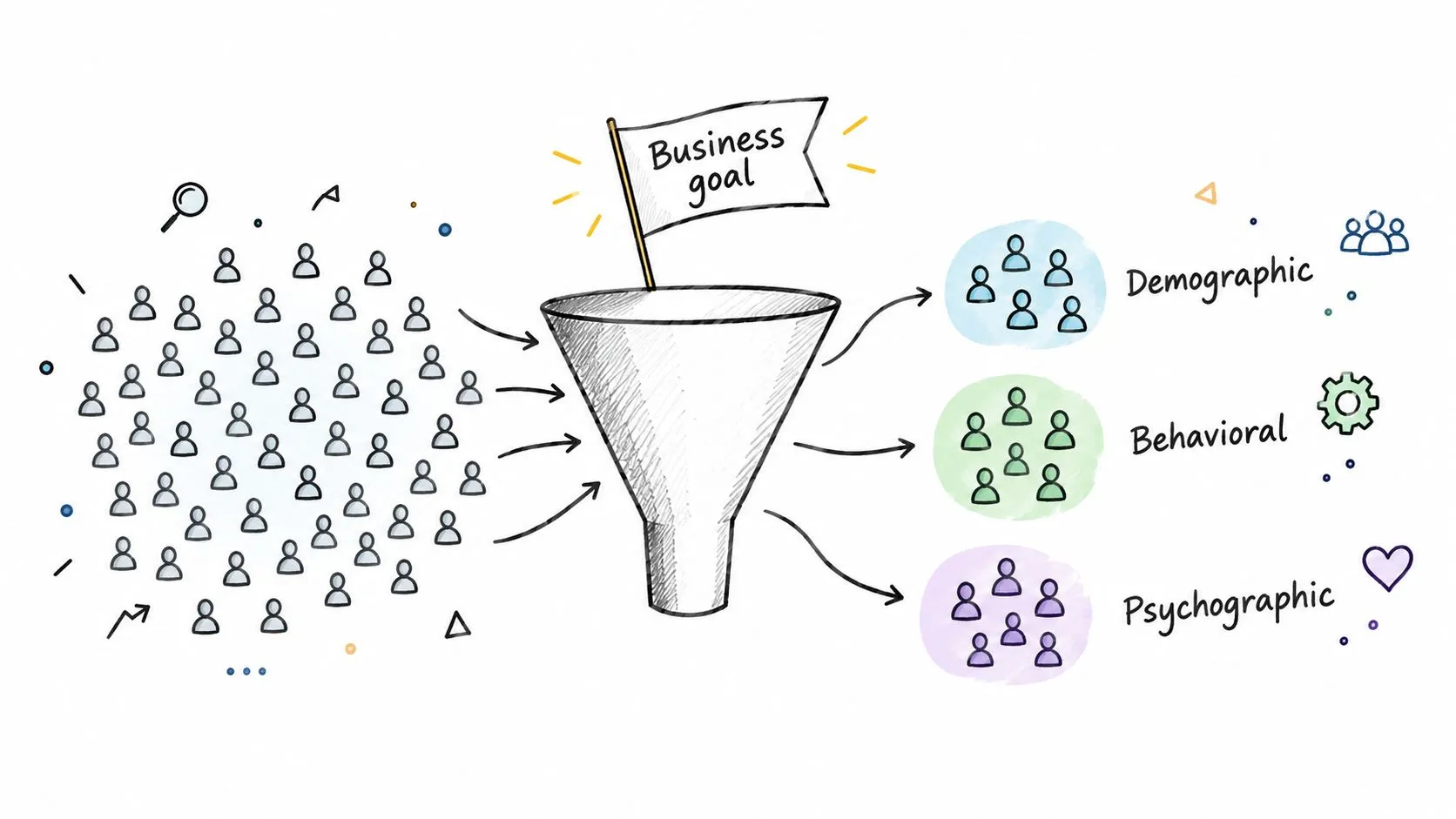
How to segment customers effectively: define a business goal, select relevant traits, group customers, validate the results, and activate each segment with a specific action. The process works best when behavioral evidence supports demographic, geographic, and psychographic context.
Table of Contents
- Why Customer Segmentation Actually Works
- Core Segmentation Criteria Explained
- Turn Groups Into Decisions
- Skip the Vanity Variables
- Match Variables to the Decision
- Create Consistent Customer Records
- Keep Segments Dynamic
- Check Size and Separation
- Test Statistical and Business Value
- Connect Data to Decisions
- Close the Feedback Loop
- How Many Segments Should You Start With?
- How Often Should You Refresh Segments?
- Can Small Teams Segment Without a Warehouse?
- How Is Segmentation Different From Tags?
Why Customer Segmentation Actually Works
Customer segmentation replaces broad averages with groups that share meaningful characteristics. A retailer, for example, might separate frequent low-value buyers from occasional high-value shoppers, then use loyalty rewards for the first group and replenishment reminders for the second. For useful foundational context on how audience segmentation works, see Adwave customer segmentation insights.
The strongest segments combine several lenses. Below is a summary of the four foundational criteria used to divide customers into actionable groups.
Core Segmentation Criteria Explained
| Criteria Type | Definition | Common Use Cases |
|---|---|---|
| Demographic | Who customers are | Offers by age or income |
| Geographic | Where customers live | Regional pricing or delivery |
| Behavioral | What customers do | Retention and recommendations |
| Psychographic | Why customers choose | Values-based messaging |
In practice, layering these traits makes a segment more useful. "Customers in London" is descriptive; "London customers who purchased twice, browse on mobile, and prefer sustainable products" suggests a clear campaign.
Turn Groups Into Decisions
Segmentation only matters when it changes an action. It can guide personalized pricing, product recommendations, onboarding, retention messages, or channel selection. A lapsed high-value customer may need a service reminder, while a new customer needs education rather than a discount.
A segment without a decision attached is merely a label, not a strategy.
Before grouping anyone, write the decision you want to improve and the outcome you will measure. Then choose only variables connected to that outcome. This prevents teams from collecting every available attribute and creating complicated groups nobody uses.
Customer data becomes more useful when it reveals motivations through behavior. Recency, purchase frequency, spending, campaign engagement, and product usage often expose differences that age or location alone miss. In practice, segmentation acts like an operating system for customer understanding, connecting evidence to coordinated decisions across marketing, product, and support teams.
Start with a small number of distinct, measurable segments. Validate whether they differ in conversion, retention, or lifetime value, then revise them as behavior changes. Useful segmentation is a repeatable decision process, not a one-time database exercise.
Before figuring out how to segment customers, get clear on the business decision those segments need to drive. Cutting churn, lifting lifetime value, and improving onboarding each call for different evidence, so pick one measurable outcome and start there—something concrete like reducing 90-day churn among new subscribers.
Work backward from that outcome. Ask what customer behavior shows up before it happens, then select variables that can actually inform an action. For churn, useful signals tend to be days since last login, support ticket volume, feature adoption rate, and purchase frequency. For retention work, recency, frequency, and monetary value still give you a solid starting point through RFM analysis, as MoEngage’s customer segmentation analysis guide explains.
Skip the Vanity Variables
Your database probably holds age, job title, device, location, campaign clicks, and a dozen other fields. More inputs don’t automatically mean better groups. Include a variable only because it explains behavior or determines what your team will do next.
A useful segment connects a measurable difference in behavior to a specific decision.
Match Variables to the Decision
A subscription company investigating cancellations might prioritize:
- Engagement: sessions, active days, and key feature usage
- Customer history: tenure, plan type, and prior upgrades
- Friction: failed payments, unresolved tickets, or repeated errors
A retailer trying to increase order value would look at something different—product categories, purchase intervals, discount sensitivity, and browsing patterns. Layer demographic or geographic context only when it genuinely changes targeting, delivery, pricing, or messaging.
Write a one-sentence segment brief before you touch any data. Something like: “Identify customers with declining usage who are likely to cancel, then trigger education before renewal.” That sentence keeps SQL, Python, and reporting focused on a result instead of an interesting but unused profile. With Querio, teams can inspect those relationships directly in warehouse data and document the assumptions alongside the analysis.
Figuring out how to segment customers begins and ends with data you actually trust. Build around a warehouse rather than a patchwork of spreadsheets. Transactions, product interactions, campaign touches, and support tickets need to connect through a single stable customer ID. That unified view surfaces behavior isolated systems miss—think someone adding items to their cart online and then buying in-store two days later.
Structure event tables with one row per event and explicit fields for customer_id, timestamp, event name, product, channel, and value. Lock timestamps to one timezone. Store currency consistently. Document whether a number represents gross, refunded, or net revenue.
Create Consistent Customer Records
Normalize attributes before you touch segment logic. Map country and plan names to controlled lists. Standardize dates. Keep source fields intact where original definitions differ—“United States,” “US,” and “USA” should roll up to one reporting value, but the original string stays visible for auditing.
Deduplicate centrally, using rules everyone agrees on. Email alone breaks down when households or teams share an inbox, so combine account IDs, payment references, and verified profile signals where appropriate. Track which record survived and why rather than silently dropping duplicates.
A segment is only as trustworthy as the identity rules behind it.
Missing values deserve the same attention. A blank income field usually means “we didn’t collect it,” not “zero.” Never fill unknowns with business assumptions without flagging the imputation. Compare segment sizes before and after exclusions—sharp drops often signal hidden bias.
Run freshness checks on row counts, duplicate IDs, late-arriving events, and unexpected null spikes. Publish a plain-language data dictionary: what each field means, who owns it, refresh cadence, and known edge cases. Analysts and nontechnical stakeholders both benefit.
For practical examples of querying warehouse data, read this guide to data warehouse analytics. Then schedule recurring quality checks. Accurate segmentation lives on timely data, not a one-time cleanup.
Once your warehouse is in decent shape, the next move is turning segment definitions into queries you can actually run on a regular basis. Build a customer-level feature table with the essentials: last purchase date, order count, revenue, active days, product categories—whatever captures the behavior you care about. A rolling RFM view, for instance, might look at recency, frequency, and monetary value over the past 180 days.
SELECT customer_id, DATEDIFF(day, MAX(order_date), CURRENT_DATE) AS recency_days, COUNT(DISTINCT order_id) AS order_count, SUM(net_revenue) AS revenue FROM orders WHERE order_date >= CURRENT_DATE - INTERVAL '180 days' GROUP BY customer_id;
Sometimes the business needs segments that are easy to explain and act on. In those cases, just write explicit rules. A retailer might label anyone with three or more orders and above-average revenue as "loyal advocates," while customers who haven't bought anything in 90 days automatically land in a reactivation audience.
For trickier patterns where rules fall short, pull the feature table into Python and experiment with clustering. Scale your numeric variables, test a few different cluster counts, then profile each group by size, revenue, retention, and whatever behaviors make them distinct. It's worth checking out a comparison of clustering algorithms for customer segmentation before settling on one.
The whole warehouse prep workflow needs to stay transparent and maintainable. This infographic lays out five connected practices, starting with event-table design and running all the way through ongoing accuracy checks.
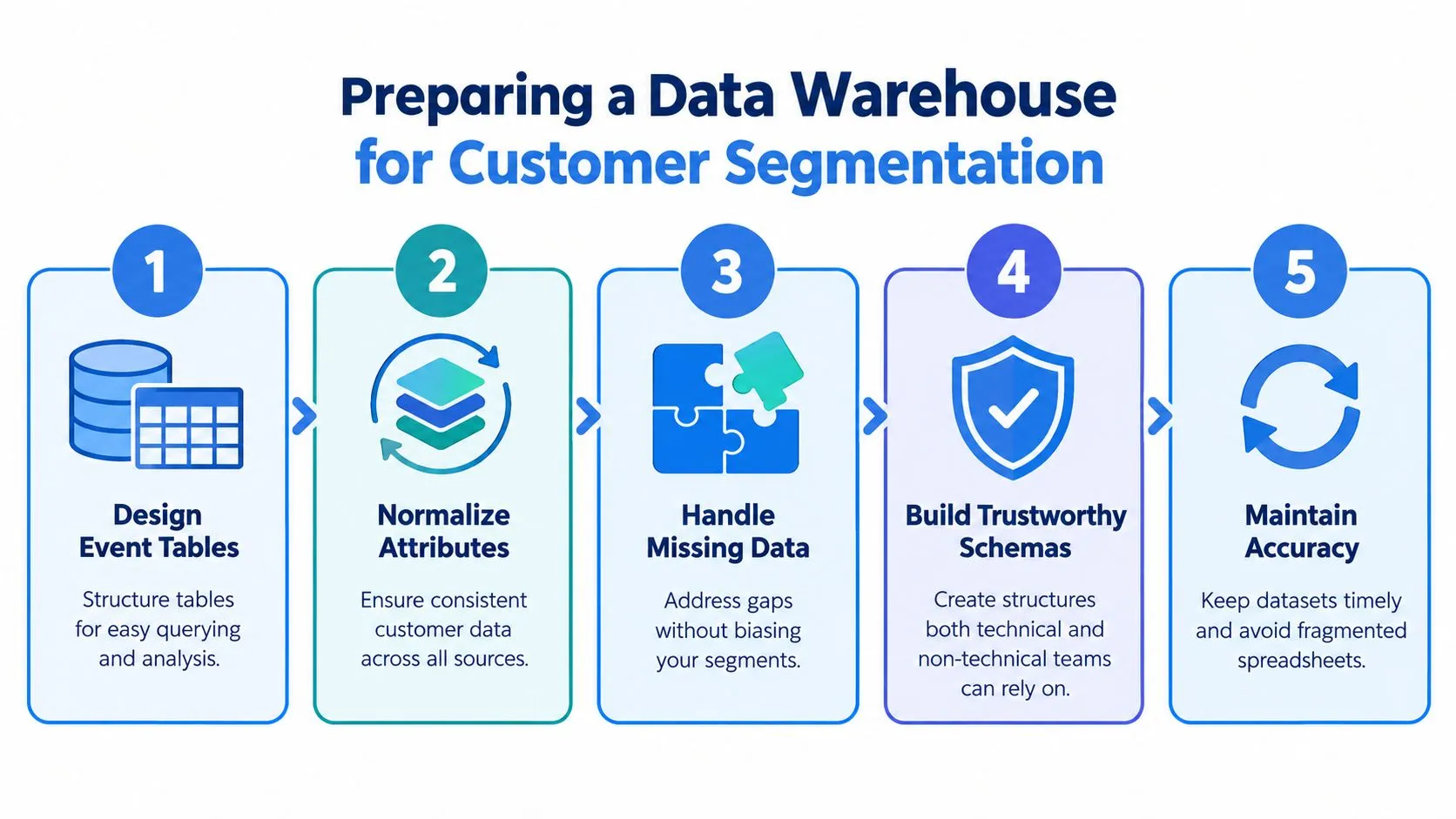
The takeaway here is straightforward: reliable segments come from consistent schemas, thoughtful handling of missing data, and regular refreshes—not just clever models.
Keep Segments Dynamic
Materialize segment membership into a dedicated table with fields like segment_name, assigned_at, updated_at, and a column tracking which rule set or model version produced the assignment. Refresh cadence depends on how fast the underlying behavior changes—daily for churn signals, weekly for purchasing patterns, and less often for stable profile attributes.
Treat segment logic like production software: version it, test it, monitor it, and document ownership.
When a new product line shifts buying cycles, you should be able to update feature definitions without breaking every downstream campaign. A compatibility view helps here—existing dashboards and marketing workflows keep running while teams validate the revised segment logic in parallel.

A segment doesn't earn its place in your marketing stack just because a query produced it. Before pushing anything live, verify that it's large enough to justify targeting, distinct enough to explain behavior, and practical enough to act on. The starting point is simple: stack each segment against the full customer base on retention, conversion, revenue, and engagement. If you can't point to a meaningful divergence, the segment isn't pulling its weight.
Check Size and Separation
Small audiences can look tantalizing on paper but fall flat when you factor in campaign costs. Set a minimum audience floor based on your channel economics and reach, then flag anything that slips below it. At the same time, watch for overlap. When two segments share almost identical recency, frequency, and value profiles, you're likely looking at one segment wearing two labels.
- Compare each segment's averages against the overall baseline to surface real differences, not just relative ones.
- Look at distributions, not just means. Two groups can share an average but behave completely differently.
- Track membership drift after each data refresh. A stable segment signals a reliable signal; a churning one suggests noise.
- Tie every segment to a concrete business action. If you can't name the play, retire the segment.
One retailer I worked with identified a "high-value browser" segment converting at 4.2% against a 2.1% baseline. That gap grabbed attention, but the number only held up after checking sample size, seasonality, and whether the segment was defined using data available before conversion. Otherwise, you're measuring an outcome, not predicting one.
A useful segment predicts a decision-relevant behavior, not merely a statistical difference.
Test Statistical and Business Value
Confidence intervals or a suitable significance test separate persistent effects from random noise. For clustered segments, metrics like silhouette scores offer a useful lens on separation, but a strong model score should never override business judgment. Broader customer segmentation analysis guidance reinforces the need to monitor retention, lifetime value, conversion, and engagement at the segment level.
Run a small holdout campaign before committing budget. Send reactivation nudges to the target group while holding out a matched cohort, then compare the lift. Keep segments that produce a measurable signal; merge or retire those that don't. Tools like Querio let teams run these validation checks directly against warehouse data, which keeps everything close to the source and out of spreadsheet purgatory.
A validated segment is only as good as the action it drives. Push membership into your CRM, email tool, ad audiences, and in-app experience using stable identifiers and a clear refresh cadence — otherwise you're shipping stale lists and hoping for the best.
The practical logic is straightforward: a customer showing declining usage gets an onboarding reset, while a repeat buyer sees early access or loyalty rewards inside the product. That distinction only works if the wiring between your data warehouse and execution channels is solid and documented. For broader context on why this layer matters, insights from nexus IT group are worth a look.
Connect Data to Decisions
Don't scatter segment metadata across five tables. Create a single destination field that captures segment name, status, assignment date, and the model version that produced it. Once that exists, lock down ownership before anything goes live:
- Marketing controls message and send frequency.
- Product controls in-app treatment and UI changes.
- Data owns refresh schedules and quality checks.
- Compliance reviews consent flags and sensitive attributes.
Real-time updates make sense for fast-moving signals — cart abandonment, session drops, churn spikes. For slower purchase cycles, a daily or weekly refresh usually hits the sweet spot without burning compute.
If a segment can't trigger a specific experience, it's not ready for activation.
Close the Feedback Loop
Every segment should answer back. Track it against the exact metric that justified its existence — whether that's conversion, retention, average order value, engagement depth, or unsubscribe rates — and compare against a matched holdout group. A reactivation campaign, for example, should prove it drove incremental purchases, not just opened eyes on a dashboard.
Set a fixed review cadence and log what changed at each cycle. If customers are flipping between segments faster than expected, dig into your data freshness or reconsider rule thresholds before assuming the model broke. When performance fades, experiment with creative, timing, or product treatment first — rebuilding the entire model is rarely the fastest fix.
For churn-focused programs specifically, learn more about reducing customer churn. Querio helps teams query warehouse data directly and keep this feedback loop running without stitching everything together in disconnected spreadsheets. The real payoff comes over time: activation results feed back into behavioral signals, sharpening the next round of segmentation and turning one-off analysis into a repeatable growth engine.
How Many Segments Should You Start With?
Three to five segments, anchored to a single business decision, is a solid starting point. A subscription team focused on churn might separate new users, engaged users, declining users, and inactive users. Adding more groups beyond that often blurs meaningful differences and creates campaigns that nobody owns or maintains.
A segment earns its place when three conditions hold: enough customers to act on, behavior that is genuinely distinct, and a clear action tied to it. If two groups always receive the same message or treatment, they should probably be merged.
How Often Should You Refresh Segments?
Let the speed of behavior dictate the cadence. Churn-risk segments often need daily updates; purchasing segments tend to work well on a weekly cadence; and more stable demographic groups can refresh monthly or quarterly.
After each refresh, check both membership drift and performance. If customers are jumping segments unexpectedly, the problem is usually upstream—event delays, rule changes, or missing data—not the strategy itself. Fix the data before fixing the segment.
Can Small Teams Segment Without a Warehouse?
Absolutely. A clean CRM export or spreadsheet with a stable customer ID, recent activity, purchase count, revenue, and consent status is often enough. Build a simple RFM or lifecycle model, document the definitions clearly, and refresh it on a consistent cadence.
The catch is fragility. Spreadsheets become harder to trust every time a new data source appears. A warehouse-first workflow starts to pay off when you need to join product events, transactions, support data, and campaign responses in one place.
How Is Segmentation Different From Tags?
A tag is usually a flat descriptive label, like “newsletter subscriber.” A segment adds defined criteria, analysis, membership rules, and an intended action. “Subscribers who have not opened three campaigns and purchased twice” can directly trigger a re-engagement flow. A tag alone cannot.
Good segmentation turns customer data into repeatable decisions.
Querio helps teams analyze warehouse data without waiting for analysts. Explore Querio.