Guide
How to Reduce Customer Churn: how to reduce customer churn with proven tactics
Discover how to reduce customer churn with practical, data-driven strategies to measure, diagnose, and prevent churn for sustainable growth.
Tackling customer churn isn't about a single magic bullet. It's a continuous loop: you Measure what’s happening, Diagnose the underlying causes, Act on those insights, and then Iterate based on the results. This simple framework is your key to shifting from a reactive "fire-fighting" mode to proactively building a product that customers stick with for the long haul.
Why Your Churn Problem Is Bigger Than You Think
Let’s be honest—customer churn is a silent growth killer. We all get caught up in the thrill of acquiring new users, but while we're celebrating those wins, churn is quietly draining our revenue and stalling our momentum.
It’s easy to dismiss a "small" churn rate, but the numbers don't lie. A seemingly harmless 5% monthly churn rate will cause you to lose nearly half—a staggering 46%—of your entire customer base in just one year. That's not a leak; it's a flood. This compounding effect means you're constantly fighting just to stand still, making real growth feel almost impossible.
The real frustration, though, is the guessing game. Why did they leave? Was it a clunky onboarding experience? A critical missing feature? Did a competitor lure them away with a better deal? Without clear answers, your retention efforts are just expensive shots in the dark. You end up buried in spreadsheets and manual reports, all while more customers quietly slip through the cracks.
This guide is designed to cut through that noise. It’s a practical playbook for founders, product leaders, and data teams who need actionable insights, not just more dashboards. We'll show you how to stop guessing and start fixing the real friction points driving customers away.
Here’s a look at the simple, four-part process that underpins any successful churn reduction strategy.
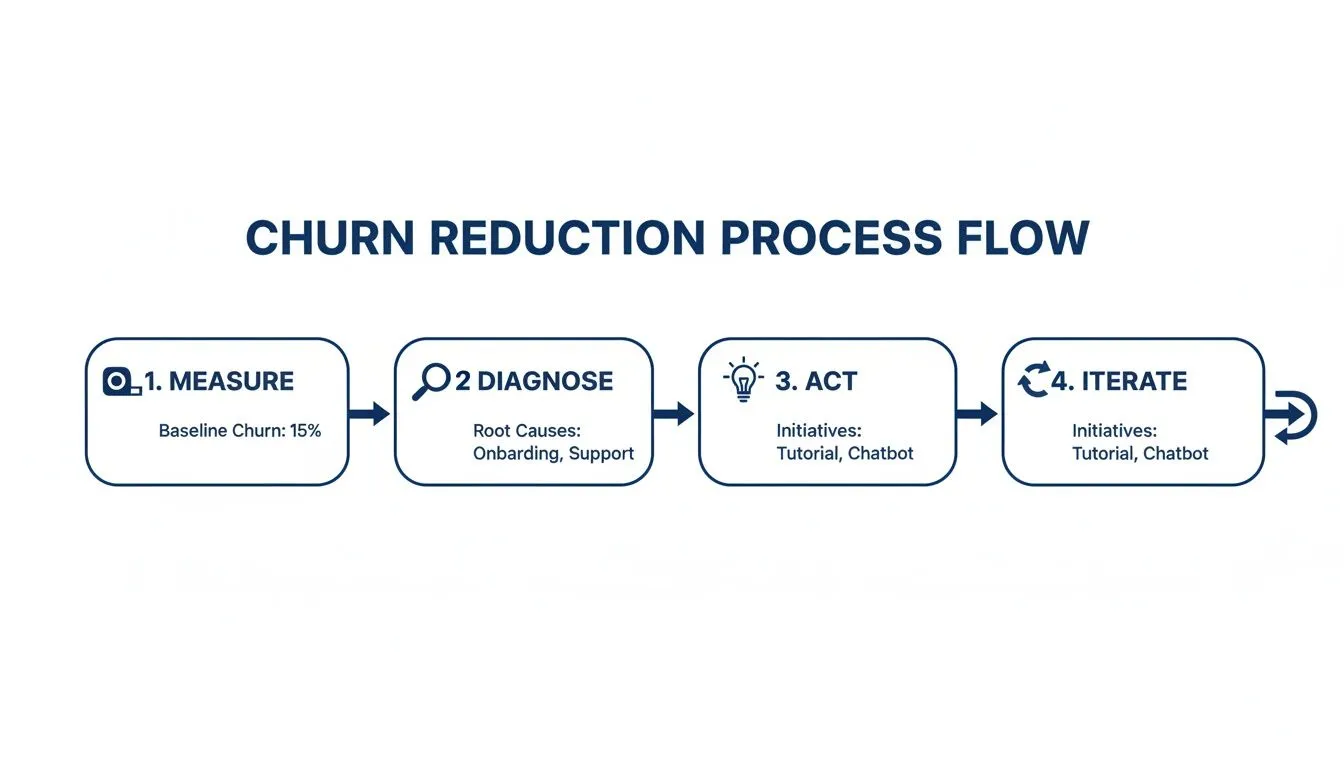
As you can see, this isn't a one-and-done task. It's a cycle of continuous improvement that starts with knowing your numbers and ends with learning from your actions.
A Modern Approach to a Persistent Problem
The old way of analyzing churn—relying on manual SQL queries and static reports—is simply too slow for today's world. By the time you've managed to piece together a trend, the damage has already been done and you've lost another cohort of customers.
Thankfully, modern business intelligence tools have completely changed the game, giving teams the ability to get real-time, actionable answers.
With the right approach, churn stops being a simple loss and becomes a powerful signal. Every point of friction is an opportunity to strengthen your product, re-engage users who are on the fence, and ultimately build deeper loyalty.
Instead of spending weeks trying to connect the dots, teams can now use AI-driven analytics to surface critical insights instantly. Imagine being able to ask, "What behaviors are most common among users who churned in their first 30 days?" and getting a clear, data-backed answer in seconds. This speed closes the gap between diagnosis and action.
This is where you can turn retention into your most powerful growth lever. To see how AI helps uncover these critical data points, take a look at our guide on what metrics really matter and how AI can surface them.
Measuring What Matters to Understand Churn
You can't fix a problem you don't truly understand. When it comes to customer churn, that means moving past surface-level numbers and getting to the core metrics that reveal the genuine health of your business. Guesswork leads to wasted engineering cycles and ineffective marketing campaigns, but a solid measurement framework turns that ambiguity into a clear, actionable roadmap.
The goal isn’t just to track percentages on a dashboard; it’s to understand the stories those numbers are telling. Your product team might discover, for instance, that users who ignore a key feature in their first two weeks are three times more likely to cancel. That’s the kind of insight that shifts your entire approach from reactive fire-fighting to proactive growth.
First, Nail the Core Metrics
To get a clear picture of churn, you have to look beyond a single, company-wide percentage. Three foundational metrics give you a multi-dimensional view: Customer Churn Rate, Revenue Churn, and Customer Lifetime Value (LTV). Each one tells a slightly different, but equally critical, part of the story.
To make this easier to digest, here's a quick rundown of the essential metrics you should be tracking from day one.
Key Churn Metrics Every Business Should Track
| Metric | How to Calculate It | What It Tells You |
|---|---|---|
| Customer Churn Rate | (Lost Customers ÷ Total Customers at Start of Period) × 100 |
The raw percentage of customers you're losing. Great for understanding the volume of churn. |
| Revenue Churn Rate | (MRR Lost to Churn ÷ MRR at Start of Period) × 100 |
The financial impact of churn. Highlights whether you're losing high-value or low-value accounts. |
| Customer Lifetime Value (LTV) | Average Revenue Per Account (ARPA) ÷ Customer Churn Rate |
The total revenue you can expect from a customer. A high LTV means sticky, valuable customers. |
Tracking these gives you a baseline for business health. While you're setting up your dashboards, you might find our deeper dive into mastering essential SaaS metrics like retention helpful.
These metrics provide the "what," but to truly move the needle on retention, you need to dig deeper into the "who," "when," and "why."
The most dangerous assumption is thinking all churn is equal. A 5% customer churn rate could hide a devastating 15% revenue churn rate if you're consistently losing your highest-value accounts. Understanding the difference is where real strategy begins.
Unlock Deeper Insights with Cohort Analysis
Calculating your overall churn rate is like looking at a blurry photo—you get the general idea, but all the important details are missing. Cohort analysis brings that picture into sharp focus by grouping customers based on when they signed up (e.g., the "January 2024" cohort).
This lets you compare the behavior of different groups over time. Did customers who signed up in June stick around longer than those from January?
Imagine you rolled out a slick new onboarding flow back in May. By comparing the "May" and "June" cohorts to earlier ones, you can directly measure its impact. If the newer groups have a dramatically lower churn rate in their first 90 days, you’ve just found hard evidence that your new onboarding is a winner.
This is how you stop asking, "Is our churn rate high?" and start answering, "Why are our March signups churning more than our April ones?"
Putting Cohort Analysis to Work
Let's make this real. A SaaS company sees its overall churn rate ticking up. Instead of panicking, the team runs a cohort analysis and uncovers a few critical patterns:
-
A Broken Onboarding Experience: The cohort of users who joined after a recent pricing change shows a 30% spike in churn within the first 14 days. This immediately points them to a problem with how new pricing tiers are being explained during sign-up.
-
Finding the "Aha!" Moment: By segmenting cohorts based on what they do, the team finds that users who create and share a report in their first week have an 80% lower churn rate over the next six months. This becomes the critical milestone they now guide every new user toward.
-
Spotting Seasonal Trends: They also notice that cohorts acquired in Q4 consistently churn at a higher rate. Digging in, they realize these customers are often buying for a single, year-end project and need a totally different engagement strategy to see long-term value.
This is the kind of granular insight you’ll never get from a single, top-level metric. Cohort analysis gives you the context needed to find the biggest leaks in your customer journey and plug them for good.
Diagnosing the Root Causes of Customer Attrition
Once you've got your core churn metrics nailed down, you know the "what." But that’s only half the story. The far more important question is, "why?" Just tracking churn rates is like knowing your car is losing fuel but never bothering to check for a leak. To actually reduce customer churn, you have to get your hands dirty and diagnose the specific friction points that are pushing people out the door.
This diagnostic phase is where the real detective work begins. It’s all about blending quantitative data with qualitative insights to build a complete picture of where things are going wrong in the customer journey. You’ll need to combine hard numbers from user analytics with direct feedback to uncover the root causes of attrition, not just the symptoms.

Visualizing user behavior, like you see above, is often the first step. It helps you spot the patterns that come right before a customer decides to leave, turning raw data into a clear story about where your experience is breaking down.
Sift Through User Behavior Data for Clues
Your product usage data is a goldmine. Long before they hit the cancel button, customers often "vote with their feet" through their actions—or lack thereof. By analyzing these behavioral patterns, you can spot the leading indicators of churn and identify at-risk users before they’re gone for good.
Start by looking for the classic signals of disengagement. They’re often subtle, but they speak volumes:
- Declining Login Frequency: A user who once logged in daily and now only shows up once a week is sending a pretty clear message.
- Reduced Feature Adoption: Are they sticking to one or two basic features while completely ignoring the advanced tools that deliver the real value? That's a bad sign.
- Fewer Key Actions: Track the core actions that correlate with customer success, like creating a report or inviting a teammate. A sudden drop-off in these activities is a major red flag.
Think of these quantitative signals as your early-warning system. They tell you who is at risk, which is your cue to dig deeper into why.
Combine Data with Direct Customer Feedback
Analytics show you what users are doing, but only direct feedback can tell you why they’re doing it. You absolutely have to combine these two sources to get the full picture. Data alone is never enough; you have to actually talk to your customers to understand their goals, their frustrations, and what they really think.
Here’s something that surprises a lot of founders: only 1 in 26 unhappy customers actually complain. The other 25 just leave silently. That makes proactively gathering feedback a non-negotiable part of understanding what’s really driving people away.
So, how do you get this crucial intel? A few methods work consistently well:
- Cancellation Surveys: As a customer is leaving, make your last interaction a simple, one-question survey: "What was the primary reason you decided to cancel?" Keep it short and open-ended. You'll get brutally honest, unfiltered responses.
- Net Promoter Score (NPS) Surveys: The score itself is just a number. The real value is in the comments from your Detractors (scores 0-6) and Passives (7-8). This is where you'll find specific complaints about product gaps or service issues that need fixing.
- Direct Interviews: Make a habit of reaching out to both recently churned customers and your most loyal power users. Ask the churned customers what went wrong. Then, ask your power users what keeps them coming back. The contrast between these two perspectives is often incredibly revealing.
The magic really happens when you connect these qualitative insights back to your behavioral data. For example, you might discover that customers who mentioned "confusing navigation" in their cancellation surveys all show a pattern of abandoning a specific feature flow in your analytics. Suddenly, you have a clear, actionable problem to solve.
Zero In on the Onboarding Experience
For many products, especially in SaaS, the customer journey is won or lost right at the beginning. A confusing or underwhelming onboarding experience is one of the biggest—and most preventable—drivers of early-stage churn. If users don't get that "aha!" moment quickly, why would they stick around?
Poor onboarding is a silent killer. It accounts for a whopping 23% of all customer losses. This initial frustration causes people to give up early, with subscription services seeing churn spike by 30% in the first 90 days alone. On the flip side, companies that nail the initial experience and set clear expectations from day one can cut churn by as much as 67%. You can dig into more of these eye-opening numbers in these key customer retention statistics.
This is why a deep-dive analysis of your onboarding funnel is so critical. Pinpoint exactly where users are dropping off. Are they getting stuck on a particular step? Do they consistently fail to activate a key feature? You can even ask what drove churn last month without writing any SQL using natural language tools to uncover these insights faster.
By meticulously diagnosing these root causes—blending analytics with feedback and focusing intensely on that crucial first impression—you can stop guessing and start knowing. This is how you build a clear, prioritized roadmap to keep your customers happy and engaged.
Putting Your Churn Insights Into Action
Once you've diagnosed why customers are leaving, it's time to shift gears from analysis to action. Knowing the root causes is critical, but it's only half the battle. The real progress comes from building a practical, targeted playbook of interventions that directly address the friction points you’ve uncovered.
A scattergun approach rarely works. You can't just throw a dozen random initiatives at the wall and hope something sticks. Instead, a layered retention strategy—focused on the specific pain points causing people to leave—is how you’ll make a real dent in your churn rate.

Nail the Onboarding to Deliver Value—Fast
As we’ve seen, those first few weeks are absolutely make-or-break. A confusing or underwhelming onboarding is one of the quickest ways to lose a new customer. The goal here is simple: get users to their "aha!" moment as quickly and smoothly as possible. You have to prove your product’s value before they even have a chance to second-guess their decision.
Forget the generic, one-size-fits-all product tour. Your onboarding flow should be designed to drive activation. Here are a few practical ideas:
- Interactive Guides: Build in-app tutorials and tooltips that actually walk users through a critical first task, like creating their first project or inviting a teammate.
- Personalized Checklists: Don't just show a static list. Create dynamic checklists that tick off items as users complete key setup steps. It gives them a sense of progress and a clear path forward.
- Behavior-Based Emails: Set up a welcome sequence triggered by user actions (or inaction). If a new user hasn’t activated a core feature within three days, a friendly, automated email with a helpful guide can be the perfect nudge.
The whole point is to focus on outcomes, not just features. Help them get a small, meaningful win right away, and you'll lay the groundwork for a long, healthy customer relationship.
Get Proactive with Communication and Support
Waiting for customers to complain is a losing game. By the time someone reaches out with a problem, their frustration is already peaking. A core part of any effective retention playbook is proactive outreach to reduce customer churn. This means anticipating needs and offering help before it’s requested.
The most loyal customers aren't the ones who never have problems. They're the ones who know you'll be there to solve them quickly when they do. Exceptional support isn't a cost center—it's one of your most powerful retention tools.
Don’t underestimate the power of great customer service. Research shows that 60% of customers name it as their top reason for sticking with a brand, and a whopping 96% see service as key to their loyalty.
The stakes are high. 56% of people have abandoned a brand over a bad service experience, and for 66%, just one poor interaction is enough to end the relationship. On the flip side, a great experience can convince customers to spend 140% more. These numbers make it crystal clear: ignoring customer service is a direct path to higher churn.
Let Customer Feedback Shape Your Product and Pricing
Your customers are constantly telling you what they want—you just have to listen. The feedback you collect from cancellation surveys, NPS comments, and support tickets is a goldmine. It’s a direct roadmap for product improvement.
When you act on this feedback, you're doing more than just fixing a bug or adding a feature. You're showing your customers that you hear them and value their opinion, which creates a powerful loyalty loop.
Imagine a customer cancels because you're missing a key integration. A few months later, you launch that very integration and send them a personal email to let them know. That single gesture can be enough to win them back for good.
Consider these strategic moves:
- Build a "Voice of the Customer" Program: Systematically collect, categorize, and review customer feedback. Use this data to inform your product roadmap so you’re building what users actually need.
- Re-evaluate Your Pricing Tiers: Is there a huge feature gap between your free and paid plans that's pushing people away? Sometimes, a small tweak—like moving a popular feature to a lower-priced tier—can dramatically improve stickiness.
- Offer Flexible Plans: For customers churning due to budget issues, having an option to pause their subscription or downgrade to a cheaper plan can keep them in your ecosystem instead of losing them entirely.
By building a playbook that tackles onboarding, communication, and product strategy, you create a layered defense against churn. Each piece reinforces the others, creating a cohesive experience that makes your customers feel understood and gives them every reason to stay.
Getting Ahead of Churn with AI

Fighting churn isn’t a one-and-done project; it’s a constant cycle of learning and fine-tuning. After you launch an intervention—a revamped onboarding flow, a new email campaign—the real work begins. You have to measure its impact scientifically. This is where A/B testing becomes your best friend.
By splitting users into a control group (the old experience) and a test group (the new one), you get proof. Did the cohort with the new onboarding checklist really have a 15% lower churn rate in their first month? A/B testing provides that concrete answer, turning your retention efforts from educated guesses into a data-driven science.
This loop—hypothesize, test, measure, repeat—is the engine that drives real, sustainable improvements in retention.
Shifting from Reactive to Predictive
While A/B testing helps you perfect your current strategies, the real leap forward is getting ahead of the problem entirely. Instead of just reacting after a customer leaves, modern teams are now using AI and predictive analytics to flag at-risk accounts before they even consider canceling.
This approach completely flips the script. It moves your team from playing defense to playing offense, all powered by real-time behavioral data.
Imagine your analytics platform quietly tracking hundreds of small signals: a slight dip in how often a user logs in, a hesitation to adopt a key feature, or a drop in the number of reports they generate. On their own, these are just blips on the radar. But together, they form a pattern that a smart AI model can recognize as a clear warning sign of impending churn.
The most powerful way to reduce churn is to solve a problem the customer hasn't even complained about yet. Predictive analytics gives you the foresight to step in when the relationship is still salvageable, not after it's already broken.
Putting Churn Prediction into Action with AI
Platforms like Querio analyze all this user behavior in real-time to build a dynamic "health score" for every single account. When an account's score dips below a certain threshold, it can automatically kick off a workflow. Maybe it alerts the customer success manager, enrolls the user in a re-engagement email sequence, or even triggers a targeted in-app message with a helpful guide.
To do this right, you need the right tools. It's worth looking into specialized predictive analytics software that can accurately forecast customer behavior and help you prioritize your efforts.
For product leaders, this creates an incredible feedback loop. You can see, clear as day, which features are correlated with long-term stickiness and which ones are common among users who eventually churn. This data should feed directly back into your product roadmap. For a closer look at this, we've broken down how AI improves KPI forecasting accuracy.
The Financial Case for Proactive Retention
Ignoring retention is a costly mistake. We're in a churn crisis—even a 5% monthly churn rate means you lose 46% of your customers over a year. AI-driven prediction is no longer a luxury; it's a necessity.
The numbers don't lie. A mere 5% reduction in churn can boost profits by 25-95%. This is especially true when you remember that acquiring a new customer costs 5x more than keeping an existing one. A simple 2% lift in retention can have the same bottom-line impact as a 10% cut in costs.
Ultimately, the goal is to weave churn awareness into your company's DNA. When you operationalize these insights with accessible dashboards and AI-driven analytics, retention stops being one team's problem. It becomes a core function across the entire organization, ensuring everyone from product to support is focused on building an experience customers can't imagine leaving.
Frequently Asked Questions About Reducing Churn
What Is a Good Customer Churn Rate?
There's no single magic number, but for SaaS companies, the general benchmark for a "good" annual churn rate is between 5-7%. That said, context is everything. If you're an early-stage startup still nailing product-market fit, your numbers will naturally be higher.
The key is to track your rate religiously and focus on the trendline—is it going down? It's also crucial to look at churn from two different angles:
- Customer Churn (Logo Churn): This is the straightforward count of how many customers you lost.
- Revenue Churn: This measures the actual MRR (monthly recurring revenue) you lost from those cancellations.
Losing ten small-fry accounts is a completely different problem than losing one enterprise giant. That's why revenue churn often tells a more honest story about the health of your business.
How Can I Predict Which Customers Are Likely to Churn?
Churn rarely comes out of the blue. It’s almost always preceded by a trail of digital breadcrumbs—subtle shifts in user behavior that signal they're losing interest.
Think about it: before someone cancels, they stop showing up. You'll see this in your data as a drop in login frequency, declining use of core features, a spike in support tickets, or a plummeting Net Promoter Score (NPS). These are your early warning signs.
Today’s AI-driven BI platforms can connect these dots for you. They build predictive models that crunch thousands of data points to flag at-risk accounts, giving your team a heads-up to step in before it's too late.
What Is the Most Effective Churn Reduction Strategy?
If you can only fix one thing, fix your customer onboarding. A staggering amount of churn happens in the first 90 days, and it's almost always because new users never experienced that "aha!" moment where the product's value clicked.
Your single most powerful retention lever is a smooth, guided onboarding flow that gets a user to their first "win" as fast as humanly possible. This experience sets the tone for their entire journey with you.
Ultimately, tackling churn is about shifting from a reactive "Oh no, they cancelled" mindset to a proactive one. When you measure the right things, dig into the root causes, and use modern tools to anticipate customer needs, you build a business people simply don't want to leave.
Ready to stop guessing and start understanding why your customers churn? Querio's AI-powered analytics platform turns your data into clear answers in seconds. Get started for free.