Guide
Natural Language Analytics: A Strategic Guide
Master natural language analytics by understanding core architecture, deployment patterns, and proven strategies for scaling self-serve data teams.

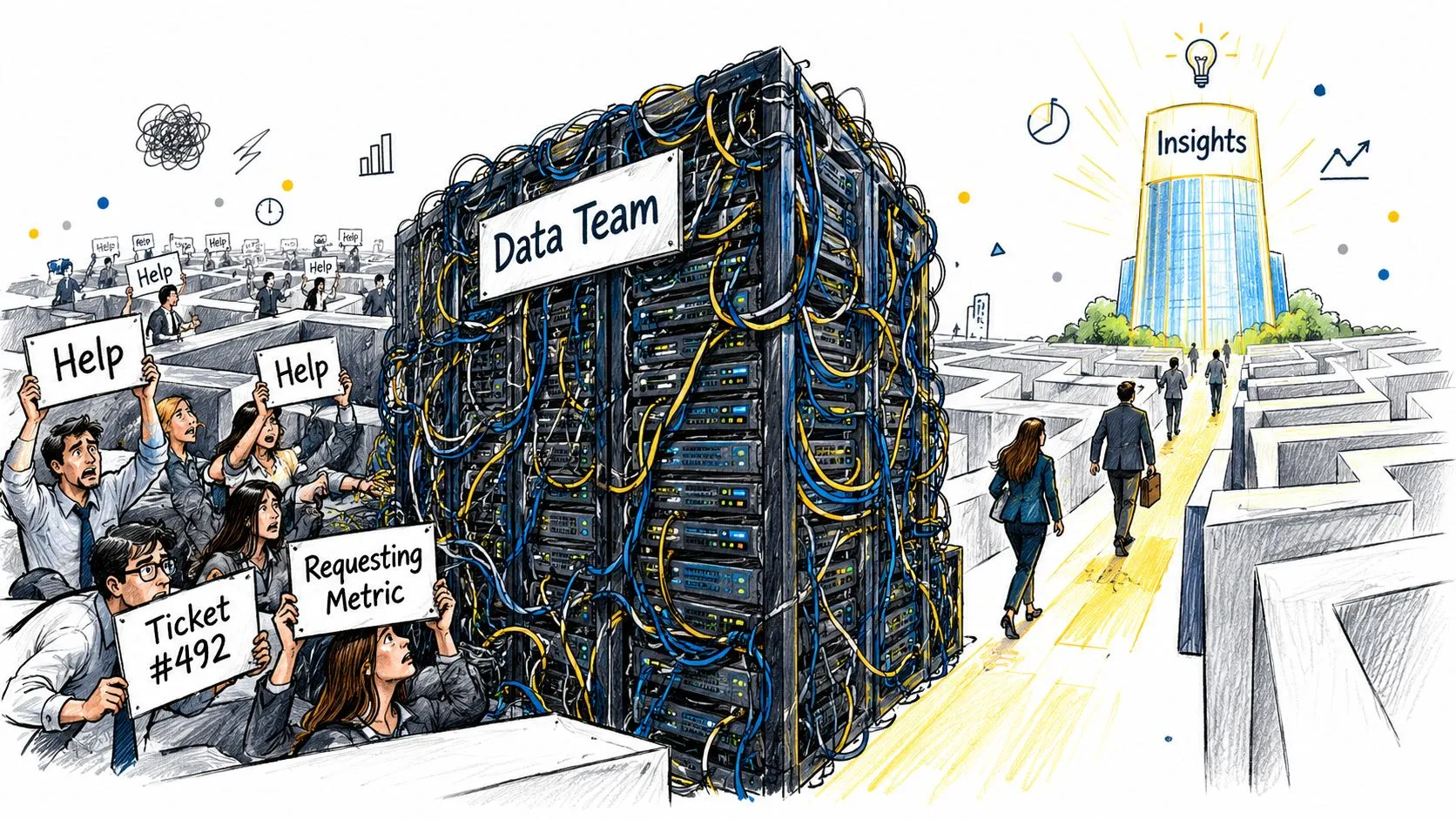
A product manager asks for weekly activation by customer segment. The sales lead wants pipeline coverage by region. An executive needs a current revenue view before a meeting. Each request sounds simple, yet the answer often depends on a data engineer finding the right tables, an analyst interpreting the metric, and someone checking whether the query used the approved definition. The data team becomes a human API, and business questions wait in a queue.
Natural language analytics changes that operating model, but it isn't a chatbot placed in front of a database. It is an architectural layer that translates human intent into governed analytical execution. The interface matters, but the durable value sits underneath it, in semantic definitions, metadata, retrieval systems, query planning, access controls, validation, and observability.
The technology has developed alongside natural language processing itself. The path runs from Alan Turing's 1950 paper Computing Machinery and Intelligence, through the 1954 Georgetown-IBM translation experiment, ELIZA in the mid-1960s, statistical language models in the late 1980s and 1990s, and the transformer architecture introduced in 2017. GPT-3 reached up to 175 billion parameters in 2020, while ChatGPT's release in 2022 brought conversational language systems to a mainstream audience, as outlined in this history of natural language processing.
Table of Contents
- Defining the Next Generation of Data Access
- Core Components and Technical Architecture
- Cloud Agents versus Warehouse-Native Deployments
- Business Use Cases and Measuring ROI
- Navigating Accuracy and Enterprise Trust
- Implementation Roadmap and Evaluation Criteria
Defining the Next Generation of Data Access
At 9:00 a.m., a growth team asks whether activation fell because onboarding changed or because the customer mix shifted. The analyst already has a dashboard, but the dashboard doesn't expose the exact comparison. A ticket is created. By the time the result arrives, the meeting has passed and the team has moved on to another decision.
That pattern is expensive even when the request itself is easy. Analysts spend time locating tables, interpreting ambiguous terms, writing SQL, checking joins, and explaining the result. Engineers maintain a growing collection of one-off reports. Business users learn that asking for data is slow, so they either stop asking or build unofficial spreadsheets from exports.
From interface to analytic agent
A natural language analytics system accepts a question such as, “How did activation change for self-serve customers after the onboarding release?” It must then resolve several distinct problems:
- Intent: Determine whether the user wants a comparison, trend, explanation, or diagnostic.
- Entities: Identify “activation,” “self-serve customers,” and “onboarding release” as business concepts rather than ordinary words.
- Time logic: Translate “after the release” into a valid period or event boundary.
- Metric logic: Select the approved activation definition and the correct denominator.
- Execution: Generate a query that respects joins, filters, permissions, and warehouse constraints.
- Verification: Check whether the result is complete, plausible, and explainable.
That is why the useful mental model is an end-to-end analytic agent, not a conversational skin over raw tables. The agent interprets a request, retrieves relevant context, plans an operation, executes against structured data, evaluates the output, and presents both the answer and its reasoning path.
A semantic layer is central to this design. It maps terms such as “activation,” “net revenue,” or “qualified pipeline” to approved measures, dimensions, relationships, and time rules. A practical explanation of why semantic layers matter for AI analytics is useful for teams deciding whether to expose raw warehouse schemas or governed business models.
Why the economics change
The benefit isn't that every employee suddenly becomes a data scientist. The benefit is that data professionals can stop spending their best hours on repetitive interpretation and retrieval. They can maintain the definitions, models, tests, and workflows that make self-service reliable, while business teams handle routine questions independently.
This also changes the quality threshold for analytics infrastructure. A dashboard can hide its assumptions behind a polished chart. A natural language system brings those assumptions into the interaction, because users can ask follow-up questions and challenge the result. The platform must therefore expose the metric definition, filters, source model, and relevant caveats instead of presenting a number with no provenance.
For leaders assessing the category, the market signals sustained enterprise interest. One 2026 market report estimates natural language processing at USD 36.8 billion in 2025, with a projection of USD 193.4 billion by 2034 and a projected 19.7% CAGR. The same report estimates that North America held 45.7% of the market in 2025. A separate 2026 analysis projects growth from USD 38.3 billion in 2025 to USD 50.13 billion in 2026, with a projected 30.9% CAGR. These are market projections, not proof that a particular analytics deployment will succeed, but they show why data leaders are evaluating language-based access as infrastructure rather than novelty. See the natural language processing market analysis for the underlying estimates.
Practical rule: If the system can't show which metric definition, data model, filters, and permissions produced an answer, it hasn't replaced the ticket queue. It has only hidden the queue inside an opaque interface.
For an executive perspective on how this shift affects data operating models, the Artul.ai executive analysis provides useful context. The architectural conclusion is straightforward: the conversational surface may attract adoption, but the invisible data contract determines whether that adoption survives contact with production work.
Core Components and Technical Architecture
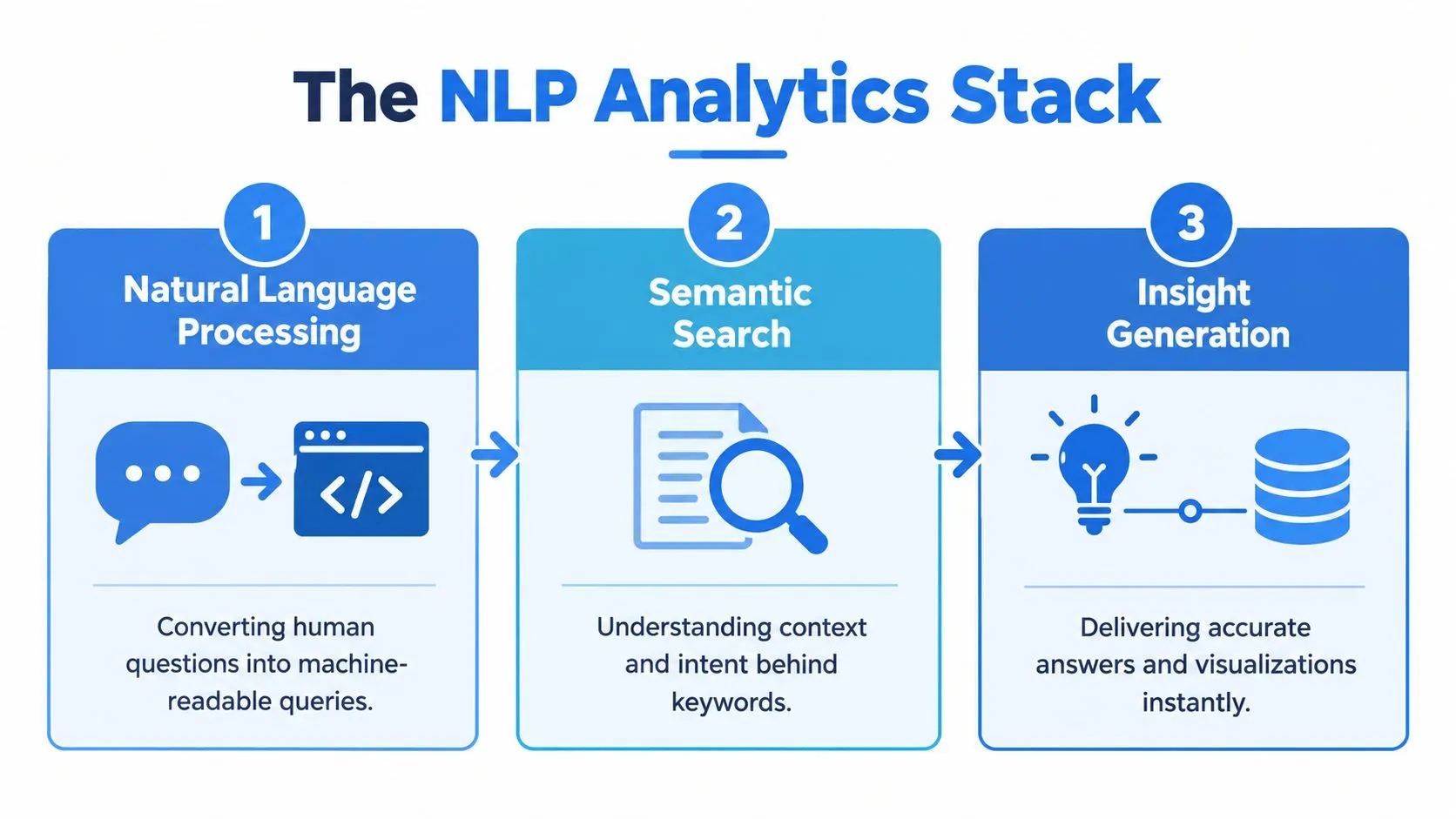
A production system usually follows a pipeline that looks simple from the outside and demanding from the inside. A user submits a question. The system identifies intent, retrieves business context, constructs an analytical plan, executes it, checks the result, and returns an explanation or visualization.
The intake valve
The natural language interface is the intake valve, not the reasoning system. It captures text or voice, preserves conversation context, records the user's identity, and detects whether the request is complete enough to process.
A good interface doesn't pretend that every question is unambiguous. If someone asks for “sales,” the system may need to distinguish bookings, recognized revenue, gross sales, or net sales. If someone asks for “last month,” the system should use the organization's calendar rules rather than arbitrarily selecting a date range.
The interface should also support controlled clarification. A short prompt such as “Do you mean recognized revenue or bookings?” is more valuable than a fluent answer built on an assumption. The system can display its interpretation before execution, particularly for high-impact queries.
Semantic parsing and embedding retrieval
The next layer converts language into business meaning. Keyword matching isn't enough because internal terms, abbreviations, and synonyms vary across teams. Embedding pipelines help retrieve relevant descriptions from a searchable index of metrics, tables, columns, glossary terms, example questions, policies, and documentation.
That retrieval system needs careful boundaries. A vector database can find relevant context, but relevance isn't the same as authority. The index should distinguish approved metric definitions from draft documentation, historical models, and user-generated notes. Metadata should include ownership, freshness, sensitivity, lineage, and permitted use.
The semantic layer then turns retrieved context into an executable model. It should define:
- Measures: The formula, aggregation, filters, and exclusions for a business metric.
- Dimensions: The entities and attributes available for grouping or filtering.
- Relationships: The valid joins and grain of each model.
- Hierarchies: The permitted movement from total to region, account, product, or other levels.
- Synonyms: The language users apply to governed concepts.
- Policies: The row and column restrictions that apply to each role.
Oracle's nl2analytics benchmark makes an important distinction. Natural-language-to-SQL isn't only a translation task. The system must discover analytic-view metadata and correctly choose dimensions, hierarchies, levels, and measures. Its results report that an Analytic View SQL skill with specialized tools substantially outperforms a vanilla agent baseline across model families. The engineering lesson is clear: schema-aware tools and explicit business semantics matter more than asking a general model to guess.
LLM inference and the execution pipeline
The language model acts as a reasoning engine, but it shouldn't receive unrestricted authority over the warehouse. It can select tools, construct SQL, explain a result, and propose a follow-up analysis. The surrounding orchestration layer should enforce allowed operations, query limits, approved models, and validation steps.
A safer execution sequence looks like this:
- Authenticate the user and load their data entitlements.
- Classify the request as a metric lookup, comparison, trend, drill-down, or diagnostic.
- Retrieve semantic context from governed metadata and relevant examples.
- Construct a query plan before generating executable SQL.
- Validate the plan against known measures, dimensions, joins, and policies.
- Run the query with warehouse controls and appropriate resource limits.
- Check the output for empty results, unexpected grain, duplicate joins, and inconsistent totals.
- Return evidence including the interpretation, source model, filters, and result.
The model shouldn't be the only component deciding whether an answer is valid. A deterministic validator can check whether the query uses an approved measure or whether a requested breakdown is compatible with the selected model. Python notebooks can add another layer for reusable analysis, statistical tests, and domain-specific transformations.
This architecture creates a useful separation between language flexibility and data authority. Users can ask questions naturally, while the system answers through controlled models and executable checks. Teams comparing product approaches may find this overview of AI agent architecture helpful when mapping orchestration, tools, memory, and execution boundaries.
The deployment decision also affects the pipeline. For readers evaluating the commercial implications of workplace copilots alongside data systems, this Microsoft Copilot UK pricing analysis offers relevant context. It doesn't answer the warehouse architecture question, but it illustrates why license cost, access scope, and operational ownership need to be considered separately from model capability.
Cloud Agents versus Warehouse-Native Deployments
Where the agent runs determines what it can see, how quickly it can act, and who owns the controls. Cloud-based agents and warehouse-native deployments can both support natural language analytics, but they create different operational contracts.
A cloud agent typically offers a fast path to adoption. The vendor manages the interface, model integrations, orchestration, upgrades, and often the semantic configuration. This can suit a team that needs to validate demand without building an agent platform. The trade-off is that metadata and query context may move through an external service, subject to the vendor's retention, regional hosting, security, and integration policies.
A warehouse-native agent keeps orchestration and computation closer to the data platform. It can use existing identity controls, network boundaries, warehouse functions, and governance policies. That proximity can reduce data movement and simplify access to internal models, but it shifts more responsibility to the data organization. Teams must manage deployment, upgrades, testing, runtime cost, and the reliability of the user experience.
| Feature | Cloud-Based Agents | Warehouse-Native Deployment |
|---|---|---|
| Initial setup | Usually faster, with managed interfaces and integrations | Requires more platform engineering and warehouse configuration |
| Data proximity | Query context may pass through an external service | Computation and query execution remain close to warehouse data |
| Security control | Depends on vendor isolation, contracts, regions, and connectors | Leverages existing warehouse identity, policy, and network controls |
| Customization | Often constrained by supported models, tools, and extension points | Greater control over prompts, tools, models, notebooks, and validators |
| Operational ownership | Vendor carries much of the platform maintenance | Internal teams own reliability, upgrades, and observability |
| Latency profile | Network hops and external orchestration can add variability | Fewer external transfers, though warehouse workload still determines speed |
| Integration depth | Strong when the vendor already supports the organization's BI stack | Strong when the warehouse is the primary source of truth |
| Best fit | Rapid pilots, small platform teams, and standardized environments | Sensitive data, complex semantics, and teams needing deep control |
Security is a workflow property
Security isn't solved by choosing “cloud” or “native” as a label. The implementation must enforce identity at every stage, including metadata retrieval, prompt construction, SQL generation, notebook execution, cached results, and exported files.
A system that hides raw rows but exposes sensitive metric definitions may still leak information. A system with excellent warehouse permissions can still create risk if the agent sends excessive schema context to an external model. Review data residency, retention, encryption, tenant isolation, audit logs, connector permissions, and model-training policies before allowing production access.
Latency and customization pull apart
Cloud products reduce the amount of infrastructure a team must build, but customization may stop at configuration. Warehouse-native systems can support organization-specific planners, validators, Python workflows, and semantic conventions, yet those capabilities require engineering discipline.
The right decision depends on the failure you can tolerate. If the priority is learning whether users will ask questions in natural language, a managed cloud agent can shorten the path to a controlled pilot. If the priority is protecting sensitive intellectual property, preserving warehouse policy enforcement, or supporting unusual business logic, native deployment deserves serious consideration. A detailed comparison of warehouse-native AI analytics and lakehouse BI can help frame that decision around the existing stack rather than around interface preference.
Business Use Cases and Measuring ROI
Natural language analytics creates value where people ask recurring questions but don't need a bespoke analytical project each time. The strongest candidates usually have a trusted source model, a stable business definition, and a clear decision attached to the answer.
A product team might ask which onboarding step correlates with activation by customer segment. An operations leader might investigate orders that missed a service-level target. A finance manager might compare forecast and actual performance by channel. An executive might ask for the drivers behind a change in a key metric. These questions differ in subject, but they share a dependency on governed definitions and fast iteration.
The operational return
The first return comes from changing the data team's queue. Analysts no longer need to answer every request that involves a known metric and a permitted slice of data. They can focus on model design, experimentation, causal analysis, data quality, and decisions that require judgment.
That doesn't mean tickets disappear. It means the team can reserve human effort for work that benefits from human context. Routine questions become self-service, while complex requests enter a better-defined workflow with clearer requirements.
Measure the operational effect through signals such as:
- Request mix: Track which recurring questions the system resolves and which still need analyst intervention.
- Rework: Record how often users correct metric definitions, filters, or interpretations after receiving an answer.
- Time to decision: Observe whether teams can move from a business question to an action without waiting for a reporting cycle.
- Data-team capacity: Compare time spent on repetitive retrieval with time spent on modeling, quality, and strategic analysis.
- Maintenance burden: Monitor whether the new system reduces one-off dashboards or merely adds another surface to maintain.
Avoid measuring success by query volume alone. A high number of questions can indicate adoption, confusion, or repeated failed attempts. Pair usage with answer acceptance, corrections, escalations, and the decisions users make after receiving results.
The strategic return
The second return is distributed judgment. Product leaders can validate a hypothesis while the context is still fresh. Sales and operations teams can investigate exceptions before asking an analyst to formalize the analysis. Executives can interrogate a reported result instead of accepting a static summary.
The system becomes more valuable when it supports follow-up questions. “Show the trend” should lead naturally to “break it down by plan,” then “exclude trials,” then “compare it with the prior period,” with the same metric contract preserved throughout. Without that continuity, users receive isolated answers and still need to reconstruct the analysis manually.
ROI should therefore include the quality of decision access, not only labor reduction. Ask whether teams use the same definitions, whether people can reproduce an answer, whether stakeholders discover questions earlier, and whether the data function spends more time improving the organization's analytical foundation.
The economic target isn't to remove analysts from the loop. It's to stop spending analyst time on work that a governed system can execute consistently.
For startups and mid-market organizations, this distinction matters. A small data team can offer broad analytical access without pretending that every user should learn SQL. A larger enterprise can use the same pattern to standardize definitions across departments, provided each domain has the context, permissions, and integrations required for its work.
Navigating Accuracy and Enterprise Trust
A natural-language answer can look precise while using the wrong table, an invalid join, an incomplete filter, or an aggregation that changes the data grain. The failure often surfaces only when a user compares the result with another report. Fluent wording hides technical defects rather than correcting them.
Accuracy must be designed into the analytics stack. The system should record how it interpreted the question, which semantic objects it selected, which retrieval results influenced the response, what query it generated, and which checks it completed. Users need a clear route from the narrative answer back to structured evidence and the warehouse objects behind it.

Why generic benchmarks aren't enough
The ClickHouse open data-agent benchmark evaluated 29 models under an identical harness. Across 201 warehouse questions, the top system reached 76.6% correctness, while the benchmark also measured pass rate, token cost, and wall-clock time. The ClickHouse data-agent benchmark is useful because it evaluates correctness alongside efficiency, but its results describe the defined environment, not every warehouse or business domain.
A model that performs well against one schema may fail against another. Table names, metric definitions, join paths, documentation quality, and user vocabulary all affect generation. Slowly changing dimensions, nested events, fiscal calendars, and mixed business grains create additional failure modes. Prompt quality changes results too.
Deployment architecture determines where these failures can be controlled. A cloud SaaS agent may provide a managed embedding pipeline and faster initial setup, but the team must verify how it retrieves metadata, applies permissions, and sends generated queries to the warehouse. A warehouse-native design keeps execution close to governed models and existing workload controls, though the organization must operate more of the semantic, retrieval, and evaluation layers itself. Neither approach removes the need for tested definitions and query validation.
Run an internal evaluation set rather than relying on a public leaderboard. Include real questions from executives, product managers, finance, operations, and analysts. Add ambiguous questions, known traps, permission-sensitive requests, and follow-ups that test context preservation. Test the same cases against the intended deployment architecture, not only against a vendor demonstration.
Make correctness observable
A practical evaluation harness should inspect more than the final prose:
- Semantic selection: Did the system choose the approved measure and correct dimensions?
- Query validity: Does the SQL compile, and does it use permitted models?
- Result correctness: Does the output match a reviewed answer or an independently calculated expectation?
- Grain safety: Did joins duplicate records or combine incompatible levels?
- Permission enforcement: Did the system restrict rows and columns correctly?
- Reproducibility: Does the same question produce a stable result when the underlying data has not changed?
- Cost and speed: Does the answer stay within acceptable warehouse and user-experience limits?
Trust also depends on how the system handles uncertainty. If a question is underspecified, request clarification. If two approved definitions exist, show the distinction. If the data is stale or incomplete, state that limitation. For a deeper treatment of how to stop a BI tool from making up numbers, connect each answer to the underlying models, filters, and evidence instead of presenting unsupported confidence.
Qlik's coverage of accuracy challenges in natural language analytics notes that inconsistent business definitions can make the same question return different answers across teams. That problem is architectural as much as linguistic. A shared semantic layer, controlled metadata embeddings, and deployment-specific permission checks reduce the room for competing interpretations. Generative interfaces can remain useful when structured controls surround them.
Trust test: Give a reviewer the question, interpretation, query, source model, and result. If they cannot reproduce the answer or explain the calculation, the system is not ready for high-consequence decisions.
An agent can extend verification by comparing its result with structured analytics, testing alternative interpretations, and flagging conflicts. Language generation then becomes one stage in an analytical workflow. The final authority remains the governed data, query checks, and evidence that a reviewer can inspect.
Implementation Roadmap and Evaluation Criteria
Start with a narrow domain where the metric definitions are understood and the business questions recur. Inventory the approved models, glossary terms, access policies, historical questions, and known failure modes before selecting a model or interface.
Evaluate each tool against the architecture, not the demo:
- Semantic compatibility: Can it use your existing metrics, dimensions, hierarchies, lineage, and permissions?
- Warehouse fit: Does it execute near the data, respect workload controls, and support your primary warehouse?
- Retrieval quality: Can the embedding pipeline distinguish approved metadata from stale or informal documentation?
- Validation: Does it test SQL, grain, permissions, empty results, and metric consistency before presenting an answer?
- Developer workflow: Can data teams extend it with Python notebooks, custom tools, tests, and reusable analytical code?
- Language coverage: Can it handle the languages, abbreviations, and regional terminology used by your teams?
- Observability: Can you inspect prompts, retrieved context, generated queries, costs, failures, corrections, and user feedback?
- Governance: Can administrators enforce retention, access, audit, and data residency requirements?
Run the pilot with real questions and a human review process. Publish the approved metric definitions, collect corrections, and turn failed questions into evaluation cases. Expand only when the system demonstrates stable behavior across departments, not merely when users enjoy the interface.
A multilingual rollout needs more than translated prompts. Each business unit may use different definitions, workflows, integrations, and domain vocabulary, and language ambiguity can expose gaps in enterprise semantics. Coverage of language barriers in BI and analytics reinforces why localization, context rules, privacy controls, and semantic consistency should be designed together.
Natural language analytics succeeds when the organization treats it as shared infrastructure. Give business users a simple way to ask questions, but give the data team ownership of the models, policies, tests, and feedback loops that make the answers dependable.
Querio deploys AI coding agents directly on your data warehouse, combining natural-language questions with live data, SQL generation, visual results, follow-up analysis, and custom Python notebooks. If you're moving from a ticket-driven data team toward governed self-service analytics, visit Querio to evaluate how that warehouse-native approach fits your stack.