Guide
Dimensions Data Warehouse
Dimensions data warehouse. Learn what dimensions are in a data warehouse, the main types, schema patterns, keys, and SCD strategies
You're reviewing a quarterly dashboard when three customer counts appear for the same period. Finance counts paying accounts, product counts users who opened the application, and marketing counts contacts with an active campaign record. Each number is internally consistent, yet none matches the others. The warehouse didn't fail because it lacked data. It failed because nobody agreed on the descriptive context attached to the data.
That context is the job of dimensions in a data warehouse. Fact tables record events such as orders, payments, or support interactions. Dimension tables describe the people, products, dates, locations, and statuses connected to those events. When the dimensions are modeled carefully, analysts can filter and group facts without rebuilding business definitions from scratch. When they aren't, every dashboard becomes a private interpretation of the company.
Table of Contents
- Why Dimensions Matter Before You Model Anything
- Star Schema Versus Snowflake in Practice
- The Five Dimension Types You Will Actually Use
- Surrogate Keys and Slowly Changing Dimensions
- A Worked Example for a Customer Dimension
- Naming, Ownership, and Conformed Dimensions
- Performance and Storage Trade-offs Worth Knowing
- Pitfalls, FAQ, and a Modeling Checklist
Why Dimensions Matter Before You Model Anything
A fact row only answers part of a question. It may tell you that an order produced revenue, but it doesn't tell you who placed it, what product was sold, where the customer belonged, or which date should be used for analysis. A dimension supplies those descriptors. This is why dimensional models commonly separate measurable business events from descriptive context, a pattern discussed in Querio's data warehouse modeling guide.
The most important modeling decision comes before choosing a table name: define the grain. Grain states what one row represents. For an orders fact, the grain might be one row per order line. For a subscription fact, it might be one row per subscription status change. A row at the order-line grain can't be safely mixed with a monthly account summary because both contain a customer key.
Practical rule: Write the grain as a sentence before writing SQL. If the team can't finish “one row represents...” unambiguously, the model isn't ready.
Dimensions turn events into questions
Suppose fct_order_line stores quantity, discount, and net revenue. Joining dim_customer lets an analyst group revenue by segment or region. Joining dim_product supports category analysis, while dim_date enables reporting by month, quarter, or fiscal period. The fact supplies the measurements, and the dimensions supply the vocabulary used to interpret them.
The join also creates a contract. Every fact row needs a dimension key at the correct level of detail, and every fact must conform to the grain declared for its table. If one team joins customer attributes from a current operational table while another uses a historical warehouse dimension, the same order can be attributed to different segments depending on the report.
Trust depends on shared definitions
Dimensions are therefore more than lookup tables. They're shared definitions encoded in a structure that downstream tools can reuse. A conformed customer dimension gives finance, marketing, support, and product teams the same customer identity and the same attribute meanings.
This discipline has mattered for decades. The practice's genesis is commonly traced to the late 1980s, the term “data warehouse” appeared in an IBM Systems Journal article in 1988, and Ralph Kimball's The Data Warehouse Toolkit introduced dimensional modeling to the BI industry in 1996, helping standardize the star-schema approach built around facts and dimensions (historical overview of data warehouses). The broader warehouse market reached more than USD 13 billion globally in 2018 and was projected to grow at over 12% CAGR from 2019 to 2025, reflecting the central role of consolidated, analysis-ready data (data warehousing market analysis).
Star Schema Versus Snowflake in Practice
Take an orders model with fct_order_line, dim_customer, and dim_product. In a star schema, the customer dimension contains attributes such as customer name, city, country, and segment in one table. The product dimension contains product name, category, and brand in another. The fact sits in the center, with direct joins to each dimension.
select
    d_customer.country,
    d_product.category,
    sum(f_order_line.net_revenue) as revenue
from fct_order_line as f_order_line
join dim_customer as d_customer
  on f_order_line.customer_sk = d_customer.customer_sk
join dim_product as d_product
  on f_order_line.product_sk = d_product.product_sk
group by 1, 2;
A snowflake schema normalizes parts of those dimensions. Customer might connect to dim_city, which connects to dim_country. Product might connect to dim_category. The descriptive information is less duplicated, but the query must follow the relationship chain.
select
    d_country.country_name,
    d_category.category_name,
    sum(f_order_line.net_revenue) as revenue
from fct_order_line as f_order_line
join dim_customer as d_customer
  on f_order_line.customer_sk = d_customer.customer_sk
join dim_city as d_city
  on d_customer.city_sk = d_city.city_sk
join dim_country as d_country
  on d_city.country_sk = d_country.country_sk
join dim_product as d_product
  on f_order_line.product_sk = d_product.product_sk
join dim_category as d_category
  on d_product.category_sk = d_category.category_sk
group by 1, 2;
Why the star is usually the default
Analytics users generally benefit from fewer joins and flatter tables. BI tools can discover the relationships more easily, analysts can write simpler SQL, and model reviewers can inspect one customer or product record without following a chain of auxiliary tables. Modern columnar warehouses may optimize normalized joins effectively, but that doesn't remove the maintenance and comprehension cost for the people using the model.
The snowflake pattern still has legitimate uses. A very wide hierarchy with substantial attribute repetition may justify normalization. A storage-sensitive environment may benefit from shared hierarchy tables, and a source system that already has carefully normalized reference data may be easier to preserve in that form than to flatten immediately.
| Aspect | Star Schema | Snowflake Schema |
|---|---|---|
| Fact joins | Direct joins from fact to dimensions | Joins can continue through related dimensions |
| Analyst experience | Simpler exploration and SQL | More relationship knowledge required |
| Storage | May duplicate descriptive values | Reduces repeated hierarchy attributes |
| BI compatibility | Usually straightforward | Depends more heavily on semantic-layer support |
| Maintenance | Easier for analytics marts | Useful when hierarchy reuse justifies extra structure |
Use a star schema for most analytics marts. Choose snowflake deliberately when hierarchy depth, storage pressure, or source-system constraints outweigh the cost of additional joins. The practical trade-offs are also discussed in Querio's star schema data modeling guide.
The Five Dimension Types You Will Actually Use
Dimension labels are useful when they help a team make a decision. They aren't academic decorations. Each type describes a recurring modeling situation, and the same dimension can sometimes fit more than one category.
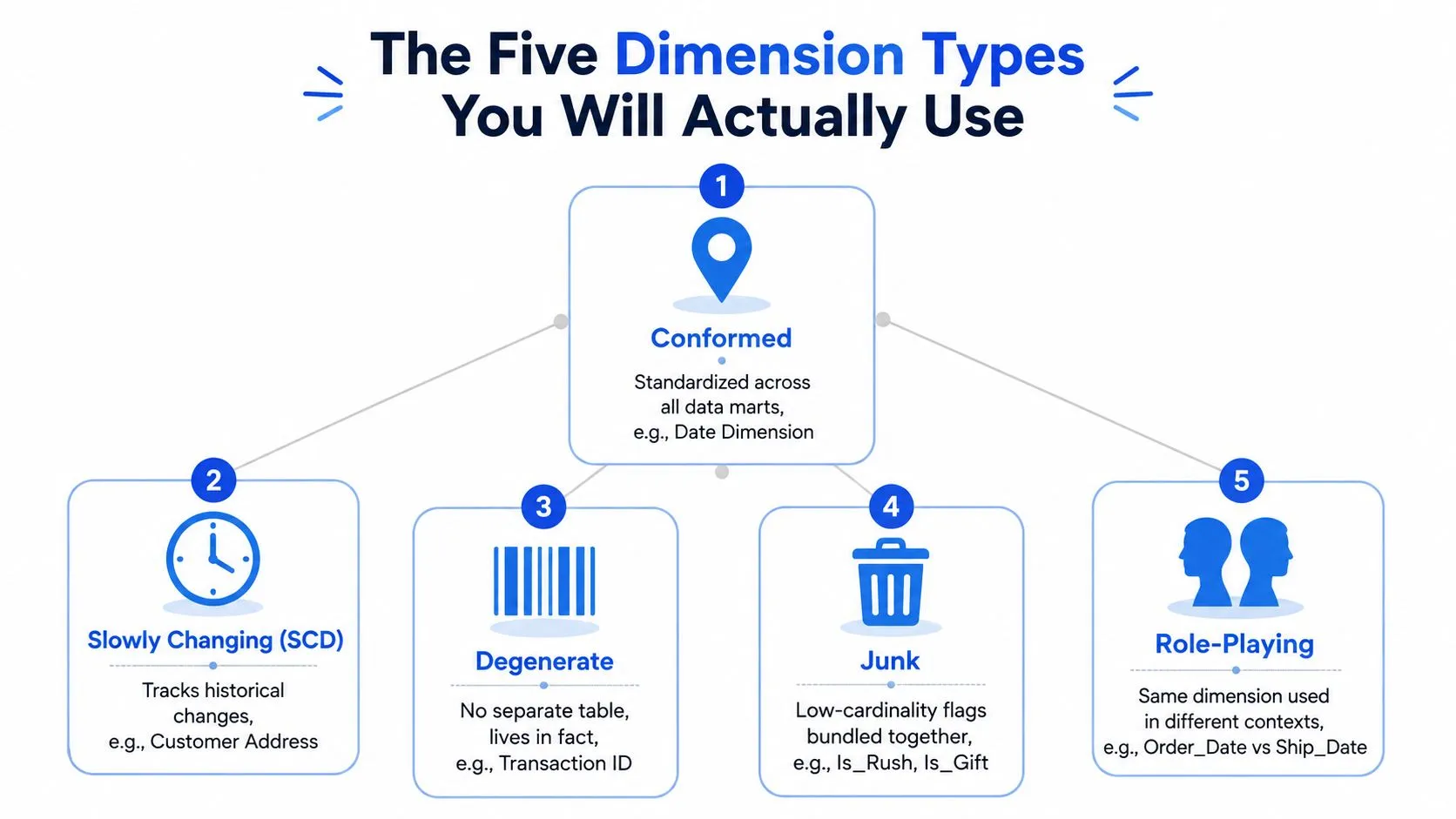
Conformed dimensions
A conformed dimension uses the same meaning and structure across multiple marts. dim_date is the familiar example. Sales, support, and product usage facts should agree on calendar attributes such as date, month, quarter, and fiscal period. A shared dim_customer can play the same role across revenue and retention models.
The key isn't merely reusing a table. The organization must agree on what the attributes mean and how their keys behave.
Slowly changing dimensions
A slowly changing dimension, or SCD, handles attributes that change over time. If a customer moves from the Enterprise segment to the Mid-Market segment, the team must decide whether historical orders should appear under the old segment or the new one. That choice determines whether the dimension overwrites the value or preserves a versioned row.
Degenerate dimensions
A degenerate dimension has a business identifier but no useful descriptive attributes that justify a separate table. order_id stored directly on fct_order_line is a standard example. It helps users trace a transaction without forcing the warehouse to create a table containing little more than an identifier.
Junk dimensions
A junk dimension groups small, low-cardinality indicators and statuses into one controlled structure. Flags such as is_rush, is_gift, and payment_review_status may otherwise spread across a fact table. A junk dimension can make combinations queryable, but it shouldn't become a dumping ground for unrelated fields.
Role-playing dimensions
A role-playing dimension is one physical dimension used in multiple analytical roles. One dim_date can be joined to a shipment fact as order_date, ship_date, and delivery_date, often through view aliases that expose each role clearly. The underlying date definition stays consistent while the business meaning of each join remains explicit.
The categories overlap. A date dimension can be both conformed and role-playing. A customer dimension can be both conformed and slowly changing. Use the labels to communicate behavior and design intent, not to force every table into one exclusive box.
Surrogate Keys and Slowly Changing Dimensions
A customer's email, a product SKU, or an ISO country code may look like a convenient join key. Keep those natural keys in the dimension for traceability, but don't make them the warehouse's primary fact-to-dimension join. Operational identifiers can change, collide across source systems, or be reused. A warehouse-controlled surrogate key gives each dimension version its own stable identity.
The decision becomes clearer when history enters the conversation. Slowly changing dimensions aren't one technique. They're different answers to the question, “Which past values must reporting preserve?”
Type 1 overwrites the value
Type 1 replaces the existing attribute. It suits corrections that shouldn't create analytical history, such as fixing a spelling mistake or removing an accidental formatting error. The model stays simple, but a report can no longer recover the previous value from that dimension row.
Type 2 preserves versions
Type 2 inserts a new dimension row when a tracked attribute changes. Effective dates and an is_current flag identify the valid period for each version. This is usually the right choice when historical reporting must reflect the context that existed when an event occurred, such as customer segment, employee department, or product classification.
Type 3 keeps a narrow comparison
Type 3 adds a previous-value column, such as previous_segment, alongside the current value. It can answer a tightly defined now-versus-prior question, but it doesn't preserve a complete sequence of changes. Treat it as a specialized compromise, not a substitute for Type 2 history.
| SCD Type | How It Stores History | Typical Use Case | Main Trade-off |
|---|---|---|---|
| Type 1 | Overwrites the existing value | Corrections and attributes where history has no analytical value | Previous value is lost |
| Type 2 | Adds versioned rows with validity fields | Historical customer, employee, or product analysis | More rows and more loading logic |
| Type 3 | Stores current and selected previous values | Narrow current-versus-prior comparisons | Limited historical depth |
The standard SCD trade-off between overwriting history and preserving it is documented in this practical guide to slowly changing dimensions. In production, the hardest decisions often concern mixed strategies. A customer dimension might preserve segment and region historically, while overwriting a corrected name. Late-arriving changes need an explicit policy, because a backdated update can affect which surrogate key a historical fact should reference.
A Type 2 load for a customer address might look conceptually like this:
merge into dim_customer as target
using stg_customer_changes as source
on target.customer_id = source.customer_id
and target.is_current = true

when matched
and target.address <> source.address
then update set
    valid_to = source.change_timestamp,
    is_current = false

when not matched
then insert (
    customer_sk,
    customer_id,
    address,
    valid_from,
    valid_to,
    is_current
)
values (
    source.customer_sk,
    source.customer_id,
    source.address,
    source.change_timestamp,
    null,
    true
);
The exact syntax varies by warehouse, and a real implementation must manage the newly inserted version after closing the old one. The important point is the contract: facts reference the surrogate version that was valid for the event, not whichever customer row happens to be current today. A backdated correction can otherwise report past revenue against the wrong address, segment, or region.
A Worked Example for a Customer Dimension
Consider a customer dimension whose grain is one row per customer per version. The natural key is customer_id, while customer_sk identifies the warehouse version referenced by facts. The table includes name, segment, region, tier, valid_from, valid_to, and is_current.
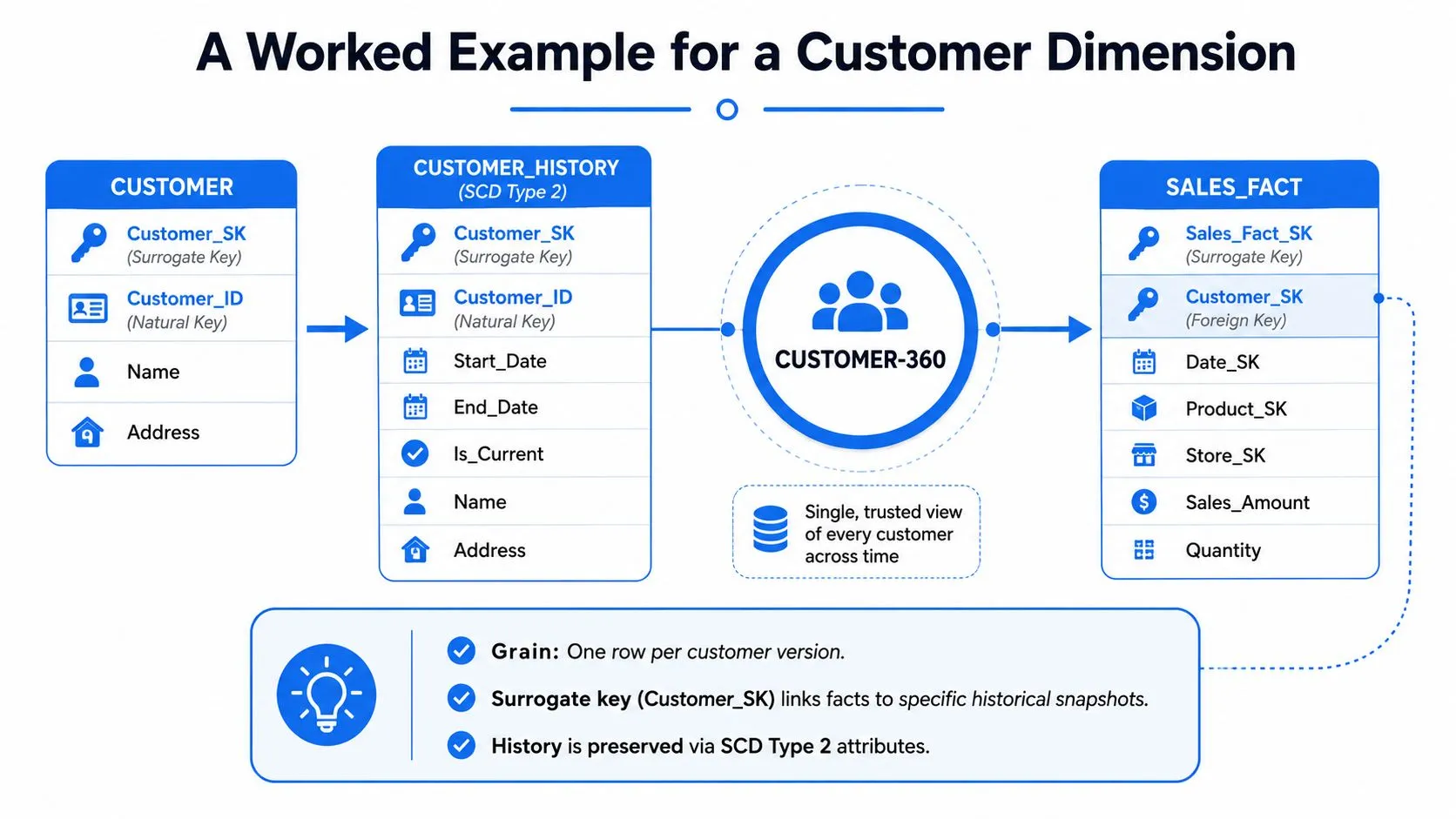
Assume a customer begins in the Silver tier in the West region. When the customer upgrades to Gold, the warehouse closes the earlier version and inserts a new row with the same natural key but a new surrogate key. A later organizational restructuring moves the customer from West to East. If the tier remains Gold, the new version still records the region change because the row represents a complete customer snapshot at a point in time.
The fact relationship
A sales fact references customer_sk, not just customer_id. That distinction preserves context. A fact row referencing customer_sk = 42 can be reported against Gold and West in January, while a later fact referencing the newer customer version can be reported against Gold and East in March.
The customer hasn't become two customers. The dimension contains two historical versions of one customer, and each fact points to the version that applied when the event was recorded. This is the practical meaning of aligning grain, surrogate keys, and SCD behavior.
Why one shared dimension helps
Marketing can analyze customers by the segment in effect when purchases occurred. Finance can reconcile revenue using the same historical attributes. Support can inspect the current customer version without creating a separate customer definition.
That shared model prevents three departments from building three customer marts with different rules. The governance challenge remains significant, especially when self-service users create overlapping customer definitions across domains. Modern guidance highlights this risk: dimensions are often treated as wide descriptive tables, while the harder problem is preventing duplicated business logic and semantic drift as more technical and non-technical users query the warehouse (dbt's guide to dimensional modeling).
Naming, Ownership, and Conformed Dimensions
A warehouse can have technically correct joins and still become unusable if teams can't tell which table to trust. Naming conventions make the intended path visible. They also reduce the number of decisions analysts must make before answering a business question.
Adopt conventions such as:
- Table prefixes: Use
dim_for dimensions andfct_for facts in analytics-facing schemas. - Singular entities: Prefer
dim_customeroverdim_customerswhen the table represents the customer entity. - Consistent columns: Use
snake_case, with_skfor surrogate keys andis_currentfor current-row flags. - Explicit roles: Name role-playing joins clearly, such as
order_date_skandship_date_sk.
Conformance needs an owner
A conformed dimension should have a named owner, a written definition, and a change process. “Customer” needs more than a table name. The owner should document whether the entity means an account, a person, a paying organization, or another agreed business object. They should also explain how merges, deletions, unknown records, and historical changes work.
A shared dimension without ownership is shared vocabulary without a dictionary.
Self-service access increases the stakes. Notebook users and BI users can reproduce a table locally, alter a filter, and publish a new “customer” definition without realizing that another team already relies on a different rule. Governance should therefore include discoverability, documentation, tests, and review for changes to conformed dimensions, not just permissions on the database.
The goal isn't to prevent every team from creating specialized models. Teams may need a product-usage customer view or a support-specific account bridge. The rule is to make the relationship to the enterprise dimension explicit, so a specialized model extends the shared definition instead of replacing it.
Performance and Storage Trade-offs Worth Knowing
A customer dimension can look small in a diagram and still drive major warehouse costs. A denormalized table with many attributes increases the bytes scanned by broad queries, while Type 2 history adds another row whenever a tracked attribute changes. The right design depends on how often users filter those attributes, how much history they need, and whether the warehouse can prune unused data.
| Dimension concern | What to measure | Practical trade-off |
|---|---|---|
| Type 2 growth | Version-count growth over time | More historical accuracy means more rows, storage, and merge work |
| Wide attributes | Columns and bytes scanned per query | Rarely used, high-cardinality fields make a convenient table more expensive |
| Hierarchies | Repeated values versus shared lookup rows | Repeated descriptions consume space; separate structures add relationship and maintenance work |
| High-cardinality joins | Join fan-out in the query plan | Duplicated or non-unique keys can multiply intermediate rows and memory use |
| Refresh behavior | Rows inserted, updated, or expired per load | Frequent changes can make a wide dimension costly to rebuild and test |
Partitioning should follow the dimension's history and access pattern. For a Type 2 table, a warehouse may prune effectively when queries commonly filter by an effective or expiration date. Partitioning by a column that users rarely filter does little, and very small partitions can add management overhead.
Choose clustering columns from recurring filters and join keys, then confirm the query plan. A stable business identifier, current-row flag, or commonly filtered geography may help, but clustering cannot correct duplicate keys or mixed grain.
Wide tables suit self-service when analysts repeatedly use the same descriptive attributes. They become less attractive when every query scans many unused columns or when Type 2 changes create substantial version history. Keep rarely used, high-cardinality details in a governed extension rather than forcing every BI query to carry them.
Before choosing a physical layout, separate the business definition from its implementation. Querio's physical versus logical data model guide explains that distinction, which helps teams discuss storage and access costs without changing what the dimension means.
Pitfalls, FAQ, and a Modeling Checklist
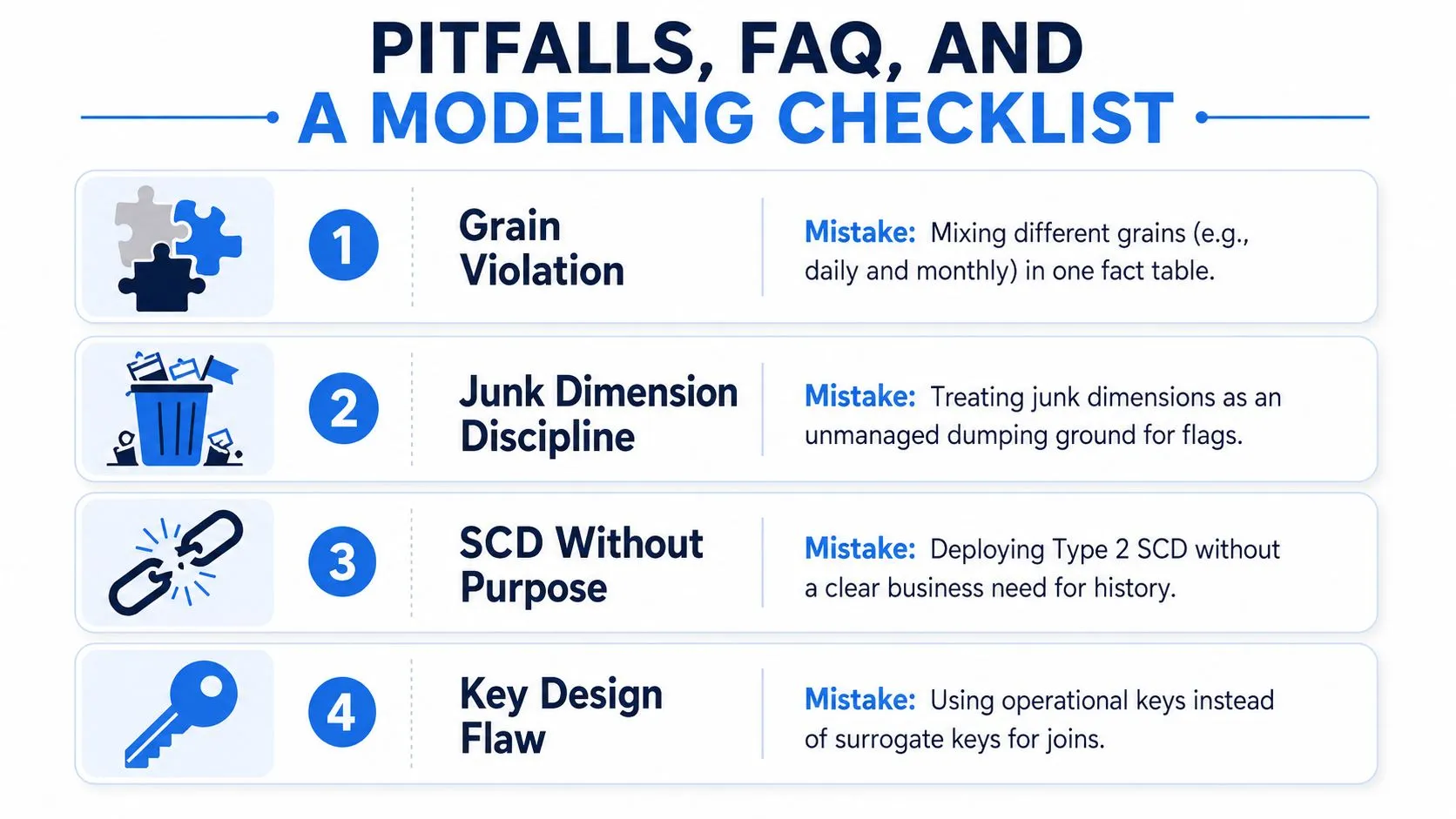
Most dimension failures are predictable. Teams mix grains inside one fact, use a junk dimension as an ungoverned bucket, deploy Type 2 history without defining date behavior, or let every department fork the customer dimension. Fix the cause, not the dashboard symptom.
Quick answers
What is a degenerate dimension? It's a business identifier stored on the fact table when no separate descriptive dimension is useful, such as an order ID.
When should I use a role-playing dimension? Use one shared dimension when the same entity has multiple analytical roles, such as order date and shipment date.
Are natural keys ever acceptable? Keep them for traceability and source reconciliation. For warehouse fact joins, a warehouse-controlled surrogate key is safer when sources can change or overlap.
Pre-release checklist
- State the grain: Write exactly what one row represents.
- Choose the key: Separate natural identifiers from the warehouse surrogate key.
- Select SCD behavior: Decide which attributes overwrite and which preserve history.
- Check conformance: Reuse or formally extend existing customer, product, date, and geography definitions.
- Assign ownership: Document the business meaning, maintainer, and change process.
- Test row behavior: Run a row-count and duplicate-key sanity check before release.
Dimensions are a governance discipline as much as a SQL pattern. Querio deploys AI coding agents directly on a data warehouse and provides a file-system approach with custom Python notebooks, allowing technical and non-technical users to query and build on governed company data. Visit Querio to explore a self-service workflow that keeps dimension definitions connected to the analytics work built on top of them.