Guide
Analytics Security: Protecting Data
Master analytics security with practical guidance on threat models, warehouse controls, RBAC, data masking, and secure self-service architecture
Encrypting analytics data at rest and in transit is necessary, but it isn't sufficient. The dangerous moment often begins after a legitimate user, notebook, dashboard, pipeline, or AI agent decrypts that data and starts processing it. At that point, the warehouse is answering queries, the notebook kernel holds values in memory, and a service account may be transforming sensitive records without a human actively watching.
That changes the practical definition of analytics security. The question isn't only whether attackers can break into storage. It's whether the right person or machine can read, join, export, transform, and retain the right data during an active workload. Security teams that focus on encryption while ignoring runtime behavior and non-human identities can still leave their most valuable data exposed.
The market reflects this broader responsibility. One industry estimate places the security analytics market at USD 7.8 billion in 2024, with a projection of USD 15.7 billion by 2030 and a 12.5% compound annual growth rate, while another forecast projects growth from USD 12.0 billion in 2021 to USD 25.4 billion by 2026, implying 16.2% annual growth (market estimates and projections). The underlying shift is operational: digital teams need continuous visibility across logs, user behavior, cloud infrastructure, and anomaly detection.
Table of Contents
- Why Analytics Security Is No Longer Just About Encryption
- Threat Models for Modern Analytics Stacks
- Secure Architecture Patterns for Data Warehouses and Notebooks
- Choosing Between RBAC and ABAC for Analytics Access
- Data Masking and Runtime Protections for Active Workloads
- Implementation Checklist for Analytics Security Controls
- Monitoring Audit Trails and Compliance Evidence
- Enabling Secure Self-Service Analytics at Scale
Why Analytics Security Is No Longer Just About Encryption
The popular advice is simple: encrypt sensitive data at rest, encrypt it in transit, and control the keys. Those controls protect storage and network movement, but they say little about what happens when a query engine, notebook, BI tool, or AI pipeline actively uses the data.
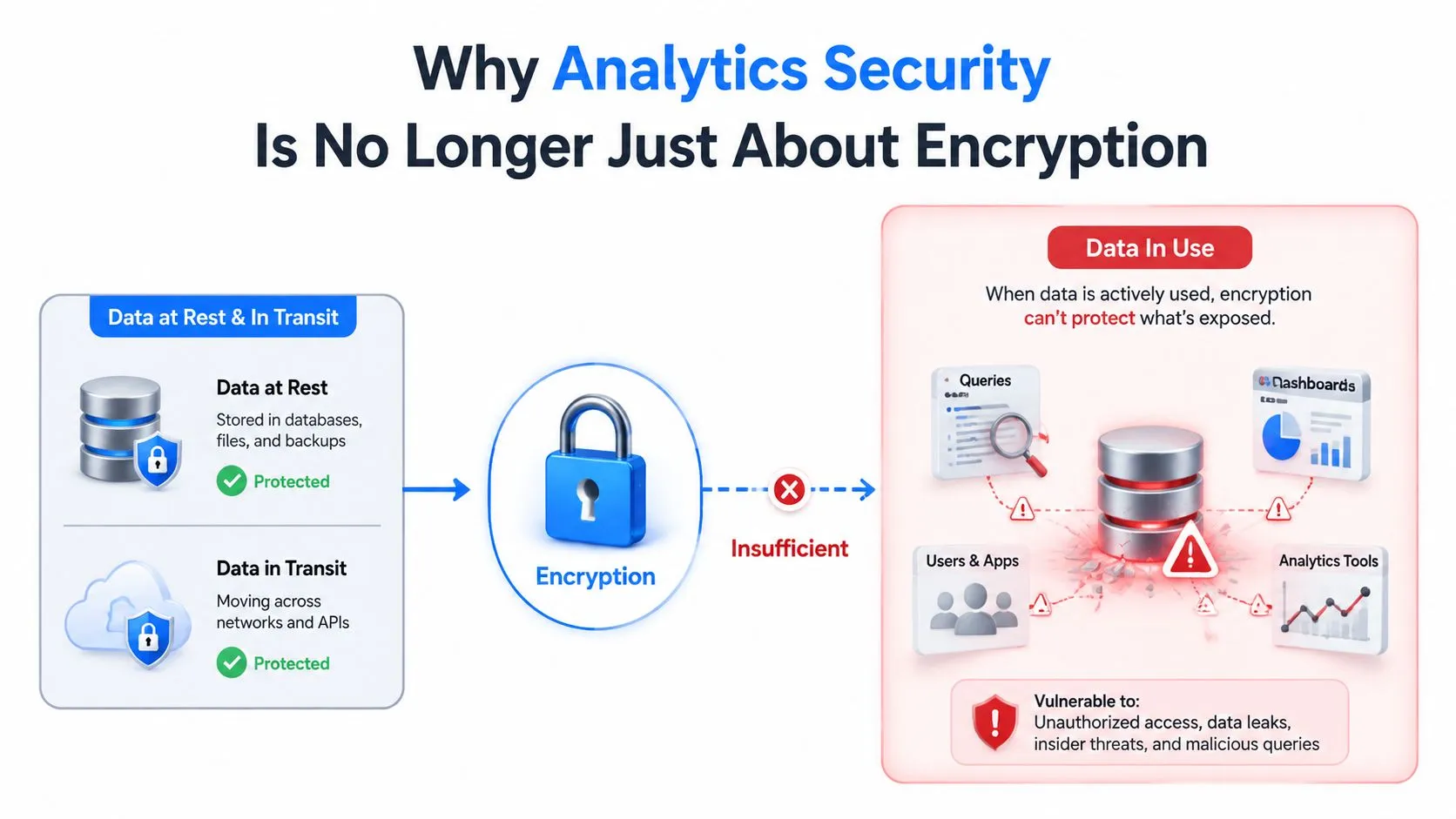
The exposure starts after access is granted
A data scientist can run a broad query from a notebook, write sensitive output to a local file, or pass records into a model workflow. An analyst can export a dashboard result. A semantic layer can expose a column that the application interface never intended to reveal. Encryption doesn't distinguish between a legitimate analytical task and an unnecessarily broad one after the authorized session begins.
That is why data-level controls for analytics and AI access matter more than application-only permissions. Effective governance needs policy decisions at the database, schema, table, and column levels, with masking for sensitive fields, centralized exceptions, audit trails for every access path, and recurring review of access patterns. Human-facing IAM alone can fail when automated workflows inherit broad warehouse permissions.
Machines now hold the keys to analytical access
Non-human identities include service accounts, OAuth tokens, orchestration workers, dbt jobs, model-training pipelines, and AI agents. They often have longer-lived access, broader permissions, and less obvious ownership than individual employee accounts. A compromised token can look like normal automation unless logs connect the identity to the workload, originating system, query, and purpose.
The security problem is therefore not just “who is the user?” It's also “which process is acting, under whose authority, against which data, and what can it do with the result?” A production design that can't answer those questions has an analytics security gap, even if every storage bucket is encrypted.
Practical rule: Treat every query execution identity as a security principal, including scheduled jobs and AI agents.
Cloud analytics guidance from Microsoft's secure cloud-scale analytics framework emphasizes a single authoritative identity source, automated controls, least privilege, simplified built-in roles, and continuous monitoring. Those principles reduce configuration drift and make access easier to audit. They also create the foundation for runtime safeguards such as row and column controls, query inspection, and egress monitoring. For an overview of how these ideas fit into an analytics product environment, see Querio's security overview.
Threat Models for Modern Analytics Stacks
Analytics stacks fail in component-specific ways. A useful threat model follows the data path from identity provider to BI interface, warehouse, notebook, transformation job, and export destination. Generic categories such as “external attacker” or “insider risk” don't tell engineers which control to implement.
Start with the query surfaces
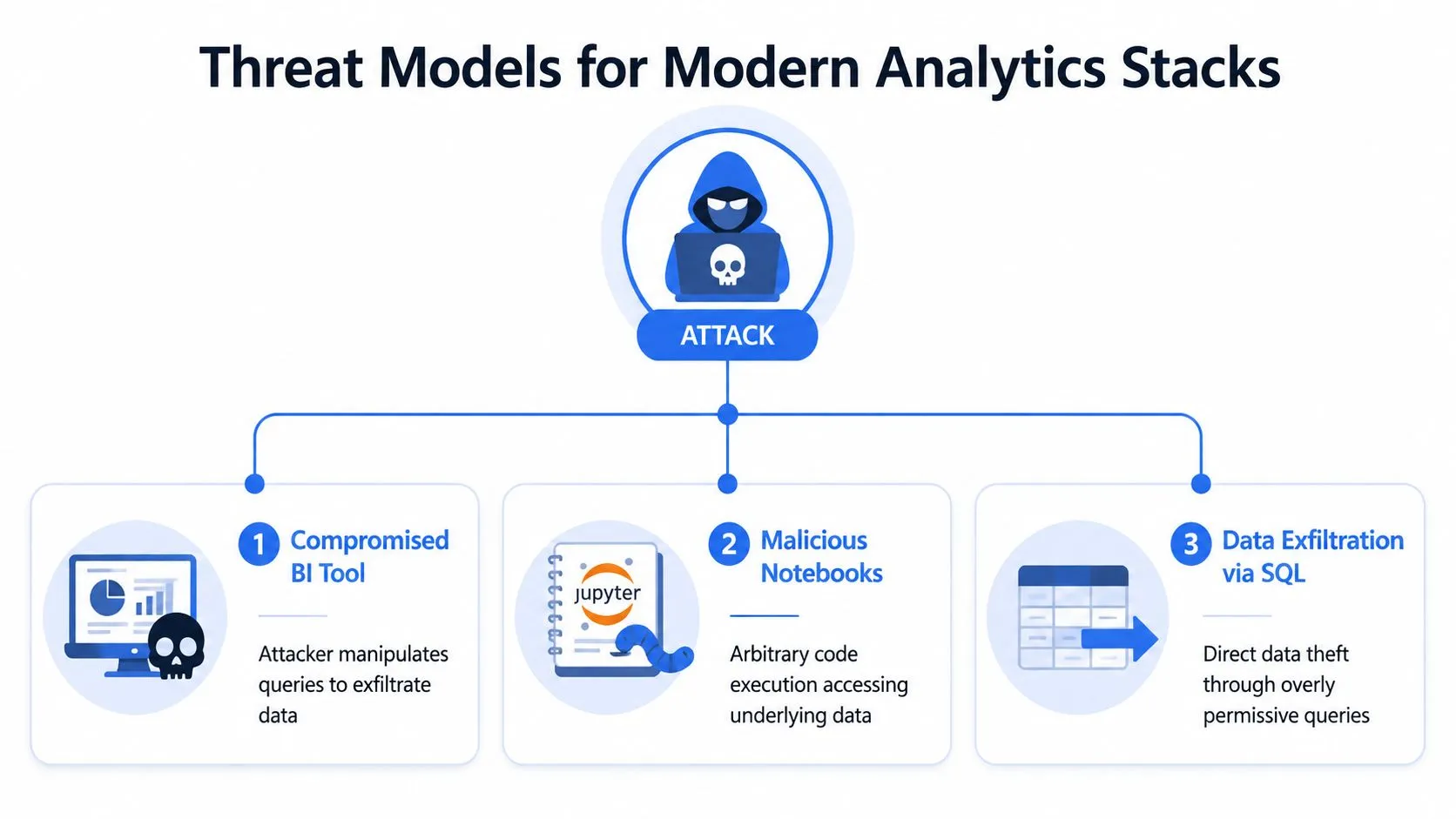
A compromised BI credential is dangerous because the dashboard may be only a thin client over broad warehouse access. If the credential can alter filters, parameters, or generated SQL, an attacker may turn a legitimate report into a mechanism for extracting tables it was never meant to expose. Query limits and warehouse permissions need to constrain the underlying identity, not merely the dashboard interface.
Parameterized filters also deserve scrutiny. A dashboard can appear safe while passing user-controlled values into a query-building path that changes joins, predicates, or selected fields. The relevant test isn't whether the front end validates a form field. It's whether the warehouse receives a query that remains bounded under hostile input.
Notebook environments introduce a different class of risk. A notebook can execute arbitrary packages, expose secrets through cell output, retain data in checkpoints, or send results to an external endpoint. A user may not intend to leak information, yet a dependency, extension, or copied code cell can create an outbound path.
Include the automation layer
ETL and AI pipelines often use service accounts that read across multiple schemas. If one account handles ingestion, transformation, feature creation, and model training, a single compromise can provide access far beyond one task. Third-party connectors create another supply-chain boundary because they may store credentials, replicate data, or execute queries under delegated permissions.
Insider threats don't require a dramatic bulk export. A user can infer sensitive values through carefully chosen aggregates, download scheduled reports over time, or join supposedly harmless dimensions until an individual becomes identifiable. A misconfigured transformation can also propagate restricted columns into downstream models and dashboards without changing the original source table.
A credible threat model follows both the query and the identity that issued it.
Useful testing includes replaying stolen-session scenarios, attempting restricted joins, reviewing notebook egress, and checking whether scheduled exports retain the same controls as interactive queries. Teams that need to reason about generated SQL should also understand common LLM SQL failure modes, because incorrect or over-broad queries can create operational and security consequences even without a malicious prompt.
Secure Architecture Patterns for Data Warehouses and Notebooks
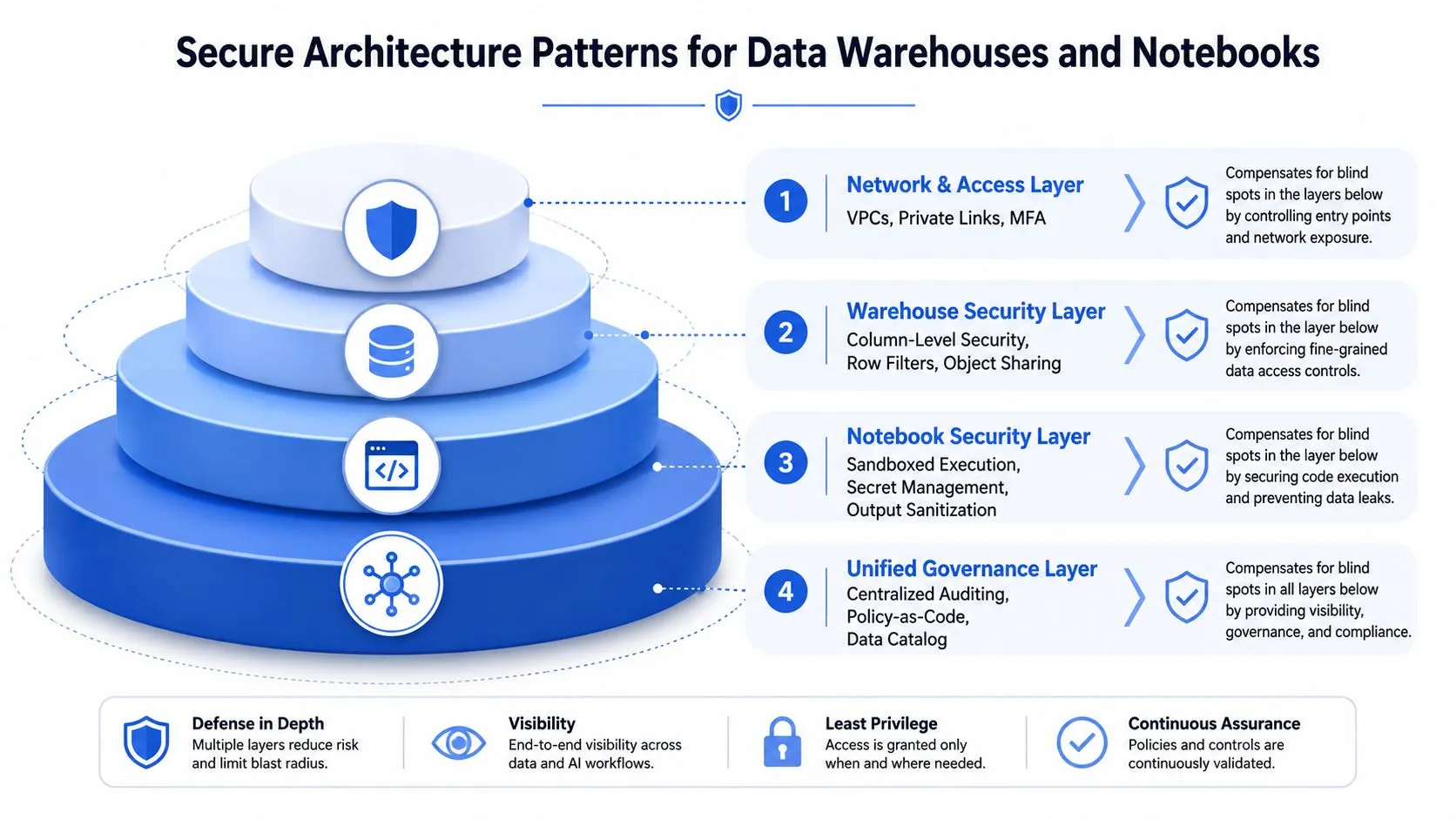
A warehouse role can't protect a file that an analyst has already downloaded. Notebook isolation can't compensate for a service account that can read every sensitive table. Secure architecture works through overlapping controls, with each layer limiting the damage caused by a failure elsewhere.
Constrain the warehouse first
Use private connectivity where the platform supports it, separate workloads by function, and apply resource governance to prevent abusive or accidental scans from affecting production systems. A transformation job shouldn't necessarily share a compute boundary with interactive exploration, and an AI workload shouldn't receive unrestricted access just because it uses the same warehouse.
At the data layer, enforce row filters and column policies rather than trusting every consuming application to implement them correctly. Maintain immutable audit records outside the workload's administrative control. Session controls, short-lived credentials, and explicit object grants reduce the value of a stolen connection.
Treat notebooks as untrusted execution environments
Notebook users need useful freedom, but the kernel should run in an ephemeral, sandboxed environment with controlled package installation and restricted network egress. Inject secrets through a managed secret store rather than plaintext environment files or notebook cells. Sanitize outputs and prevent automatic persistence of sensitive results in logs, checkpoints, or downloadable artifacts.
A practical design separates three decisions:
- Can the user start the workload? Identity and network controls answer this.
- What can the workload query? Warehouse policies and data-level entitlements answer this.
- Where can the result go? Kernel isolation, DLP, and egress controls answer this.
That last question is where many implementations stop short. A read-only warehouse connection still permits exfiltration if the notebook can freely call external services or write unrestricted files. Conversely, a locked-down notebook doesn't help if the warehouse returns raw PII to any authenticated analyst.
The architecture should be tested as a chain, not as isolated products. Simulate a compromised BI session, a malicious notebook package, and a leaked service token. Confirm that at least one independent layer blocks or limits each path. Teams building embedded and self-serve experiences can also review embedded analytics security practices when aligning application behavior with warehouse enforcement.
Choosing Between RBAC and ABAC for Analytics Access
RBAC is easier to explain, implement, and troubleshoot. A small data team can use roles such as analyst, engineer, and administrator, then grant access to well-defined schemas. The model becomes awkward when users span business units, tenants, jurisdictions, projects, and temporary responsibilities. Teams add exceptions, duplicate roles, and eventually lose confidence in what each role permits.
ABAC evaluates attributes such as department, tenant, region, project, employment status, or request context. It handles dynamic policy decisions more naturally, but it requires reliable attributes, consistent enforcement, strong testing, and better tooling. A policy engine that nobody can debug becomes its own operational risk.
| Factor | RBAC | ABAC |
|---|---|---|
| Best fit | Stable teams and predictable access groups | Multi-tenant, contextual, or frequently changing access |
| Administration | Simple at first, role growth becomes difficult | More complex policy design, fewer manually maintained roles |
| Row filtering | Works when each role maps cleanly to a data slice | Strong fit when access depends on tenant, region, or ownership |
| Column protection | Straightforward for broad groups | Useful when field access depends on user or workload attributes |
| Auditability | Easy to explain individual role grants | Requires clear policy evaluation logs |
| Failure mode | Overlapping roles create excessive access | Missing or incorrect attributes produce unexpected decisions |
The right choice is often hybrid. Use RBAC for broad capabilities, such as whether someone can query a warehouse or create a dashboard. Use ABAC-style rules for data scope, such as filtering records by tenant or restricting sensitive columns based on context.
Row-level security answers “which records can this identity see?” Column-level security answers “which fields can it see within those records?” If a support analyst needs order status but not contact details, column controls are the cleaner boundary. If a regional manager can view all fields for one territory, row controls are more appropriate.
Performance and maintenance matter. Complex policies can make query behavior harder to predict, while coarse roles can create dangerous standing access. Before selecting a model, map the data subjects, ownership boundaries, temporary access needs, and audit requirements. For teams designing secure financial systems, CEFCore's role-based access control guidance offers useful context on keeping roles explicit and reviewable. BI-specific implementation considerations are covered in role-based security practices for BI platforms.
Data Masking and Runtime Protections for Active Workloads
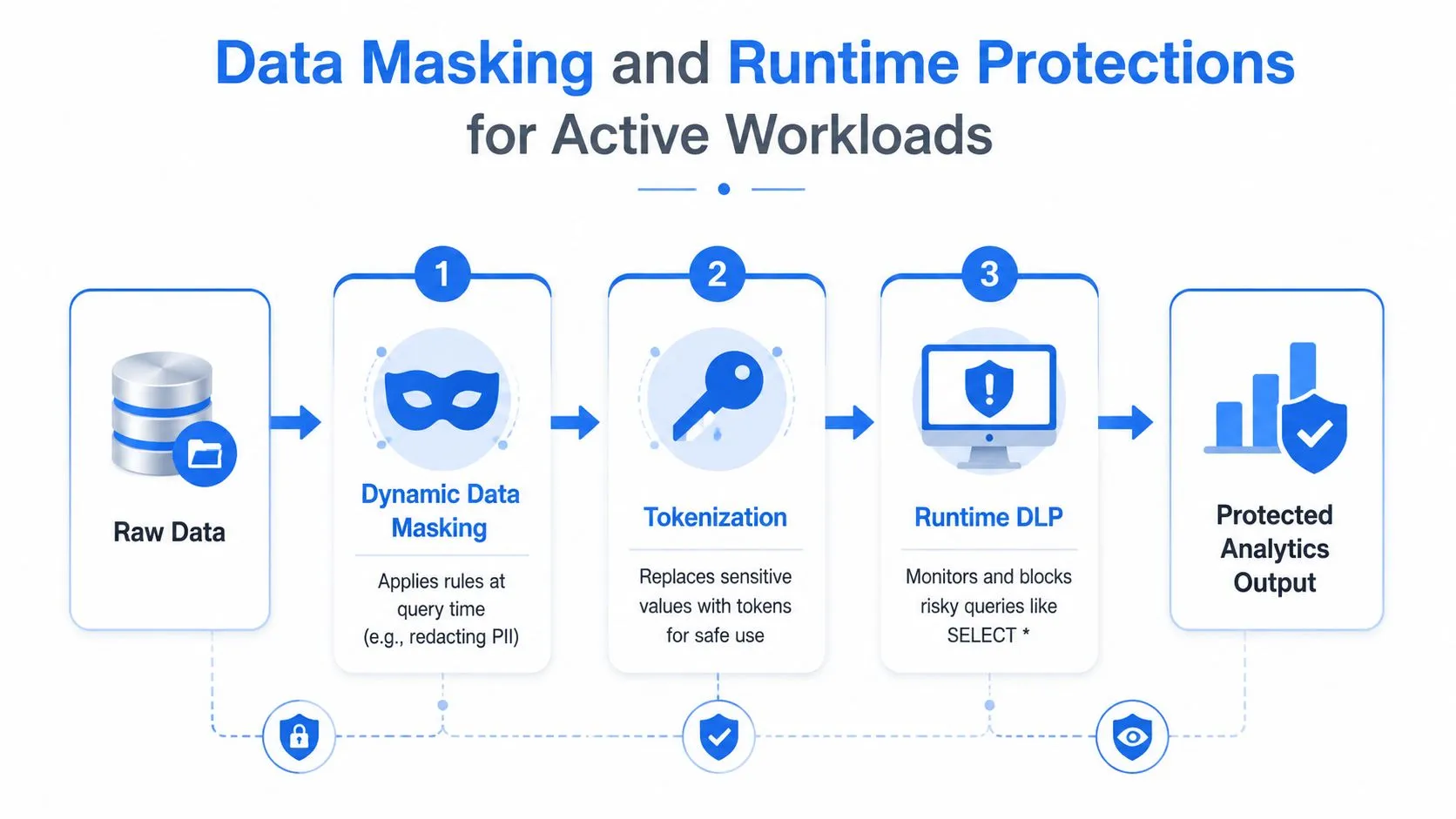
A query such as SELECT * FROM customers can expose sensitive values while the underlying table remains perfectly encrypted on disk. The control must operate at query time, during processing, and at the point where results leave the controlled environment.
Preserve utility without exposing identity
Dynamic masking is useful when analysts need the shape of a field but not its raw value. Email addresses can be partially redacted, identifiers can be tokenized, and sensitive categories can be generalized. Tokenization preserves joinability without placing the original identifier in the notebook or model input.
Masking shouldn't be applied blindly. A fraud model may need patterns associated with a customer, while a reporting user may only need aggregated behavior. Start with the analytical purpose, then decide whether to mask, tokenize, aggregate, or deny access entirely.
Put DLP close to execution
Runtime DLP can inspect query intent, result content, and export behavior. It can flag broad selections, unusual joins, repeated extraction patterns, sensitive columns in outputs, or attempts to send data to an external destination. Blocking every suspicious query creates workarounds and shadow workflows, so enforcement should distinguish between a legitimate approved job and an unexplained interactive request.
Differential privacy and carefully designed aggregation can reduce the risk of inference from small groups, but they also affect precision and repeatability. The team should document where statistical protection is required and where exact values are operationally necessary.
For AI and machine-learning workflows, the policy needs to follow data through feature creation, training, evaluation, and artifact storage. A model-training service account shouldn't automatically inherit raw production access merely because the model needs useful patterns. Restricting fields before they enter the active workload is generally safer than hoping downstream prompts, notebooks, or model code will remove them later.
Runtime protection is the point where analytics security becomes enforceable behavior, not a storage declaration.
Implementation Checklist for Analytics Security Controls
A secure rollout should begin with identity, then move toward data policy and active-workload controls. The sequence matters because teams can't test data entitlements reliably while ownership and credentials remain unclear.
Establish identity ownership
- Connect the authoritative identity provider: Require SSO where appropriate and make employee, team, and employment-state attributes available to policy evaluation.
- Inventory non-human identities: List service accounts, OAuth tokens, orchestration workers, dbt jobs, notebook runtimes, and AI agents. Record owners, permissions, purpose, and rotation responsibility.
- Remove orphaned access: Disable credentials without a current owner or documented workload. Test dependent jobs before removal, then retain a rollback path.
- Separate duties: Avoid one service account handling ingestion, transformation, exploration, and model training unless the access boundary is explicit and justified.
Establish warehouse boundaries
Apply network policies, private connectivity, session controls, and least-privilege baseline roles. Classify sensitive datasets and attach ownership to tables and columns, not just projects or dashboards.
Before enforcement, test with representative identities:
- Run an allowed query and confirm expected rows and fields appear.
- Run a forbidden query and verify the warehouse denies or masks it.
- Attempt an export through the BI tool, notebook, and API.
- Confirm the event records identity, workload, object, action, time, and result.
- Revoke access and verify cached or scheduled paths don't retain unintended permissions.
Add runtime and recovery checks
Sandbox notebook execution, restrict outbound network paths, control package installation, and inspect generated query results. Start in observe mode when possible, then enforce rules that have clear owners and exception procedures.
Measure success through evidence rather than vanity dashboards. You should be able to show reduced standing privilege, complete ownership for machine identities, reliable denials for restricted fields, and usable logs for investigations. If a policy blocks legitimate work, fix the policy or workflow instead of teaching users to copy data into uncontrolled tools.
Monitoring Audit Trails and Compliance Evidence
A bucket full of query logs isn't an audit trail. Production evidence must connect the warehouse event to the notebook cell, dashboard request, transformation run, model, and human sponsor responsible for the access.
Capture the complete access story
For every sensitive operation, retain enough context to answer:
- Who or what acted: Human identity, service account, agent, job, or token.
- What it touched: Database, schema, table, column, model artifact, and output location.
- When it happened: Start time, completion time, session, and related workflow run.
- Why it happened: Ticket, scheduled job, notebook, dashboard, model version, or approved purpose.
- What happened next: Result classification, export, downstream write, alert, block, or exception.
The difficult part is correlation. Snowflake, Databricks, and BigQuery can each produce useful warehouse events, but notebook metadata, orchestrator runs, identity-provider logs, and BI activity often live elsewhere. A unified access graph can connect these records without forcing investigators to search each console manually.
Detect behavior, not just events
Alerting should focus on patterns that deserve investigation. A BI identity that suddenly queries sensitive columns, a service account that operates outside its normal workload, or a notebook that performs repeated broad exports may be more meaningful than a single isolated query.
Audit retention and evidence packaging should match the organization's legal and contractual requirements. For SOC 2, HIPAA, or GDPR reviews, teams need reproducible evidence of policy operation, access review, exception approval, and response. They shouldn't rely on screenshots or manually assembled log fragments.
A practical starting point is to browse the audit logs API and compare the available event fields with the evidence your auditors and incident responders need. The API isn't the governance model, but it can expose gaps in identity context, object detail, or event correlation before those gaps become an incident problem.
For AI workloads, provenance deserves separate treatment. The available research highlights a serious governance gap: 76% of organizations don't fully govern or monitor non-human identities, while a 2026 forecast reports that 33% lack evidence-quality audit trails, 78% can't validate data before it enters training pipelines, and 77% can't trace training data provenance (Netwrix and related findings). Those figures point to a practical requirement: logs must explain not only which data a model accessed, but also which identity initiated the access and which artifact consumed the result.
Enabling Secure Self-Service Analytics at Scale
A central data team that approves every request becomes a bottleneck as the organization grows. Removing controls entirely creates broad standing privileges, unmanaged exports, and fragile trust in every dashboard or AI workflow. The workable alternative is self-service with infrastructure-level guardrails.
Provision policy as code alongside warehouses, schemas, semantic models, and notebook environments. Use just-in-time grants for sensitive domains, automatic expiration, row and column rules, dynamic masking, and query-level DLP. Give analysts a safe default path so they don't need to understand every underlying permission boundary before answering a business question.
Semantic layers can help, but they shouldn't become the only enforcement point. If the warehouse accepts unrestricted queries from another path, the semantic model is a convenience layer rather than a security boundary. Enforce the decisive policies where the data is accessed, then make approved tools inherit those controls consistently.
This approach changes the operating model. Data engineers maintain reusable controls, identity attributes, audit pipelines, and tested policy templates. Analysts and product teams get faster access to governed data without filing a new ticket for every exploration. AI agents can operate under scoped identities instead of borrowing a human account.
Querio is one option for this model. It deploys AI coding agents directly on a data warehouse and supports custom Python notebooks for technical and non-technical users, while its product materials describe row-level security, RBAC, SSO, encrypted read-only connections, and audit logging. The important evaluation question isn't whether a tool advertises self-service. It's whether its warehouse permissions, runtime execution, identity model, and audit evidence remain enforceable when users and agents move beyond a curated dashboard.
The security analytics market's expansion reinforces the strategic point. North America holds the largest regional share in forecasts, with one estimate assigning it 41.5% of global revenue in 2025 and another placing it at 40.2% in 2024 (regional market analysis). Network security analytics represented 37.4% of application share in 2025, while cloud security analytics is projected to grow at 16.85% CAGR through 2031, according to the same market source. Organizations are moving from perimeter monitoring toward cloud-first, data-layer, and runtime controls.
Start by inventorying machine identities and testing one sensitive workflow end to end. Then make the secure path the easiest path for every analyst, service account, and AI agent.
Querio helps teams provide self-serve analytics through AI coding agents and custom Python notebooks connected directly to governed warehouse data, with controls such as row-level security, RBAC, SSO, read-only connections, and audit logging. Visit Querio to evaluate a more practical path from manual data requests to secure, policy-driven analytics infrastructure.