Business Intelligence
Multi-Tenant Analytics: Isolation Patterns That Scale
Compare five tenant isolation patterns—IDs, RLS, schemas, databases, and hybrid—to balance data safety, cost, and performance.

I choose tenant isolation by two needs: who can read the data and who shares the compute. My starting point is shared tables with row-level security (RLS) when pooled resources meet tenant needs. When one tenant’s workload slows others down, I consider dedicated compute - not just a separate schema or database.
I compare 5 patterns by leakage risk, noisy-neighbor protection, setup effort, and cost:
- Tenant IDs: Low-cost shared tables, but every access path needs correct filtering.
- RLS: Database-enforced row access, with compute still shared.
- Separate schemas: Tenant-specific objects and grants, but shared resources.
- Dedicated databases: Separate data stores; performance isolation requires separate compute.
- Hybrid isolation: Shared and dedicated tiers based on tenant requirements.
Quick Comparison
| Pattern | Data boundary | Noisy-neighbor protection | Setup and upkeep | Cost |
|---|---|---|---|---|
| Tenant IDs | Application filters | None by itself | Simple setup; filter review | Low |
| RLS | Database policies | None by itself | Policy setup and testing | Low |
| Separate schemas | Schema-level grants | None by itself | Per-tenant migrations | More upkeep |
| Dedicated databases | Database access controls | Strong with separate compute | Per-tenant infrastructure and migrations | High |
| Hybrid | Depends on placement | Depends on compute tier | Routing and migration across tiers | Varies |
My rule across all five: test every access path. Verify tenant membership, scope caches and scheduled jobs, and test dashboards, APIs, and exports for cross-tenant exposure. Read-only access does not prevent cross-tenant reads.
I also set migration thresholds before rollout, weighing security, workload, retention, recovery needs, and per-tenant cost. Then I test a small migration and keep a rollback route ready.
::: @figure 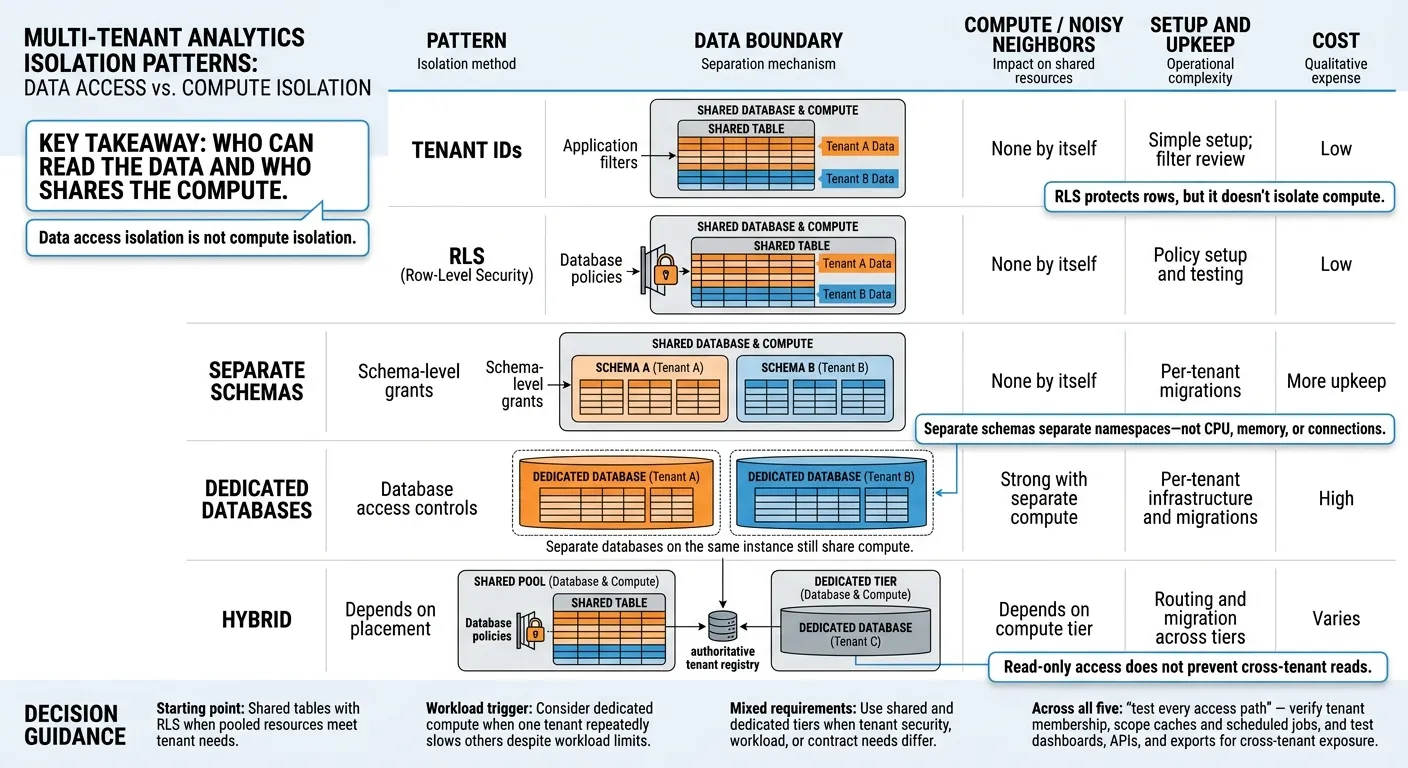 {Multi-Tenant Analytics: 5 Isolation Patterns Compared}
:::
AWS re:Invent 2019: SaaS tenant isolation patterns (ARC372-P)
::: @iframe https://www.youtube.com/embed/fuDZq-EspNA :::
1. Shared Tables with Tenant IDs
Shared tables store all tenants’ data together. Every tenant-scoped fact and dimension table has a non-null tenant_id, which passes through every dbt model to preserve ownership. Application-side filtering - not the database - keeps tenant rows separate. [1][2]
Tenant Boundary Enforcement
Centralize tenant filtering in dbt and the semantic layer. Pass tenant identity through a verified token, not an editable request field. A single missing WHERE clause can expose another tenant’s records. [1][2]
Run automated isolation tests in CI. Authenticate as one tenant, then check that dashboards, exports, and API endpoints return no other tenant’s records. Keep audit logs showing who queried what, when, and under which tenant identity. Use read-only credentials for BI access, but know their limits: they reduce write risk, not cross-tenant read risk. [1][3]
Workload Isolation
Tenant IDs separate data ownership, not compute. Heavy exports and complex queries still compete for shared warehouse resources. Set query timeouts and per-tenant rate limits, and use tenant-scoped pre-aggregations. Track tenant usage: repeated CPU or connection pressure that slows other customers signals a need for stronger workload separation. [1][2]
If filtering needs to happen inside the warehouse rather than in application logic, row-level security is the next step.
Operating Complexity and Cost
Provisioning is simple: onboarding requires no new schema or database, and model changes deploy once. This keeps infrastructure and migration overhead low. The tradeoff? Strict enforcement logic. Every new analytics access path must preserve the tenant boundary and pass isolation tests. [1][2]
If shared-table enforcement becomes too brittle, move to warehouse-enforced isolation.
2. Shared Tables with Row-Level Security
Tenant Boundary Enforcement
Row-level security (RLS) puts tenant enforcement in the database, keeping the cost savings of shared tables without relying on every query to include the right filter. A missed filter won’t expose every tenant’s rows. PostgreSQL uses CREATE POLICY; Snowflake, BigQuery, and Redshift offer similar controls, but their details differ. A PostgreSQL session-context design won’t necessarily work on another platform. [1][3]
Bind the verified tenant identity to the policy context before any query runs. If that context is missing, access should fail closed. Test policies with the production analytics role - not an admin account. [1][3]
Workload Isolation
RLS protects rows, but it doesn’t isolate compute. Keep predicates simple and index tenant_id. For expensive views, use timeouts, per-tenant rate limits, or pre-aggregations to control resource use. [1][2][3]
Operating Complexity and Cost
Shared tables keep the cost advantage of pooled storage and compute, but managing policies becomes part of running analytics. That’s a day-to-day operating tradeoff, not just a technical one. Run background workers and scheduled jobs under least-privilege service identities, and log both tenant context and workload type. [1][2][4]
3. Separate Schemas per Tenant
Tenant Boundary Enforcement
When shared-table policies get too hard to manage, separate schemas give each tenant its own namespace within one database. This provides stronger isolation than shared tables with less overhead than dedicated databases.
Route requests through an allowlisted tenant-to-schema mapping - not a URL parameter. Grant each session access only to that tenant’s schema and objects. Switching schemas alone isn’t enough. Schema-scoped grants make object-level access control simpler. [1][2][4]
Audit broad grants and overlapping roles, including those used by dbt jobs and service accounts. Excessive privileges can let one compromised credential access other tenants’ data, even when routing works correctly. [4]
Workload Isolation
Separate schemas suit tenants that need custom objects or table layouts without separate infrastructure. But they separate namespaces - not CPU, memory, or connections. One tenant’s export or query can still slow down everyone else. Track resource use by tenant and move toward dedicated compute when contention affects other tenants. [1][2]
Operating Complexity and Cost
Infrastructure stays shared, but each tenant adds provisioning, grants, and updates. Every migration must run against each schema, so automation is required to prevent drift. [1][2][3]
A few hundred schemas can become hard to manage without strong automation. Treat that as a warning about management overhead, not a hard limit. Review permissions quarterly, and consider stronger separation when one tenant’s data dwarfs the rest or a contract requires infrastructure-level isolation. At higher scale or with stricter contract requirements, shared infrastructure is no longer enough. [1][2][3]
4. Dedicated Databases per Tenant
When separate schemas don’t provide enough isolation, dedicated databases are the next step.
Tenant Boundary Enforcement
Each tenant gets its own database. For the strongest isolation, run each database on dedicated infrastructure. In Postgres, separate databases on the same instance still share compute, so they don’t offer full isolation.
Routing still matters. Verify the tenant’s identity and load tenant context into the session before running a query. If a request reaches the wrong database, database separation won’t protect it.
Workload Isolation
Dedicated databases work well when a tenant’s heavy exports or complex queries must not slow down other tenants. To isolate performance, give that tenant separate compute. Keep query timeouts, per-tenant connection limits, and tenant-aware monitoring in place, too.
Operating Complexity and Cost
With dedicated databases, you can back up and restore each tenant independently. The tradeoff: higher costs and more environments to manage.
Automate schema changes and roll out updates through blue-green or canary releases. Choose dedicated databases when physical separation is required, one tenant dwarfs the rest, or noisy-neighbor risk becomes a business problem - not simply because tenants need cleaner namespace separation.
5. Hybrid Isolation
Hybrid isolation combines the patterns above: most tenants share infrastructure, while higher-risk tenants move to dedicated tiers. Teams can start with shared infrastructure and move tenants to stronger isolation as security, workload, or contract needs change.[1][2]
Tenant Boundary Enforcement
Use one authoritative tenant registry as the control plane for shared and dedicated placement. Record each tenant’s isolation mode, deployment region, permissions, compute policy, retention, and migration state.[1][2][3]
Determine placement from verified tenant identity carried in a signed JWT - not a client-provided tenant ID. For shared placements, enforce RLS and RBAC so a missing tenant filter fails closed.[1][2][3]
Stale registry entries and routing bugs can break isolation. Test dashboards, APIs, and exports end to end, and use audit logs to flag cross-tenant access.[1][3] Routing also depends on tracking resource use per tenant.
Workload Isolation
Track resource use by tenant, not just overall server health. If one tenant’s data or query load dwarfs the rest - or starts slowing other tenants - move that tenant to dedicated compute.[1][2] Dedicated placement also makes sense when a contract or regulator requires physical separation.[1][2] These moves add operational overhead: that’s the core tradeoff of hybrid placement.
Operating Complexity and Cost
Hybrid placement keeps the cost savings of shared compute without dedicating infrastructure to every tenant.[2] But it adds operational work: teams must manage routing, provisioning, and migrations across both shared and dedicated models.
Record the semantic-layer version in the tenant registry to keep governed metric definitions - and metric calculations - consistent across tiers.[1][2]
Compare Enforcement, Performance, and Cost
Choose the lowest level of isolation that still blocks leakage and protects tenants from noisy neighbors. Compare each pattern on three points: who enforces the boundary, who absorbs contention, and who pays the operating cost.
Tenant Access Controls
| Pattern | Enforcement and leakage exposure | Recovery and deletion independence |
|---|---|---|
| Shared tables with tenant IDs | Application filters enforce access; a forgotten WHERE clause can expose another tenant’s rows |
Requires tenant-specific deletion and selective recovery |
| Shared tables with RLS | Database policies enforce access; queries without tenant context fail closed | Shared backups still require selective recovery |
| Separate schemas | Schema grants provide logical separation within one database | Tenant objects are separate, but backup independence depends on tooling |
| Dedicated databases | Infrastructure-level isolation offers the lowest cross-tenant leakage risk | Greater independence for tenant-level restores and deletion |
| Hybrid isolation | Enforcement varies across tiers | Depends on each tenant’s placement |
Resolve tenant identity on the server, then use it consistently in SQL filters and RLS policies. Carry tenant context in signed JWTs. The analytics layer should not trust tenant IDs supplied through URL parameters or request bodies.[1] Index tenant_id so shared-table filters run fast.[1]
Compute Sharing and Workload Limits
| Pattern | Compute sharing and contention | Controls and workload fit |
|---|---|---|
| Shared tables with tenant IDs | Tenants share CPU, memory, and connections | Use tenant concurrency caps, query timeouts, and export throttling |
| Shared tables with RLS | The same shared-resource contention, with extra query work from policies | Use the same limits and account for policy overhead |
| Separate schemas | Objects are separate, but compute is usually shared | Logical separation does not prevent noisy neighbors |
| Dedicated databases | Dedicated resources reduce cross-tenant contention | Best fit for regulated tenants or tenants with sustained heavy workloads |
| Hybrid isolation | Combines a shared pool with isolated placements | Limit shared-tier workloads and provide dedicated compute for sustained heavy demand |
Track resource use per tenant, not just overall server health.[2] Move workloads when a tenant repeatedly slows others down despite those limits.[2] For background analytics jobs, use dedicated read-only database users with SELECT-only privileges.[3] Apply the same tenant-scoped controls to dashboards like Tableau with RLS, APIs, exports, and background jobs.[1][3]
Provisioning, Maintenance, and Cost
| Pattern | Provisioning, migrations, and object counts | Customization, reporting, and cost |
|---|---|---|
| Shared tables with tenant IDs | Little provisioning work; one shared migration | Lowest infrastructure overhead, but filters still need review |
| Shared tables with RLS | Shared migrations plus policy maintenance | Cost-efficient pooling with fewer developer errors |
| Separate schemas | Provision grants and objects, then migrate every schema | Easier tenant customization, but more objects mean more work |
| Dedicated databases | Provision connections and databases, then migrate every database | Strong tenant isolation, with the highest cost to run and maintain |
| Hybrid isolation | Maintain both shared and dedicated deployment paths | Flexible placement, but routing and migrations add complexity |
Object counts, grants, and per-tenant migrations drive overhead.[1][2] When comparing costs, weigh that work against each tenant’s risk and workload needs.
Best Fits, Tradeoffs, and Warning Signs
Choose the lowest isolation level that still prevents data leakage and keeps one tenant’s workload from disrupting another when you build self-serve analytics for customers.
| Pattern | Main advantage | Tradeoff | Best tenant fit | Escalation signal |
|---|---|---|---|---|
| Shared tables with tenant IDs | Low cost and simple migrations | Missed tenant filters can leak data | B2B SaaS with many small tenants | Unscoped jobs or exports |
| Shared tables with row-level security | Centralized database enforcement that fails closed | Complex predicates add overhead | B2B SaaS with strict security needs | Cross-tenant cache exposure |
| Separate schemas | Logical separation with tenant customization | More per-tenant maintenance as tenants grow | Mid-market B2B SaaS needing customization | Per-tenant schema drift from manual changes |
| Dedicated databases | Strong isolation with dedicated compute | Highest cost and maintenance complexity | Healthcare, finance, and regulated enterprise teams | Limited tenant-level restore and deletion isolation |
| Hybrid isolation | Flexible placement based on cost and requirements | Multiple isolation models to manage | Tiered SaaS with mixed workloads and security needs | Sustained CPU, memory, or connection contention |
These warning signs call for fixes to permissions, routing, or automation. Changing the storage layout alone won’t address them.
Tenant-Isolation Checklist
After choosing a pattern, validate these controls before release. Treat these checks as release gates.
- [ ] Verify identity and tenant membership before generating queries. Use signed JWTs, not client-supplied tenant IDs.
- [ ] Keep RLS predicates simple, indexed, and free of multi-table joins.
- [ ] Partition cached results by tenant and enforce permissions when retrieving them, including through shared links.
- [ ] Bind scheduled reports and exports to the correct tenant and destination.
- [ ] Use read-only credentials and log tenant access for each service account.
- [ ] Log user or service identity, tenant, query, tables, columns, timestamp, purpose, and destination.
- [ ] Test as Tenant A and confirm that Tenant B’s data is inaccessible through queries, dashboards, caches, and exports.
In Querio, inspectable, editable SQL/Python supports query review, while a governed context layer keeps metrics consistent. Neither replaces warehouse permissions or end-to-end isolation tests.
Conclusion: Choose Isolation That Fits Your Tenants
Use the matrix above to choose the least-isolated pattern that meets your security and workload needs. Shared tables with RLS keep costs low and support fast growth. Separate schemas allow moderate customization, dedicated databases provide strict separation, and hybrid isolation works when tenant needs vary widely. [1][2]
Weigh security, workload, retention, and per-tenant cost together. Also consider whether your team can automate provisioning, backups, and updates. [2]
Set migration thresholds before contention becomes normal. Move tenants that repeatedly exceed limits despite workload guardrails, or whose needs outgrow shared enforcement. [1][2]
After choosing a pattern, start with a canary migration and keep the old route available for rollback. Compare results, verify routing across dashboards, exports, and jobs, and keep tenant audit logs. Expand only after isolation checks pass. [1][2]
FAQs
::: faq
How do we set tenant migration thresholds?
Set tenant migration thresholds based on storage usage, query performance, monthly costs, and resource allocation. These metrics help you spot when a tenant has outgrown shared capacity and needs stronger isolation - for example, a move from a shared database to a dedicated silo [1][2].
Use REST APIs to automate provisioning, configuration, and migration of tenant workspaces. This helps keep security and performance consistent as your user base grows [1]. :::
::: faq
How can we prevent tenant context leaks in connection pools?
Keep tenant context isolated between transactions. In PostgreSQL, use SET LOCAL rather than SET inside a transaction. This automatically clears the context when the transaction ends.
Authenticate users with short-lived JWTs generated by the backend and containing the tenant identifier. Before running a query, verify the JWT and load its tenant ID into the database session context. Then enforce Row-Level Security (RLS) to filter data for that tenant - even when connections are reused. :::
::: faq
How do we validate a migration without disrupting tenant analytics?
Run automated tests in your CI pipeline to verify tenant isolation across dashboards, API endpoints, and natural-language queries. Sign in as specific tenants and check that each receives only its own data.
Migrate tenants in stages before the full rollout to isolate edge cases. Audit the warehouse’s row-level security (RLS) policies and logs to confirm that rules are enforced consistently. During the transition, check for cross-tenant access that violates permissions. :::