Business Intelligence
What is Embedded Business Intelligence (Embedded BI)
Embedded BI delivers real-time analytics inside apps and portals, enabling faster in-context decisions, secure multi-tenant dashboards, and simple self-service reporting.
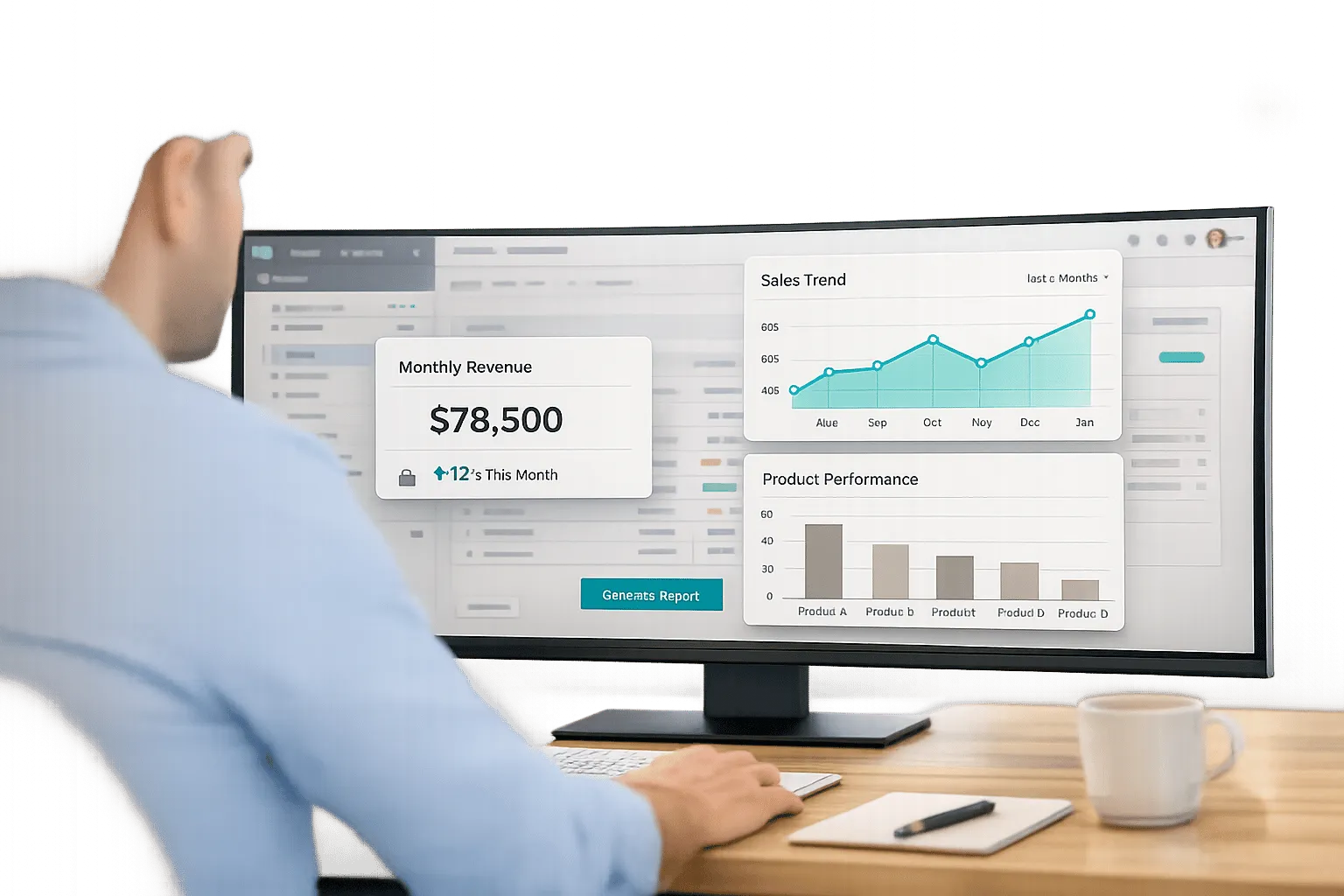
Embedded Business Intelligence (Embedded BI) integrates analytics, reporting, and data visualization directly into software applications, websites, or portals. Instead of switching between tools, users access insights within their existing workflows. This approach accelerates decision-making by delivering real-time data and actionable insights where they are needed most.
Key highlights:
- What it does: Embeds dashboards, reports, and analytics into apps using APIs, SDKs, or iFrames.
- Who benefits: Non-technical users like managers and customers who need quick insights without learning complex tools.
- Why it matters: Cuts decision-making time from days to seconds by integrating data directly into daily operations.
- Applications: SaaS platforms, e-commerce, fintech, and more use Embedded BI for tasks like customer dashboards, operational reporting, and fraud detection.
- Growth: Expected to grow to $182.7 billion by 2033, with real-time analytics replacing 60% of traditional reporting by 2026.
Embedded BI is transforming how businesses use data, making insights accessible, faster, and more user-friendly.
Embedded BI vs. Traditional BI
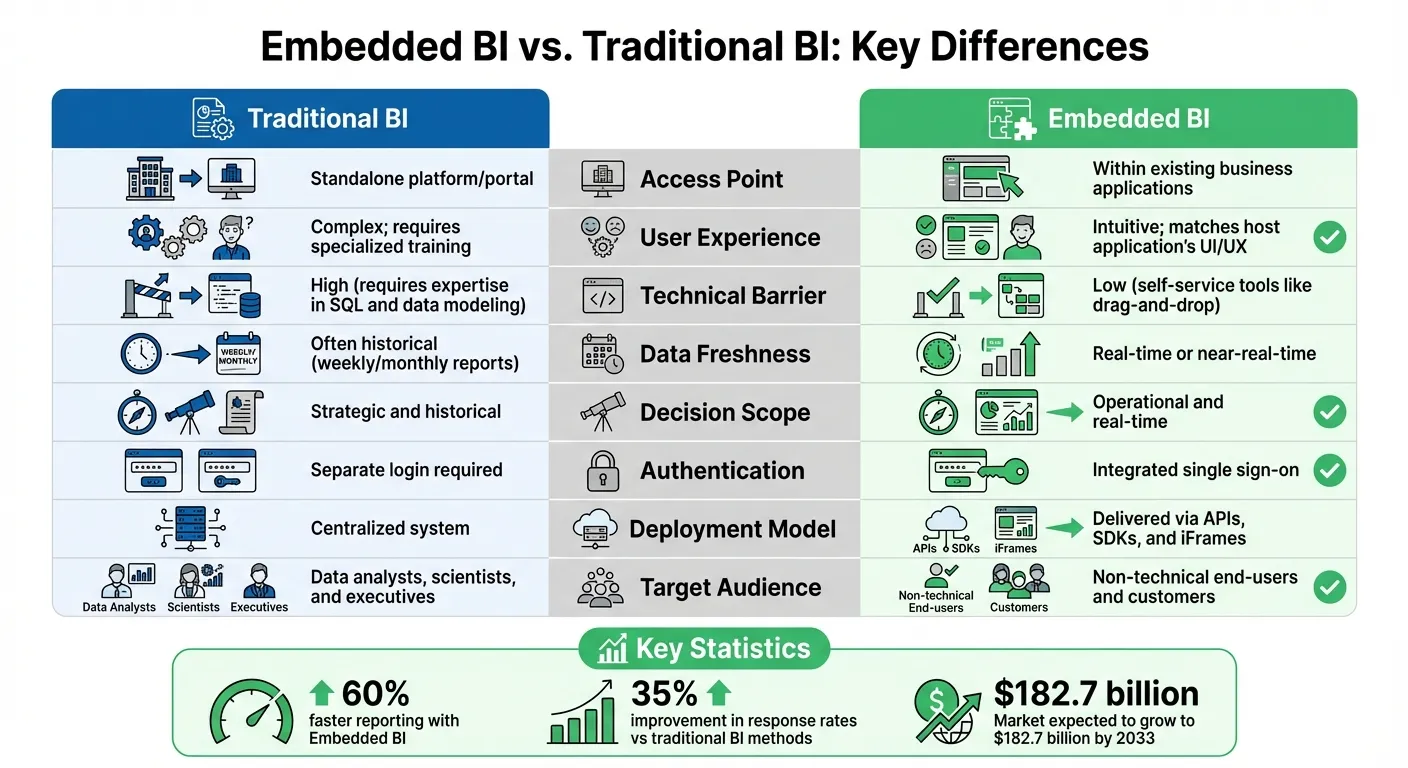
Main Differences Between Embedded BI and Traditional BI
The primary distinction between Embedded BI and Traditional BI lies in how users access insights. Traditional BI operates as a separate platform, requiring users to log in and navigate away from their daily tools. In contrast, Embedded BI integrates directly into the applications people already use, offering a seamless experience.
| Factor | Traditional BI | Embedded BI |
|---|---|---|
| Access Point | Standalone platform/portal | Within existing business applications |
| User Experience | Complex; requires specialized training | Intuitive; matches host application's UI/UX |
| Technical Barrier | High (requires expertise in SQL and data modeling) | Low (self-service tools like drag-and-drop) |
| Data Freshness | Often historical (weekly/monthly reports) | Real-time or near-real-time |
| Decision Scope | Strategic and historical | Operational and real-time |
| Authentication | Separate login required | Integrated single sign-on |
| Deployment Model | Centralized system | Delivered via APIs, SDKs, and iFrames |
| Target Audience | Data analysts, scientists, and executives | Non-technical end-users and customers |
Traditional BI systems are primarily designed for internal stakeholders, focusing on strategic planning and data modeling best practices. Embedded BI, on the other hand, serves both internal teams and external customers, offering actionable insights for day-to-day operations.
Here’s a compelling stat: Organizations using Embedded BI report 60% faster reporting and a 35% improvement in response rates compared to traditional BI methods [5]. These differences highlight why Embedded BI delivers a more efficient and user-friendly experience.
Why Embedded BI Works Better Than Traditional BI
When you compare the two, Embedded BI clearly stands out for its ability to integrate insights directly into the tools you use daily. This eliminates the need for context-switching, making decision-making faster and more efficient. For example, Embedded BI can provide real-time insights like revenue trends, user behavior, or churn risk directly within a CRM or other business application.
In contrast, Traditional BI requires a more cumbersome process. A user must first identify their question, log into a separate BI platform, find the relevant report, analyze the data, and then return to their original task. This back-and-forth not only slows down decision-making but also increases the risk of missed opportunities.
The numbers back this up: the Embedded BI market is expected to grow to $182.7 billion by 2033, with a compound annual growth rate of 12.82%. Moreover, context-driven AI models are predicted to replace 60% of traditional reporting by 2026, further emphasizing the shift toward real-time, in-app analytics [5].
Embedded BI doesn’t just improve efficiency; it fundamentally changes how businesses interact with data - bringing insights to the forefront when and where they’re needed most.
Core Features of Embedded BI
Integration with Business Applications
Embedded BI weaves analytics directly into the tools your team already relies on - like CRMs, ERPs, or custom SaaS platforms. By using REST APIs, GraphQL, and JavaScript SDKs (e.g., React, Vue), it integrates dashboards seamlessly into applications, sidestepping the performance challenges often associated with iFrames [1]. White-labeling options allow full control over CSS, typography, and branding, ensuring the analytics blend perfectly with your application's design [1].
Speed is critical here - users tend to abandon dashboards if they take longer than 3 seconds to load, which makes SDK-based integration a game-changer [6]. For example, Global K9 Protection Group cut reporting costs by 60% while improving scalability and enabling real-time customer reporting after adopting embedded analytics [6].
Real-Time Data and Interactive Dashboards
Access to real-time data can completely reshape how decisions are made. Embedded BI delivers live insights directly within workflows, turning decision cycles that used to take days into moments. Interactive dashboards with customizable filters, drill-down options, and self-service analytics empower users - regardless of technical expertise - to navigate and understand data without needing SQL skills [1].
Smart integration matters too. Placing key metrics and charts next to action buttons ensures that decisions are informed and immediate [1].
"Embedded analytics cuts decision time from days to seconds by delivering real-time insights exactly where decisions are made, so teams can act on live data instead of stale reports."
- Rahul Pattamatta, Co-Founder & CEO, Databrain [1]
Security is another cornerstone. Features like Row-Level Security (RLS) and Role-Based Access Control (RBAC) ensure users only see data relevant to their roles [1]. For instance, JobNimbus, a construction CRM, achieved a 70% enterprise user adoption rate by tailoring embedded analytics to its contractors, which also helped reduce customer churn significantly [6].
Multi-Tenancy and Scalability
For SaaS providers, multi-tenancy architecture is non-negotiable. This architecture ensures data isolation through methods like programmatic provisioning, guest tokens, or workspace-based setups [1][2]. Features like row-level and column-level security keep sensitive data accessible only to the right users [1][2].
Scalability is built into these platforms. With horizontal scaling, caching, and asynchronous queries, dashboards maintain sub-second performance even as data volumes and user numbers grow [1][2]. APIs for programmatic provisioning make it easy to onboard thousands of users or tenants without manual intervention [1][2].
"Embedded analytics platforms are built to scale automatically as your customer base and data volume grow, so you don't need to re-architect custom dashboards every time you 5x your users."
- Rahul Pattamatta, CEO, Databrain [1]
Adopting embedded BI can lead to up to a 60% reduction in operational costs by eliminating manual reporting and streamlining workflows [6]. When selecting a solution, prioritize platforms with SOC 2 Type II or ISO 27001 certifications to meet stringent security standards [1][2]. These features not only enhance efficiency but also ensure the system can grow alongside your business needs.
How Companies Use Embedded BI
Embedded BI is reshaping industries by weaving real-time data into daily operations, enabling smarter, faster decision-making.
Customer Dashboards in SaaS Platforms
SaaS companies are using Embedded BI to enhance customer dashboards, delivering insights directly within their platforms. For example, JobNimbus, a construction CRM, achieved a 70% enterprise user adoption rate by integrating analytics tailored for contractors, which helped reduce customer churn [6] [9].
These dashboards empower users to explore data and generate custom reports through easy-to-use interfaces, even without technical expertise [6] [2]. Multi-tenant security with row-level controls ensures that customers can only access data they’re authorized to see [7]. Shopify's merchant dashboard is a standout example, offering real-time sales tracking, customer insights, and inventory analytics - all seamlessly embedded into its ecosystem to improve retention [7].
But the impact of Embedded BI doesn’t stop at customer dashboards. It’s also transforming operational reporting in retail and e-commerce.
Operational Reporting for E-commerce and Retail
In e-commerce and retail, Embedded BI enables real-time operational monitoring, eliminating the need to export data to separate tools. Store managers and merchandising teams can track key metrics like inventory turnover, shrinkage, and carrying costs directly within their POS or ERP systems [8] [9].
Live inventory tracking, complete with stock alerts, helps businesses avoid stockouts and overstocking. Meanwhile, sales velocity and revenue trends guide merchants in identifying best-selling products and adjusting pricing strategies on the fly [8] [4]. For instance, Global K9 Protection Group reported a 60% reduction in operational costs after adopting Embedded BI to enhance customer reporting while maintaining scalability [6]. Role-based access ensures that store managers see location-specific data, while executives have a company-wide view [4] [2].
These tools allow teams to act quickly and with greater accuracy, driving operational efficiency across the board.
Better Decision-Making in Fintech Applications
Fintech companies are leveraging Embedded BI to tackle challenges like fraud detection, compliance, and financial analysis - all in real time. AI-driven analytics monitor transactions as they happen, flagging suspicious activity to heighten embedded analytics security [10] [4].
By processing data from multiple sources, embedded tools create precise customer risk profiles and assess credit capacity for small businesses, especially those underserved by traditional banks [11] [13]. The numbers are staggering: by 2026, embedded finance transactions in the U.S. are projected to surpass $7 trillion, a massive leap from $2.6 billion in 2021 [13].
Compliance is another area where Embedded BI shines. Automation of Anti-Money Laundering (AML) and Know Your Customer (KYC/KYB) protocols minimizes the risk of penalties, with 94% of financial institutions planning to invest in compliance technologies [11].
"AI is going to handle all of that [processing data and invoices] and be a game changer."
In B2B payment orchestration, AI-powered tools analyze invoices to determine the best payment methods and timing [10]. Account managers can access customer profitability metrics and sales pipelines directly within their CRM, embedding insights into their daily workflows [12]. By 2030, AI-embedded B2B payments are expected to hit $16 trillion in transaction value [10].
Embedded BI is clearly becoming a cornerstone for industries that rely on real-time data to drive results.
Benefits of Embedded BI
Embedded BI brings value to end users, organizations, and product teams alike, offering a range of advantages that enhance decision-making, operational efficiency, and product innovation.
Benefits for End Users
For end users, embedded BI simplifies decision-making by integrating analytics directly into the tools they already use. Imagine a sales rep accessing customer profitability metrics right in their CRM while closing a deal. This eliminates the need to switch between platforms, keeping their focus intact and their momentum steady.
Self-service analytics features further empower users without technical expertise. Thanks to tools like drag-and-drop interfaces and natural language processing, they can pose questions in plain English and instantly see visualized answers - no need to rely on IT or data analysts.
Another key advantage is real-time data access. Instead of relying on outdated reports, users can act on live insights. For instance, a store manager receiving inventory alerts through their POS system can reorder stock immediately, avoiding costly shortages.
Benefits for Organizations
Embedded analytics also deliver a strategic edge to organizations. Making analytics a built-in feature of a product encourages users to stay longer and derive more value, which boosts customer retention and engagement.
Additionally, when insights are delivered in context, teams can act faster, spreading a data-first mindset beyond just the data specialists. Over time, this shift cultivates a culture of informed decision-making, which can provide a lasting competitive advantage.
Benefits for Product Teams
Product teams, in particular, stand to gain a lot. By opting for embedded BI solutions instead of building analytics from scratch, they save significant time and resources. There’s no need to develop and maintain custom dashboards, security frameworks, or data pipelines, allowing teams to focus on delivering new features faster.
Flat-rate pricing models also simplify financial planning. Unlike per-seat pricing, which can eat into margins as user numbers grow, flat rates allow product managers to scale analytics features predictably [2][5]. This makes it easier to budget for advanced capabilities and justify investments.
Embedded BI also opens doors for monetization. Product teams can introduce premium analytics tiers, offering advanced reporting or custom dashboards as upsell options. By 2026, over 80% of software vendors are expected to embed GenAI capabilities into their BI tools, enabling conversational "AI Analysts" that make these premium features even more appealing [5]. With less time spent maintaining reporting infrastructure, engineers can focus on innovating the core product.
| Benefit Category | Specific Outcome | Impact |
|---|---|---|
| End Users | In-app decision-making | Reduces context switching; enables self-service analytics |
| Organizations | Strategic differentiation | Improves retention; fosters a data-driven mindset |
| Product Teams | Build vs. buy advantage | Faster feature delivery; predictable scaling costs |
| Financial | Revenue growth | Premium analytics tiers and upsell potential |
Best Practices for Implementing Embedded BI
Getting embedded BI right means focusing on security, seamless integration, and user-friendly design. Studies reveal that 73% of organizations fall short by neglecting security during the initial stages, while implementations that prioritize user experience see an 85% adoption rate in the first month - far above the 45% industry average [15]. Below are essential strategies to ensure your embedded BI solution delivers on its promises.
Data Security and Governance
Security isn't something to tack on later - it needs to be part of the foundation. Use Row-Level Security (RLS) and Role-Based Access Control (RBAC) to control access to data and dashboards based on user roles [16]. Your embedded BI should integrate seamlessly with your application's existing authentication methods, such as Single Sign-On (SSO), OAuth, or SAML, rather than creating redundant user management systems.
For SaaS platforms with multiple tenants, isolating data is critical. Misconfigured session tokens can lead to data leaks across tenants, so ensure tokens and API calls are validated and have expiration policies [16]. If you're using AI-driven analytics, send only schema metadata to models instead of raw data, and rely on customer-managed endpoints to maintain control [16].
To meet regulations like HIPAA, GDPR, and SOC 2, maintain detailed audit logs. These should capture every user action - queries, filters, timestamps, and user IDs - to support compliance [16].
Integration with Existing Systems
Once security is locked down, the next step is to integrate your BI solution into your existing systems. Opt for dedicated SDKs instead of basic iFrames for better performance and a more native experience [14][17]. SDKs and secure APIs also ensure that only trusted front ends interact with your data services [16][3].
Start with a Proof of Concept (PoC) to identify potential integration hurdles early. This approach can cut implementation time to as little as five weeks, compared to the 18 months typically needed for in-house builds [15].
Regularly review web policies like CORS (Cross-Origin Resource Sharing), Content Security Policy (CSP), and iFrame settings to keep your endpoints secure [16]. Monitoring failed queries and usage patterns can also help spot security risks or permission errors. A well-implemented system can reduce customer support tickets by 60%, allowing your team to focus on higher-priority tasks [15].
User Adoption and Training
To encourage adoption, make your BI interface look and feel like an integral part of your application. Use your brand's colors, logos, and fonts to white-label the interface, which helps build trust and simplifies the user experience [14][17]. Cater to different user skill levels by including intuitive drag-and-drop tools for beginners and advanced customization options for experienced users [14][17].
Offer robust training materials, such as video tutorials and detailed guides, to help users make the most of the system [14]. Measure engagement through metrics like the number of reports created, how often users interact with the tool, and the speed at which they gain insights [3]. Traditional BI tools that require switching between platforms can waste hours of employee time each week [17]; your embedded BI should eliminate that inefficiency.
Conclusion
Embedded BI has reshaped the way businesses interact with and utilize data. By delivering real-time insights directly within daily workflows, it enables sales teams to identify trends during customer calls, helps e-commerce managers make instant inventory adjustments, and allows SaaS platforms to offer customers immediate access to performance metrics. This seamless integration speeds up decision-making and fosters an environment where data becomes a natural part of every process.
The evolution from traditional BI to embedded solutions is all about making data accessible to everyone. It empowers employees across the organization to make informed decisions faster, without relying on specialized teams or tools.
To succeed, a solution must strike the right balance between strong security measures (like RLS and SSO), effortless data connectivity, and an interface that feels like a natural extension of existing workflows. Today's implementations are moving beyond basic iFrame setups, opting instead for SDK-based integrations that provide a smoother, more integrated experience [2][18].
Querio checks all these boxes. It connects directly to leading data warehouses - such as Snowflake, BigQuery, Redshift, or PostgreSQL - and allows users to ask questions in plain English. Behind the scenes, it generates real SQL and Python, ensuring transparency and accuracy. With features like embedded analytics tools, embedded analytics architecture and APIs, and SOC 2 Type II compliance, Querio makes it easy to embed analytics into any application while maintaining the necessary security and governance standards.
When done right, embedded BI doesn’t just streamline operations - it changes the way your entire organization views and uses data. Analytics become part of the dialogue, driving strategy rather than being an afterthought. Leveraging these capabilities turns data into a cornerstone of your organization’s daily decision-making and long-term success.
FAQs
Do I need a data warehouse before using Embedded BI?
A data warehouse isn't an absolute necessity for using Embedded BI, but it's highly recommended. Why? It acts as a centralized hub for optimized data, enabling real-time analytics. This ensures your applications deliver consistent and reliable insights, boosting both the accuracy and efficiency of your Embedded BI setup.
How do I embed analytics without slowing down my app?
To include analytics in your app without affecting its performance, rely on efficient strategies like APIs, cloud-based solutions, and carefully optimized embedding techniques. Lightweight tools, such as IFrames, are another way to preserve speed while integrating analytics. Prioritize smooth integration into your app's user interface to provide real-time insights without compromising on speed or efficiency.
What’s the best way to enforce tenant data isolation?
To keep tenant data separate in a multi-tenant embedded analytics setup, it's crucial to implement strong security measures. Options include using shared databases with row-level security, separate schemas, or even dedicated databases for each tenant.
Some key practices to follow are:
- Encryption: Protect data both in transit and at rest.
- Identity management: Ensure only authorized users can access specific data.
- Access controls: Prevent unauthorized access by strictly managing permissions.
By pairing these strategies with compliance frameworks like HIPAA or SOC 2, you can maintain privacy, integrate analytics securely, and scale effectively - all while safeguarding tenant data.