Guide
what is white label software: A quick guide to reselling
what is white label software and how does it work? Learn the model, benefits, and pitfalls to launch branded solutions fast.
Ever heard of white-label software? It's a pretty simple concept with a huge impact. Imagine a great local bakery that supplies donuts to all the coffee shops in town. Each coffee shop puts those donuts in their own branded bags and sells them as their own. The coffee shop gets a fantastic product to sell without having to hire a baker or build a kitchen.
That’s exactly how white-label software works. One company builds a great piece of software, and another company buys it, puts their own branding on it, and sells it to their customers as part of their own service.
What's the Big Idea Behind White Labeling?
At its core, the white-label model is all about a smart partnership. It lets a business offer a powerful software solution without the enormous time, expense, and headaches that come with building it from the ground up. Instead of getting bogged down in a multi-year development cycle, a company can license a field-tested solution, customize the look and feel, and get it in front of customers almost overnight.
This approach is a game-changer for businesses that want to grow their service offerings fast. Think about a digital marketing agency that wants to offer social media scheduling. Instead of building a tool, they can license a white-label platform, add their logo, and immediately create a new, sticky revenue stream.
Key Takeaway: White labeling is about speed and focus. It frees you up to do what you do best—marketing, selling, and building customer relationships—while a specialized partner handles the heavy lifting of software development and maintenance.
Why Is This Model Catching On?
The explosive growth of the white-label model isn't a fluke; it's fueled by some serious business benefits. The global SaaS white-label market is on track to blow past $209.14 billion by 2028, and for good reason. Companies using this strategy can slash their time-to-market by a staggering 60-70% compared to building from scratch. You can find more SaaS white label market statistics that paint a very clear picture of this trend.
Ultimately, it comes down to a trade-off. You give up the absolute, granular control you’d get from a custom-built product, but in return, you get speed, lower costs, and the reliability of a solution that’s already proven. It's like standing on the shoulders of software experts to get to your destination faster.
How the White Label Model Actually Works
To really get what white-label software is all about, you have to look at the relationship behind the product. It’s a classic partnership built on a smart division of labor between two main players: the software provider (the one who builds it) and the reseller (that’s you). This setup lets everyone play to their strengths.

I like to think of it like building a custom car. The provider manufactures the high-performance engine, the perfectly tuned chassis, and all the complex guts that make the car go. As the reseller, you get to design the sleek body, put your badge on the hood, and sell it as your own exclusive model. The customer just sees a fantastic car with your name on it.
The Provider’s Role: The Unseen Engineer
The provider is the brains behind the operation—the architect and engineer of the software. They’re responsible for the entire backend, making sure the product is fast, secure, and reliable. All the heavy lifting happens here.
You can count on them to handle:
-
Core Development: They write the code, squash the bugs, and maintain the application's foundation.
-
Infrastructure Management: All the messy stuff—servers, databases, uptime—is their problem, not yours.
-
Updates and Bug Fixes: They’re constantly pushing out improvements, adding new features, and patching security holes to keep the software current.
-
Tier-3 Technical Support: When a really tricky technical problem comes up that your team can't solve, they are the cavalry.
Basically, the provider runs the factory. They’ve already invested the time and money to build something great, so you don't have to start from scratch.
Key Insight: A good provider isn't just a vendor; they're an extension of your team. You get access to a full-fledged engineering department without the massive payroll and headaches.
The Reseller’s Role: The Brand and Customer Champion
Now for your part. As the reseller, you get to focus on everything the customer sees and experiences. You’re in charge of the brand, the marketing, and building strong customer relationships. This is where you shine.
Your job is all about growth and service:
-
Branding and Customization: You’ll add your logo, apply your brand colors, and set up your own domain. The goal is to make the software feel like it was born in your office.
-
Marketing and Sales: It's on you to get the word out. You'll create the marketing campaigns, run the sales demos, and close the deals.
-
Pricing and Packaging: You decide what it's worth. You’ll set the price points and create service tiers that make sense for your target audience.
-
Onboarding and Support: You are the face of the product. You’ll guide new customers through setup and handle all the frontline support questions.
A perfect example is when a company wants to add powerful reporting dashboards to its existing app. Instead of building an analytics engine from the ground up, they can use a solution that offers embedded analytics. The provider supplies the complex tech, and the reseller seamlessly integrates it. To the end-user, it just looks like a fantastic new feature. They have no idea a third party is powering it all. It's a brilliant way to instantly upgrade your product.
White Label vs. Private Label vs. Reselling
Diving into software partnerships can get confusing fast. You'll hear terms like "white label," "private label," and "reselling" used almost interchangeably, but they're not the same thing at all. Each represents a distinct business model, and picking the wrong one can be a costly mistake.
So, what's the real difference? It boils down to two key things: exclusivity and customization.
A white label product is a one-to-many solution. Think of it as a single, fully-built piece of software that a provider sells to numerous businesses, each of whom can slap their own brand on it. On the other hand, private label is a one-to-one deal. This is where a provider develops a unique software solution exclusively for a single client.
Then you have reselling, which is the most straightforward of the bunch. You're simply selling another company’s product as-is, under their brand. It's no different than a local electronics store selling a Sony television.
Defining the Differences
The path you choose has a massive impact on everything from your brand identity to your competitive edge. A white label solution gets you up and running quickly with a product that's already been tested in the market, but you'll be using the same core technology as your competitors. A private label gives you something no one else has, but be prepared for a much bigger bill and a far longer development timeline.
This is why the white label model has become so popular. In the closely related marketing world, the industry is on track to hit nearly $100 billion by 2026. An incredible 73% of marketing agencies already use white label services to expand their offerings. The data shows those who partner up grow 2.3 times faster and see 20% higher profit margins. The one-to-many approach just works, offering a scalable way to grow without building from scratch, a trend you can dig into with these white label marketing statistics.
The Core Idea: Here’s a simple analogy. White label is like a fleet of identical, high-quality cars that different taxi companies can paint yellow, green, or blue and add their own logo. Private label is like commissioning a one-of-a-kind car, built from the ground up to your exact design. And reselling? That’s just being an authorized dealer for Ford or Toyota.
Comparing Partnership Models
Understanding the key business and operational differences between these three common approaches is the first step toward making a smart decision. You're essentially weighing the trade-offs between branding power, market exclusivity, and how much control you want over the final product.
Let's put it all side-by-side to make the differences crystal clear.
| Feature | White Label | Private Label | Reselling |
|---|---|---|---|
| Branding Control | High—you apply your own logo, colors, and domain. | Total—the product is built to your brand's specifications. | None—you sell the product under the provider's brand. |
| Market Exclusivity | Low—competitors may sell the same core software. | High—the software is created exclusively for you. | Low—you are one of many resellers for the same product. |
| Customization | Limited to branding and configuration options. | Extensive—you can specify features and functionality. | None—you sell the product exactly as it is. |
| Time to Market | Very Fast—the product is ready to be deployed. | Slow—requires a full custom development cycle. | Instant—the product is already available to sell. |
| Upfront Cost | Low—typically a subscription or licensing fee. | Very High—you fund the entire development process. | Very Low—often just a partnership agreement. |
There's no single "best" option here. The right choice really comes down to your budget, your timeline, and what you hope to achieve in the long run.
Key Business Benefits of White Label Software
Choosing a white-label solution isn't just a technical shortcut. It's a strategic play that can deliver immediate, tangible advantages to your business, impacting everything from your finances to your product roadmap. Think of it as a way to punch far above your weight class.
The single biggest win is speed. You can slash your go-to-market timeline from months—or even years—down to just a few weeks. This agility means you can jump on market opportunities the moment they appear and start bringing in revenue almost immediately.
Accelerate Growth and Expand Your Offerings
Let’s say you run a digital marketing agency. Your clients are clamoring for better SEO reporting, but building a top-tier reporting tool from the ground up is a colossal project. By licensing a white-label platform, you can bolt that high-value service onto your offerings overnight.
This kind of instant expansion hits several key business goals at once:
-
Increases Customer Lifetime Value: You now have a new, sticky service to upsell your existing clients.
-
Enhances Brand Authority: Offering a full suite of tools makes you look like an industry leader and a one-stop shop.
-
Creates New Revenue Streams: You’re not just keeping clients happy; you’re generating fresh income from a product you never had to build.
This simple flowchart can help you see how your main business goal—whether it's pure branding, total exclusivity, or just simple reselling—points to a specific partnership model.
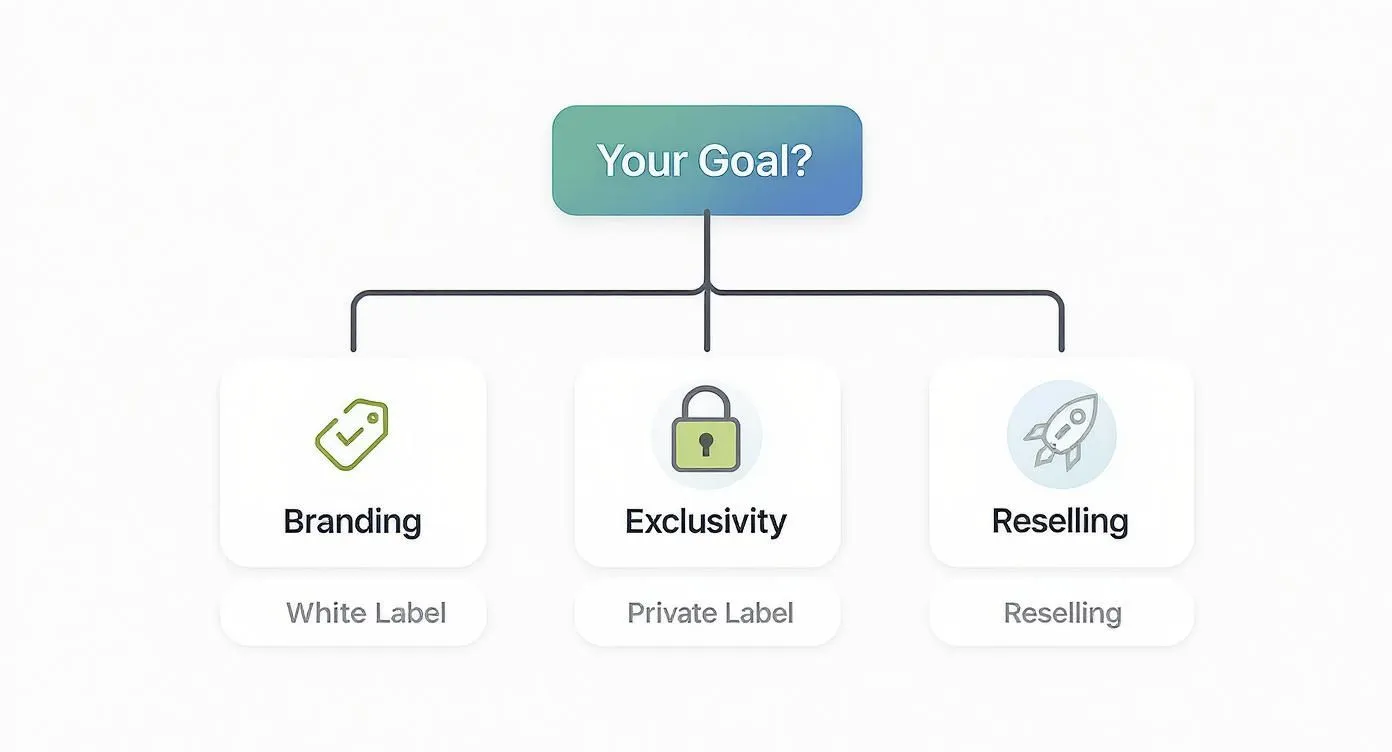
As you can see, if your primary objective is to quickly add a feature that carries your brand, the white-label path is your most direct route.
Drastically Reduce Costs and Reallocate Capital
Developing software from scratch is a massive financial drain. You have salaries for developers, designers, and project managers, plus the never-ending costs of infrastructure and maintenance. White-labeling lets you sidestep that entire R&D budget black hole.
By dodging a potential multi-million dollar development cost, you free up cash. That capital can then be poured back into the things that actually grow your business: marketing, sales, and fantastic customer support.
This financial advantage is a huge reason for its popularity. Take the white-label payment gateway market—it was valued at $2.62 billion in 2024 and is still growing. This is driven by companies that want into the fintech game without the headache of building the complex infrastructure themselves.
Many of the perks of white-labeling, like saving money and getting access to expert-level tech, are similar to the general benefits of outsourcing software development. It all comes down to focusing on what you do best—serving your customers—while relying on a proven, scalable technology partner. As you weigh the costs, you’ll find a range of white-label pricing models at https://querio.ai/pricing to fit different budgets.
What Are the Downsides? Navigating the Risks and Challenges
Jumping into a white-label solution can feel like a fantastic shortcut, but it's not a journey without a few potential storms on the horizon. To make it work, you have to go in with your eyes wide open, fully aware of the trade-offs you're making.
Think of it this way: you're handing over the keys to a core part of your business. That means you're creating a dependency on your software provider. They're the ones in charge of critical updates, security patches, and fixing bugs. If they're slow to respond or their development plans don't match what your customers are asking for, your hands are tied. This can directly damage your brand's reputation, and there's often very little you can do about it.
Overcoming the Common Hurdles
Another big challenge is standing out from the crowd. If you and three of your competitors are all using the same underlying software, how do you make your version the obvious choice? This is the problem of product differentiation. When the core features are identical across the board, it’s easy to fall into a race to the bottom on price—and that’s a race nobody wins.
Then there are the customization limitations. You can put your logo on it and change the colors, but you usually can't change how the software actually works. The core features and workflows are locked in. If a key client comes to you with a specific need that the platform can't meet, you might just have to say no and watch that business walk away.
So, how do you protect yourself? It comes down to being proactive:
-
Nail Down a Rock-Solid Service Level Agreement (SLA): Before you sign a single document, get everything in writing. Your contract should spell out exact timelines for support, bug fixes, and critical updates. Vague promises won't help you when something goes wrong; you need guarantees.
-
Make Your Brand About Amazing Service: Since you can't compete on unique software features, focus on creating a customer experience that's second to none. Differentiate yourself with incredible onboarding, proactive support, and helpful resources that your competitors simply aren't offering.
-
Dig Deep into Their Security: Remember, your provider's security is your security. You need to be confident that they are protecting your customers' data and your brand's integrity. A transparent provider should be able to give you a clear security and compliance overview that details their practices and proves they meet industry standards.
How to Choose the Right White Label Partner
Picking a white-label software provider is hands-down the most critical decision you'll make. Get it right, and your partner feels like a natural extension of your team, fueling your growth. Get it wrong, and you’re stuck with a frustrating roadblock that can hurt your brand and frustrate your customers.
Doing your homework here isn't just a good idea—it's your best defense against a world of headaches and wasted money.
Think of it like choosing a co-pilot for a long flight. You need someone with a stellar track record, a clear flight plan, and the skills to navigate unexpected turbulence. Your vetting process needs to be just as rigorous, focusing on their stability, the quality of their product, and the support you'll get long after the contract is signed.
Evaluate Provider Reputation and Vision
First things first: dig into the provider's history and reputation in the industry. A company that's been around the block is usually a safer bet than a startup that just launched last month. Hunt down case studies, pore over reviews on sites like G2 or Capterra, and see who their other partners are. A solid reputation is often a sign of a reliable product and a happy customer base.
Just as important is where they're headed. You're not just buying a piece of software for today; you're investing in its evolution. If a provider can't show you a clear product roadmap, that's a major red flag.
Here are a few questions you absolutely need to ask:
-
What does your product roadmap look like for the next 12-18 months? You need to see that their plans align with where your customers are going.
-
How do you handle feature requests from partners? This tells you if they actually listen to their resellers or if they just build in a vacuum.
-
What's your plan for staying ahead of the competition? A great partner is always thinking about the next move.
Assess Technical Capabilities and Support
Beyond their reputation, the software itself has to be bulletproof. Scalability, security, and integration capabilities are non-negotiable. As your business grows, the platform has to keep up without breaking a sweat. For example, check out their API documentation and look through their list of native software integrations. This will tell you a lot about how smoothly their product will slot into your existing tech stack.
A partner’s technical support is a direct reflection of how much they value your business. Slow response times or unresolved tickets are major red flags that signal future problems.
Finally, put their support and onboarding process under a microscope. A brilliant product with terrible support is a nightmare waiting to happen. Ask them to walk you through their onboarding for new resellers and show you the training materials they provide. A partner who is genuinely invested in your success will offer detailed training and have a responsive, multi-level support system ready to go.
This foundation is what separates a profitable, long-term partnership from a short-term failure.
Frequently Asked Questions
When you're exploring a white-label partnership for the first time, a few key questions always come up. Let's tackle them head-on to clear up any confusion and give you the confidence to move forward.
Who Handles Customer Support?
This is one of the most important things to get straight from the start. In a typical white-label setup, you (the reseller) are on the front lines, handling what's called Tier 1 support. This means you’re the first person your customers talk to for basic questions, onboarding help, and simple troubleshooting.
The original software creator usually steps in for the heavy lifting—Tier 2 or Tier 3 support. They’ll handle deep technical problems, software bugs, or server issues that are beyond your team's scope. A solid partnership will have a crystal-clear process for how you escalate these bigger problems, so you’re never left scrambling for an answer.
How Much Can I Customize The Branding?
Branding is the whole point, right? The good news is that most white-label software gives you a lot of control over the look and feel.
You can almost always expect to be able to:
-
Add Your Company Logo: Swap out their logo for yours.
-
Use Your Brand's Colors: Change the color scheme to match your brand's unique palette.
-
Set a Custom Domain (URL): Run the software on a subdomain like
app.yourcompany.comto make it a seamless part of your own digital home.
What you can't usually change is the core functionality. The features and how they work are generally locked in. This allows the provider to maintain and update one reliable product for all of its partners.
Key Insight: The idea is to make the software look and feel like you built it from scratch, even though a trusted partner is managing the engine under the hood.
Is White Labeling a Good Strategy for Startups?
Without a doubt. For a startup trying to make every dollar count, a white-label product is one of the quickest and most capital-efficient ways to get to market. You can launch a sophisticated, road-tested solution without the massive upfront cost and time sink of building it yourself.
This approach frees up a startup's precious resources to focus on the things that really move the needle early on: finding and winning over customers. If you want to dig deeper, you can find answers to other common questions about white label services and see why it’s such a popular model for new businesses.
Ready to add powerful, code-free analytics to your product? With Querio, you can embed AI-powered dashboards and an "Ask your data" experience directly into your app. Learn more about our white-label embedded analytics solution.