Business Intelligence
What is AI powered Embedded Analytics? Features, Benefits & Top Platforms (2026 Guide)
How AI-powered embedded analytics brings NLQ, predictive models, live data, and governance into apps to speed decisions, cut IT dependency, and secure access.
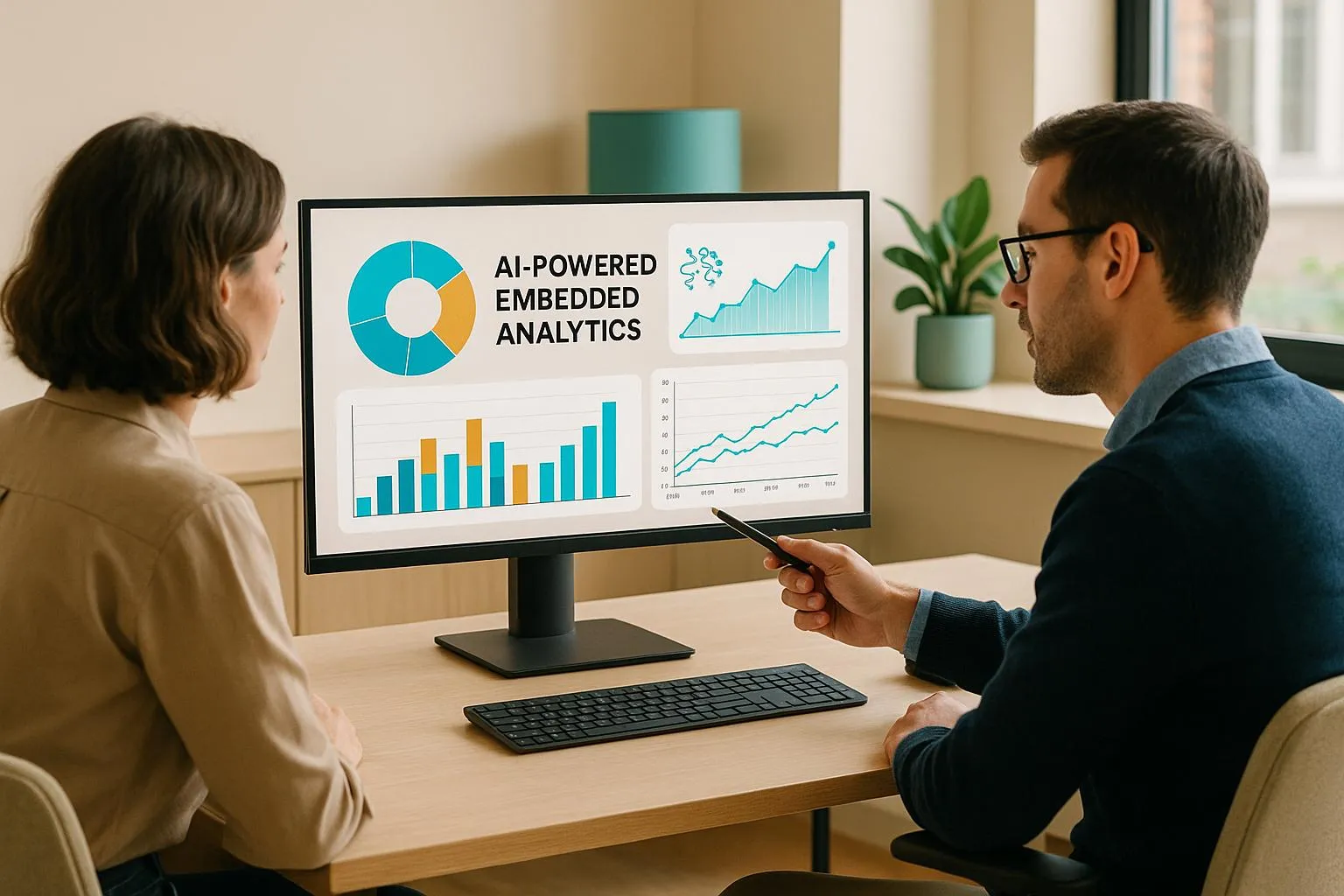
AI-powered embedded analytics integrates data insights directly into the tools you already use, like CRMs or project management platforms. It uses AI features such as natural language querying and predictive analytics to deliver actionable insights without needing technical expertise. This eliminates the hassle of switching tools, speeds up decision-making, and reduces dependency on data teams.
Key Highlights:
- Natural Language Querying (NLQ): Ask data questions in plain English and get instant visualizations.
- Predictive Analytics: Forecast trends and detect anomalies to plan ahead.
- Automation: Automates reports and updates dashboards in real-time.
- Row-Level Security: Ensures users only access data they’re authorized to see.
- Governance Tools: Standardizes metrics and ensures compliance with privacy regulations.
Benefits:
- Faster Decisions: Insights delivered instantly within workflows.
- Less IT Dependency: Enables self-service analytics for business users.
- Cost Efficiency: Automates repetitive tasks, saving time and resources.
Top Platform for 2026:
Querio stands out with live data connections, built-in governance, and no hidden fees. It’s ideal for teams needing quick insights while maintaining data control.
AI-powered embedded analytics is reshaping industries like e-commerce, finance, and healthcare by integrating insights into everyday tools. Future trends include autonomous decision-making, explainable AI, and real-time edge analytics for IoT systems.
AI-Powered Embedded Analytics
::: @iframe https://www.youtube.com/embed/HEwV9iV5LnE :::
Core Features of AI-Powered Embedded Analytics
AI-powered embedded analytics takes raw data and turns it into actionable insights, breaking down technical and security barriers. These features make analytics easier to use and more impactful for everyone in an organization.
Natural Language Querying (NLQ)
Imagine being able to ask questions about your data the same way you’d ask a colleague. That’s the power of natural language querying. Instead of wrestling with complex SQL or specialized tools, users can simply type or speak their questions in plain English. For example, a marketing manager might ask, "Which campaigns brought in the most revenue last quarter?" or a customer success lead could inquire, "Which accounts have shown declining activity over the past 30 days?"
This conversational approach eliminates the technical hurdles that often slow down decision-making. A sales director, for instance, doesn’t need to wait days for the data team to process a request. Instead, they can get answers instantly, directly within their workflow.
Here’s how it works: the system interprets the intent behind the question, finds the right data sources, and automatically creates visualizations. It even remembers the context of previous questions, so users can easily dig deeper without starting over. This makes exploring data feel intuitive and fluid.
Whether it’s a product manager analyzing feature adoption, an e-commerce team reviewing cart abandonment trends, or a relationship manager pulling live portfolio data during a client call, the common thread is speed and accessibility. Insights are available exactly when and where they’re needed.
And while NLQ simplifies how users interact with data, predictive analytics takes it a step further by anticipating what’s coming next.
Predictive Analytics and Automation
Embedded machine learning doesn’t just tell you what happened - it helps you prepare for what’s ahead. Predictive analytics shifts the focus from reactive reporting to proactive planning.
By analyzing historical data, these models forecast future trends. For example, a subscription service can predict which customers are at risk of canceling based on their usage and engagement patterns. Similarly, an e-commerce platform can estimate inventory needs by examining seasonal trends and promotional impacts. These forecasts allow businesses to make smarter decisions, allocate resources efficiently, and address problems before they grow.
Another key feature is anomaly detection. The system constantly monitors data streams and flags unusual patterns, like potential fraud in fintech, performance issues in SaaS, or inventory mismatches in retail. These alerts help teams act quickly, often before the problem becomes critical.
Automation doesn’t stop there. Routine tasks - like generating performance reports, updating dashboards, or calculating metrics - happen automatically. This frees data teams to focus on strategic analysis, while business users get the insights they need without lifting a finger.
But with analytics becoming more accessible, ensuring data security and governance is more important than ever.
Row-Level Security and Governance
As analytics tools spread across organizations, managing data access becomes a top priority. Row-level security ensures users only see the data they’re authorized to view. For example, a sales rep might only access their accounts, while a regional manager sees data for their entire territory. In multi-tenant SaaS platforms, this feature ensures each customer only views their own data.
Context layers and business glossaries also play a key role, standardizing metric definitions and improving transparency. These tools are particularly critical in regulated industries like healthcare and finance, where compliance is non-negotiable. Audit trails record who accessed which data and when, while data lineage tools trace how information flows through the system, ensuring accuracy and accountability.
For businesses handling sensitive customer data, such as e-commerce platforms operating across regions, these features help meet privacy regulations like GDPR and CCPA. They can restrict access to personal data based on roles or geographic rules. SaaS companies serving enterprise clients also rely on row-level security to maintain strict data separation, a must for earning client trust.
Benefits of AI-Powered Embedded Analytics
AI-powered embedded analytics is changing how businesses operate by delivering insights exactly when and where they're needed. Let’s break down the key advantages with real-world examples.
Faster Decision-Making
Timely insights can make all the difference. Traditional analytics often means jumping between tools or waiting for custom reports - by the time the data arrives, the moment to act might already be gone. Embedded analytics eliminates this delay. For instance, a customer success manager working in a CRM can instantly spot accounts showing early signs of churn. They can even analyze churn drivers without needing to write complex SQL queries. With insights readily available, teams can act quickly, staying ahead of challenges and seizing opportunities.
Reduced IT and Data Team Dependency
Overburdened data teams often struggle to keep up with endless requests for reports and analysis. This creates bottlenecks and slows down decision-making. AI-powered embedded analytics changes the game by enabling embedded self-service analytics. Business users can generate their own insights without relying on IT, allowing data teams to focus on higher-priority, strategic projects. This independence not only speeds up workflows but also reduces the need to expand data teams significantly.
Cost and Operational Efficiency
Manual data tasks are a drain on time and resources. Automating processes like data preparation and report creation saves both money and effort. Teams can shift their focus from repetitive tasks to more innovative work. For example, automation in forecasting and compliance ensures smoother operations while cutting costs. The result? A more streamlined and agile organization that’s better equipped to respond to emerging opportunities and risks.
Top AI-Powered Embedded Analytics Platforms for 2026
Selecting the right embedded analytics platform can completely change how insights are delivered. By 2026, embedded analytics platforms will vary in features like natural language querying (NLQ), data governance, and real-time connectivity. This guide highlights Querio as a standout AI-native analytics platform and compares its features with other solutions.
Querio: The AI-Native Analytics Workspace
Querio is designed for businesses aiming to make data accessible to everyone while maintaining strong governance. It allows users to query live data directly in plain English and instantly generates accurate visualizations.
Querio connects seamlessly to Snowflake, BigQuery, and Postgres, ensuring data stays secure and up-to-date. These direct, read-only connections, secured with encrypted credentials, preserve data integrity.
Its semantic layer simplifies governance by letting data teams define joins, metrics, and glossary terms once. This ensures consistency across reports and eliminates repetitive requests. Business users gain the freedom to explore data independently, while data teams retain control over definitions and access.
For advanced analysis, Querio includes a built-in Python notebook that supports both SQL and Python. This setup enables deep dives for analysts without overwhelming non-technical users, who can still benefit from the same governed data.
When it comes to embedded analytics, Querio brings this robust experience directly to your customers. Its integration allows end users to access self-service analytics without needing additional infrastructure. Features include drag-and-drop dashboards for tracking KPIs and creating visual stories, as well as scheduled reports to keep stakeholders informed without extra tools.
Querio's pricing is straightforward - no hidden query fees and unlimited viewers. The platform is SOC 2 Type II compliant with a 99.9% uptime SLA, meeting enterprise-level security and reliability needs. Plus, a money-back guarantee reflects its confidence in delivering premium results.
By combining self-service capabilities for business users with strong governance controls, Querio helps organizations scale insights without needing to expand their data teams proportionally.
Platform Comparison Table
Here’s a breakdown of how Querio stacks up against traditional BI platforms and code-first solutions:
| Feature | Querio | Traditional BI Platforms | Code-First Solutions |
|---|---|---|---|
| Natural Language Querying | AI-powered NLQ with context-aware responses | Limited or available as an add-on | Requires custom development |
| Live Data Connections | Direct connections to Snowflake, BigQuery, Postgres | Often requires data extraction or caching | Flexible but needs configuration |
| Semantic Layer | Built-in, one-time setup for governance | Available but complex to implement | Requires custom development |
| Python & SQL Support | Integrated notebook for both | Limited or uses separate tools | Full control but higher complexity |
| Embedded Analytics | Fully integrated self-service capabilities | Available but often limited in customization | Customizable but resource-intensive |
| Pricing Model | No hidden fees, unlimited viewers | Typically usage-based or per-seat pricing | Varies, often includes infrastructure costs |
| Best For | Teams reducing analyst dependency while maintaining governance | Enterprises with established analytics teams | Technical teams with development resources |
| Setup Complexity | Low - semantic layer set up once | Medium to high | High - requires significant development |
| Security & Compliance | SOC 2 Type II, read-only connections, encrypted credentials | Varies by vendor | Depends on implementation |
The best platform for your organization will depend on your technical resources, user needs, and long-term analytics goals. Querio is ideal if you want to empower non-technical users while easing the workload on data teams. Traditional BI platforms are better suited for companies with established analytics workflows and dedicated teams. Meanwhile, code-first solutions offer maximum customization but demand significant development effort and ongoing maintenance.
Assess your current reporting delays and IT challenges to see if Querio's integrated approach aligns with your analytics strategy for 2026.
sbb-itb-284a532
Real-World Applications of AI-Powered Embedded Analytics
AI-powered embedded analytics is reshaping how industries make decisions by weaving data insights directly into everyday tools and workflows. By integrating analytics into applications, companies allow users to access actionable insights seamlessly, without switching platforms. This approach tackles a range of business challenges, from predicting customer behavior to identifying fraudulent activities.
E-Commerce and SaaS
For e-commerce and SaaS companies, understanding customer behavior quickly is key to reducing churn and improving operations. Embedded analytics makes this process more efficient by providing insights directly within existing workflows.
In SaaS, churn prediction becomes a proactive tool when integrated into customer success dashboards. Account managers can pinpoint at-risk customers in real time, enabling teams to intervene before issues escalate. These insights help customer success teams act faster and more effectively.
E-commerce businesses use embedded analytics to improve demand forecasting and inventory management. For example, merchandising teams can analyze live warehouse data to spot trending products by region, compare sales patterns, and make informed purchasing decisions - all without needing complex SQL queries. Imagine a product manager asking, “What’s our bestselling category in the Northeast this quarter?” Embedded analytics can generate precise, up-to-date charts in seconds using platforms like Snowflake or BigQuery.
Marketing teams also benefit by embedding analytics into their platforms. They can segment users based on browsing habits, cart abandonment rates, and purchase frequency. This empowers marketing managers to explore data independently, while data teams maintain control through a semantic layer for SaaS that ensures consistent metrics across all queries. These tools not only enhance customer insights but also streamline decision-making across teams.
Financial Services
Speed and accuracy are critical in financial services, where protecting customers and meeting compliance standards are top priorities. Embedded analytics plays a vital role in transaction monitoring and risk management systems.
Fraud detection becomes more effective when analytics are embedded into payment systems. Analysts can ask questions like, “Show me all transactions over $10,000 from new accounts in the last hour,” and instantly receive visualizations. By comparing new transactions with historical patterns, the system flags anomalies for further investigation.
Risk scoring also becomes more transparent. Loan officers can query why a specific loan application received a certain rating, uncovering which factors - such as credit history or debt-to-income ratio - were most influential. This transparency not only supports compliance but also speeds up approval processes.
Trading platforms also benefit from embedded analytics by flagging unusual patterns before they escalate. Compliance teams can monitor anomalies in real time, with secure, read-only access to live data sources. Robust governance mechanisms ensure data security while maintaining real-time visibility.
Healthcare and Retail
Both healthcare organizations and retailers operate in environments where timely, data-driven decisions can make a huge difference. Embedded analytics helps these industries improve efficiency while keeping tools simple for non-technical users.
In healthcare, predictive analytics supports clinical teams by identifying resource needs. For instance, when embedded into electronic health systems, caregivers can ask, “Which patients are at the highest risk for readmission this week?” and receive prioritized lists based on historical data. This allows care teams to focus on high-risk patients without sifting through extensive records.
Hospital administrators also benefit by using natural language queries to analyze staffing, equipment usage, and appointment schedules. Embedded analytics reveals trends that help them optimize resources, while a semantic layer ensures consistent definitions of terms like “wait time” and “patient volume” across departments.
Retailers, on the other hand, use embedded analytics to fine-tune inventory and pricing strategies. Store managers can ask, “Which products are selling faster than expected this month?” and adjust orders to avoid stockouts. Pricing teams can use dashboards to analyze competitor data, demand trends, and profit margins, enabling them to adapt pricing strategies quickly and effectively.
Across these industries, embedded analytics reduces reliance on dedicated data teams while maintaining strong governance. Business users gain the ability to explore data and answer questions independently, while data teams manage metrics, access controls, and data relationships centrally through a semantic layer. This balance allows organizations to scale their analytics efforts without adding more staff, making data-driven decisions more accessible to everyone.
Future Trends in AI-Powered Embedded Analytics
The world of embedded analytics is evolving quickly, driven by advancements in AI and the growing need for smarter, more proactive data tools. By 2026 and beyond, analytics will shift from simply reporting data to actively supporting decisions, reshaping how businesses operate. The market for embedded analytics is projected to hit $182.7 billion by 2033, growing at a steady annual rate of 12.82%.
Agentic BI and Autonomous Actions
Analytics tools are moving beyond answering questions - they’re starting to take actions on their own. With agentic AI, these systems don’t just generate insights; they execute workflows, make recommendations, and even implement decisions without constant human input.
This shift represents a move from user-driven to process-driven software. For example, instead of waiting for someone to ask, "Which customers are likely to churn?" an agentic system can automatically identify those customers, analyze the reasons, create personalized retention offers, and send them to the right account manager - all without manual intervention. Every step is documented, so teams can review why specific actions were taken.
By 2028, it's estimated that 90% of B2B buying - worth over $15 trillion - will involve AI agents, meaning embedded analytics must support both human users and autonomous systems.
Financial institutions are already testing these systems for back-office tasks. For instance, agentic analytics can monitor transactions, flag anomalies, investigate potential issues using multiple data sources, and escalate only the cases that require human judgment. This approach speeds up response times and reduces compliance teams’ workloads.
However, with greater autonomy comes the need for strong governance. Organizations must adopt practices like "model P&L" reviews - regular evaluations of AI performance to ensure that predictive analytics deliver measurable value while minimizing risks. By 2026, half of global organizations are expected to require "AI-free" skills assessments to address the decline in critical thinking caused by reliance on AI systems.
Explainable AI and Multimodal Interfaces
As analytics systems take on more complex tasks, transparency and accessibility become essential.
Explainable AI ensures trust by making decisions easier to understand. For example, if a system denies a loan or flags a transaction as fraudulent, users need clear explanations of the factors behind those decisions. This transparency builds confidence in the technology.
Meanwhile, multimodal interfaces are making analytics tools more user-friendly by allowing voice, image, and text-based queries. Picture this: instead of typing "Show me Q4 revenue by region", a sales manager can simply ask the question aloud while reviewing a presentation. These interfaces are also transforming fields like product design and R&D. For example, design teams can use multimodal AI to analyze CAD files or simulations, asking questions about material costs or structural integrity and receiving instant feedback.
The demand for natural language interfaces is a major driver of this trend. The global natural language processing (NLP) market, valued at $3 billion in 2017, is expected to skyrocket to $43 billion by 2025.
Edge Analytics for IoT and Real-Time Insights
For industries relying on IoT devices and autonomous systems, speed is everything. Enter edge computing, which processes data locally on devices rather than sending it to the cloud. This reduces latency and improves resilience. The edge computing market, valued at $43 billion in 2023, is projected to surpass $85 billion by 2026.
Take manufacturing as an example. Factories use edge analytics to monitor equipment in real time. Sensors can detect issues like temperature spikes or unusual vibrations, signaling potential failures. By analyzing this data locally, systems can send alerts or even shut down machinery within milliseconds, preventing costly downtime and safety risks.
Autonomous vehicles are another prime example. These cars generate massive amounts of data that must be processed instantly to make life-or-death decisions. Edge analytics allows them to interpret their surroundings, predict the actions of other vehicles or pedestrians, and respond in real time - all without relying on cloud connectivity.
Retailers are also tapping into edge analytics to streamline operations. Smart shelves equipped with sensors can detect when stock levels are low and automatically place restocking orders, ensuring shelves remain stocked even if the internet goes down.
Despite its advantages, edge computing comes with challenges. Security and compliance are critical, as edge devices must meet the same data protection standards as centralized systems. This includes encryption, access controls, and audit trails. Additionally, as more analytics processing shifts to the edge, organizations must ensure that these systems align with regulatory requirements and internal policies.
Interestingly, edge computing also supports sustainability efforts. By processing data locally, it reduces the energy needed for data transmission and centralized processing. Companies using this approach have reported energy and resource savings of up to 20–30%.
These trends are pushing embedded analytics to new heights, making insights not only faster but also more actionable than ever before.
Conclusion
Breaking down data silos and overcoming technical barriers is becoming non-negotiable for businesses aiming to thrive in 2026. AI-powered embedded analytics is reshaping how organizations interact with their data, making it easier than ever for teams to access actionable insights through plain English queries.
This shift doesn’t just improve access to information - it transforms operations. Teams can make faster decisions, sidestep bottlenecks, and reduce their reliance on technical teams for routine reporting. This newfound independence allows technical staff to focus on more strategic, high-value projects instead of being bogged down by repetitive tasks.
On top of that, embedded analytics brings cost savings. With features like natural language querying powered by AI and built-in data governance, these platforms eliminate the need for additional tools or analysts, delivering advanced functionality without the usual expenses.
The future of embedded analytics is even more exciting. Trends like agentic BI, explainable AI, and edge analytics are redefining the space, shifting it from reactive reporting to proactive, autonomous decision-making.
For forward-thinking businesses, tools like Querio provide an AI-native workspace that integrates with a modern data layer and key data sources. This enables users to create dashboards and uncover insights instantly, giving organizations the edge they need to stay competitive, adapt to market shifts, and empower their teams with real-time, actionable data.
FAQs
::: faq
How does AI-powered embedded analytics help organizations make faster and more efficient decisions?
AI-powered embedded analytics takes decision-making to the next level by weaving data insights directly into the tools and applications employees rely on every day. No more jumping between platforms - users can view real-time data visualizations and actionable insights right within their workflows.
With automated data analysis and trend detection, these analytics significantly cut down the time spent on manual data exploration. This means teams can channel their energy into making well-informed, timely decisions that have a direct impact on business success. :::
::: faq
How does AI-powered embedded analytics ensure data privacy and compliance?
AI-powered embedded analytics platforms take data privacy and regulatory compliance seriously by implementing advanced security features. These often include strong encryption protocols to protect sensitive data, role-based access controls to limit access to authorized users, and frequent compliance audits to adhere to regulations like GDPR, HIPAA, and CCPA.
Many platforms also offer customizable security settings, enabling businesses to tailor protections according to their own privacy policies and legal obligations. By combining these safeguards, AI-driven embedded analytics helps organizations protect critical information, build trust, and still gain valuable insights for smarter decision-making. :::
::: faq
How can businesses evaluate if an AI-powered embedded analytics platform like Querio aligns with their goals and requirements?
To figure out if an AI-powered embedded analytics platform like Querio is the right choice for your business, start by outlining your main goals and challenges. Think about what kind of data insights you need, how well the platform needs to integrate with your current systems, and the type of user experience you want to deliver.
Check if the platform aligns with your priorities by looking for features like real-time analytics, customizable dashboards, or predictive tools. It's also important to consider how scalable and user-friendly it is, ensuring it can handle both your present requirements and future growth.
Lastly, consider how the platform can improve decision-making by delivering actionable insights and integrating smoothly into your workflows. By clearly defining your objectives and comparing them with Querio's features, you'll be better equipped to make the right decision for your business. :::