Business Intelligence
what is ad-hoc analysis
On-demand ad-hoc analysis: flexible, self-service data queries that deliver real-time answers, faster decisions, and less IT dependence.
Ad-hoc analysis is an on-demand data investigation method used to answer specific, unexpected business questions. Unlike standard reports or dashboards, it focuses on solving immediate problems by diving deeply into data, enabling quick and independent decision-making.
Key Points:
Purpose: Investigates unique issues outside routine reporting.
Flexibility: Allows users to customize queries and explore data in real time.
Self-Service: Empowers business teams (like marketing and sales) to analyze data without relying on IT.
Examples: Identifying reasons for sales drops, spotting emerging trends, or testing hypotheses quickly.
Tools: Modern platforms (e.g., Querio) simplify this process with features like Natural Language Query (NLQ) and AI-driven insights.
Ad-hoc analysis helps teams act swiftly, reduce reliance on IT, and make informed decisions in fast-changing business environments.
Core Characteristics of Ad-Hoc Analysis
Customization and Flexibility
Ad-hoc analysis breaks away from rigid templates, making it easier to zero in on a specific issue - like a sudden sales drop in one region. Instead of navigating through broad dashboards that might not have the answers, you can tailor the analysis to address the immediate problem at hand.
This approach also allows for real-time exploration of data. You can hypothesize, test, and refine your queries on the spot, turning the process into a dynamic back-and-forth rather than a static report [2][6]. This iterative method transforms data analysis into an ongoing conversation, enabling quicker and more focused problem-solving.
Real-Time Data Exploration
What sets ad-hoc analysis apart is its ability to deliver insights in real time. When something unexpected happens, like a surge in customer churn or an underperforming campaign, you can go from confusion to actionable clarity within hours instead of waiting for the next scheduled report [2][7]. This speed is critical in fast-moving industries like e-commerce or fintech, where delays can lead to lost revenue or missed chances.
For example, if sales drop by 15%, ad-hoc analysis can help uncover the root cause - such as a shipping delay in the Midwest impacting customer satisfaction. Armed with this knowledge, teams can take immediate action, whether it’s reallocating ad spend, fixing supply chain issues, or addressing operational hiccups before they spiral out of control. The key is the ability to explore data independently and act swiftly.
Self-Service Insights
Self-service tools put the power of data analysis directly into the hands of the people who know the business best - your marketing, sales, and operations teams. Instead of waiting on IT for support, business users can choose their own data sources, metrics, and formats using no-code BI tools [1][5].
Modern tools, like those with Natural Language Query (NLQ) capabilities, make this process even easier. You can type a question in plain English - like "Why did Midwest sales drop last week?" - and get immediate visual answers [1][5]. This accessibility enables teams to make faster, more informed decisions.
The benefits are clear. Companies using self-service ad-hoc tools report labor cost savings of 20–40% on data-related queries and reductions in report creation times by 70–90% [5]. Beyond the numbers, this independence ensures teams can act on insights right away, preventing missed opportunities and driving quicker resolutions.
What is Ad Hoc Reporting?
Common Business Use Cases for Ad-Hoc Analysis
Ad-hoc analysis stands out for its flexibility and ability to provide immediate insights, making it a powerful tool for handling a variety of business challenges.
Investigating Performance Anomalies
When something seems off - like a sudden sales drop or an unexpected 18% rise in churn - ad-hoc analysis helps uncover the "why" behind the numbers. Dashboards can flag these anomalies, but they often don't explain the root causes.
Here’s how it works: Start with the anomaly and connect relevant datasets to dig deeper. For instance, if churn rates spike, you could link churn data with feature usage logs and support ticket records to uncover patterns [2][3]. This process lets you move from a broad issue - such as a nationwide sales decline - and zero in on more specific factors, like regional performance, individual store metrics, or even time-of-day trends [2][3]. Interestingly, 60–70% of business intelligence needs arise unexpectedly, requiring this kind of on-the-spot investigation [8].
This kind of targeted analysis not only solves immediate problems but also helps reveal larger market trends.
Identifying Emerging Trends
Catching trends early can be a game-changer. Ad-hoc analysis allows businesses to spot shifts in customer behavior or market dynamics before they become widely apparent.
Take Reddit, for example. Its sales team uses ad-hoc analysis to track when specific brands are mentioned across its massive network of over 2 million communities. By turning these insights into real-time visualizations, Reddit has significantly boosted its advertising sales [9]. Similarly, Bugcrowd, a cybersecurity platform, uses ad-hoc analysis to centralize customer interaction data. This enables their sales and customer success teams to identify upsell opportunities and improve account health, effectively reducing customer churn [9].
These on-demand insights are invaluable for staying ahead of the curve and capitalizing on emerging opportunities.
Testing Hypotheses Quickly
Ad-hoc analysis is a powerful tool for validating ideas before making big moves, like launching a product or adjusting pricing. Instead of asking vague questions like "Are customers satisfied?" you can focus on specific issues, such as "Why did our NPS drop by 10 points among recent users?" [2].
This method significantly speeds up decision-making - cutting the time by 55% - and can improve campaign ROI by 12–18% [1]. For example, if a pricing change leads to fewer conversions, or if a new feature boosts engagement, teams can quickly adjust strategies and reallocate resources to what works best. The emphasis here is on speed - getting answers today rather than waiting weeks for a scheduled report.
Tools and Techniques for Ad-Hoc Analysis
Ad-hoc analysis thrives on a blend of analytical methods and technology, allowing businesses to quickly tackle questions and deliver reliable answers - without sacrificing accuracy or security.
Analytical Techniques
Techniques like regression analysis, hypothesis testing, and drill-down methods are central to ad-hoc analysis. For example, they can pinpoint the causes behind trends such as a nationwide drop in sales by examining data specific to regions, stores, or timeframes [7]. Pattern recognition also plays a key role, revealing connections like the link between feature usage and customer churn. While these methods have been around for a while, modern tools have made them accessible even to users without technical expertise.
These methods become even more powerful when paired with advanced business intelligence (BI) platforms that simplify data integration and access.
Modern BI Platforms
Platforms like Querio are game-changers. They connect directly to analytical data warehouses such as Snowflake, BigQuery, Amazon Redshift, and ClickHouse, ensuring production performance remains unaffected. One standout feature is Natural Language Query (NLQ), which converts plain-English questions into inspectable SQL and Python queries [7]. This approach has gained traction - 88% of marketers now use AI to extract insights through natural-language queries [7].
Querio’s ability to generate real SQL and Python ensures transparency, as every answer can be traced back to the underlying data. Additionally, governance tools like data dictionaries ensure consistent definitions of metrics (e.g., "active user") across departments. Security is bolstered with Role-Based Access Control (RBAC) and Row-Level Security (RLS), restricting data access to authorized users only [7]. These features make self-service insights both efficient and secure, empowering teams to address business challenges swiftly.
AI and Automation in Ad-Hoc Analysis
AI and automation take ad-hoc analysis to the next level, transforming it from a reactive process into a proactive resource. For instance, Querio’s AI agents not only answer questions but also suggest follow-up queries, highlight anomalies, and automatically select the best visualizations - like bar charts or heat maps - for the data retrieved [7]. By running multiple queries in seconds, AI ensures insights are delivered quickly and accurately, even at scale.
"Ad hoc querying bridges the gap between raw data and actionable insight. It transforms data from a historical record into a live, interactive resource for making smarter, faster decisions." - Querio [7]
AI-driven platforms also maintain consistent calculations across reports using governed logic, ensuring accuracy even as data scales [7][5]. This ability to deliver fast, on-demand insights is crucial for staying competitive in today’s rapidly changing markets.
Benefits of Ad-Hoc Analysis for Organizations
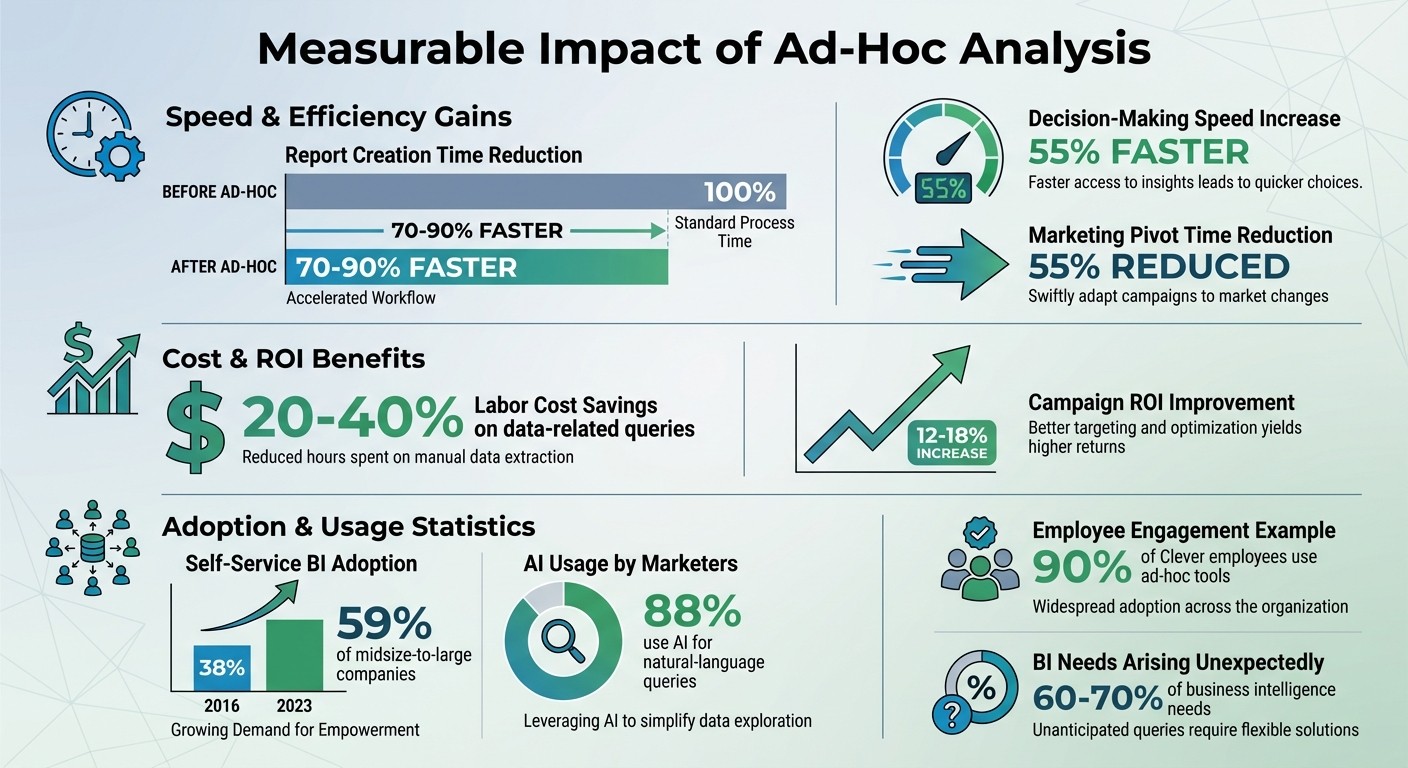
Ad-Hoc Analysis Benefits: Key Statistics and ROI Impact
Ad-hoc analysis offers practical advantages for organizations, especially those operating in fast-moving industries. For smaller data teams, it can translate into cost savings, a sharper competitive edge, and better use of resources. These benefits are driven by quicker decisions, greater flexibility, and stronger team collaboration.
Faster Decision-Making
Ad-hoc analysis builds on self-service reporting tools, allowing marketing teams to make quick, informed adjustments. Instead of waiting days - or even weeks - for IT to generate a custom report, teams can answer pressing questions in minutes. These tools can cut report creation time by up to 90% and speed up decision-making processes by over 50% [1][5]. For example, organizations using ad-hoc tools report a 55% reduction in the time it takes to make marketing pivots [1].
This speed has a direct impact on campaign performance. Marketing teams can reallocate budgets to high-performing channels within hours rather than waiting for quarterly reviews. This agility has been shown to boost campaign ROI by 12–18% [1].
Increased Agility and Responsiveness
Ad-hoc analysis enables teams to react immediately to market changes by diving into real-time data. Whether it’s addressing a sudden spike in customer churn, responding to a competitor’s move, or spotting an emerging product trend, these tools act like a real-time GPS for your business. Unlike static dashboards that focus on historical data, ad-hoc analysis helps uncover why something is happening right now [5][2].
This ability to pivot quickly brings measurable benefits. Teams equipped with self-service tools save on labor costs tied to manual data queries [5]. Additionally, data specialists are freed from routine reporting tasks, giving them more time to focus on strategic projects like predictive modeling and system design [1].
Better Collaboration Across Teams
Ad-hoc analysis breaks down silos by providing all teams access to consistent, reliable data. When marketing, sales, and product teams can query data in plain English, they align on a shared understanding of metrics. Tools like Querio ensure everyone is on the same page by standardizing definitions, such as what constitutes an "active user", through data dictionaries [7].
At Clever, an education technology company, 90% of employees now use ad-hoc tools for data exploration. They’ve even created a Slack channel called "Number Munchers" where team members share insights and tips [4].
"Ad hoc analysis is the bridge between seeing a number on a screen and understanding the story behind it. It provides the context needed to make confident, informed decisions rather than relying on assumptions." – Querio [2]
This approach is gaining momentum. By 2023, 59% of midsize-to-large companies had adopted self-service BI, up from 38% in 2016 [5]. As businesses face growing demands for speed and adaptability, ad-hoc analysis is becoming a must-have tool.
Conclusion
Ad-hoc analysis has proven to be a game-changer for businesses, offering customization, real-time insights, and self-service business intelligence capabilities that drive impactful decisions. By eliminating the need to wait for IT-generated reports, teams in marketing, sales, and finance can tackle urgent questions in minutes instead of weeks. This shift has made ad-hoc analysis an essential tool for addressing pressing business challenges [2].
The advantages are clear: faster decision-making, reduced costs, and the ability to adapt strategies in real time. Companies using self-service ad-hoc tools report labor savings of 20–40% on data queries [5]. With quicker access to critical insights, teams gain both speed and independence, enabling them to act on opportunities or challenges as they arise.
Querio simplifies this process by directly connecting to your data warehouse and translating plain English queries into accurate SQL and Python. Every result is transparent, governed by shared business logic, and protected by SOC 2 Type II standards, ensuring reliability and security. It's no surprise that 88% of marketers now leverage AI to uncover insights through natural-language queries [7], showcasing Querio's effectiveness in modern data analysis.
"Ad hoc querying bridges the gap between raw data and actionable insight. It transforms data from a historical record into a live, interactive resource for making smarter, faster decisions." – Querio [7]
From investigating unexpected churn to testing new hypotheses or responding to market shifts, ad-hoc analysis empowers teams to turn curiosity into actionable insights. With tools like Querio, curiosity doesn't just spark ideas - it drives meaningful action.
FAQs
When should I use ad-hoc analysis instead of a dashboard?
Ad-hoc analysis is perfect for tackling specific, urgent questions that standard dashboards or reports just don’t address. Whether you're investigating anomalies, digging into data spur-of-the-moment, or trying to understand unexpected issues - like a sudden dip in sales or the effects of a marketing campaign - this method shines. Unlike dashboards, which offer ongoing metric tracking, ad-hoc analysis delivers focused, rapid insights tailored to immediate decision-making needs.
What data do I need before running an ad-hoc analysis?
Before diving into ad-hoc analysis, it's crucial to collect data that directly ties to the business question you're trying to answer. This could involve pulling information from areas like sales figures, customer behavior patterns, or marketing campaign performance.
Make sure the data is accessible, detailed, and formatted for analysis - structured tables or organized databases work best. Starting with the right data not only simplifies the process but also ensures the insights you generate are precise and actionable.
How do I keep ad-hoc analysis secure and consistent?
To keep ad-hoc analysis both secure and consistent, it's crucial to establish solid data governance and security measures. Start by implementing role-based permissions to manage access effectively and block unauthorized queries. Tools like semantic layers and monitoring systems ensure that the data remains accurate and consistent across analyses. Additionally, conducting regular audits and maintaining oversight strengthens security while still allowing the flexibility needed for on-demand analysis.
Related Blog Posts