Mastering ad hoc reporting means for faster, smarter decisions
Explore ad hoc reporting means and how on-demand data fuels faster, smarter decisions for your team.
published
Outrank AI
ad hoc reporting, business intelligence, data analysis, self service BI, on-demand reporting
d4c0d065-fcc8-4593-9fcd-31b02f442e96

At its core, ad hoc reporting is about creating a report for a specific, one-time purpose. Think of it as generating insights on the fly to answer an immediate business question that just popped up, happening completely outside your normal reporting schedule.
What Ad Hoc Reporting Looks Like in Practice
Imagine your standard monthly report is like a printed road map. It gives you a great, reliable overview of the terrain you expected to cover. But what happens when you run into an unexpected roadblock or a massive traffic jam?
That's when you need an instant reroute. Ad hoc reporting is your GPS in this scenario. It gives you the real-time data you need to navigate the surprise obstacle.
The term ad hoc is Latin, meaning "for this." It perfectly captures the spirit of these reports—they are built for a particular, immediate need. They aren't planned out weeks in advance or part of your routine dashboard refresh. Instead, they’re sparked by a sudden question or an urgent problem that your standard reports just can't answer. A marketing manager might suddenly ask, “Why did our website traffic from social media plummet by 30% yesterday?” An ad hoc report is how they’d find the answer.
The Move Toward On-Demand Answers
This capability changes data from a static, historical record into a dynamic tool for active problem-solving. It gives teams across the entire company—from finance to operations—the power to dig into anomalies, test a new theory, or find answers on their own, without having to join a long queue for the data team. This move toward self-service analytics is a massive driver of business agility.
The rise of self-service BI tools has fundamentally changed how companies operate. By empowering non-technical users to access and analyze data directly, organizations can react to market changes faster and make more informed decisions at every level.
The pressure to make decisions faster has only accelerated this trend. In 2023, it was estimated that 59% of midsize-to-large companies had adopted self-service BI, which is the engine behind ad hoc reporting. That’s a huge jump from just 38% back in 2016 and shows a clear move away from the slow, IT-bottlenecked reporting of the past.
You can learn more about the key concepts that define ad hoc reporting and why it's becoming so critical. Ultimately, this on-demand approach isn't just a feature; it's a cultural shift toward making proactive, data-driven decisions every single day.
How Ad Hoc Reporting Differs from Scheduled Reports
It’s easy to get ad hoc and scheduled reporting mixed up, but they play very different roles in a smart data strategy. They aren't in competition; they're two sides of the same coin.
Think of your scheduled reports as a routine physical. They give you a consistent, predictable look at your company's health—things like monthly sales numbers, website traffic, or quarterly profits. They're built to monitor the metrics you already know are important, on a regular schedule.
Ad hoc reporting, on the other hand, is like going to a specialist when you notice something isn't right. It’s the tool you reach for when a manager sees a weird number in a standard report and asks, "Wait, why did our sales in the Northeast suddenly drop 15% last week?" You need a quick, targeted report to dig in and find answers now.
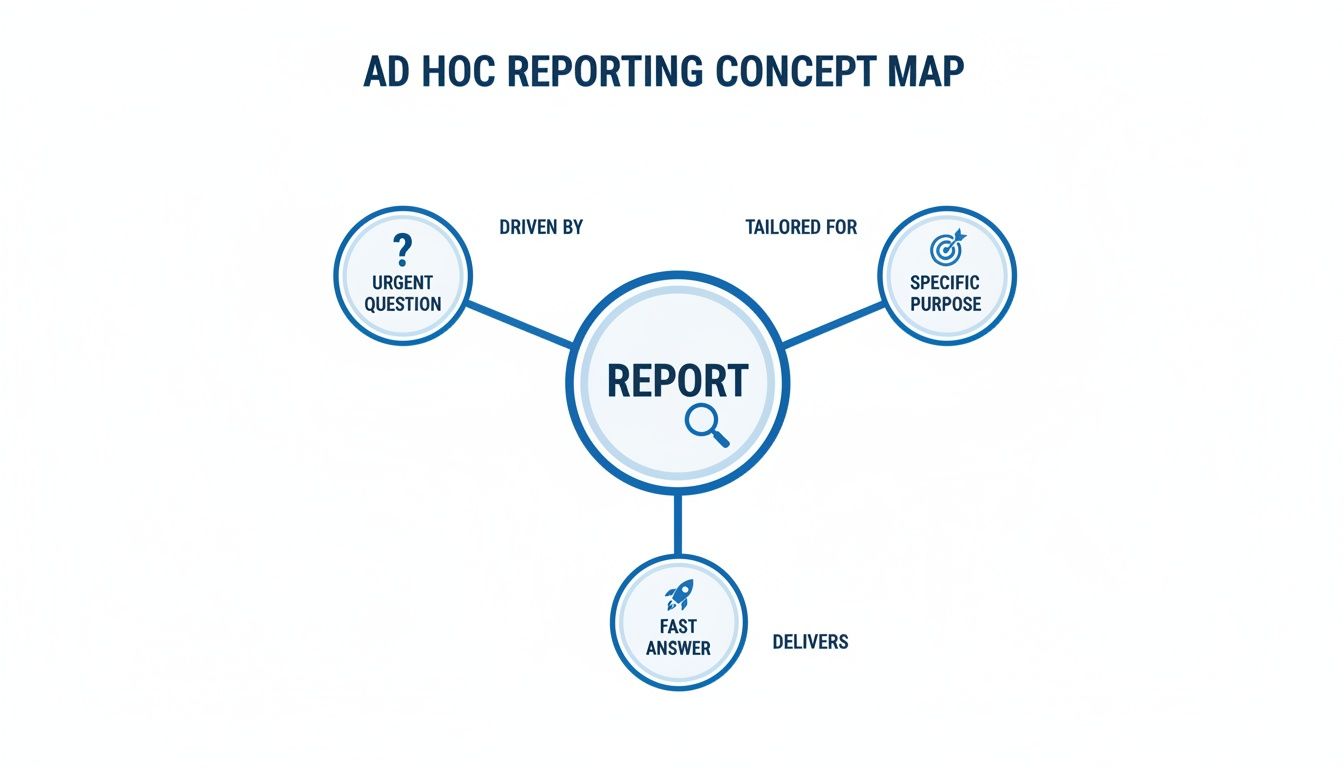
This process is all about reacting to the unexpected. It starts with a pressing question and ends with a specific insight you can act on immediately.
Ad Hoc Reporting vs Scheduled Reporting at a Glance
To really nail down the differences, it helps to put them side-by-side. The table below breaks down their distinct characteristics, from their purpose and frequency to the people who use them.
Characteristic | Ad Hoc Reporting | Scheduled Reporting |
|---|---|---|
Purpose | Investigation—answering specific, urgent business questions. | Monitoring—tracking established KPIs and business performance over time. |
Frequency | On-demand, created as needed when questions pop up. | Recurring, delivered on a fixed schedule (daily, weekly, monthly). |
Audience | Typically a small, specific group or even a single person. | A broad, consistent audience like a department or leadership team. |
Content | Highly flexible and customized to the specific question. | Static and standardized, with a predefined format and metrics. |
Lifespan | Short-term. Often a one-off report that serves its purpose and is done. | Long-term. Part of an ongoing series of reports for historical context. |
Trigger | An unexpected event, anomaly, or a new business question. | The passage of time (e.g., end of the week, end of the month). |
As you can see, one is for routine observation, while the other is for deep-dive problem-solving. A healthy data culture needs both to thrive.
The bottom line is simple:
Scheduled reports tell you what is happening. Ad hoc reports help you discover why it's happening.
One gives you the signal that something's up; the other gives you the insight to figure it out. By using scheduled dashboards to keep a steady pulse on the business and empowering teams with ad hoc tools, you get the best of both worlds: stability and agility.
How Ad Hoc Reporting Drives Real Business Value

Knowing the definition of ad hoc reporting is one thing. Understanding how it actually makes a business better is where the real magic happens. It’s the tool that shifts a company’s entire mindset from reactive to proactive, turning everyday curiosity into a genuine competitive edge.
The biggest, most immediate win? Speed.
Think about the old way: you have a question, you submit a ticket, and then you wait. Days, sometimes even weeks, go by while the swamped data team tries to get to your request. With ad hoc reporting, business users get their answers in minutes. This speed allows teams to jump on opportunities and fix problems as they happen, not after they’ve spiraled.
This speed isn't just a convenience; it translates directly into cost savings. Ad hoc reporting tools have been shown to slash report creation times by an average of 70–90%. And when your own team members can pull the numbers they need, you're looking at labor cost savings between 20–40% on those queries.
More Than a Tool, It’s a Cultural Shift
When you give teams direct access to data, the whole company dynamic changes. Your data analytics team is suddenly freed from the endless churn of small, repetitive report requests. They're no longer a bottleneck.
Instead, they can finally dedicate their expertise to the big, complex projects that move the needle—like building powerful data models or conducting predictive analysis to guide the company's future. The entire workforce becomes more data-savvy and agile.
Ad hoc reporting puts the power of inquiry directly into the hands of the people who know the business best. It creates a culture where anyone can investigate a hunch, test an idea, or challenge an old assumption with cold, hard data.
This capability is a fundamental piece of any modern data strategy. Ad hoc reporting is a crucial part of the bigger picture of business intelligence. If you want to understand that broader context better, it's worth reading up on What is Business Intelligence.
Ultimately, getting good at ad hoc reporting helps your business become:
More Agile: You can react instantly to market shifts or internal performance issues because you can find the root cause right away.
Smarter and Faster: Every team has the evidence they need to make confident decisions without getting stuck in a queue.
More Empowered: It builds a culture of ownership where people are encouraged to find their own answers and take action.
How Different Teams Win with Ad Hoc Reporting

The real value of ad hoc reporting isn't just a technical concept—it comes alive when you see how teams on the ground use it to solve urgent, real-world problems. It's the go-to tool for getting clarity when the stakes are high and time is running out.
Let's look at a few examples of what this looks like day-to-day.
From Marketing to Finance
Imagine you're a marketing manager, and you suddenly spot an alarming drop in lead conversions from one of your biggest ad campaigns. Your standard dashboard shows you what happened—conversions are down a whopping 40%—but it offers zero clues as to why.
Instead of filing a ticket with the data team and waiting, you jump in and run an ad hoc report. You ask a very specific question: "Which ad creative, demographic, and geographic area saw the biggest drop-off in the last 48 hours?"
Within minutes, the report pinpoints the problem. A single ad creative isn't rendering properly for users on a specific mobile device, and only in the Midwest. Armed with that insight, you can immediately pause that ad, fix the issue, and save the entire campaign from disaster.
Now, let’s switch gears to a finance team scrambling a few days before their quarterly board meeting. A sharp-eyed controller notices that the operational expenses (OPEX) are way over budget. Their scheduled reports show the variance but don't have the granularity to explain it.
The team needs answers, and they need them now. They generate an ad hoc report that breaks down OPEX by vendor, department, and transaction date for the entire quarter. The culprit becomes obvious: two large, unbudgeted software license renewals were processed in the same month by two different departments. It was a costly oversight. This discovery allows them to walk into the board meeting with a clear explanation and a plan to implement a new approval process to make sure it never happens again.
Ad hoc reporting transforms vague concerns into actionable insights. It allows the experts on the ground—in marketing, finance, or operations—to investigate anomalies immediately, using their domain knowledge to ask the right questions and find the root cause.
From Operations to Product
Finally, picture an operations lead at an e-commerce company. Customer complaints about shipping delays are piling up, but the high-level logistics dashboard doesn’t show where the bottleneck is.
The ops lead pulls an ad hoc report to dig into the entire fulfillment process. She asks: "Which stage of the order-to-delivery cycle is taking the longest, and which warehouse is most affected?" The report isolates the problem to the "picking and packing" stage, but only at their largest distribution center. With this specific data, she can reallocate staff to that warehouse and investigate their workflow for snags, directly tackling the delay.
In every one of these cases, ad hoc reporting is about getting the right slice of data to the right person at the exact moment they need it. It bridges the critical gap between spotting a problem and actually understanding it, helping teams make faster, smarter decisions that protect revenue, control costs, and keep customers happy.
Building a Framework for Successful Ad Hoc Reporting
Just handing your team a powerful ad hoc reporting tool isn't enough. To get real value, you need to build a framework that supports and encourages curiosity, all while making sure the answers people find are actually accurate and trustworthy.
Without a solid foundation, even the best software can quickly create data chaos. This foundation really comes down to four key pillars: solid governance, the right tools, smart data modeling, and ongoing user training. Get these right, and you turn a simple tool into an engine for growth.
The Foundation: Trustworthy Data
The absolute bedrock of any good reporting system is data governance. Think of it as the rulebook that ensures your data is high-quality, consistent, and secure. If your marketing team defines an "Active User" one way and your product team defines it another, their ad hoc reports will create conflicting numbers and undermine everyone's trust in the data.
Strong governance is all about establishing a single source of truth. It means everyone works from the same validated data models and agrees on a shared set of definitions.
Ad hoc reporting thrives on freedom, but that freedom must be built on a foundation of control. Governance provides the guardrails that allow users to explore data safely and confidently, knowing the numbers they pull are accurate.
This structure is what prevents the "wild west" of data, where anyone can pull reports from unverified sources, leading to mass confusion and bad decisions.
Empowering Users the Right Way
Once your data is in a good, trustworthy place, the next step is to empower your team. This really boils down to two things: choosing the right tools and providing great training. A tool that's too complex for a non-technical user is just an expensive paperweight.
The ideal solution hits that sweet spot between power and usability. It needs an intuitive interface that lets a business user ask a question and build a report without having to learn code. But the tool is only half the battle.
Effective training is what drives adoption. People need to feel confident and understand:
How to use the tool: The basic mechanics of filtering data, creating a chart, and sharing what they've found.
What data is available: Where to find the information they need and what the different fields and metrics actually mean.
How to ask good questions: Training should help them frame specific, answerable questions that lead to clear, useful insights.
This whole process is a cornerstone of building a self-sufficient data culture. For a deeper dive, check out our beginner's implementation guide to self-service analytics.
Ultimately, a successful ad hoc reporting setup isn't just about buying software. It’s about creating an entire environment where trusted data is easy to access for trained users who have the right tools to turn their natural curiosity into genuinely actionable insights for the business.
The Future of Ad Hoc Reporting with AI
Ad hoc reporting gives teams the power to ask specific, one-off questions. But what happens when you give that capability a brain? That's exactly what's happening as artificial intelligence moves on-demand analysis from a manual, drag-and-drop process into a genuine conversation with your data. This is the next leap forward in making deep insights accessible to everyone, not just data specialists.
The biggest shift is the rise of Natural Language Query (NLQ). Instead of wrestling with complex menus and filters, anyone can simply ask a question in plain English. Imagine an operations manager just typing, "Show me our top 10 products by profit margin in California last quarter," and getting an instant, accurate visualization. This finally tears down the technical barrier between a business question and its answer.
AI as an Analytical Partner
Modern AI doesn't just sit around waiting for you to ask the right question. It’s becoming a proactive partner, constantly sifting through your data to find patterns and anomalies you might have missed entirely. An AI-driven BI platform can flag a sudden dip in customer engagement or uncover a surprising correlation between two marketing channels, effectively telling you where to dig deeper.
AI transforms ad hoc reporting from a reactive tool for answering known questions into a proactive engine for discovering unknown opportunities. It becomes a partner in the analytical process, guiding users toward more meaningful insights.
This whole evolution is supported by technologies that improve the entire data pipeline. For instance, AI-powered data extraction engines can drastically speed up the process of gathering information and improve its accuracy before it even gets to your report.
For any business trying to empower its teams, this is a total game-changer. It means your product managers, marketers, and finance experts can all conduct sophisticated analyses without needing a data science degree. If your data team is drowning in requests, learning how to reduce ad hoc analysis bottlenecks with AI is the clear next step.
Ultimately, the future of ad hoc reporting points to deeper insights, faster answers, and a truly data-driven culture where anyone's curiosity can spark the next big breakthrough.
Got Questions About Ad Hoc Reporting? We’ve Got Answers.
As teams start to embrace on-the-fly analysis, a few key questions always pop up. Getting these sorted out from the beginning is crucial for building a solid, confident ad hoc reporting culture.
Let’s tackle some of the most common ones head-on.
"Is Ad Hoc Reporting Secure?"
Absolutely—as long as you set it up thoughtfully. Modern business intelligence platforms are designed with security as a foundational layer, not an afterthought. They come packed with powerful features like role-based access controls, which act like a digital gatekeeper for your data.
This is what allows a marketing manager to dig into campaign performance without ever laying eyes on sensitive HR records. The secret sauce is a strong data governance policy that clearly defines who can see what. Get that right, and your data stays locked down.
"Do I Need to Be a Tech Whiz to Run These Reports?"
Not like you used to. In the not-so-distant past, pulling a custom report meant you needed to know SQL or have a data analyst on speed dial. Thankfully, those days are over. Today’s self-service BI tools have democratized data, making ad hoc analysis available to just about anyone.
The real power of modern ad hoc reporting is putting insights directly into the hands of the person who knows the business best—not just the person who knows the most code.
Tools with simple drag-and-drop builders or AI assistants that understand Natural Language Query (NLQ) have been game-changers. Now, anyone can get answers just by asking questions in plain English. With a little bit of initial training, your business users will be off and running their own analyses.
"Will Ad Hoc Reports Make Our Standard Dashboards Obsolete?"
Not at all. Think of them as two different tools in your toolbox, each with a specific job. They’re partners, not competitors.
Standard Dashboards are your car's dashboard. They give you a constant, at-a-glance view of your most important metrics (your KPIs). They answer the question, "How are we tracking against our goals?"
Ad Hoc Reports are what you use when a warning light comes on. They’re for digging deeper into specific, unexpected events that your dashboard might have flagged. They answer the follow-up question, "Why did that number suddenly spike?"
A truly data-driven organization relies on both. You need the steady, high-level overview from your dashboards and the focused, deep-dive capability of ad hoc reports to get the full picture.
Ready to empower your teams with fast, reliable answers? Querio’s AI-powered platform lets anyone ask questions in plain English and get trusted insights in seconds. Explore Querio today.