Guide
Analytics as Service: What It Actually Is and How to Choose
Analytics as Service. Understand analytics as a service, explore managed versus self-serve models, and learn how to choose the right path for your data team
The request arrives marked “simple”: add a dashboard, confirm a trend, break down a segment. Your analysts already have a queue full of similar requests. Every answer depends on locating the right tables, checking definitions, validating the numbers, and explaining the result. By the time the report is ready, the business question has changed.
That's the operational problem behind the growing interest in analytics as a service. Companies aren't buying another charting tool just to make prettier dashboards. They're looking for a way to expand access to reliable analysis without expanding infrastructure, maintenance work, and analyst headcount at the same pace. The decision can be smart, but only when leaders examine what they're giving up in exchange for speed and convenience.
Table of Contents
- The Data Team Bottleneck Problem
- What Analytics as a Service Actually Means
- Managed Service versus Self-Serve Delivery Models
- Hidden Barriers to Adoption After Purchase
- Cloud Infrastructure as the Foundation
- When to Choose AaaS and When to Build In-House
The Data Team Bottleneck Problem
A product manager needs engagement data before a planning meeting. Finance wants a revenue view that uses a different customer definition. Sales asks for a list of accounts that changed behavior. Each request sounds manageable on its own, yet the data team has to investigate the source systems, reconcile metrics, write queries, test the output, and explain the limitations.
The backlog grows because analysts become a human API. They spend their time translating business questions into one-off reports instead of improving the data model, defining trusted metrics, or building reusable workflows. Business users wait, then create spreadsheets and unofficial dashboards when the wait becomes unacceptable.

Why the queue keeps expanding
The bottleneck usually isn't a lack of intelligence on the data team. It's a mismatch between demand and delivery. More teams want timely answers, while every answer still passes through a small group of people who understand the warehouse, business logic, permissions, and reporting tools.
A platform or managed analytics provider can absorb part of that demand. It can give business users governed access to approved data, reusable metrics, dashboards, and exploratory analysis. That doesn't remove the need for analysts. It changes where their effort goes.
Practical rule: If analysts answer the same question repeatedly, the organization has a system-design problem, not a productivity problem.
The right response isn't to hand every employee unrestricted database access. That creates security risks, inconsistent definitions, and more support work. The better approach is to expose trusted data products that let users answer routine questions while keeping sensitive logic and governance under data-team control.
For teams trying to escape this pattern, this practical guide to stop being the data team bottleneck offers a useful framing. The important question is whether a service can reduce repetitive work without hiding the underlying trade-offs.
What Analytics as a Service Actually Means
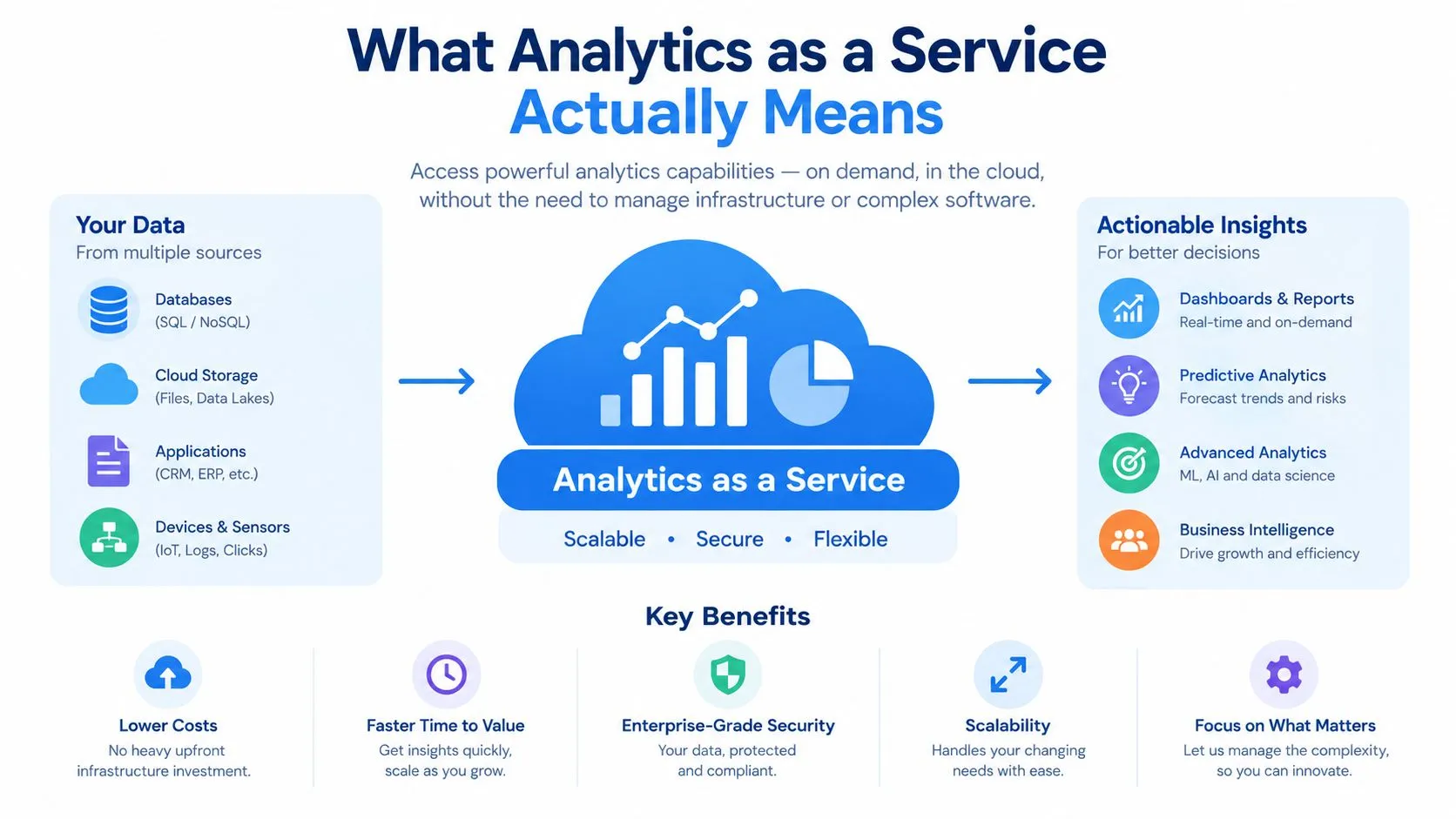
Analytics as a service is typically a cloud subscription or on-demand platform connected to data warehouses, operational databases, and other business sources. The service centrally handles capabilities such as data processing, machine learning, dashboards, and reporting, while users consume the resulting analytics through managed interfaces. Insightsoftware's explanation of analytics as a service describes this delivery model and its emphasis on avoiding underlying infrastructure management.
The distinction matters. A conventional BI license may give you visualization software, but your team still has to maintain pipelines, provision compute, manage upgrades, secure access, and support the environment. AaaS shifts some of that operational burden to the provider or platform. You're paying for an analytics capability, not merely a chart editor.
What you're actually outsourcing
AaaS can cover several layers:
- Infrastructure: Compute, storage, availability, and platform maintenance.
- Processing: Transformation and preparation of data for analysis.
- Analytics capabilities: Dashboards, reporting, machine learning, and increasingly natural-language interaction.
- Access management: Permissions, workspace controls, and governed distribution.
- Scaling: Adjusting workloads as more users, data, or analytical tasks arrive.
Those layers don't always come from one vendor. Some providers deliver a fully managed service, while others offer a self-serve platform that leaves configuration and governance with your team. That distinction becomes critical when you evaluate sovereignty, latency, customization, and integration work.
The category is expanding beyond standalone BI. Fortune Business Insights estimates that the global analytics-as-a-service market reached USD 12.75 billion in 2025 and projects USD 99.90 billion by 2034, representing a projected 25.70% CAGR from 2026 through 2034 in its forecast. The same market analysis also reflects the broader shift toward outsourced analytics infrastructure and flexible consumption.
Another estimate places the market at USD 13.3 billion in 2024 and forecasts USD 39.8 billion by 2029, as reported in the same market source. The exact market boundary varies by researcher, but the direction is consistent. Buyers are treating analytics delivery as an operating capability that can be consumed from a platform rather than assembled entirely in-house.
The embedded analytics market reinforces that direction. Mordor Intelligence forecasts estimates ranging from USD 89.25 billion in 2026 to USD 169.18 billion by 2031 at a 13.65% CAGR, and another range from USD 26.88 billion in 2026 to USD 86.2 billion by 2034 at a 15.68% CAGR. These projections are summarized in Mordor Intelligence's embedded analytics market coverage. The practical implication is clear: analytics increasingly belongs inside the workflows where decisions happen, not only in a separate reporting portal.
This overview of a SaaS analytics platform provides further context on how these systems fit into modern data operations.
Managed Service versus Self-Serve Delivery Models
The choice between managed and self-serve delivery isn't a choice between “easy” and “technical.” It's a choice about where operational responsibility lives.
With a managed service, the provider handles much of the infrastructure, maintenance, and workload scaling. Your team defines requirements, supplies access to data, and consumes the results. This model works well when speed matters more than deep control and the organization doesn't have enough engineering capacity to operate another production system.
A self-serve platform gives your organization more direct control. Your team configures connections, defines permissions, manages semantic logic, and decides how users build analyses. You retain more responsibility, but you also retain more flexibility when the business needs unusual workflows or close alignment with an existing warehouse.
The trade-off in one view
| Factor | Managed Service | Self-Serve Platform |
|---|---|---|
| Time to initial value | Usually faster because the provider operates more of the stack | Depends on internal setup and integration capacity |
| Operational overhead | Lower for infrastructure and routine maintenance | Higher because your team owns more configuration and support |
| Customization | Can be constrained by provider capabilities and service boundaries | Greater control over workflows, logic, and user experience |
| Data control | Requires careful review of residency, access, processing, and retention terms | More direct control over where data stays and how it's accessed |
| Governance | Provider may supply controls, but your team still owns policy decisions | Your team designs and operates the governance model |
| Vendor dependence | Higher if proprietary models, metadata, or workflows accumulate | Lower in some areas, although platform choices still create dependencies |
| Scaling | Provider handles more workload management | Your team manages capacity, performance, and configuration |
| Best fit | Lean teams prioritizing speed and reduced maintenance | Teams with technical capacity and demanding control requirements |
Don't confuse self-service with no governance
Self-service analytics only works when users can discover data without inventing their own definitions. That requires clear ownership, documented metrics, sensible access policies, and a mechanism for correcting bad source data.
The managed model can accelerate deployment, but it doesn't make governance disappear. A vendor can enforce technical permissions, yet your organization still has to decide who may access customer records, which revenue definition is official, and how long analytical outputs should remain available.
Decision test: Choose managed delivery when the cost of maintaining the stack is greater than the value of owning every layer. Choose self-serve when control over data behavior is central to the product, compliance posture, or operating model.
For companies building internal capability, this beginner's implementation guide to self-service analytics is a useful starting point. Don't select a model based on the demo. Map the responsibilities that begin after procurement, then confirm that someone has the capacity and authority to own each one.
Hidden Barriers to Adoption After Purchase
The purchase decision is often the easy part. The difficult work begins when the platform meets real data, real permissions, and real users.
Integration is the first shock. An AaaS platform may connect cleanly to a modern warehouse, yet still require substantial work to reconcile legacy databases, application exports, event streams, and undocumented transformations. A connection is not the same as a usable analytical model. If customer identifiers differ across systems, the service will reproduce that inconsistency faster than your team can resolve it.
Data quality creates the second problem. Missing fields, duplicate records, late updates, and changing definitions undermine trust. Users don't judge the platform by its architecture. They judge it by whether the answer to a familiar business question matches what they already know.

The risks that deserve attention
Security and compliance require more than checking whether a vendor has standard certifications. Ask where data is processed, which regions store it, how access is logged, whether support staff can view it, and how deletion requests work. Data sovereignty becomes especially important when legal or contractual requirements restrict where information may reside.
Latency also deserves a specific test. If a decision depends on near-real-time operational data, a service that copies data into a separate environment may introduce delays that make the analysis less useful. If the platform queries source systems directly, it may create workload contention or unpredictable response times.
Market coverage identifies integration complexity, data quality, security, and unclear ROI as persistent barriers to adoption. Precedence Research's analytics-as-a-service market summary discusses these recurring obstacles. Mordor Intelligence also highlights data sovereignty, hybrid and multi-cloud adoption, and explainability concerns, particularly where governance requirements affect deployment decisions.
Use a simple post-purchase checklist:
- Integration ownership: Name the person accountable for each source connection and transformation.
- Data-quality controls: Define how users report incorrect results and how fixes are verified.
- Residency review: Document permitted processing regions before sensitive data enters the service.
- Latency testing: Test representative workloads, not only clean demo data.
- ROI definition: Measure reduced manual work, faster decisions, or broader access using agreed operational indicators.
Change management matters because users must trust the new workflow. This guide to analytics change management is relevant for organizations moving people away from familiar spreadsheets and ticket-based reporting.
Cloud Infrastructure as the Foundation
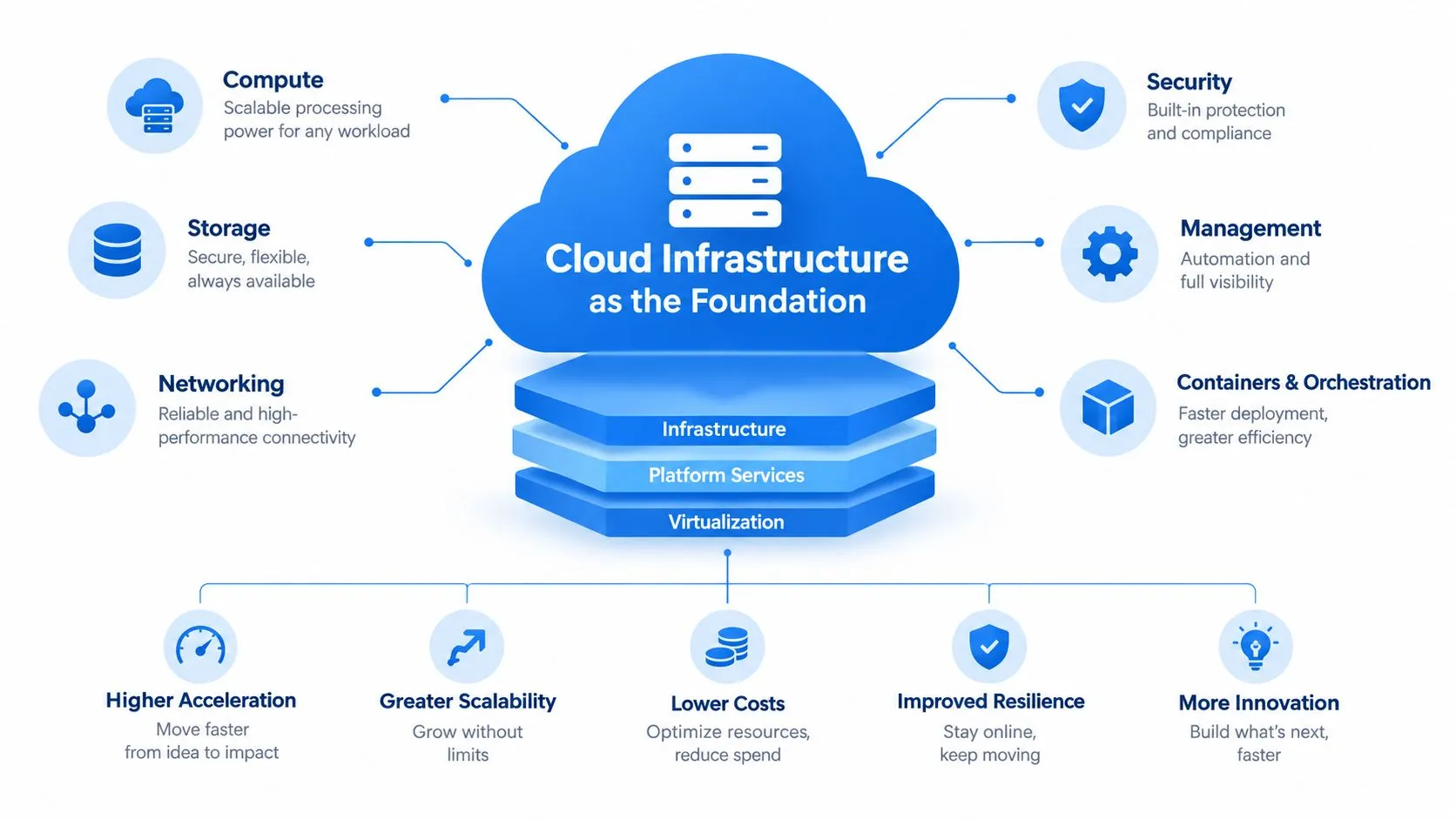
Analytics as a service gained traction because the surrounding infrastructure became easier to consume. Centralized cloud data, remote access, elastic compute, and delegated platform management created the conditions for analytics services to sit on top of existing systems.
BARC reported that cloud business intelligence and data-management usage rose by 50% over three years, increasing from 29% to 43%, according to its research on BI and data management in the cloud. That shift matters because organizations already moving analytical workloads into hosted environments face fewer barriers to consuming analytics through another managed layer.
A separate 2024 PwC cloud and AI survey found that 74% of organizations had most of their middle-office data in the cloud, while 79% had most of their back-office data in the cloud. Those figures are included in the same BARC research reference. The data foundation is increasingly remote, centralized, and accessible through controlled interfaces.
The infrastructure advantage has limits
Cloud adoption reduces some friction, but it doesn't resolve architectural mismatch. A company may have cloud data and still lack consistent schemas, reliable lineage, or acceptable access controls. Moving the location of data doesn't automatically make the data ready for self-service analytics.
The most effective teams treat the cloud warehouse as a governed foundation rather than a dumping ground. They establish source ownership, standardize important entities, and separate raw data from trusted analytical models. AaaS then becomes a delivery layer over a foundation that people can understand and manage.
Cloud makes analytics easier to distribute. It doesn't make unreliable data trustworthy.
Leaders should also examine how the service interacts with existing cloud commitments. A platform that duplicates data may increase storage and transfer costs. One that queries the warehouse directly may simplify lineage but compete for compute. A service that runs analytics in its own environment may offer specialized capabilities while increasing sovereignty and integration review.
The practical conclusion is straightforward. Cloud readiness is a strong prerequisite for AaaS, but it isn't a substitute for data architecture. Before signing, trace one important metric from its source system through transformation, permissioning, query execution, and final presentation. Any unclear handoff is a future adoption problem.
When to Choose AaaS and When to Build In-House
Choose analytics as a service when your main constraint is delivery capacity. It's a sensible move for a lean data team that needs to launch quickly, support more business users, and avoid operating another complex analytics stack. It also fits organizations whose requirements change frequently and where flexible access matters more than deep platform customization.
A managed service is particularly attractive when the data is suitable for hosted processing, governance requirements are straightforward, and the provider can demonstrate acceptable latency on representative workloads. In that situation, outsourcing infrastructure and maintenance lets internal specialists focus on modeling, decision support, and higher-value analytical work.
Build or retain more of the stack in-house when control is the primary requirement. That includes strict data-sovereignty rules, sensitive datasets, demanding latency requirements, complex authorization models, or analytical workflows that depend on custom code and organization-specific logic.
Use constraints, not fashion
Ask these questions before deciding:
- Where must the data remain? If the answer is tightly defined by law, contract, or policy, eliminate services that can't meet those conditions.
- How quickly must results arrive? Batch reporting and operational decisioning have different architecture requirements.
- Who will own metric definitions? If no team can maintain the semantic layer, self-service will produce confusion regardless of the product.
- What happens when the provider changes terms or features? Review export options, metadata portability, and exit procedures.
- Which work should analysts stop doing? AaaS earns its place when it removes recurring manual effort, not when it adds another interface.
For mid-market companies, a self-serve platform connected directly to the existing warehouse can provide a middle path. Querio, for example, uses AI coding agents on connected data warehouses and lets technical and non-technical users work with company data through plain-English questions, SQL, Python, notebooks, and analytical workspaces. That approach keeps more analytical work close to the organization's existing data environment while reducing dependence on individual analysts for routine exploration.
The right answer isn't “always outsource” or “always build.” Choose AaaS when speed and reduced maintenance outweigh the need for control. Keep ownership in-house when sovereignty, latency, governance, or customization are business-critical constraints. Put those criteria in writing before a vendor demo, and you'll evaluate the operating model instead of being persuaded by the interface.
If your data team is buried in repetitive requests, Querio provides a self-serve workspace that connects to existing warehouses and supports analysis through plain-English questions, SQL, Python, and notebooks. Visit Querio to assess whether a warehouse-connected approach can reduce analyst bottlenecks while preserving the control your data environment requires.