Business Intelligence
Wren AI vs Vanna AI: Open-Source Text-to-SQL Compared
Open-source Text-to-SQL compared: semantic-layer governance vs retrieval-based developer workflows, failure modes, and maintenance.

If I had to pick fast: I’d choose Wren AI for governed analytics teams, and Vanna AI for developer-built app workflows. That’s the short answer.
Here’s why:
- Wren AI is still an active open-source project.
- Vanna AI’s main GitHub repo was archived on March 29, 2026, which changes the open-source story right away.
- Wren AI leans on a semantic layer, so teams define business terms like MRR, churn, and active customer before SQL gets written.
- Vanna AI leans on retrieval, examples, and docs, so output depends more on what your team has written and kept up to date.
- In testing, the split was less about SQL syntax and more about failure mode:
- Wren AI fails on missing semantic coverage
- Vanna AI fails on stale schema context and stale training data
- Benchmark claims were not used as the truth source. That matters because a 2026 CIDR paper found annotation error rates of 52.8% in BIRD and 66.1% in Spider 2.0-Snow.
Put simply: Wren AI gives you tighter control over metric definitions, while Vanna AI gives developers more room to build their own workflow. But neither tool removes setup work, review, or SQL validation.
What this comparison covers:
- Warehouse support
- Semantic modeling vs retrieval
- SQL accuracy on the same prompts
- Setup effort
- Maintenance load
- Fit for analyst self-serve, internal assistants, and app teams
Wren AI: The Context Layer That Teaches AI Agents Your Database
::: @iframe https://www.youtube.com/embed/ll7dZxSwHko :::
Quick Comparison
::: @figure 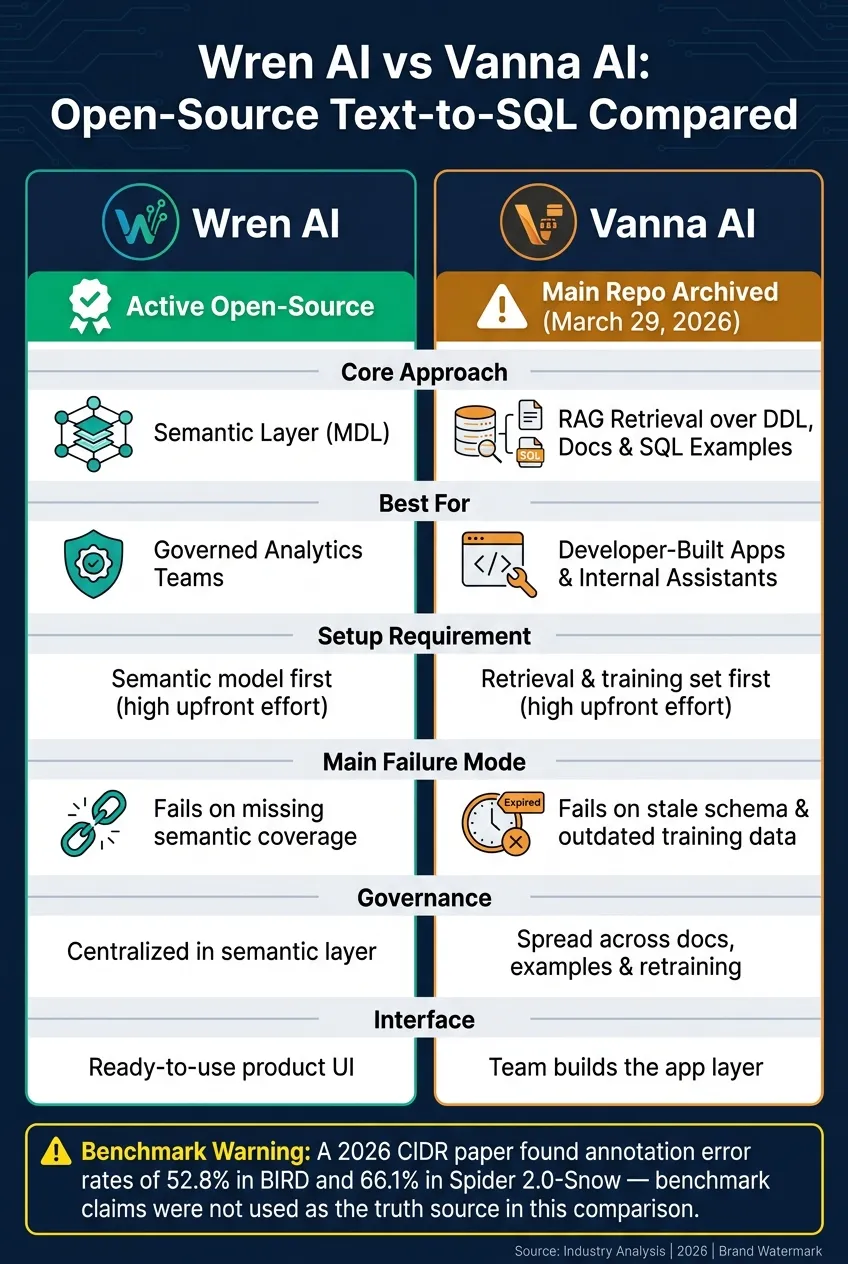 {Wren AI vs Vanna AI: Open-Source Text-to-SQL Comparison}
:::
{Wren AI vs Vanna AI: Open-Source Text-to-SQL Comparison}
:::
| Criteria | Wren AI | Vanna AI |
|---|---|---|
| Open-source status | Active | Main repo archived read-only |
| Core approach | Semantic layer | Retrieval over DDL, docs, and SQL examples |
| Best for | Governed analytics | Embedded app and assistant use cases |
| Setup | Semantic model first | Retrieval and training set first |
| Main risk | Missing business definitions | Outdated schema and examples |
| Interface | Ready-to-use product path | Team usually builds the app layer |
| Governance | Centralized | More spread across docs and training data |
So if you want warehouse-native self-serve with fixed business definitions, Wren AI is the better pick. If you want text-to-SQL inside your own product or internal tool, Vanna AI makes more sense - with the tradeoff that your team owns more of the app and review layer.
How Wren AI Works and Where It Fits
Wren AI is a governed GenBI system built to turn business questions into SQL and analytics based on your semantic model. That detail matters because Wren’s output is only as good as the match between its semantic layer and the logic in your warehouse.
Wren AI Architecture: Semantic Model, SQL Planning, and Database Support
Wren AI’s MDL semantic layer maps business terms like revenue, churn, and active customer to warehouse tables, joins, and metrics before SQL is generated. Instead of asking the model to guess meaning from raw column names, you define that meaning first. Wren then uses those definitions to plan and run SQL.
It connects to major warehouses, including Snowflake, BigQuery, Redshift, PostgreSQL, Databricks, and Trino. It also works with OpenAI, Claude, Gemini, and local Ollama models [1][2]. The flow is direct: business term → MDL mapping → SQL planning → warehouse execution.
Where Wren AI Is Strongest
Wren AI does its best work on complex, multi-join analytical queries. That’s the kind of query where prompt-only systems often break down, especially on joins and table selection [1]. So if you’re testing multi-table revenue, churn, and conversion prompts, this is the kind of setup where Wren should shine.
It also fits well for teams already using dbt models. MDL semantic definitions can line up with business logic your team may already have in place. That work up front helps keep metrics and definitions steady over time instead of drifting from one dashboard or query to the next.
What Wren AI Requires to Run Well
Wren AI needs semantic modeling up front before it becomes dependable. Put simply, it works best when a team is willing to do governance work early.
Someone on your team has to build and maintain the MDL semantic layer. That means documenting business terms, mapping relationships, and keeping definitions aligned as the warehouse and dbt models change. A good way to start is to keep the scope tight:
- Begin with a small, well-documented set of tables
- Build a golden-query library for common questions
- Test ambiguous prompts and measure accuracy so the system learns to refuse a guess
The self-hosted setup also means your team owns the whole stack, from model routing and authentication to the user interface. That gives you more control, but it also makes Wren AI a higher-maintenance option. Vanna AI takes a lighter, more framework-led path, which makes the tradeoff easier to compare in the next section.
How Vanna AI Works and Where It Fits
Vanna AI uses retrieval over DDL, documentation, and example SQL pairs instead of a prebuilt semantic layer. When someone asks a question, Vanna pulls the most relevant schema context and example queries from a vector database, then sends that context to an LLM to generate SQL[1][2].
That makes the biggest difference when your documentation and examples spell out fuzzy business terms like "active customer." If that term means one thing to finance and another to product, Vanna can do a much better job when those definitions already live in the materials it retrieves. That’s the same type of prompt used in the text-to-SQL comparison above.
Vanna AI Architecture: Python Framework, RAG Training, and Integrations
Vanna is a Python framework trained on three inputs:
- Your DDL
- Plain-language documentation
- Example question-SQL pairs
Those artifacts are stored in a vector database and retrieved at query time so the LLM gets schema context tied to your setup. Vanna 2.0, released in late 2025, added identity management, row-level security, audit logging, and rate limiting[1][2].
The main open-source GitHub repository, vanna-ai/vanna, was archived as read-only on March 29, 2026, as the project moved toward a commercial and hosted focus[1].
Where Vanna AI Is Strongest
Vanna fits best in embedded apps, internal assistants, and developer-built BI workflows. It tends to work best when your team already controls the app, the identity layer, and the workflow around it.
Put simply: if you already have the plumbing in place, Vanna can slot into that setup without forcing you into a fixed BI model.
What Vanna AI Leaves to Your Team
Your team still handles data curation and validation. That includes checking joins, filters, business definitions, and row counts before trusting output in production[3].
Vanna 2.0 added governance features that help, but the day-to-day work doesn’t disappear. Teams still need to manage review, access, and updates. That’s where the tradeoff shows up: Vanna can help generate SQL, but your team still has to make sure the answers are right.
Wren AI vs Vanna AI: Feature Comparison, Failure Modes, and Maintenance
Feature-by-Feature Comparison Table
These two setups lead to very different ownership patterns in production. On the same schema and the same sample questions, the split shows up in how each tool fails and who has to fix it. You see that most clearly in day-to-day maintenance and failure handling.
| Feature | Wren AI | Vanna AI |
|---|---|---|
| Core mechanism | MDL semantic layer | RAG with DDL, docs, and SQL pair training |
| Schema retrieval | Semantic-layer planning | Retrieval from a vector store at query time |
| Example SQL training | Not required | Required as part of training |
| Governance and traceability | Centrally defined metrics and inspectable SQL | Depends on training set quality and SQL traceability |
| Setup complexity | High - requires upfront semantic modeling and testing | High - requires building retrieval and a UI harness |
| Maintenance burden | Update the semantic layer as business logic changes | Curate and refresh the training set as schemas change |
| Best-fit team | Analytics teams needing governed, consistent metrics | Developer teams building custom internal assistants |
Same Questions, Different Failure Modes
On the same warehouse questions, the main split isn't SQL syntax. It's where the system breaks.
Both tools can produce SQL that runs fine but is still logically wrong. These are observed failure patterns, not benchmark scores.
Wren AI's failure mode is coverage. If a business concept isn't defined in the semantic layer, the tool either fails closed or makes a guess. Multi-join paths can also break down when the semantic model doesn't clearly define the join route. The upside is simple: fix the semantic model once, and that fix carries across the system.
Vanna AI's failure mode is staleness. If your schema changes and the training set doesn't get updated, Vanna can keep writing SQL against an old structure. The query may still run. That's the tricky part. It can return an answer that looks fine but is wrong underneath. That's a much harder problem to spot.
Both tools also share one risk: ambiguous metric interpretation. If "active customer" means one thing to finance and another thing to product, neither tool clears that up by itself. Wren handles this better by design, but only when someone defines the metric clearly in the semantic layer. Vanna handles it through documentation and example pairs, so output quality depends heavily on input quality.
That leads straight to the next issue: who owns the cleanup work after deployment.
Implementation and Maintenance Responsibilities Table
| Responsibility | Wren AI | Vanna AI |
|---|---|---|
| Semantic modeling | Team builds and maintains MDL semantic layer | Team writes documentation and SQL pair examples |
| Vector store operations | Not applicable | Team manages and refreshes the vector database |
| Schema refresh | Update the semantic model | Update DDL and retrain the vector store |
| Ongoing governance | Centralized in the semantic layer | Spread across documentation, examples, and retraining |
Neither tool removes engineering work. Wren AI pushes more of that work to the front through semantic modeling. Vanna AI spreads the effort across documentation updates and retraining.
That's the setup tradeoff at the center of the decision. For a broader look at the market, see our comparison of text-to-SQL tools. With that in mind, the next step is choosing the tool based on team structure and use case.
Which Tool to Choose for Your Analytics Team
The choice here comes down to your operating model: governance-first analytics or developer-built retrieval. Wren AI is the governed choice; Vanna AI is the flexible one. You see that tradeoff most clearly in the kinds of teams they serve and the way those teams work day to day.
Best Fit by Use Case
Analyst self-service on Snowflake or BigQuery is where Wren AI pulls ahead. If non-technical users need consistent answers to business questions like revenue by segment, churn by cohort, or active customers, Wren’s semantic layer keeps those answers aligned. The same business term points to the same definition each time, which cuts down on confusion and back-and-forth.
Internal AI data agents are where Vanna AI has an edge. If your engineering team wants to connect an assistant to Postgres or Redshift and manage the retrieval pipeline directly, Vanna’s Python framework gives them that control. It’s a better match for teams that want to build the system their own way instead of working inside a preset setup.
Where Querio Fits for Governed, Warehouse-Native Self-Serve
If your team needs governed self-serve on live warehouse data, not a custom framework, the decision shifts a bit. Querio is worth a look when you need a governed context layer, inspectable and editable SQL and Python, and live warehouse connections to Snowflake, BigQuery, Redshift, or Postgres - without spending months building it yourself.
That said, it’s not the right pick for teams that want a programmable framework or want to self-host every part of the stack. For data leaders who want governed self-serve without piecing it together from scratch, it’s a strong option.
Final Decision Checklist for Text-to-SQL Tools
Before you commit, line up on a few practical questions with your team:
- Who owns metric definitions? Wren centralizes them in the semantic layer. Vanna depends on the quality of your training data and documentation.
- Do non-technical users need a ready-to-use interface? Wren provides one. Vanna requires your team to build it.
- What governance and auditability does your org require? Wren’s centralized model is easier to standardize. Vanna depends more on your team keeping the retriever and examples up to date.
- Who maintains the system after launch? Wren needs semantic model updates. Vanna needs refreshes to its retrieval setup and training pairs - and its repository is archived read-only [1].
FAQs
::: faq
How much setup work does each tool require?
Both Wren AI and Vanna AI take a fair amount of engineering work. That’s because they’re developer-first frameworks, not plug-and-play apps.
So your team doesn’t just install them and move on. You need to set up, host, and maintain the full stack around them, including:
- the LLM
- the vector database
- database connections
- the user interface
And the work doesn’t stop after launch.
You’ll also need ongoing upkeep to keep training data, schema definitions, and business rules in sync with your changing data setup. If your data environment shifts, these systems need to shift with it too. :::
::: faq
Which tool is safer for non-technical users?
For non-technical users, Wren AI is generally the safer pick than Vanna AI.
Why? Wren AI is described as an actively maintained, self-hosted option with a business semantic layer. That matters because the semantic layer helps stop the system from guessing metric definitions, which can reduce confusion and bad answers.
Vanna AI, on the other hand, tends to fit more technical teams. It works best when a team can keep training data and schema alignment up to date and handle the open-source workflow without things slipping out of sync. :::
::: faq
How often do I need to update the model or training data?
You need to keep the training data up to date so it stays aligned with your warehouse schema, dbt models, and business logic.
These tools depend on retrieval-augmented generation, so their accuracy comes down to one simple thing: how closely the training set matches the current state of your data. If the schema or documentation drifts, performance drops. That’s why you need to refresh the training data whenever the underlying data models change. :::