Business Intelligence
Why semantic context is key to better AI analytics
Unlock the potential of AI analytics with semantic context, enhancing accuracy, speed, and user accessibility for better decision-making.

Semantic context allows AI to understand the meaning behind data, not just process raw numbers or keywords. This makes analytics smarter, faster, and more accurate. Here’s why it matters:
- Improved Accuracy: AI with semantic context is 3x more accurate than traditional systems.
- Handles Complex Data: Works with both structured and unstructured data, unlike modern business intelligence tools.
- Natural Language Queries: Lets users ask questions in plain language, no technical skills needed.
- Faster Insights: Semantic AI delivers results 4.4× faster and with 45% less effort.
- Consistent Metrics: Ensures all teams use the same definitions, avoiding conflicting reports.
Quick Comparison
| Feature | Traditional Analytics | Semantic AI Analytics |
|---|---|---|
| Data Handling | Structured data only | Structured + unstructured data |
| Query Method | Keywords and fixed patterns | Context-aware natural language |
| Accuracy | General trend analysis | Predictive, tailored insights |
| Team Consistency | Conflicting metrics | Standardized, unified definitions |
Semantic context transforms data into insights, making AI analytics more reliable and user-friendly. Ready to learn how it works? Keep reading.
Understanding the Semantic Layer in AI-Driven Data Analytics [GoodTalks]
::: @iframe https://www.youtube.com/embed/vQewaZWY9zo :::
How Semantic Context Improves AI Analytics
Semantic context transforms AI analytics from basic pattern recognition into a system that truly understands and connects data to business outcomes. This approach allows for a deeper integration of data with strategic goals, making analytics far more impactful.
Connecting Data to Business Logic
One of the standout benefits of semantic context is its ability to turn raw data into insights that are directly relevant to business objectives. When AI systems are programmed to understand a company's unique rules, definitions, and goals, they can produce results that drive smarter decision-making.
Take PharmaCorp as an example. The company implemented a semantic layer for its AI agent, "CommInsight", which processed historical healthcare provider (HCP) logs, prescription data, regional healthcare trends, and HCP specializations. By aligning this data with business logic for its diabetes medication Glucolance, PharmaCorp achieved impressive outcomes: a 42% increase in first-time prescriptions, a 28% drop in unproductive HCP visits, and a 35% rise in HCP satisfaction [3].
This success highlights how semantic layers create what experts call "a single source of meaning" for enterprise data [2]. By understanding how different metrics relate to business goals, semantic layers enrich AI-generated outputs with relevant metadata and context, ensuring the insights are both accurate and actionable.
Powering Natural Language Queries and Real-Time Dashboards
Semantic context doesn't just align data with business logic; it also improves how users interact with and visualize data. By interpreting business-specific terminology, AI systems can process natural language queries and generate real-time dashboards that are easy for anyone to use.
"GenBI delivers these answers to anyone, regardless of their expertise. The user doesn't need to know all the professional terms or work out if a scattergraph or a pie chart is the best option, and they don't need to know how to code database queries. They can explore data by using their own words in a natural conversation."
– Omri Kohl, CEO of Pyramid Analytics [2]
The technology behind this accessibility lies in the semantic layer's ability to bridge complex data systems with business needs [4]. For instance, if someone asks, "How did our Q4 sales perform compared to last year?" the AI doesn’t just match keywords. It understands the business context, including quarterly reporting, seasonal patterns, and year-over-year trends.
AtScale has shown how semantic layers can significantly improve the accuracy of AI-generated SQL queries, boosting them from 16% to 54% - a threefold improvement [5]. Companies using semantic layers also report results 4.4 times faster than traditional methods while cutting the effort required to generate insights by nearly half [5]. Additionally, consistent definitions ensure that insights remain reliable across teams.
Creating Consistent Metrics Across Teams
Another major advantage of semantic context is its ability to standardize metrics and key performance indicators (KPIs) across teams and departments. Without this consistency, organizations often struggle with conflicting reports and reduced trust in their analytics.
This uniformity becomes even more critical as companies scale their AI initiatives. Gartner forecasts that by 2026, 60% of AI projects unsupported by AI-ready data will be abandoned [6]. Semantic layers address this by ensuring AI systems work with standardized, well-defined data that retains its meaning across various contexts.
Real-world examples illustrate the value of this approach. A global financial services firm, for example, unified metrics across its organization by integrating AutoML capabilities with tools like Excel and Power BI while migrating analytics to cloud platforms such as Snowflake and AWS. This enabled data-driven decision-making at scale. In the manufacturing sector, companies have used semantic layers to integrate diverse data sources, ensuring consistency, reducing duplicate modeling efforts, and enhancing data literacy across the board. Similarly, a national retailer used semantic layer technology to build a real-time supply chain application, perform SKU-level analysis, and cut cloud costs by 80% while improving query performance tenfold [5].
As Evan Morris, a Freelance Networking Analyst, aptly puts it, "Without meaning, data is just noise" [2].
Benefits of Adding Semantic Context to Analytics Workflows
Building on earlier discussions about improved data interpretation, adding semantic context takes analytics workflows to the next level. By integrating semantic context, organizations can transform the way they handle data and make decisions. The impact extends beyond technical improvements, reshaping collaboration, access to information, and overall business outcomes.
Better Data Integration and Control
Semantic context simplifies the challenge of integrating diverse data sources by creating a unified framework with shared formats and vocabularies. This is especially important since a significant portion of enterprise data is unstructured [7]. By standardizing complex datasets, semantic layers improve governance, security, and role-based access control.
Take, for example, a global financial institution that used semantic layer technology for risk management. By applying semi-supervised clustering, they grouped risk descriptions into categories, allowing subject matter experts to identify common themes and establish a standardized risk taxonomy. This approach streamlined their risk identification and assessment processes [10]. Many organizations find that starting with just one or two datasets to build their semantic framework lays a strong foundation for broader integration [7].
### Self-Service Analytics Benefits and Challenges
Semantic context also makes data more accessible across an organization. According to Gartner, 47% of analytics leaders list data literacy as one of their top three challenges, with analytics adoption rates lingering at around 20% [8]. Semantic layers address this by translating complex data structures into intuitive, user-friendly language.
This enables non-technical users to explore and analyze data without depending on IT teams. Additionally, it minimizes logic duplication by supporting dynamic query composition, making workflows more efficient [9]. In essence, semantic context bridges the gap between raw data and actionable insights, empowering users at all levels.
More Accurate Decision-Making
Semantic context doesn’t just make data easier to access - it also enhances the accuracy of decisions. By embedding meaning and context into data, organizations can achieve more interpretable results, fostering trust in AI-driven outcomes.
For instance, one company boosted its chatbot’s accuracy by 60% after integrating semantic AI [1]. Similarly, semantic technology has been shown to reduce search times from days to minutes in research settings [10]. Another organization used it to analyze 30,000 documents, uncovering disparities in sensitivity levels [10]. These examples highlight how semantic context not only accelerates data evaluation but also reduces errors and bias, enabling faster and more reliable decision-making across departments.
sbb-itb-284a532
How to Implement Semantic Context in Your Analytics
Turning the concept of semantic context into a practical tool for analytics requires a clear and structured plan. Successful organizations usually begin by evaluating their current data landscape and then work toward creating a system that is both efficient and easy to maintain.
Review Your Current Data Setup
Start by taking a close look at your existing data. This means auditing its structure, the quality of its metadata, its semantic depth, and its overall consistency and complexity. For example, EK collaborated with a global telecommunications company to organize product structures, clarify the relationships among product components, and design a taxonomy that supports seamless data navigation. This structured content model now powers the dynamic creation of sales materials and enables multi-channel publishing across platforms like sales portals, marketing websites, mobile apps, and social media.
Once the audit is complete, reorganize your data into standardized formats such as JSON or XML. Break it into smaller, reusable pieces, and enforce rigorous standards. Enhance metadata by applying semantic tagging and entity extraction to make your data more searchable and meaningful. This foundational step prepares you to create a unified semantic layer for your analytics workflows. [11]
Build a Shared Semantic Layer with Cross-Team Input
A centralized semantic layer can unify data from diverse sources and transform it into actionable insights. To achieve this, involve key stakeholders from across your organization. For example, EK partnered with a global software company to design a structured content model for release notes in a continuous delivery environment. By conducting focus groups, they aligned existing practices with a forward-looking content management strategy, ensuring collaboration across departments.
Integrating the semantic layer with data governance is equally important. Set clear policies, define business KPIs, and assign ownership for critical metrics. A global retailer, for instance, solved its fragmented performance data issues by standardizing key metrics like sales and revenue. Using graph models to link concepts like product and store performance, the retailer reduced reporting steps from seven to four and slashed development time from six months to just five weeks. [5]
"When you put everything on dbt, you ensure everyone is seeing the same number. You don't get that message saying, 'oh, my director got this GMV number and I'm getting this different one.'"
– Gabriel Marinho, Lead Analytics Engineer at Inventa [12]
Start with high-impact use cases to demonstrate quick wins. Provide training to help users understand and navigate the semantic layer, and prioritize building data literacy across the organization.
"The dbt Semantic Layer gives our data teams a scalable way to provide accurate, governed data that can be accessed in a variety of ways - an API call, a low-code query builder in a spreadsheet, or automatically embedded in a personalized in-app experience. Centralizing our metrics in dbt gives our data teams a ton of control and flexibility to define and disseminate data, and our business users and customers are happy to have the data they need, when and where they need it."
– Hans Nelsen, Chief Data Officer, Brightside Health [12]
Once your semantic layer is operational, the focus should shift to keeping it up-to-date to reflect your organization’s evolving needs.
Keep Your Semantic Model Updated
Maintaining and refining your semantic model is essential. Use robust governance practices to continuously manage and validate the model around your most critical use cases. Document its key components, employ automated quality checks to catch inconsistencies, and schedule regular reviews to ensure it evolves alongside your business requirements. Tools like generative AI can help by streamlining quality control, identifying errors, and flagging redundancies.
Apply your organization's standard processes for development, testing, and deployment to your semantic model. Collaborate closely with business, analytics, and IT teams to establish common standards and adapt the model as needed. For example, EK worked with a major pharmaceutical company to develop a semantic model featuring over 960 domain-specific concepts. They also implemented auto-tagging to enrich documents, enabling an AI-powered search interface with dynamic filters and LLM-based summaries. This reduced search time significantly and improved knowledge sharing. [5]
Regular updates to your semantic model ensure that your analytics remain aligned with your business logic and continue to deliver meaningful insights.
Case Study: How Querio Uses Semantic Context
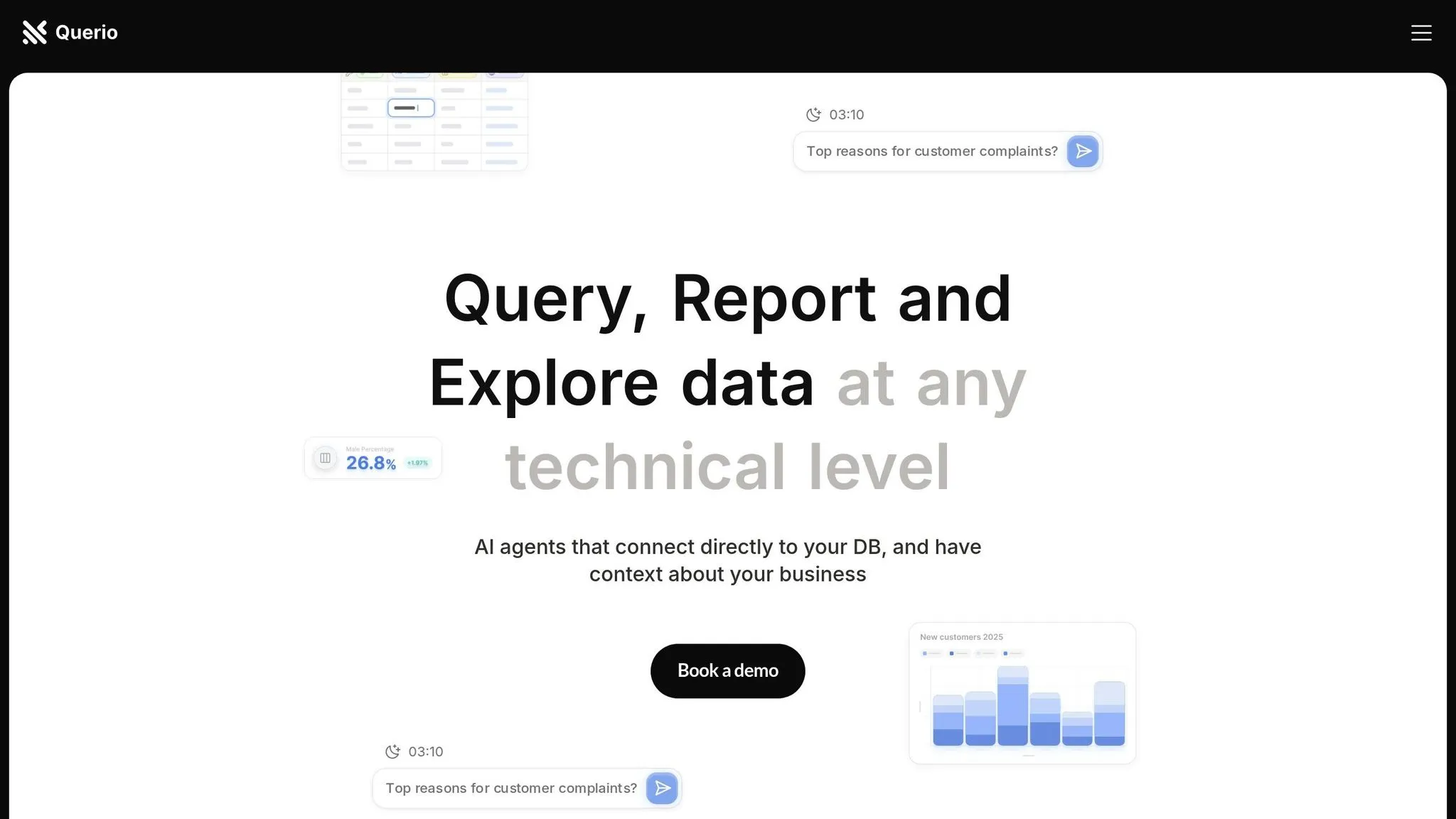
Querio is reshaping AI analytics by bridging the gap between complex data and user-friendly data analysis workflows. Its approach to semantic modeling demonstrates how businesses can make data accessible to everyone, regardless of technical expertise, while ensuring accuracy and consistency across teams.
Natural Language Questions and User-Friendly Interfaces
Querio's AI data agent uses semantic context to grasp the intent behind user questions, not just the keywords. For example, if someone asks, "What were our best-performing products last quarter?" the system interprets "best-performing" based on the business's context - whether that's revenue, units sold, or profit margins.
This semantic understanding removes the language barrier between business users and technical data queries, even when technical terms vary. Users can ask follow-up questions naturally, and the AI retains context throughout the conversation.
Beyond this intuitive query system, Querio also enhances dashboards and visualization tools, ensuring metrics remain reliable and consistent.
Live Dashboards and Tailored KPI Tracking
Querio takes data visualization to the next level with dynamic dashboards that adapt based on user roles and data relationships. These dashboards ensure that KPIs stay consistent across views. For instance, when a user creates a dashboard to track sales performance, the platform can suggest related metrics like conversion rates, average deal size, or customer lifetime value.
Custom KPI tracking is more effective because Querio understands business logic. Imagine a company defines "qualified leads" as contacts who visited the pricing page and downloaded a whitepaper. Querio's semantic model can calculate this metric across all dashboards and reports. If the business rules change, the platform updates the definition organization-wide automatically.
Bridging Business and Data Teams
Querio's semantic model strengthens collaboration between business and data teams by creating a shared vocabulary. Data teams document metric definitions and logic directly in the semantic model, ensuring everyone accesses the same calculations. Business users can then retrieve these metrics through natural language queries without needing to understand SQL or database structures.
This shared foundation reduces confusion and conflict. For example, when a business user asks about quarterly growth rates, they’re using the exact methodology defined by the data team. This eliminates the issue of departments generating slightly different versions of the same metric, which often leads to conflicting reports and unnecessary meetings.
Querio also supports version control for business logic. When metric definitions change, data teams update the semantic model, and all dashboards, reports, and AI responses reflect the new calculations instantly. Business users are notified of changes and can easily understand what was updated without diving into technical details.
Conclusion: The Future of AI Analytics with Semantic Context
The future of AI analytics is taking shape, and semantic context is at the heart of this transformation. By moving beyond static dashboards to conversational analytics that understands business-specific language, semantic layers are changing how companies derive insights. Organizations leveraging semantic layers report insights 4.4× faster and with 45% less effort compared to traditional methods [5]. Even more striking, semantic layers can boost AI accuracy from 16% to 54%, a threefold improvement over direct SQL queries [5].
Take Home Depot as an example: in 2025, they shifted from natural language queries to a semantic layer, achieving exceptional results. Their conversational analytics platform delivered what they described as "really, really good results" [14]. But this is about more than just technology - semantic layers are leveling the playing field, making data more accessible while maintaining accuracy and consistency.
"The demands of the modern business landscape make it tempting to believe that more data always leads to more insight. Semantic technologies show that it's not about how much we collect, but how we understand what we already have."
– Lilly Ryan, Security Lead, Thoughtworks [13]
This perspective highlights the power of semantic layers to standardize data and make it actionable at every level of an organization. With nearly 90% of business leaders confirming that AI is central to their strategy [15], semantic context is becoming the foundation that makes AI not just functional but also reliable and accessible.
As illustrated in case studies and strategies discussed earlier, integrating semantic context doesn’t just refine insights - it sets the stage for organizations to thrive in a fast-changing data landscape. To get started, focus on fragmented, high-priority data areas. Define business terms early, involve subject matter experts, and integrate your semantic layer with existing tools to ensure adoption. Companies that act now will position themselves to lead as AI analytics evolves from generating insights to directly driving business decisions.
The question is no longer whether semantic context will shape the future of AI analytics - it’s whether your organization is ready to harness its full potential.
FAQs
::: faq
How does semantic context make AI analytics more accurate and efficient?
Semantic context enhances AI analytics by enabling systems to grasp the meaning and connections within data, rather than simply handling raw information. This deeper understanding helps AI produce insights that are not only more precise but also more relevant and useful for making informed decisions.
By cutting down on misinterpretations and reducing the need for manual corrections, semantic context streamlines data analysis. Unlike older methods that depend on straightforward keyword matching, semantic understanding allows AI to process and retrieve data with much higher accuracy and speed. This leads to quicker, more dependable insights, giving businesses the tools they need to make smarter, data-driven choices. :::
::: faq
How can an organization integrate a semantic layer into their analytics processes?
To bring a semantic layer into your analytics workflow, the first step is to pinpoint your business priorities and key metrics. This means figuring out which insights matter most to your organization and making sure they align with your overall objectives.
Once you've done that, review your data sources and craft a semantic model that provides a unified perspective of your data. Think of this model as a bridge - it connects and standardizes data from various systems, making it easier to understand and work with.
The final step is to put the semantic layer into action. Build a metadata-driven framework that streamlines how users access data. This not only makes data interaction more straightforward but also boosts accuracy and supports smarter decision-making across your team. :::
::: faq
How does semantic context improve collaboration between business and data teams in AI analytics?
Semantic context plays a key role in bridging the gap between business and data teams by establishing a common understanding of data. It ensures that everyone interprets information the same way, cutting down on miscommunication and aligning insights with the organization’s objectives. By applying consistent business logic and making AI-driven insights easier to explain, it builds trust and encourages more meaningful conversations.
On top of that, semantic layers simplify intricate data relationships, making it easier for non-technical team members to grasp insights. This added clarity helps teams collaborate more effectively, make smarter decisions, and stay aligned across different departments. :::