Business Intelligence
Hex vs Omni (2026): Notebooks or BI? An Honest Comparison
Compare notebook-first SQL/Python analysis with semantic-layer governed BI to choose the right tool for your team's workflow.

If your team spends most of its time in SQL and Python, I’d pick Hex. If your main problem is messy KPI logic and too many report versions, I’d pick Omni.
That’s the short answer.
Here’s the split in plain English:
- Hex fits analyst-led work: SQL, Python, notebook-based analysis, and shareable data apps
- Omni fits business-facing BI: governed metrics, dashboards, and self-serve analytics
- Both work with Snowflake, BigQuery, Redshift, Postgres, and dbt
- The choice is less about feature count and more about who uses the tool every day
- For many teams, the core issue is one of two things: analysis freedom or metric control
At companies with 100–500 employees, that difference matters fast. One path helps analysts move from question to answer. The other helps finance, product, and GTM teams pull the same number without back-and-forth.
Panel - Don't Duck Up the Numbers (Small Data SF 2025)

::: @iframe https://www.youtube.com/embed/1X-3X2bNasM :::
sbb-itb-284a532
Quick Comparison
::: @figure 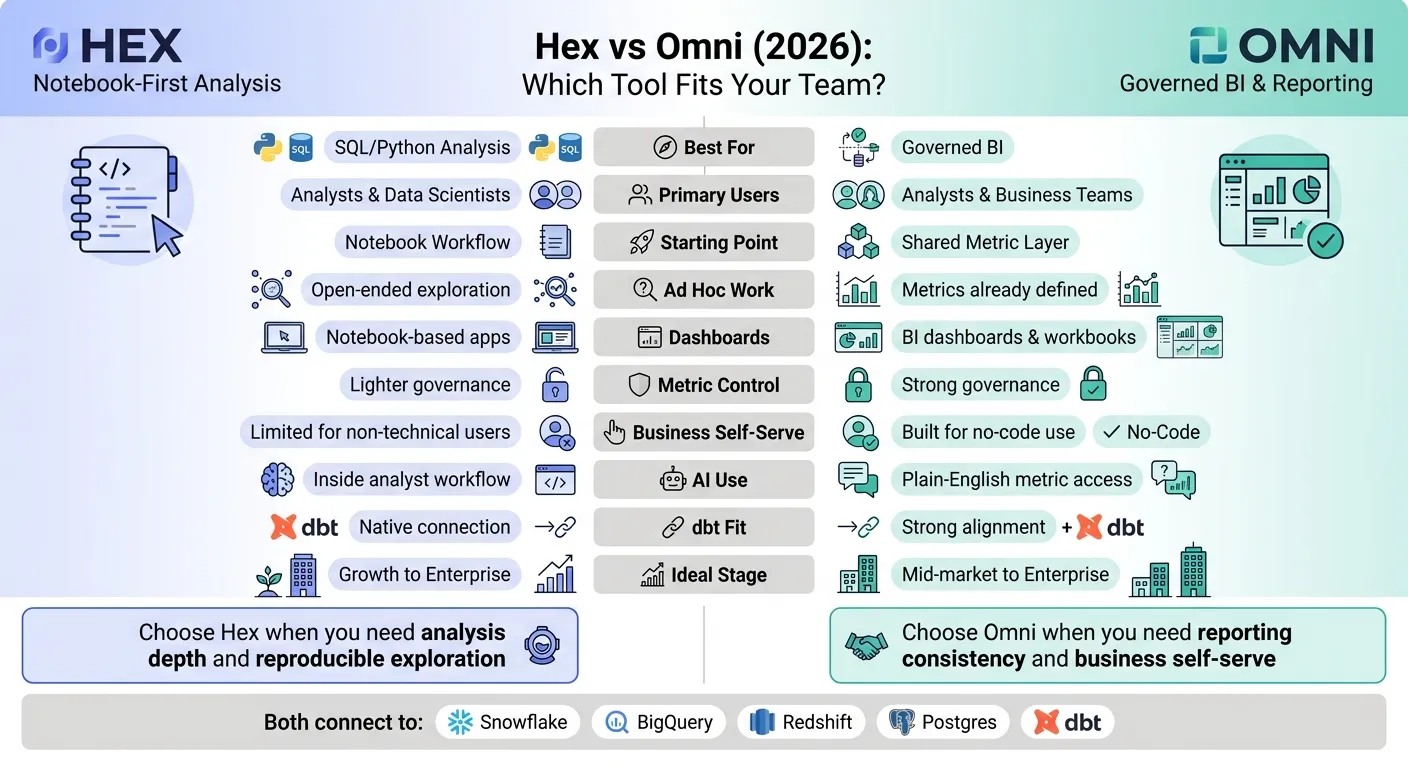 {Hex vs Omni 2026: Side-by-Side Comparison for Data Teams}
:::
{Hex vs Omni 2026: Side-by-Side Comparison for Data Teams}
:::
| Criteria | Hex | Omni |
|---|---|---|
| Best for | SQL/Python analysis | Governed BI |
| Main users | Analysts, data scientists | Analysts, business teams |
| Starting point | Notebook workflow | Shared metric or semantic layer |
| Ad hoc analysis | Strong for open-ended questions | Better when metrics are already defined |
| Dashboards | Notebook-based apps and reports | BI dashboards and workbooks |
| Metric control | Lighter governance | Strong governance |
| Business self-serve | More limited for non-technical users | Better fit for no-code use |
| AI use | Inside analyst workflow | Plain-English access to metrics |
| dbt fit | Native connection | Strong alignment |
| Best choice when | You need analysis depth | You need reporting consistency |
I see this as a workflow decision, not a tool popularity contest. Choose Hex for notebook-first analysis. Choose Omni for governed reporting. If your team needs both, I’d start with the job that causes the most friction today and decide from there.
Hex vs Omni at a glance
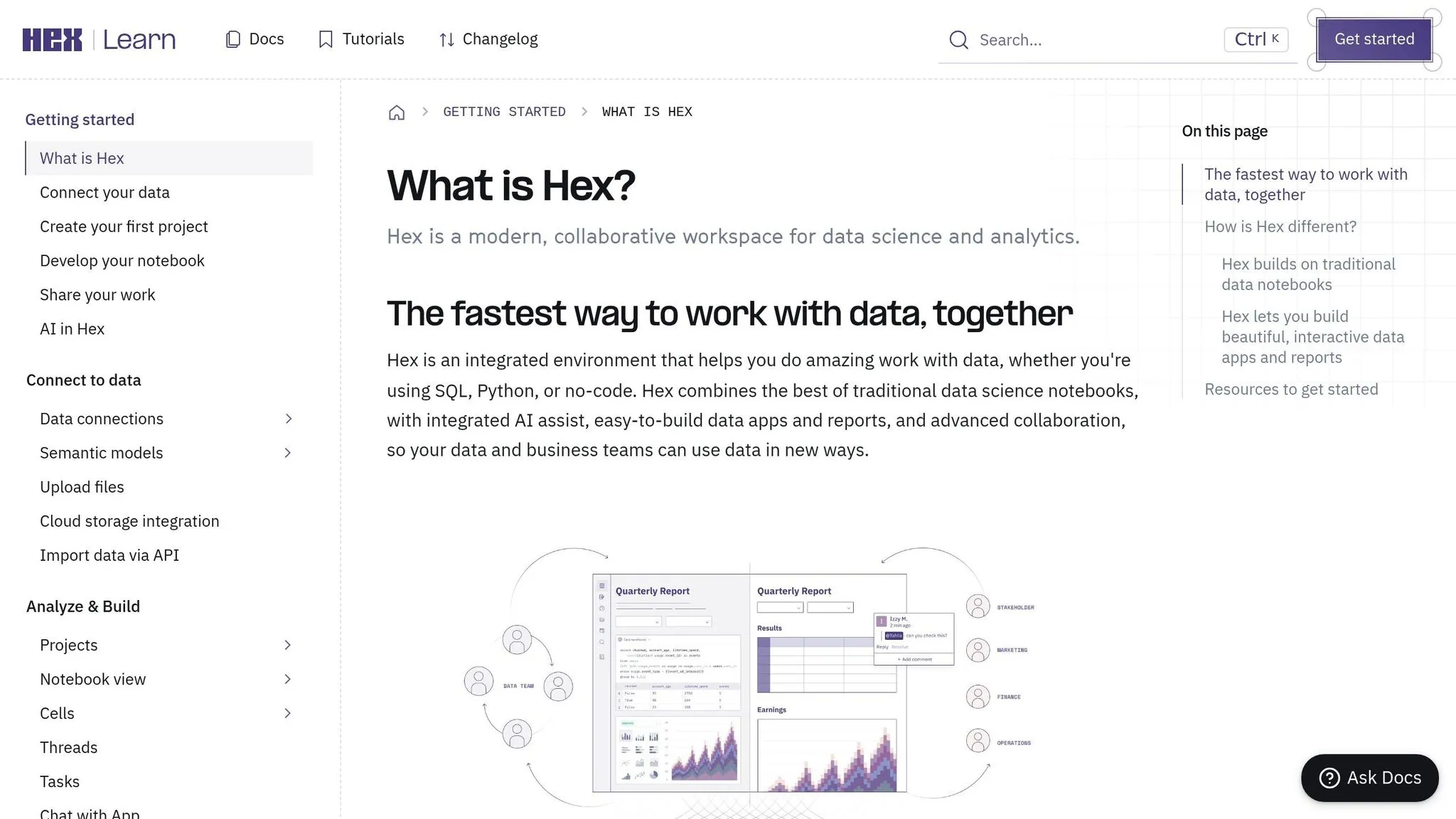
The main difference isn’t only where people do their work. It’s how each product shapes analysis, governance, and the handoff from one team to another.
Hex: reactive notebooks for analysts
Hex keeps exploration, code, and iteration in one place. It uses a reactive notebook graph that reruns downstream cells on its own, which helps keep analysis reproducible.
Omni: semantic-layer-first BI for business teams
Omni starts with a governed semantic layer, not a notebook. It centralizes metric definitions so teams report from the same logic, and business users can explore and report from that same metric layer in workbooks and dashboards. That makes Omni a better fit for consistent reporting and business self-serve.
Use Hex when analysis starts in SQL or Python. Use Omni when the starting point is a shared metric layer. The next section maps that split to specific jobs: analysis, dashboards, collaboration, and stakeholder access.
Which jobs each tool handles best
Hex is best for exploratory SQL/Python work; Omni is best for governed reporting and self-serve BI. The simplest way to choose is to match the tool to the work your team does day in, day out. The three sections below break that choice into exploration, reporting, and collaboration so it’s easier to see the fit.
Ad hoc analysis, investigations, and SQL or Python workflows
Hex is strongest when analysts are still figuring out the problem. It works well for investigations that start in SQL, move into Python, and then turn into an app or a scheduled report. If a metric already lives in the semantic layer, Omni can be fast. But if the question is still taking shape, Hex gives analysts more space to test ideas and follow the thread.
That matters most when the answer isn’t clear yet.
Dashboarding, governed metrics, and business self-serve
Omni’s semantic layer is the main edge here. If a finance stakeholder and a product manager pull the same KPI, they get the same number. That kind of consistency is much harder when logic lives inside separate notebook projects. For broad stakeholder use, especially when non-technical users need to explore, filter, and trust the numbers on their own, Omni’s production dashboards and governed metrics are the better match.
You can see the same split in how each team shares work with stakeholders.
Collaboration, AI assistance, and stakeholder access
Hex works best for analyst-to-analyst collaboration, especially when teams need to co-edit analysis and share notebook logic. Omni is built more for analysts who publish governed content that business teams can use and explore.
The AI angle also changes based on who’s using it. In Hex, AI helps inside the notebook workflow. In Omni, AI is more aligned with non-technical users who want to ask plain-English questions against governed metrics.
The table below turns those workflow differences into a side-by-side decision.
Hex vs Omni comparison table: workflow, governance, and team fit
Use this table to split workflow fit from governance fit. The simplest way to read it: Hex leans toward exploratory analysis, while Omni leans toward governed BI.
| Criterion | Hex | Omni |
|---|---|---|
| Primary users | Data scientists and analysts | Business teams and analysts |
| Core workflow | Reactive SQL/Python notebooks | Governed BI workbooks |
| Ad hoc analysis | Deep SQL/Python investigations | Fast exploration against defined metrics |
| Dashboarding | Interactive data apps built from notebooks | Governed BI dashboards |
| Semantic layer | Shared logic for analysis | Governed semantic layer for metrics |
| Governed metrics | Analysis-oriented | Core strength |
| Self-serve analytics | Conversational via Threads and Slack | No-code exploration in workbooks |
| Collaboration model | Collaborative notebooks for analysts | Governed workbooks shared with business users |
| Warehouse integrations | Snowflake, BigQuery, Redshift, and others | Snowflake, BigQuery, Redshift, and others |
| dbt alignment | Native dbt integration | Strong dbt alignment |
| Ideal company stage | Growth to enterprise | Mid-market to enterprise |
How to use this table without oversimplifying the decision
If your main bottleneck is analyst flexibility, Hex is the better fit. It’s built for teams that need to move between SQL and Python, keep investigations reproducible, and turn analysis into interactive outputs.
If your main bottleneck is self-service analytics, Omni is the more direct choice. Its strength is governed reporting and consistent metrics, so non-technical users can explore data without needing an analyst every time.
The next section turns these differences into a final recommendation.
Final recommendation: choose based on how your team works, not feature count
This choice comes down to how your team spends most of its day.
Choose Hex if your analysts work mainly in SQL and Python and need reproducible exploration.
Choose Omni if the bigger issue is inconsistent metrics and helping business teams serve themselves.
Match the tool to your main workflow. If your team needs both open-ended exploration and governed reporting, the FAQ below gets into those edge cases.