Business Intelligence
semantic layer self service BI
Turns raw technical data into business terms, standardizes metrics, enforces governance, and enables self-service BI and AI-driven insights.

A semantic layer simplifies business intelligence by translating complex data into easy-to-understand terms like "Revenue" or "Customer Lifetime Value." This tool bridges the gap between raw data and business users, allowing non-technical employees to work with data without needing SQL skills or IT support. It also ensures consistent metrics, enforces governance, and supports AI-driven analytics.
Key Takeaways:
- What it does: Converts technical data into business-friendly concepts for easier access and analysis.
- Why it matters: Eliminates conflicting metrics, improves data trust, and reduces reliance on IT.
- AI Integration: Enhances natural language queries and ensures AI outputs align with business rules.
- Governance: Maintains security with role-based access and centralized metric definitions.
- Business Impact: Speeds up decision-making and fosters collaboration across teams.
By standardizing and simplifying data access, semantic layers are essential for modern self-service BI and AI-ready platforms.
Understanding the Semantic Layer in AI-Driven Data Analytics [GoodTalks]
::: @iframe https://www.youtube.com/embed/vQewaZWY9zo :::
How Semantic Layers Enable Self-Service Analytics
::: @figure 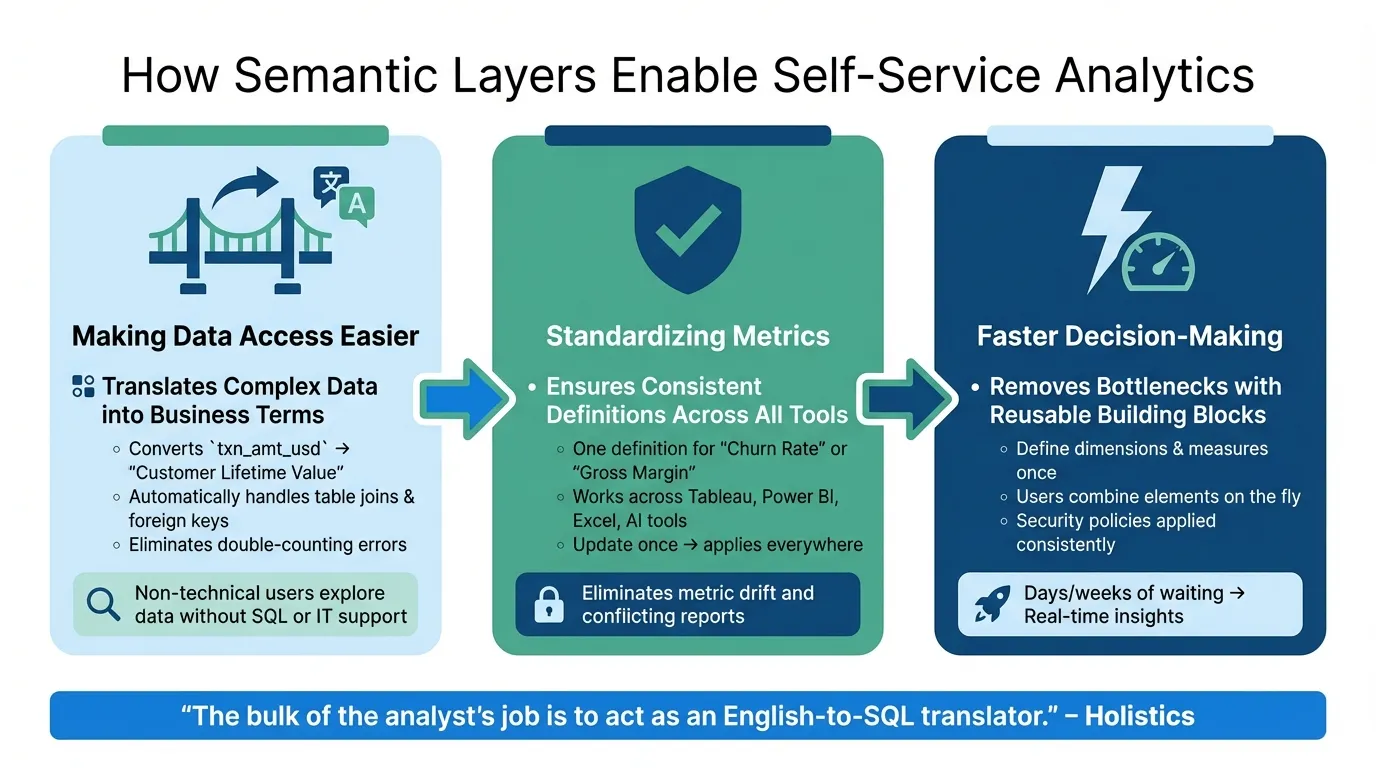 {How Semantic Layers Enable Self-Service BI: 3 Key Mechanisms}
:::
{How Semantic Layers Enable Self-Service BI: 3 Key Mechanisms}
:::
Self-service BI promises quick answers but often falls short due to technical challenges. Many organizations still struggle because non-technical users find it difficult to navigate complex database structures or write SQL queries. A semantic layer changes this by removing these technical barriers and providing a standardized way to access data across the organization. Here’s how it simplifies access and powers better analytics.
Making Data Access Easier for Non-Technical Users
A semantic layer acts as a bridge between raw database tables and the everyday language used in your business. Instead of requiring users to interpret cryptic field names like txn_amt_usd or figure out how to join multiple tables, the semantic layer translates this complexity into familiar terms.
For example, users can work with concepts like "Customer Lifetime Value" or "Monthly Recurring Revenue" without worrying about the backend processes. The semantic layer automatically handles tasks like table joins, foreign key relationships, and data conversions. This eliminates common errors, such as double-counting, which often occur when non-technical users attempt to merge datasets with different levels of detail (e.g., combining daily transactions with monthly marketing spend).
"The bulk of the analyst's job is to act as an English-to-SQL translator." - Holistics [2]
With this approach, true self-service becomes possible. Business users can explore data, create reports, and answer their own questions without relying on IT or waiting for analysts to write queries.
Standardizing Metrics and Business Logic
One of the biggest challenges in analytics is metric drift - when different teams define the same metric in conflicting ways. For instance, the Sales team might define an "Active Customer" as someone who purchased in the last 90 days, while Finance uses a 60-day window. This inconsistency leads to conflicting reports and erodes trust in the data.
The semantic layer solves this by ensuring consistent metric definitions across all tools. Whether you’re using Tableau, Power BI, Excel, or an AI tool, metrics like "Churn Rate" or "Gross Margin" are calculated the same way because they’re defined in the semantic layer.
When business logic needs to change - like updating formulas to reflect new tax rules - data teams only need to update it once in the semantic layer. The changes then automatically apply to every connected dashboard, report, or analysis. This eliminates the need to manually update dozens of spreadsheets or reports.
With standardized metrics, organizations can make decisions faster and avoid the delays caused by conflicting data.
Faster Decision-Making and Fewer Bottlenecks
Standardized metrics also enable real-time decision-making by removing bottlenecks. In traditional BI workflows, business users submit data requests to analysts, who then write SQL queries and create one-off reports. This process often takes days or weeks, and by the time the report is delivered, the original question may have changed.
A semantic layer breaks this cycle by offering reusable building blocks. Instead of creating custom reports for every request, data teams define dimensions (like "Region" or "Product Category") and measures (like "Revenue" or "Customer Count") once. Business users can then combine these elements to answer their own questions on the fly, without needing IT support.
This shift allows data teams to focus on governed self-service BI best practices rather than repetitive tasks. At the same time, security policies - like row-level restrictions that limit regional managers to their own territory’s data - are applied consistently across all tools, reducing administrative overhead.
"A semantic layer helps eliminate these friction points... accelerating insight without placing additional pressure on IT." - Denodo [7]
The results are clear: when users can directly access reliable data, they respond to changes faster and spend less time debating which version of the data is correct. This leads to quicker, more confident decision-making across the board.
Key Benefits of Using a Semantic Layer in Self-Service BI
Semantic layers go beyond simplifying data access and speeding up analytics - they play a major role in fostering collaboration and ensuring data accuracy. By building a semantic layer that acts as a unified framework for data management, they help teams build trust, eliminate confusion, and align on key metrics. Let’s explore three important ways semantic layers deliver these benefits.
Creating a Single Source of Truth
A semantic layer serves as a central hub where all business entities, metrics, joins, and access rules are consistently defined. This ensures that every self-service BI tool pulls from the same playbook, delivering consistent insights across the board. By consolidating business logic in one place, semantic layers provide both human users and AI systems with reliable, uniform definitions. It’s no surprise that 95% of global executives see modern data architectures - like semantic layers - as critical for managing today’s complex data landscapes [8].
Improving Data Quality and Trust
When metrics are defined inconsistently, trust in data takes a hit. Take this scenario: one team defines an "Active User" as someone active within 90 days, while another team uses a 60-day window. The result? Conflicting reports and confusion. A semantic layer eliminates this issue by offering metadata that clearly explains how metrics are defined and any limitations they might have. This transparency is vital, especially when 86% of analytics and IT leaders agree that AI is only as reliable as the data it’s built on [6]. Plus, modern semantic layers include features like version control and audit trails, letting teams track changes and review updates before they’re applied.
"Without a semantic layer, analytics and AI systems inherit inconsistency, governance gaps, and performance problems." - Dremio [3]
Better Collaboration Across Teams
A semantic layer creates a shared language for metrics like "Customer Lifetime Value" or analyzing churn rate, making it easier for teams to collaborate. Instead of each department crafting its own version of these metrics, the organization relies on a single, agreed-upon definition. Considering that 61% of organizations use four or more BI tools - and 25% use 10 or more - this consistency is crucial [9]. Many semantic layers also include impact analysis tools, which let teams see how changes to metric definitions ripple across dashboards, reports, and analyses [10]. This not only simplifies reporting but also lays the groundwork for advanced AI applications and better governance.
Semantic Layers in AI-Driven BI Platforms
The semantic layer has evolved from simply supporting self-service analytics to becoming a critical component in AI-driven insights. AI has undoubtedly transformed how we analyze data, but without proper safeguards, its outputs can be inconsistent or even misleading. Semantic layers act as a stabilizing force, connecting raw data with AI models through a structured framework of business definitions. This ensures that AI outputs remain consistent and aligned with established metrics, even when the AI's non-deterministic nature might otherwise lead to varying results for the same query.
Supporting Natural Language Queries
Semantic layers don’t just standardize metrics - they also provide essential context for natural language queries. With natural language querying, users can ask business questions in plain English and receive precise answers without needing to write complex SQL queries. But for AI to interpret terms like "revenue" or "active customer" accurately, it needs more than just data - it requires context. Semantic layers offer this through metadata tools like wikis, labels, and glossaries, which map everyday language to technical schemas [5][10].
This mapping enables AI to understand both the structure of the data and its relevance to the business. Instead of making assumptions about which table or column to query, the AI relies on the semantic layer's definitions to align its outputs with how your organization calculates and interprets metrics.
Maintaining Governance in AI-Driven Insights
One of the challenges with AI is its tendency to "hallucinate", creating metrics or formulas - such as for "growth" or "revenue" - that don’t align with your business logic. Semantic layers counteract this by embedding structured metadata and predefined business rules, eliminating guesswork. Governance measures like Role-Based Access Control (RBAC), Attribute-Based Access Control (ABAC), and row/column-level security are built into the semantic layer, ensuring that every query produces reliable and explainable results.
Additionally, semantic layers link business logic to data lineage, allowing users to trace AI-generated insights back to their source. This traceability not only instills confidence in the results but also enables users to verify the calculations behind them.
"The semantic layer defines what is true; AI defines how to explore it." – Push.ai [4]
Advanced Analytics Use Cases
Semantic layers go beyond answering straightforward questions - they empower AI to handle complex analytics while safeguarding data integrity. For instance, they can integrate unstructured data from sources like emails, meeting notes, or support tickets, translating these qualitative signals into a unified graph that connects with quantitative metrics [4].
This flexibility allows the same governed business definitions to be applied across various tools, including BI dashboards, AI agents, Python notebooks, and embedded applications [1][8]. Moreover, semantic layers can identify mismatches in data granularity - like attempting to join daily marketing spend data with individual sales transactions - and automatically perform pre-aggregations to ensure accurate results [1].
Best Practices for Implementing a Semantic Layer
Implementing a semantic layer can transform how your organization handles business logic, especially when it comes to enabling self-service analytics. The key to success lies in starting with small, focused steps and gradually building trust across teams. By targeting areas where inconsistent metrics are causing issues, you can avoid the pitfalls of trying to model your entire data warehouse all at once.
Centralizing Business Logic and Metrics
One of the biggest advantages of a semantic layer is the ability to define metrics once and use them consistently across all tools. To achieve this, manage your business definitions as code that is version-controlled, peer-reviewed, and tested. Formats like YAML, LookML, or JSON work well for storing these definitions, allowing you to track changes through pull requests and roll back if necessary.
For example, instead of calculating "Net Revenue" differently in each tool, define it once in the semantic layer and make it accessible via APIs to all connected applications. Start small by focusing on a single business domain - Finance or Sales are good starting points - and identify 5–10 key metrics that appear across multiple reports. Collaborate with stakeholders to agree on these definitions before you begin coding. This approach helps address the "shadow IT" issue, where analysts create their own metrics because they don’t trust the centralized logic.
Connecting Data Sources Without Creating Silos
A well-designed semantic layer should integrate your data sources rather than fragment them. Using a headless architecture allows the semantic layer to sit between your data sources and BI tools, enabling seamless connections. Whether your data resides in Snowflake, BigQuery, or on-premises databases, the semantic layer can handle joins and transformations, ensuring that every tool queries the same consistent definitions.
To unify terminology, implement synonym resolution. For instance, if one team refers to "Net Sales" while another calls it "Net Revenue", the semantic layer should recognize both as the same metric and return the same calculation. Additionally, use identity stitching to link records across different systems, ensuring accurate data attribution and a unified view.
Setting Up Governance and Access Controls
Strong governance is essential for safe and effective self-service analytics. Role-Based Access Control (RBAC) at the semantic layer ensures that user permissions carry across all connected tools. For instance, a regional sales manager should only see data relevant to their territory, whether they’re using a BI dashboard, Python notebook, or AI tool.
To enhance security, configure your semantic layer with minimal privileges. Use read-only access for the schemas required by your metrics. In platforms like Snowflake, users can query semantic views without needing direct access to raw tables, providing an extra layer of protection.
Establish workflows to certify metrics by marking them as "draft", "reviewed", or "certified." This allows users to distinguish between experimental data and metrics that are ready for production use. Below is an example of recommended privileges for a development environment:
| Role | Preparation Layer | Business Layer | Application Layer |
|---|---|---|---|
| Data Engineer | ALTER | SELECT or ALTER | SELECT or ALTER |
| Data Modeler | SELECT | ALTER | SELECT or ALTER |
| Analyst/Data Scientist | None | SELECT | ALTER |
Recommended folder-level privileges for a development environment.
Finally, treat your semantic layer as the central enforcement point for data policies. Apply security measures like dynamic data masking and row-level access policies to your warehouse tables, and let these propagate through the semantic layer. This ensures that governance scales efficiently as your organization grows and integrates new data sources.
Conclusion
Key Takeaways
A semantic layer reshapes self-service BI by turning raw, technical data into terms that are easy for business users to understand. As Dremio puts it:
"The semantic layer is the bridge between raw data and business meaning. It translates complex database schemas... into terms that analysts, executives, and AI systems can understand." [3]
But it’s not just about making data more accessible. Centralizing business logic in a semantic layer ensures everyone is working from the same playbook, eliminating confusion caused by conflicting reports. This builds trust across teams and simplifies analytics workflows by addressing data access and governance challenges.
Modern semantic layers, powered by AI, take things a step further. They enhance large language models with structured rules for better governance while enabling natural language queries and integrating both structured and unstructured data. These tools don’t just answer “what happened?” but also tackle “why did it happen?” and “what’s next?” With demand for semantic layers rising, organizations that adopt them now will be well-prepared to stay competitive as the market evolves.
Next Steps for Businesses
For businesses ready to take action, the best approach is to start small and focus on areas where inconsistent metrics cause the most issues. Identify 5–10 key metrics in a single department, such as Sales or Finance, and automate metadata extraction to quickly establish a foundation. From there, add scalable governance practices [10]. By connecting these metrics to modern business intelligence tools, you can showcase immediate value.
Querio offers an AI-powered semantic layer designed to simplify this process. With features like automated metadata capture, natural language query support, and seamless integration with various data sources, Querio helps businesses adopt best practices without unnecessary complexity. Discover how Querio can help your teams make reliable, data-driven decisions while streamlining analytics for everyone.
FAQs
::: faq
How is a semantic layer different from a data warehouse?
A data warehouse serves as a central hub for storing massive amounts of structured data. On the other hand, a semantic layer acts as a user-friendly interface layered over data warehouses or other data sources. Its purpose? To translate complex, technical data into straightforward business terms. This makes it easier for non-technical users to perform self-service analytics, maintain consistent data usage, and apply governance - all without needing to dive into the intricate structures of the data warehouse. :::
::: faq
What metrics should I define first in a semantic layer?
To effectively manage and analyze your business, begin with core metrics such as sales, profit margins, and revenue. It's crucial to ensure these figures are not only consistent but also accurate across all departments. Establishing clear governance over these metrics helps maintain alignment and prevents confusion during data analysis. :::
::: faq
How does a semantic layer keep AI answers governed and secure?
A semantic layer plays a key role in keeping AI-generated answers both secure and reliable. It does this by integrating security measures, access controls, and data governance rules directly into its framework. These features help block unauthorized access, ensure data accuracy, and minimize errors, which safeguards the overall integrity of the data.
On top of that, it simplifies complex data structures, making it easier to deliver consistent and dependable insights. This ensures decision-makers can trust the information they’re working with. :::