Business Intelligence
Best self-service analytics platforms 2026
Compare AI-driven self-service analytics platforms in 2026 — features, pricing, NLQ, and governance to pick the right BI tool.

Looking for the best self-service analytics platform in 2026? Here's what you need to know:
Self-service analytics tools empower non-technical users to extract insights without relying on IT teams. By 2026, these platforms have evolved with AI-driven capabilities, automating analysis, identifying anomalies, and delivering actionable insights. Businesses now save 50% of analysis time, with platforms like Querio, Power BI, Tableau, Qlik Sense, and ThoughtSpot leading the market.
Key Highlights:
- Querio: AI-native with live warehouse queries and transparent SQL/Python outputs.
- Microsoft Power BI: Affordable ($14/user) and integrates seamlessly with Microsoft tools.
- Tableau: Best for visual storytelling with polished dashboards.
- Qlik Sense: Excels in handling large, complex datasets.
- ThoughtSpot: Search-first design with top-rated natural language query capabilities.
Quick Comparison:
| Platform | Best For | Monthly Cost | NLQ Rating | Key Feature | Main Limitation |
|---|---|---|---|---|---|
| Querio | AI-native teams | Flexible pricing | 4.8/5 | Live queries; automated insights | Newer platform |
| Power BI | Microsoft ecosystems | $14/user | 4.1/5 | Affordable; Office 365 integration | Manual analysis; DAX complexity |
| Tableau | Visual storytelling | $75/user | 4.0/5 | High-quality visualizations | High cost; steep learning curve |
| Qlik Sense | Complex datasets | $70–$150/user | N/A | Associative engine | Expensive; limited AI tools |
| ThoughtSpot | Search-driven analytics | $25/user or $0.10/query | 4.6/5 | Accurate NLQ; search-first design | High enterprise costs |
Querio stands out for its AI-driven automation and flexible pricing, making it a top choice for modern analytics needs.
::: @figure 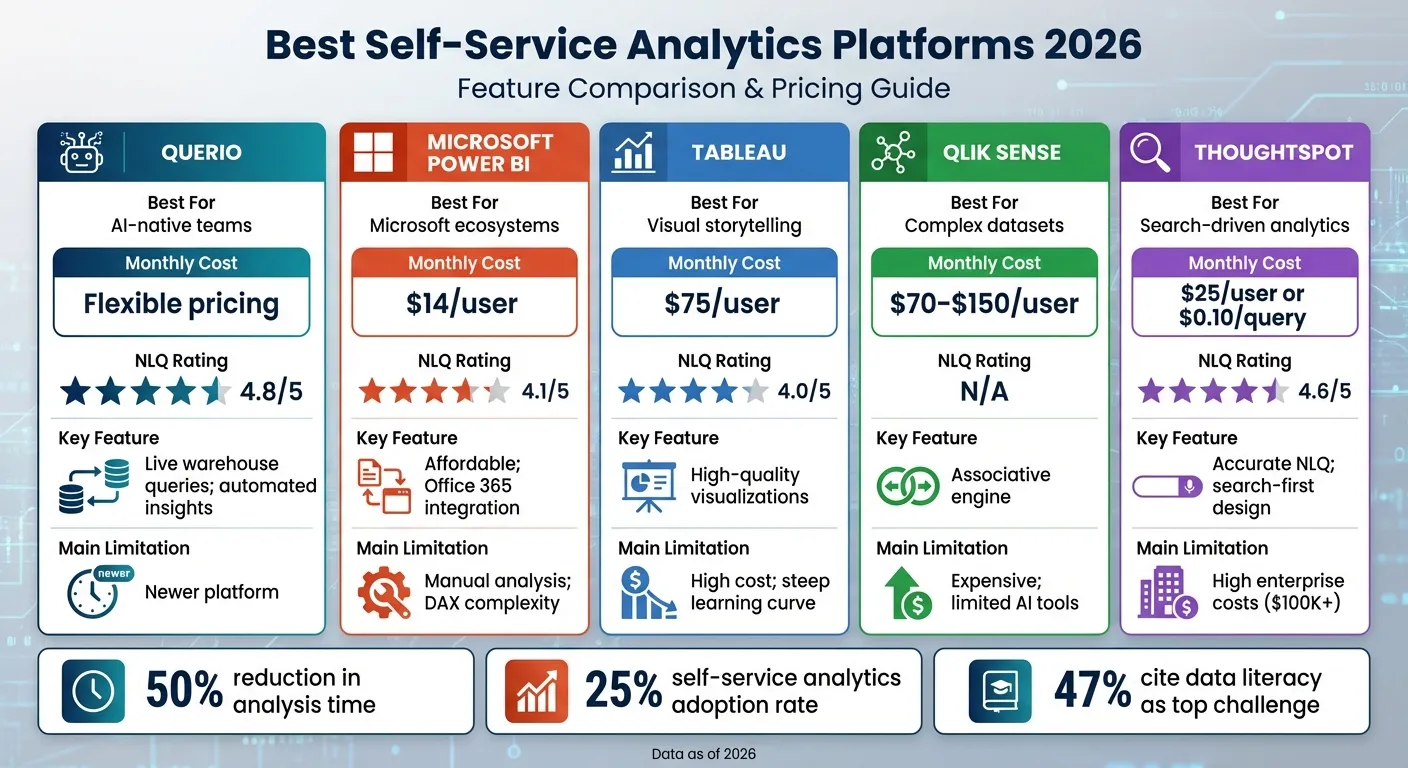 {Self-Service Analytics Platforms Comparison 2026: Features, Pricing & Ratings}
:::
{Self-Service Analytics Platforms Comparison 2026: Features, Pricing & Ratings}
:::
Power BI vs Qlik Sense | Which BI Tool Is Best? 2026
::: @iframe https://www.youtube.com/embed/zVS9LeB1pzw :::
sbb-itb-284a532
1. Querio
Querio takes a fresh approach to business intelligence (BI) by doing away with the need for complicated dashboards. Instead of requiring users to navigate filters or visualizations, it interprets plain-English questions and translates them into SQL or Python. These queries run directly on live warehouse data. In early 2026, Querio showed a fivefold speed improvement over standard BI tools, with an impressive 95% accuracy rate for AI-driven queries - even when dealing with complex multi-table joins [5]. Its natural language engine boosts both the precision and depth of insights.
AI Query Capabilities
Querio’s natural language engine simplifies data exploration. For example, users can ask, “Show customer churn by region and campaign last quarter,” without needing to know the technical details of database schemas. In one case, a marketing team discovered a 15% churn increase linked to a specific email campaign, allowing them to take immediate corrective action [7]. Every query created by the AI generates SQL or Python code that users can review, ensuring complete transparency and confidence in the results.
Warehouse Integrations
Querio integrates directly with major data warehouses like Snowflake, BigQuery, Redshift, Databricks, and ClickHouse. It uses a zero-copy architecture, querying data directly in the warehouse without requiring ETL pipelines or duplicating data. This setup reduces ETL costs by 40% and delivers sub-second query responses, even when working with datasets at the petabyte scale [8]. For instance, a retail company embedded Querio dashboards into Salesforce with SSO, speeding up decision-making by 30% [6]. These integrations are not only seamless but also prioritize strong data security and governance.
Governance and Security
Querio ensures robust security and governance through features like row-level security, column-level masking, and detailed audit logs. It complies with standards like SOC 2 Type II, GDPR, and HIPAA [5]. Forrester analysts gave it a 4.8/5 security rating, highlighting its semantic governance layer, which balances user-friendly access with centralized control [6]. Data teams can define key metrics - such as "Customer Lifetime Value" - in a shared context layer, ensuring consistent calculations across all departments. Additionally, SSO integrations with Okta and Azure AD make it easier to manage access for large-scale deployments, including those in sensitive industries like finance and healthcare [5].
Embedded Analytics
Querio is one of the best embedded analytics tools and supports integration through iframes, a JavaScript SDK, and REST APIs with JWT authentication. This ensures that governed logic remains consistent across both internal dashboards and customer-facing applications. Deployment is quick and reliable. For example, a SaaS provider achieved 99% uptime after rolling out Querio’s embedded analytics, allowing users to access real-time insights directly within their workflows [7].
2. Microsoft Power BI
Microsoft Power BI builds its analytics foundation on Microsoft Fabric, combining data engineering, warehousing, and real-time analytics into a unified system. At the heart of this setup is OneLake, a centralized data lake that eliminates the need for duplicating datasets. This streamlined "one copy of data" approach not only reduces storage redundancy but also fosters better collaboration across teams. The result? A more efficient way to maintain a single source of truth while enabling advanced AI-driven insights.
AI Query Capabilities
With Copilot, users can leverage natural language to create reports and DAX measures, cutting development time by as much as 60% [11]. As of March 2026, several enhancements have been introduced: active input fields now remain editable during processing, a prompt guide offers button suggestions for faster navigation, an AI Narrative Auto-Refresh toggle ensures summaries stay up to date, and Translytical Task Flows simplify processes like record updates and API calls [9][10].
Warehouse Integrations
Power BI connects seamlessly to over 200 native data sources, including SQL Server, Azure Synapse, and Snowflake [11]. Its DirectLake Mode reads data directly from OneLake parquet files, delivering real-time performance without compromising on speed or data freshness. The Power Query Engine, powered by the M language, allows analysts to create reusable ETL logic through Dataflows. This makes workflows more efficient and ensures teams familiar with Microsoft tools can hit the ground running with minimal adjustment.
Governance and Security
Power BI integrates with Microsoft Purview to provide automated data lineage tracking and sensitivity classification. Labels like Confidential or Internal are preserved even in AI-generated outputs, ensuring consistent data classification throughout the analytics process. Security measures such as Row-Level Security (RLS) and Object-Level Security (OLS) further enhance control, restricting data access based on user roles. This governance structure is especially beneficial for large enterprises managing complex, multi-departmental data environments.
Embedded Analytics
Power BI reports can be embedded directly into Teams, SharePoint, and PowerPoint, ranking it among the top embedded analytics tools, complete with real-time visual updates. This seamless integration with the Microsoft 365 suite simplifies executive reporting and makes Power BI a natural choice for organizations already invested in Microsoft's ecosystem.
3. Tableau
Tableau stands out for its high-quality visualizations, earning a 4.7/5 rating in 2026 [1]. Its strength lies in creating polished, presentation-ready visuals that effectively communicate data insights. This makes it a go-to tool for organizations focused on executive reporting and impactful dashboards. While some platforms emphasize automation, Tableau excels in visual storytelling.
AI Query Capabilities
In 2025, Tableau introduced Tableau Next, a leap forward in AI-driven analytics. With this update, users can explore data using natural language conversations. The platform includes three AI agents:
- Data Pro: Handles governed data preparation.
- Concierge: Enables conversational data exploration.
- Inspector: Monitors data and provides automated alerts.
It also features a governed semantic layer to ensure consistent definitions across the organization [2].
Chris Walker, Head of Product Marketing, explained: "Tableau Next represents Salesforce's bet on AI-augmented analytics, shipping with three AI agents (Data Pro, Concierge, Inspector) and a new semantic layer" [2].
Tableau’s natural language query capabilities are rated 4.0/5 [1]. With its Tableau Semantics, queries like "revenue" return consistent, organization-wide definitions, ensuring reliable insights.
Warehouse Integrations
Tableau integrates seamlessly with Salesforce Data Cloud and Agentforce, providing unified access to data within the Salesforce ecosystem [2][4]. It also includes Tableau Prep, a tool for visual data preparation that allows analysts to clean and transform data before creating visualizations [3]. Notably, Tableau has been recognized as a Gartner Magic Quadrant Leader for 18 consecutive years [4].
Embedded Analytics
For developers, Tableau offers APIs and SDKs to embed AI-powered analytics into custom applications and client-facing portals. This embedded functionality has delivered tangible results - one example generated $250 million in business value [12]. Additionally, the Tableau Pulse feature provides AI-driven metric summaries via Slack and email, shifting analytics from static dashboards to real-time intelligence [3]. This proactive approach aligns with the growing demand for actionable, real-time insights.
4. Qlik Sense
Qlik Sense scores a 4.4/5 rating in 2026, thanks to its powerful Associative Engine. This engine indexes all data relationships and can process a staggering 40 million records in about one minute. It’s an excellent choice for organizations managing complex datasets from multiple sources [13].
AI Query Capabilities
Qlik Sense offers two standout AI features: Insight Advisor, which uses natural language processing, and Qlik Answers, a generative assistant compatible with various data types. Another noteworthy tool is the AI Splits feature within its Decomposition Tree, which automatically identifies key impact factors in data. According to Forrester, these AI tools help users explore data 35% faster. For example, an automotive manufacturer improved production efficiency by 12% and reduced scrap costs by 25%, achieving a 165% ROI over 30 months. Similarly, a sales team recovered $18,000 weekly, earning a full ROI on a $30,000 investment [13].
Warehouse Integrations
Qlik Sense supports over 100 connectors, including popular platforms like SAP, Salesforce, Databricks, and Snowflake. In May 2026, Qlik introduced native JSON file loading and enhanced Databricks integration, eliminating the need for REST connectors. The platform also includes Qlik Predict for advanced forecasting and scenario modeling, alongside Open Lakehouse, which supports Apache Iceberg for unified data storage [13].
Governance and Security
Qlik Sense excels in governance and security, offering enterprise-grade multi-cloud security across AWS, Google Cloud Platform, and Azure. It’s rated 10/10 for scalability. A Forrester study highlighted its impact, showing a 209% ROI over three years. Organizations using Qlik Cloud Analytics reported a 30% reduction in BI analysis time and saved $700,000 annually on legacy systems. Pricing starts at $30 per user per month for the Business tier, while the Premium tier costs $2,700 per month for 20 full users and 10,000 view-only users [13]. These features cement Qlik Sense as a leader in secure, scalable self-service analytics, setting the stage for more advancements in the field.
5. ThoughtSpot
ThoughtSpot brings a search-first approach to data exploration, leveraging AI to make it easier for users to interact with their data. With an impressive 8.8/10 overall rating and a flawless 10/10 safety score in 2026, it stands out in the analytics space [14]. Its essential features of modern business intelligence tools like natural language query capabilities are a major highlight, earning a 4.6 out of 5 rating - the best in the market [1]. Users can simply type questions in plain English, like "What was revenue by region last quarter?" and instantly receive visualizations, no SQL knowledge required [1].
AI Query Capabilities
ThoughtSpot's Sage AI Copilot enhances the user experience by suggesting follow-up questions based on context and explaining data changes. Meanwhile, the SpotIQ engine works in the background to uncover trends and anomalies. For added efficiency, the Spotter Coach helps refine natural language queries by aligning them with the correct data fields, reducing analysis time by up to 50% [1].
Warehouse Integrations
The platform directly connects to leading cloud data warehouses, including Snowflake, BigQuery, Redshift, PostgreSQL, MySQL, and Databricks. Unlike older BI tools that depend on precomputed data extracts, ThoughtSpot performs live queries against these sources. This ensures users always access up-to-date information [15]. These real-time integrations complement its advanced querying framework while adhering to strict governance protocols.
Governance and Security
ThoughtSpot's commitment to security is reflected in its perfect 10/10 safety rating [14]. For large-scale deployments, annual contracts typically exceed $100,000. Smaller teams, however, can choose a more flexible usage-based pricing model, starting at $25 per user per month or $0.10 per query [1].
Platform Comparison: Strengths and Weaknesses
This section takes a closer look at the strengths and weaknesses of popular platforms, highlighting why Querio stands out in the market. Querio's ability to handle live warehouse queries, provide transparent SQL/Python inspection, and automate tedious analysis tasks with AI gives it a clear edge over competitors.
Microsoft Power BI offers an affordable option at just $14 per user per month, making it an attractive choice for those already using Office 365. However, its reliance on manual root cause analysis and the need for DAX expertise reveal the efficiency gap when compared to Querio's automated insights [1][3].
Tableau is celebrated for its visual storytelling capabilities, earning a 4.7 out of 5 rating for visualization and offering seamless integration with Salesforce. Yet, its $75 per user per month price tag and steep learning curve make it less approachable for non-technical users, an area where Querio’s user-friendly design excels [1][3].
Qlik Sense stands out with its associative engine, designed for exploring complex datasets across multiple sources without requiring predefined joins. However, its pricing - ranging from $70 to $150 per user per month - and its intricate data exploration process make it a tougher sell compared to Querio’s straightforward and transparent approach [1][3].
ThoughtSpot is a leader in natural language query (NLQ) tools accuracy, scoring 4.6 out of 5 and offering search-first data exploration. However, its enterprise-level costs, which can exceed $100,000 annually, highlight the affordability and flexibility of Querio’s pricing model [1].
Despite the advancements these platforms offer, self-service analytics adoption remains low, with only about 25% of organizations fully embracing it. Additionally, 47% of data and analytics leaders cite data literacy as one of their top challenges [3]. These hurdles further emphasize Querio’s position as the go-to solution for teams seeking streamlined, AI-powered analytics.
| Platform | Best For | Monthly Cost | NLQ Rating | Key Strength | Main Limitation |
|---|---|---|---|---|---|
| Querio | AI-native teams | Flexible pricing | 4.8/5 | Live warehouse queries; automated insights | Newer platform |
| Power BI | Microsoft ecosystems | $14/user | 4.1/5 | Affordable; Office 365 integration | Manual analysis; DAX complexity |
| Tableau | Visual storytelling | $75/user | 4.0/5 | Top-tier visualizations | High cost; steep learning curve |
| Qlik Sense | Complex datasets | $70–$150/user | N/A | Associative engine for multi-source analysis | Expensive; limited AI capabilities |
| ThoughtSpot | Search-driven analytics | $25/user or $0.10/query | 4.6/5 | Exceptional NLQ accuracy | Enterprise costs exceed $100K |
Conclusion
Querio stands out as the top choice for modern, AI-powered analytics. While other platforms may excel in specific areas, Querio combines a broad range of features with a focus on clarity and usability.
By offering AI-native analytics through live warehouse queries and providing transparent SQL/Python outputs, Querio simplifies complex analyses. Its Context Layer ensures consistent data definitions, addressing the data literacy issues that 47% of analytics leaders identify as a major hurdle [3]. This focus on clarity and governance directly addresses the challenge of low self-service analytics adoption, which remains at just 25% across organizations [3].
With flexible pricing models and unlimited viewer access, Querio makes scaling analytics more accessible without driving up per-user costs. Its combination of transparent analytics, strong governance, and AI-driven tools positions it as the best solution for teams aiming to scale their analytics capabilities - helping to resolve the information access challenges faced by 47% of digital workers [1].
FAQs
::: faq
How does Querio turn plain-English questions into SQL or Python?
Querio leverages AI-driven natural language processing to transform plain-English questions into SQL or Python queries. It includes a governance layer designed to maintain consistency and provide enterprise-level security. This ensures queries are both accurate and dependable - all while eliminating the need for users to have any programming or SQL knowledge. :::
::: faq
What data warehouses can Querio query live without copying data?
Querio allows you to run live queries directly on data warehouses like BigQuery and Snowflake without needing to duplicate the data. This means you get quicker insights while maintaining smooth integration with your current data setup. :::
::: faq
How does Querio enforce governance like row-level security and audit logs?
Querio strengthens data governance through features like row-level security (RLS), which limits access to specific rows of data based on user roles or attributes. Additionally, it keeps comprehensive audit logs, offering transparency and aiding compliance with regulations. These capabilities help organizations securely handle sensitive data while aligning with industry requirements. :::