Business Intelligence
The Future of AI-Driven Analytics
AI-driven analytics automates insights, natural-language queries, and workflows while enforcing governance and explainability to scale enterprise decisions.

AI-driven analytics is reshaping how businesses handle data by automating insights, simplifying queries, and enabling faster decision-making. Unlike older methods, these systems use AI tools for data analysis like machine learning, generative AI, and natural language processing to analyze both structured and unstructured data. Users can ask questions in plain English, bypassing the need for technical skills like SQL. This shift is not just about convenience - it’s transforming workflows, improving accuracy, and reducing the time spent on manual tasks.
Key highlights include:
- Faster insights: AI reduces analysis time from weeks to minutes.
- Generative AI: Automates narrative creation, code generation, and query building.
- AI agents: Handle multi-step workflows and execute tasks autonomously.
- Governance focus: Ensures data security, accuracy, and compliance.
- Enterprise adoption: Companies are scaling AI across operations, with clear strategies and measurable outcomes.
Technologies Behind AI-Driven Analytics
Machine Learning and Predictive Models
Machine learning (ML) models excel at turning historical data into actionable forecasts by uncovering patterns in massive datasets. These models are the backbone of tasks like churn prediction, fraud detection, anomaly detection, and demand forecasting. For example, they can instantly identify unusual spending behaviors, inventory shortages, or sudden shifts in customer trends - tasks that would take human analysts weeks or even months to complete. By 2025, advancements like synthetic data and transfer learning are expected to reduce the need for real data in AI training by over 50% [4]. This will make deploying these models faster and more cost-efficient.
While ML focuses on analyzing historical data to predict trends, generative AI takes things further by simplifying how users interact with data, automating complex queries, and creating narratives from raw information.
Generative AI for Analytics
Generative AI is breaking down the technical walls that once kept non-technical users from accessing and understanding their data. Instead of crafting SQL queries, teams can now ask straightforward questions like, "What were our top-selling products in Q4?" and receive immediate, clear answers. This technology also automates tasks like generating narrative explanations for charts, writing SQL and Python code, and even modernizing outdated codebases. For instance, the DataLab platform demonstrated how context-aware AI could improve accuracy by up to 58.58% while lowering token costs by 61.65% for enterprise-specific tasks [6].
Generative AI works best when integrated with a semantic layer in business intelligence. This ensures the AI understands your company's unique definitions - like how you calculate "revenue" or define "active users" - providing accurate and meaningful insights.
AI Agents in Analytics
AI agents are taking analytics to the next level by automating complex, multi-step workflows. Using reasoning frameworks like ReAct, these agents break down intricate problems into logical steps: they gather data, analyze patterns, explain their findings, recommend actions, and even execute those actions when needed. Research by BCG highlights that effective AI agents can speed up business processes by 30% to 50% and reduce time spent on low-value tasks by 25% to 40% [5]. For example, ServiceNow reported a 60% reduction in manual workloads thanks to AI agents [5].
What sets AI agents apart from traditional business intelligence tools is their proactive nature. They continuously monitor data, identify issues before they escalate, and take action - like updating dashboards or notifying teams - without waiting for human input. As BCG aptly states:
"AI agents are transforming workflows and business operations" [5].
Trends in AI-Driven Analytics for 2026 and Beyond
Moving from Experiments to Enterprise AI Programs
The days of small-scale AI trials are fading fast. Companies are no longer content with isolated pilot projects; instead, they're embracing enterprise-wide AI programs guided by senior leadership. This shift reflects the growing need for coordinated strategies to deploy autonomous systems effectively. Rather than simply automating existing tasks, businesses are rethinking workflows from the ground up to achieve meaningful results [7][8].
Take the front-runners - an elite 8% of companies that have fully integrated AI into their core strategies. These firms are outpacing their peers, with revenue growth 7 percentage points faster than those still experimenting. They're also allocating 51% of their technology budgets to cloud and AI infrastructure [10]. For example, in December 2025, a shipbuilding company slashed engineering efforts by 40% and cut design lead times by 60% by deploying agentic AI to streamline complex design processes [7]. Similarly, a telecommunications firm used AI-powered assistants to handle 40,000 daily messages, boosting digital sales by five times [7].
Many organizations are adopting the 10/20/70 rule: dedicating 10% of their focus to algorithms, 20% to infrastructure, and 70% to people, processes, and change management [7]. This strategy underscores a crucial point - technology alone doesn't drive transformation. Success comes from reimagining how teams operate and collaborate.
AI Factories and Superfactories
As AI adoption advances, companies are centralizing their efforts through AI Studios - shared platforms that house reusable tools, deployment protocols, and testing environments. These studios allow departments to access pre-built frameworks, speeding up implementation while maintaining governance and security standards [7][9].
The landscape of AI development is also shifting. By 2026, enterprises are purchasing 76% of their AI solutions from third-party vendors, a significant jump from a 50/50 split in 2024 [8]. The rapid pace of AI innovation makes building everything in-house nearly impossible. OpenAI, for instance, reported an 8x increase in ChatGPT Enterprise message traffic year-over-year, while API reasoning token usage surged by 320x [8]. The number of organizations deploying AI agents in production nearly doubled in just four months, climbing from 7.2% in August 2025 to 13.2% by December 2025 [8].
Responsible and Explainable AI
As AI systems grow more autonomous, the need for transparency and accountability has never been more urgent. By 2025, nearly 72% of S&P 500 companies identified AI as a material risk in their financial disclosures, a steep rise from just 12% in 2023 [8]. Moreover, 51% of organizations using AI have reported negative outcomes, with 33% citing issues stemming from inaccurate AI outputs [12].
That said, companies with robust responsible AI practices are reaping rewards. These organizations see an average 18% revenue boost from AI-driven products, while 60% of executives report that ethical AI practices enhance ROI and efficiency [9][10]. As one Chief Technology Officer from an electronics firm explained:
"Building ethics analysis into agentic AI isn't just about doing the right thing - it's about preventing these autonomous systems from making decisions that conflict with human values at machine speed and scale" [11].
To address these challenges, businesses are implementing safeguards like automated red teaming, deepfake detection, and continuous monitoring. For instance, in 2025, Lockheed Martin replaced 46 separate data systems with a unified platform, automating 216 data catalog definitions and cutting their AI tools by 50%. This streamlined approach allowed 10,000 engineers to securely develop and deploy AI solutions [11]. Additionally, companies are increasingly using "shadow rollouts", where new AI versions run alongside existing systems to identify issues before they go live [5].
Future Frontiers | How AI Is Reshaping Data, Analytics, and BI Ops
::: @iframe https://www.youtube.com/embed/ghXoTWEJWVM :::
sbb-itb-284a532
Data Governance and Risk Management in AI Analytics
::: @figure 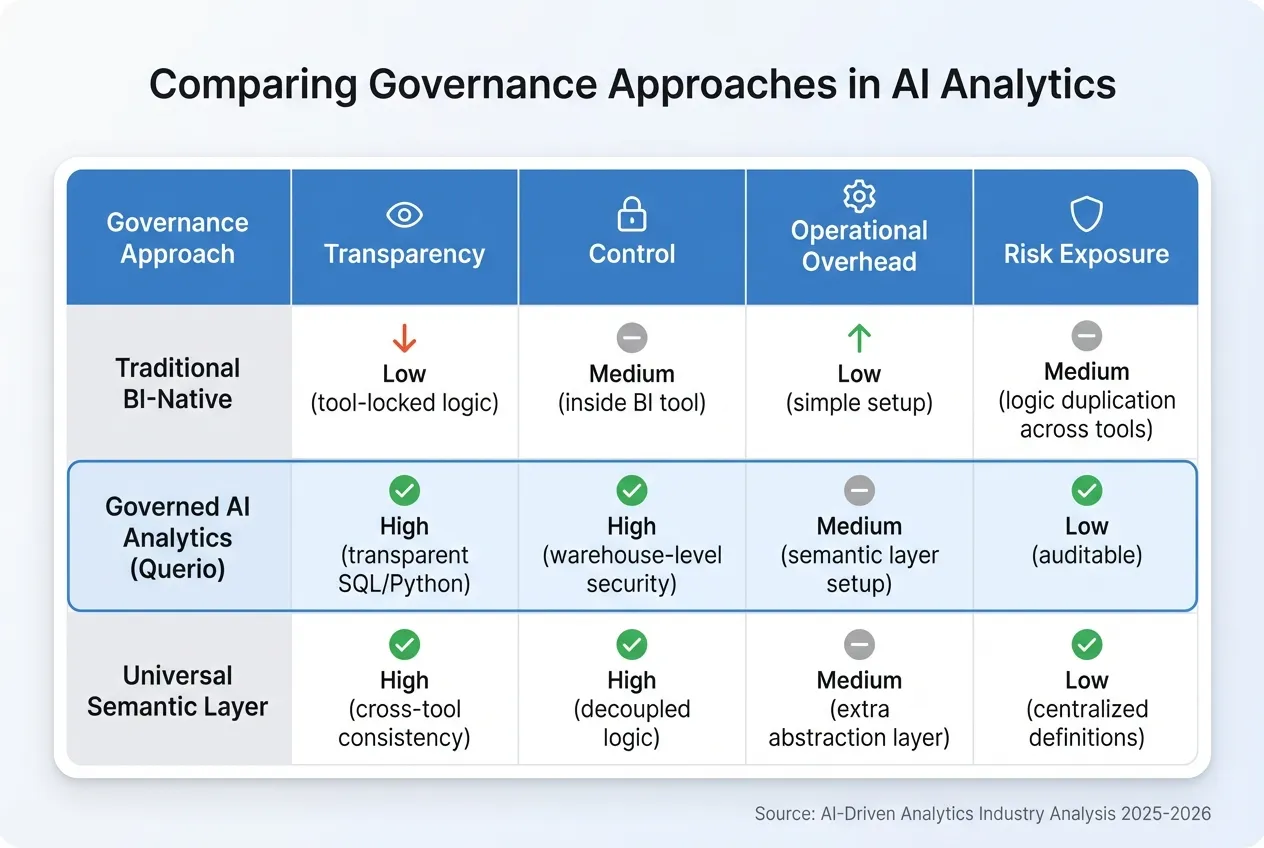 {Governance Approaches in AI Analytics: Comparison of Transparency, Control, and Risk}
:::
{Governance Approaches in AI Analytics: Comparison of Transparency, Control, and Risk}
:::
Why Governance Matters in AI Analytics
AI analytics without proper governance is like building a house on shaky ground - it’s bound to fail. In fact, 80% of digital organizations are expected to fail due to outdated approaches to data governance in the era of cloud and AI [13]. By 2027, the situation becomes even more dire, with 60% of organizations falling short of their AI goals because of fragmented ethical frameworks [4].
Governance goes beyond just meeting compliance requirements; it’s about establishing trust. Poor data quality doesn’t just harm AI models - it erodes team confidence. Effective governance ensures security, tracks data lineage, and upholds quality and compliance [13][15][16]. As Databricks aptly states:
"You can't have AI without quality data, and you can't have quality data without data governance" [15].
Real-world examples bring this to life. In June 2025, Kiwi.com transformed its data landscape by consolidating assets into 58 discoverable data products using Atlan. This move reduced central engineering workloads by 53% and boosted user satisfaction by 20% through easier access to data ownership and quality metrics [13]. Similarly, Austin Capital Bank leveraged Atlan on Snowflake to secure sensitive data and speed up project launches. Ian Bass, Head of Data & Analytics, shared:
"We needed a tool for data governance… an interface built on top of Snowflake to easily see who has access to what" [13].
The takeaway? Governance must seamlessly integrate into every analytic process to address these challenges effectively.
How Querio Enables Governed Analytics
Querio takes data governance to the next level by embedding it into every layer of AI-driven analytics. Its approach is rooted in three key pillars that mitigate risks and enhance security.
First, Querio uses live warehouse connections to ensure data remains in its original location, eliminating the need for duplication or movement - a common source of security breaches [14][19]. Whether your data resides in Snowflake, BigQuery, or Postgres, Querio queries it directly through encrypted, read-only credentials, maintaining your warehouse as the single source of truth.
Second, Querio introduces a semantic context layer that bridges the gap between raw data and natural language. This layer provides AI with business-specific definitions and logic, reducing hallucinations and biases caused by a lack of context [18][17]. For example, when your team asks, "What are our best-selling products?", the semantic layer ensures the AI accurately interprets which tables to join, applies the right filters, and understands how your organization defines "best-selling."
Finally, Querio emphasizes transparency by generating clear SQL and Python code instead of delivering black-box answers. This allows technical users to audit, validate, and even dry-run the logic before execution, ensuring compliance with organizational standards [18]. Querio also inherits your warehouse’s existing row-level filters and column masking, so AI analytics automatically respect permissions without additional manual effort [15][19].
Comparing Governance Approaches in AI Analytics
Here’s how Querio’s governance model stacks up against traditional methods:
| Governance Approach | Transparency | Control | Operational Overhead | Risk Exposure |
|---|---|---|---|---|
| Traditional BI-Native | Low (tool-locked logic) | Medium (inside BI tool) | Low (simple setup) | Medium (logic duplication across tools) |
| Governed AI Analytics (Querio) | High (transparent SQL/Python) | High (warehouse-level security) | Medium (semantic layer setup) | Low (auditable) |
| Universal Semantic Layer | High (cross-tool consistency) | High (decoupled logic) | Medium (extra abstraction layer) | Low (centralized definitions) |
The shift from compliance-driven governance to enablement-focused governance is gaining momentum. Companies like Contentsquare are leading the way by adopting unified governance platforms to create a "trusted home" for all KPIs and dashboards. Otavio Leite Bastos, Global Data Governance Lead, shared:
"Atlan is the home for every KPI and dashboard, making data simple and trustworthy" [13].
This approach not only safeguards data but also accelerates insights, freeing up data scientists to focus on analysis rather than hunting for the right datasets.
How to Adopt AI-Driven Analytics: A Step-by-Step Guide
Evaluating Your Readiness for AI Analytics
AI is reshaping business intelligence (BI), but before diving in, it's essential to assess whether your organization is truly ready for AI-driven analytics. Interestingly, only 15% of companies have the resources and capabilities to scale AI effectively [10]. The challenges often lie in areas like strategy, data management, governance, talent, and company culture [22][23].
To start, take a close look at your organization's data readiness for AI adoption. Ask yourself: Is your data unified and easy to access? Are your governance policies strong enough? Can your infrastructure handle large-scale, real-time queries? A recent survey found that just 29% of tech leaders feel their enterprise data meets the necessary standards for quality, accessibility, and security to scale generative AI [24]. If your data is siloed or requires significant manual effort to clean up, scaling AI will be an uphill battle.
But data infrastructure isn't the only piece of the puzzle. Your AI strategy must align with clear business goals and measurable KPIs - not just technical benchmarks. Research shows that companies that scale at least one strategic AI project are nearly three times more likely to exceed their ROI goals [10]. So, ask yourself: Does your leadership team have a clear vision of how AI can boost revenue, cut costs, or enhance customer experience? If the answer isn’t clear, it’s time to step back and define those objectives.
One real-world example comes from a North American utility company. In November 2025, the company tackled fragmented data by assessing maturity across 12 dimensions and creating a unified data taxonomy. By embedding data stewardship into daily workflows and scaling lineage tracking, they achieved a 20% to 25% efficiency gain in just one year. This effort recovered about $10 million in billing discrepancies and improved customer load forecasting accuracy [21].
Once you've evaluated your readiness, the next step is identifying use cases with clear, measurable benefits.
Identifying High-Impact Use Cases
A lack of focus is a common pitfall - 74% of companies report minimal AI value when projects lack clear direction [8]. To avoid this, start with use cases that offer immediate, tangible benefits.
Revenue forecasting is a great example. Finance teams often spend countless hours reconciling spreadsheets, but AI-driven analytics can automate data aggregation, identify anomalies, and deliver forecasts in minutes instead of days. Another impactful use case is churn prediction. By analyzing customer behavior in real time, AI can flag accounts that are likely to leave, giving sales teams the chance to act before it’s too late.
For retail and e-commerce businesses, pricing optimization is another game-changer. AI can evaluate competitor pricing, inventory levels, and demand trends to recommend dynamic pricing strategies that maximize profits without sacrificing sales volume. The key is to tie each use case to specific, measurable outcomes. Instead of vague goals like "better decision-making", aim for something concrete, like reducing churn by 15% or increasing forecast accuracy by 20% [20].
Set SMART goals - specific, measurable, achievable, relevant, and time-bound - to ensure your efforts drive measurable ROI [25]. Start with small, low-risk pilot projects to prove the concept and demonstrate value quickly. Once you’ve seen success, you can expand these initiatives across the organization.
Scaling AI Analytics with Querio
After identifying the right use cases, the next challenge is scaling AI analytics effectively. This is where a robust platform like Querio can make all the difference. Querio connects directly to your data warehouse, enforces governance, and empowers non-technical users through natural-language querying and a semantic context layer.
Querio integrates seamlessly with platforms like Snowflake, BigQuery, and Postgres using secure, encrypted, read-only credentials. By querying live data directly from the warehouse, it ensures up-to-date and compliant insights [1][3].
One of Querio’s standout features is its natural-language interface, which democratizes analytics. Business users can simply ask questions in plain English and get precise, SQL-backed answers. For technical teams, Querio generates transparent SQL and Python code, which can be audited and refined before execution. This transparency builds trust and ensures compliance with organizational standards.
The semantic layer is another key strength. By defining joins, metrics, and business terminology just once, Querio ensures consistent and reliable KPIs across the organization [25]. This approach reduces dependence on overstretched data teams and significantly speeds up time-to-insight.
Brett Sheppard, author of The State of AI+BI Analytics Global 2025 Report, summed it up well:
"We are witnessing a fundamental shift in how organizations harness their data" [25].
Querio helps organizations embrace this shift, combining the speed of AI with the rigor of governed analytics. This enables companies to scale confidently while maintaining control over their data and processes.
Conclusion: AI-Driven Analytics is the Future
AI-driven analytics is transforming how businesses make decisions. By 2027, it's anticipated that half of all business decisions will be augmented or automated by AI-driven decision intelligence [26]. This transition from traditional dashboards to proactive intelligence allows companies to operate more efficiently, make smarter choices, and stay competitive.
This shift also represents a move from simply reporting on past events to leveraging predictive insights and conversational tools that explain why things happen and suggest actionable next steps. By automating repetitive tasks, AI not only enhances human judgment but also gives teams more time to focus on strategic, high-impact work.
However, the journey isn't without hurdles. By 2027, 60% of organizations are expected to fall short of achieving the full potential of their AI implementations due to fragmented ethical governance frameworks [4]. To succeed, companies need clean, AI-ready data, a semantic layer vs. traditional data models, and reliable governance to ensure accuracy and compliance at scale.
Tackling these obstacles is essential. Querio offers a streamlined solution by integrating seamlessly with your data warehouse through secure, read-only credentials. It provides natural-language analytics powered by SQL and Python, ensuring transparency. Querio's semantic layer unifies insights across departments, and its ability to generate inspectable code ensures complete control and trust over the insights it delivers.
As Databricks aptly states:
"Organizations that embrace this transformation today will better position themselves to lead their industries tomorrow" [2].
Businesses that invest in governed, AI-powered analytics today will set the pace for their industries in the future.
FAQs
::: faq
How can businesses protect data and stay compliant when using AI-driven analytics?
To protect sensitive information and meet compliance standards in AI-driven analytics, businesses should adopt role-based access controls to ensure users only access the data they're authorized to see. Additionally, encrypting data both during storage and transmission adds an essential layer of security. Maintaining immutable audit logs is another key practice, as it enables tracking and monitoring of data access. These steps help align with standards like SOC 2 Type II and ensure compliance with U.S. regulations, such as the CCPA.
However, technical safeguards alone aren't enough. Companies should also prioritize data governance and ethical AI practices. This means having clear privacy policies, conducting regular risk assessments, and continuously monitoring AI models to identify and address potential biases or unexpected behaviors. When robust security measures are paired with proactive governance, businesses can confidently use AI analytics while staying compliant with regulatory requirements. :::
::: faq
What are the main advantages of combining a semantic layer with generative AI?
Integrating a semantic layer with generative AI creates a solid and reliable base for data analysis. By translating raw data into user-friendly terms like "Total Revenue", it ensures everyone - from analysts to managers - is working with the same definitions and calculations. This consistency helps prevent errors, avoids conflicting metrics, and reduces inaccuracies caused by AI hallucinations by grounding the model in structured logic.
This pairing also boosts speed and precision. The semantic layer’s caching and pre-aggregation features make queries faster, while the AI’s contextual understanding delivers insights more efficiently than traditional methods. Companies leveraging AI-driven analytics often see quicker decision-making and less time spent on data-related tasks.
On top of that, it streamlines self-service analytics. Users can simply ask questions in natural language and receive instant visualizations or insights - no need for complex queries. This approach empowers non-technical users while freeing analysts from repetitive work, all without compromising data governance or security, ensuring results you can trust. :::
::: faq
How do AI agents enhance workflow efficiency in businesses?
AI agents function as digital teammates, handling repetitive, data-heavy tasks so employees can dedicate their time to more strategic and creative efforts. These agents excel at swiftly cleaning, organizing, and enhancing raw data - much of which, around 80–90%, is unstructured. What used to take hours can now be done in seconds, delivering ready-to-use datasets. This automation not only speeds up the process but also improves accuracy, boosting error rates from 78% to 93%, while enabling real-time dashboard updates and shorter reporting cycles.
With AI agents in place, businesses can shift their focus from rigid traditional workflows to goal-oriented outcomes. These agents don’t just process data - they analyze it, make decisions, and adapt workflows on their own, all while staying under human supervision to ensure governance and ethical standards are met. The results are striking: companies that adopt AI agents report a 30–50% faster execution of business processes. This leads to a more agile organization where insights are delivered instantly, bottlenecks are removed, and teams are free to concentrate on driving innovation. :::