Business Intelligence
best conversational ai analytics tools
Conversational AI analytics tools let teams ask plain-English questions for fast, accurate insights—compare top platforms, pricing, security, and use cases.

Conversational AI analytics tools let you ask plain-language questions to extract data insights without needing SQL expertise. For instance, you can ask, “What was last quarter's revenue in the Northeast?” and get instant, actionable answers. These tools save time, reduce dependency on data teams, and improve access to insights for non-technical users.
Key Takeaways:
- Time Savings: Users report saving up to 20 hours per month.
- Accuracy: Tools with a semantic layer improve query accuracy by defining business-specific terms.
- Security: Most platforms prioritize data privacy, with features like SOC 2 compliance and row-level security.
Top Tools:
- Querio: Connects directly to data warehouses like Snowflake and BigQuery. Focuses on governance and accuracy. Has a free plan; Core is $2,499/month.
- Displayr: Ideal for market research with automated PowerPoint reports. Offers a free trial.
- BlazeSQL: Affordable at $39/month, supports 12 SQL databases with local privacy options.
- Tellius: Explains "why" performance changes occur using AI-driven insights. Premium plan supports up to 10 users.
- Polymer: Tailored for marketing and e-commerce, integrates with Shopify and Google Ads. Includes a free tier.
- DataGPT: Executes complex queries and statistical tests quickly with a usage-based pricing model.
Quick Comparison
| Tool | Pricing | Best For | Key Features | Data Source Examples |
|---|---|---|---|---|
| Querio | Free plan; Core $2,499/mo | Enterprise teams | Direct data warehouse connections, semantic layer | Snowflake, BigQuery |
| Displayr | Free trial available | Market research teams | Automated reporting, traceable processes | Excel, SQL, survey data |
| BlazeSQL | $39/month | Small to mid-sized teams | Local privacy, Slack integration | Snowflake, PostgreSQL |
| Tellius | Premium, Enterprise | Large enterprises | Explains "why" insights, predictive analytics | Snowflake, Databricks |
| Polymer | Free tier available | Marketing/e-commerce | Pre-built dashboards, live data templates | Shopify, Google Ads |
| DataGPT | Usage-based pricing | Non-technical teams | Advanced query planning, zero hallucinations | Custom-built architecture |
These tools cater to a range of needs, from enterprise-grade governance (Querio) to small-team affordability (BlazeSQL). Selecting the right platform depends on your budget, team size, and security priorities.
::: @figure 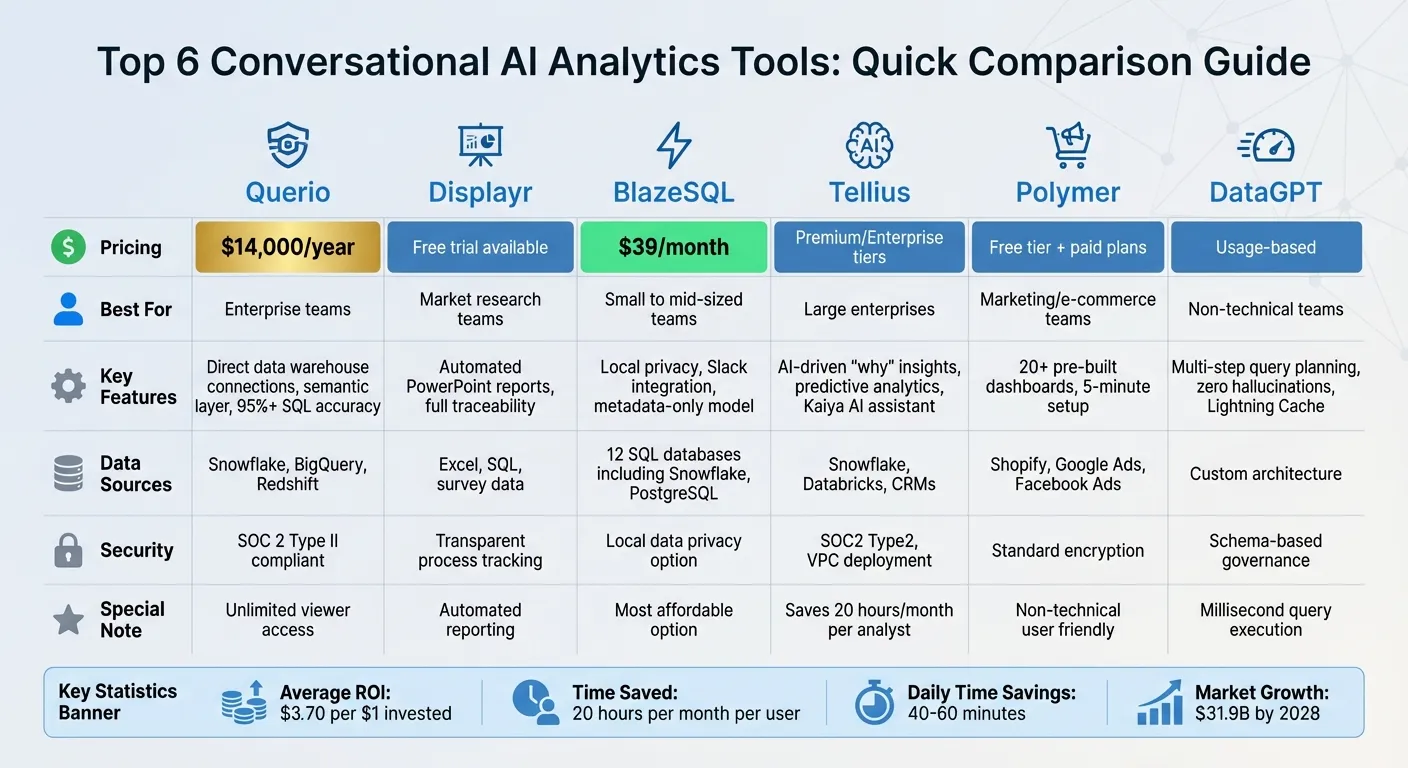 {Conversational AI Analytics Tools Comparison: Features, Pricing, and Best Use Cases}
:::
{Conversational AI Analytics Tools Comparison: Features, Pricing, and Best Use Cases}
:::
1. Querio
Querio is an analytics workspace powered by AI, designed to turn plain English questions into precise SQL and Python code. It helps business teams uncover actionable insights by connecting directly to your data warehouses like Snowflake, BigQuery, Amazon Redshift, ClickHouse, and PostgreSQL. With read-only, encrypted credentials, Querio ensures your data stays secure and untouched.
Natural Language Querying
Querio simplifies complex data queries by allowing teams to define joins, metrics, and terminology upfront in its context layer. This means the AI understands your business-specific terms, whether you're looking into "customer acquisition cost" or comparing "booked revenue" to "GAAP revenue." The platform boasts over 95% accuracy in SQL generation [1]. Plus, it produces inspectable code for easy verification and supports follow-up questions through interactive notebooks that automatically generate charts and graphs.
"I immediately started saving 7-10 hours a week!" - Guilia Acchioni Mena, Co-Founder, Zim [2]
Governance and Security
Querio takes security seriously, maintaining SOC 2 Type II compliance and adhering to CCPA standards [1]. Using a zero-trust architecture, the platform ensures your data remains private and secure. Importantly, it doesn’t use customer data or interactions to train its language models [2]. Querio also respects your existing data permissions, including row-level security and data masking, and guarantees 99.9% uptime [1]. On top of that, organizations have reported an average return of $3.70 for every $1 they invest [1]. These measures, paired with competitive pricing and deployment flexibility, make Querio a reliable choice.
Pricing and Deployment
Querio has a free plan, and Core is $2,499 a month (or $25,000 a year billed annually), with no per-seat pricing (unlimited users on every plan). Querio also offers flexible deployment options, including self-hosted environments, and integrates seamlessly with standard SSO systems for easy access management.
2. Displayr
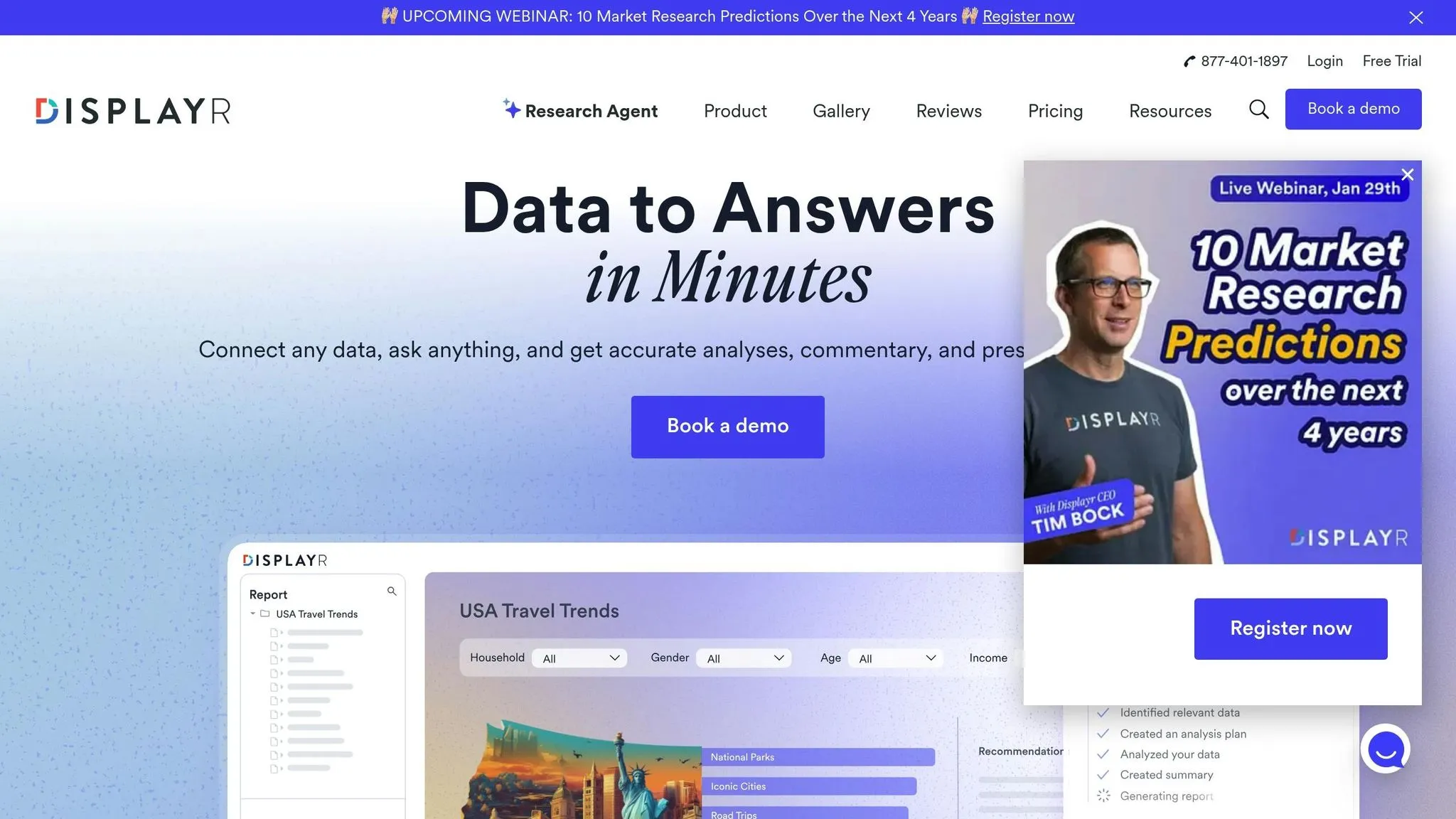
Displayr is a conversational AI platform tailored for market research and consumer insights. It integrates seamlessly with various data sources like Excel, CSV files, SQL databases, survey data, and APIs. The platform is gaining traction in the Data Visualization space, offering top AI tools for data exploration designed to simplify research workflows [4].
Natural Language Querying
Displayr enables users to generate instant visualizations by typing plain English queries. The system understands context and intent, making it easy to refine queries naturally. For example, you can ask, "Now split it by region", and the platform will adjust the results accordingly. Beyond just answering questions, Displayr streamlines workflows by automating the creation of PowerPoint reports and dashboards, saving teams valuable time.
"Most conversational platforms still treat analysis like a black box, so traceability is a critical differentiator." - Edward Pollitt [3]
Governance and Security
One of Displayr's standout features is its commitment to transparency. Unlike many tools that operate as "black boxes", Displayr provides full traceability. Users can track every step of the process - from the original data source to the final visualizations - reviewing filters, calculations, and logic applied along the way. This level of clarity not only builds trust but also ensures teams can confidently rely on the insights generated, even in complex data environments.
Pricing and Deployment
Displayr offers a free trial, allowing users to explore its AI-powered analytics firsthand. The platform is designed to scale with growing data needs and evolving user requirements, making it a flexible choice for businesses of all sizes.
3. BlazeSQL
BlazeSQL is designed for SQL database teams that prioritize speed and security. This conversational AI data analyst chatbot focuses on generating queries quickly while maintaining local data privacy, making it a practical choice for organizations with strict security needs.
Data Source Support
BlazeSQL works with 12 SQL databases and data warehouses, including popular options like Snowflake, BigQuery, Microsoft SQL Server, PostgreSQL, MySQL, MariaDB, Oracle, Redshift, Databricks, Amazon Athena, ClickHouse, and SAP SQL Anywhere. To ensure optimal performance, each database connection is capped at 300 tables, meaning teams need to carefully decide which tables to include for analysis.
The platform integrates seamlessly with Slack - users can tag @Blaze for instant insights - and also offers an API to embed query results into existing workflows. With just one click, users can transform query results into interactive dashboards, simplifying the transition from raw data to actionable visuals. This process is essential when building a conversational AI tool for real-time analytics to ensure data remains accessible. These features enhance user experience while supporting secure data practices.
Governance and Security
BlazeSQL employs a metadata-only security model, meaning it only accesses table and column names, not the actual data rows. For those using the desktop version, all query results remain on the local system, addressing privacy concerns for industries with strict regulations. To further improve query accuracy, BlazeSQL offers a "Knowledge Base" feature where users can define schema descriptions, terminology, and example queries, enabling the AI to better align with specific business needs.
Pricing and Deployment
BlazeSQL is available starting at $39 per month. It offers a cloud-based solution with the added option of a desktop version, which ensures all query results stay local and private for maximum data security.
4. Tellius
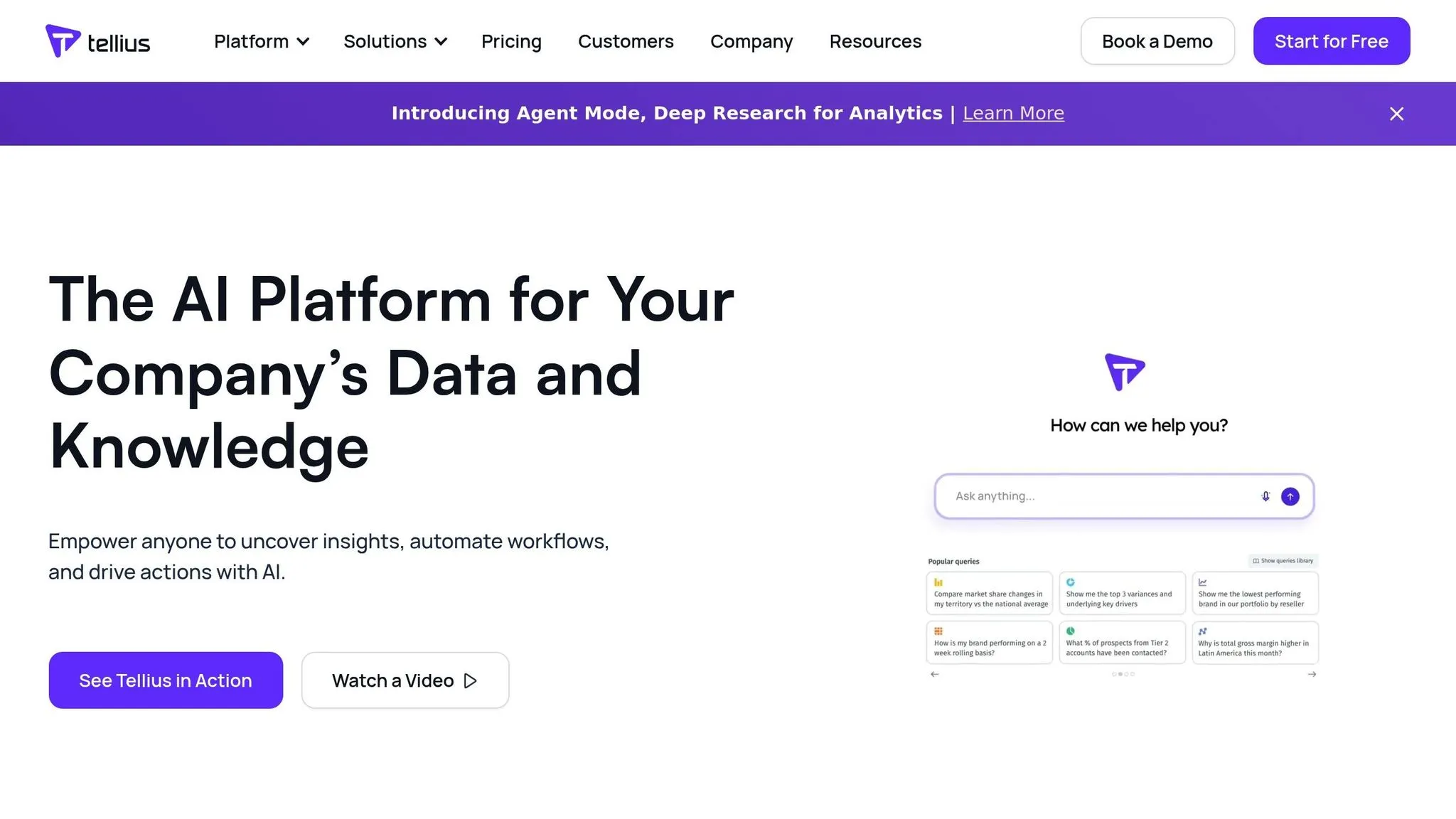
Tellius stands out in the world of conversational AI analytics by making data insights more accessible and actionable. Unlike tools that simply crunch numbers, Tellius serves as an intelligence layer, using conversational AI to explain why performance changes occur. At the heart of the platform is Kaiya, its AI assistant, which allows users to ask plain-language questions and receive automated insights - no need for SQL expertise or manual reporting.
Data Source Support
Tellius connects seamlessly with a wide range of data sources, offering hundreds of prebuilt connectors for platforms like Snowflake, Databricks, and popular CRMs. Its "Knowledge DNA" semantic layer unifies data from diverse tables and applies business logic, creating a cohesive view for real-time analysis. Through its Live Pushdown Mode, Tellius generates insights directly within cloud data platforms, eliminating the need to move data while keeping everything secure. For industries like pharmaceuticals, this means integrating data from sources like formulary, claims, and specialty pharmacies to uncover performance drivers. By combining strong data integration with conversational querying, Tellius simplifies complex analytics.
Natural Language Querying
Kaiya doesn’t just answer surface-level questions; it keeps track of the conversation's context, allowing users to ask follow-ups without repeating earlier details. For instance, users can refine queries by product or time period effortlessly. Beyond answering "what" questions, the platform’s Insights Agent digs deeper, addressing "why" questions by pinpointing key drivers and anomalies. To ensure transparency, its "Search Inspector" reveals the underlying logic and SQL behind the AI’s conclusions.
A Marketing Analytics Lead at a major retailer shared their perspective:
"No more guesswork. We type a question - like 'Which segments respond best to our premium line?' - and watch AI unify all the data. It's a total game-changer" [5].
The benefits are tangible: one software company cut weekly reporting time by 30% within days, while a healthcare organization saved 20 hours per month per analyst [5].
Governance and Security
Tellius prioritizes security and compliance, meeting SOC2 Type2 standards and encrypting data both in transit and at rest. Its AI models are not trained on user data, ensuring privacy. For industries with strict regulations, Tellius offers single-tenant deployments in a customer’s own Virtual Private Cloud (VPC). Row-level security ensures users only see the data they’re authorized to access, while on-premises models provide deterministic analysis for consistent and reliable results.
Pricing and Deployment
Tellius provides two main pricing tiers:
- The Premium Plan supports up to 10 users, with 50 million rows of data (live-mode) and 10GB of storage.
- The Enterprise Plan offers unlimited users, data, and storage, along with advanced features like AutoML, custom machine learning modeling, SAML/SSO, API access, and white-labeling. Deployment options include customer cloud, on-premises, or Tellius Cloud.
These flexible plans make it easier for teams to streamline decision-making and focus on what matters most.
sbb-itb-284a532
5. Polymer
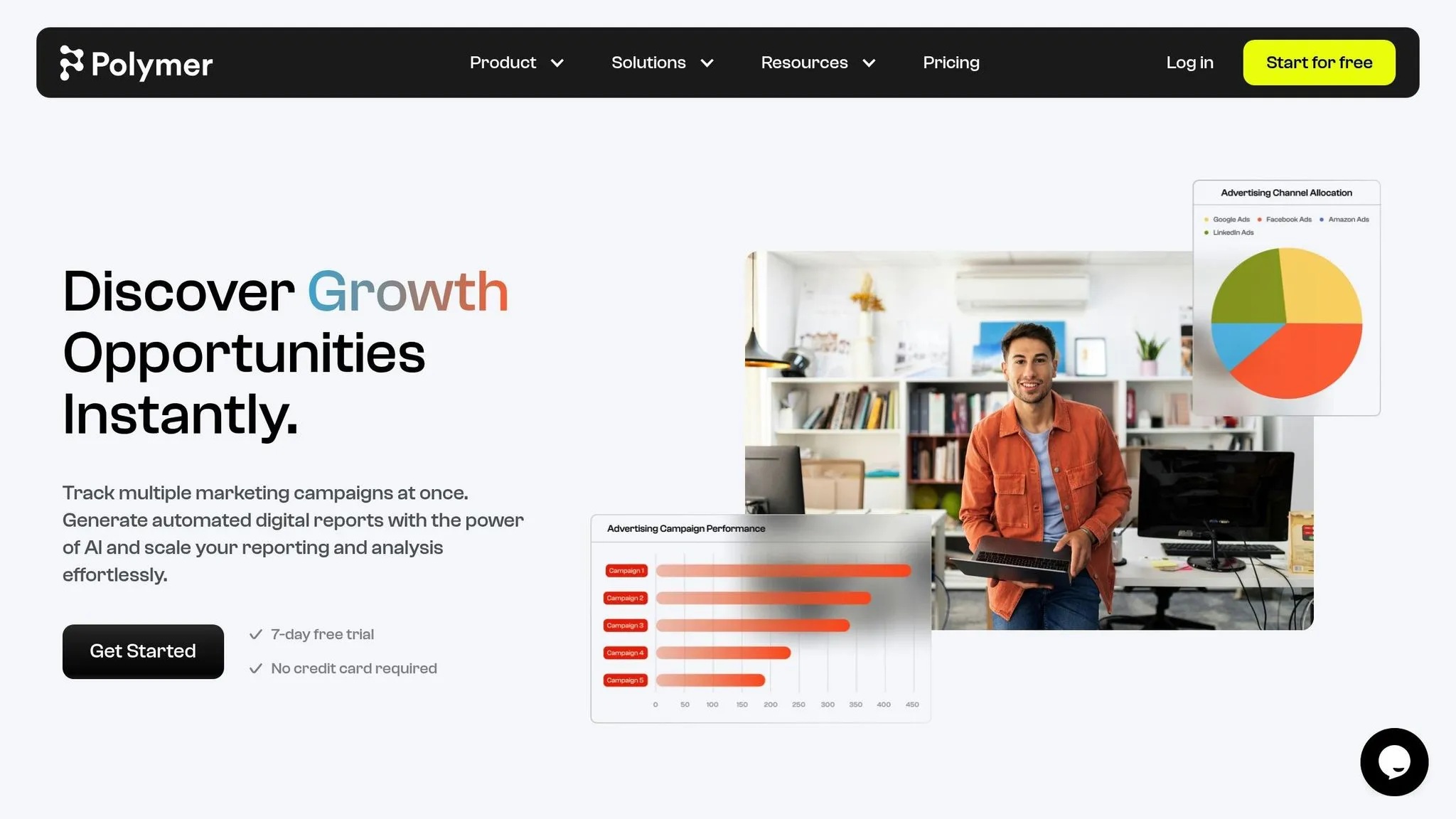
Polymer is a conversational AI analytics tool tailored for marketing and e-commerce teams that don't have a technical background. One of its standout qualities is how quickly users can get started - within just five minutes of signing up, you can dive into analyzing your data. Adam Morgan from MVP Philanthropy shared his experience:
"I was so impressed with the amount that I was able to do within 5 minutes of signing up." [6]
Data Source Support
Polymer integrates seamlessly with major platforms like Shopify, Facebook Ads, Google Ads, and Google Analytics (GA4). Its "E-Commerce Business Overview" template automatically combines data from these sources into a single, easy-to-read dashboard. This allows users to gain insights across channels effortlessly. On top of that, Polymer provides over 20 pre-built dashboard templates, enabling users to visualize live data instantly [6].
Natural Language Querying
With the Polymer AI Chat interface, you can simply type questions in plain English and get visualized answers. Its Question Suggestions feature highlights important metrics, such as ROAS, CPA, and customer lifetime value, making it especially useful for marketing, sales, and e-commerce teams [6]. The intuitive design pairs well with its flexible pricing options.
Pricing and Deployment
Polymer offers a free tier with no upfront costs, giving teams the chance to explore its AI Chat features before deciding to upgrade [6].
6. DataGPT
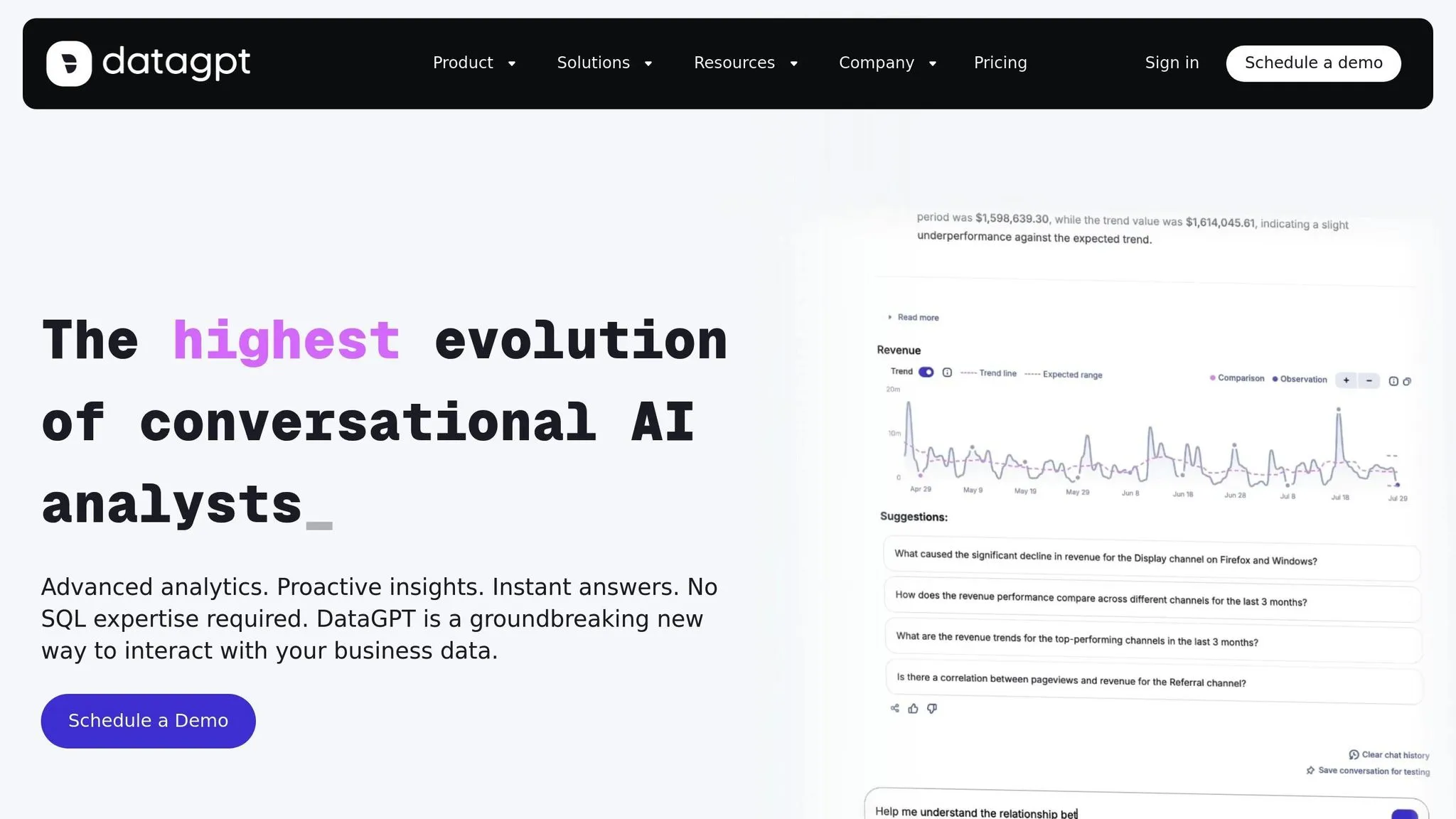
DataGPT steps in as a fresh alternative to top business intelligence tools, offering a unique architecture that combines a data connection layer, compute engine, and analytics engine. Together, these components execute thousands of queries and statistical tests in mere milliseconds[7]. Ben-Zion Benkhin, CEO & Founder of Wombo, highlighted its impact:
"We're able to get answers instantly, that would take weeks of work from our BI tools. Almost everyone on the team uses it every day."[7]
By leveraging its advanced data connection and computing abilities, DataGPT aims to elevate both the speed and depth of data analysis.
Data Source Support
Through its custom-built architecture, DataGPT efficiently manages large-scale data. A one-time schema configuration defines key data parameters, metric calculations, and business context, ensuring consistent and accurate queries. Its "Data Navigator" feature empowers non-technical users to explore metrics and dig into details without needing advanced expertise[7].
Natural Language Querying
DataGPT simplifies complex analysis by creating multi-step plans for each query. These plans cover a range of tasks, including descriptive analysis, identifying key drivers, spotting anomalies, analyzing trends, testing correlations, and adjusting for seasonality. Dan Calzone, Director of Growth at Plex, shared his experience:
"DataGPT has transformed the ease and speed in which I can use our data. Other BI and dashboard tools were just simply too complex and time intensive to get answers... I can finally answer not just what happened but why."[7]
Governance and Security
Governance is built into DataGPT’s design, ensuring reliability and security. The platform claims "zero hallucinations", addressing common challenges in generative AI with its unique architecture. Its schema configuration process enforces governance by standardizing data definitions and metric calculations across the organization, delivering consistent and trustworthy insights[8].
Pros and Cons
Choosing the right conversational AI analytics tool depends heavily on your team’s size, technical skill set, and governance priorities. While modern platforms boast impressive SQL accuracy and deliver strong ROI [1], factors like pricing, data source compatibility, and transparency can significantly influence their long-term value. Below is a breakdown of the strengths and trade-offs of some popular tools.
Querio offers no per-seat pricing (unlimited users on every plan) and a context layer that keeps metric definitions consistent across analyses. It has a free plan, Core at $2,499 per month, read-only encrypted connections and SOC 2 Type II compliance, making it a great fit for enterprises prioritizing governance and scalability.
Displayr excels in automated reporting, transforming natural language queries into PowerPoint presentations and dashboards almost instantly. With a free trial and custom pricing tailored for market research teams, it’s ideal for organizations needing detailed, automated reports [3].
BlazeSQL stands out for its affordability at just $39 per month, offering clear SQL-to-English transparency. This makes it an excellent choice for small and mid-sized teams that value a straightforward, inspectable analytics process [1].
Tellius uses AI-driven agents to support predictive analytics, helping large enterprises automate diagnostics and save analysts around 20 hours per month on routine data tasks [1].
Polymer is tailored for non-technical users, providing AI-powered data categorization and automated visualizations. It includes a free tier with affordable upgrade options, making it accessible for teams with varying budgets.
DataGPT employs a usage-based pricing model and Lightning Cache technology, offering flexibility for teams with fluctuating analytics demands.
One key feature to consider across these tools is traceability. Tools with visible logic help avoid the "black box" challenges that affect 78% of chat-based AI queries [1].
When deciding, think about what matters most for your organization: scalability without per-seat costs (like Querio), automation and speed (offered by Tellius), transparency (as seen in BlazeSQL’s visible logic), or specialized reporting workflows (provided by Displayr). Balancing upfront costs with long-term governance and scalability will help ensure you pick the best tool for your needs.
Conclusion
Conversational AI analytics tools have reshaped how teams work with data, delivering an average ROI of $3.70 for every $1 spent and saving users 40–60 minutes daily[1]. What used to take weeks can now be accomplished in mere minutes.
Among the many platforms available, Querio distinguishes itself with features tailored for enterprise needs. Its direct connections to major data warehouses like Snowflake, BigQuery, and Postgres eliminate the hassle of data duplication. By offering enterprise-grade functionality without additional per-user fees, Querio is particularly well-suited for industries with strict regulations[1].
For smaller teams, BlazeSQL provides a budget-friendly option at $39 per month, while Tellius leverages AI to help analysts reclaim up to 20 hours per month from repetitive tasks.
With the conversational AI market forecasted to hit $31.9 billion by 2028 and generative AI spending projected to reach $644 billion by 2025 - a staggering 76.4% jump from the previous year[1] - the demand for advanced analytics tools is surging. This growth highlights the need for solutions like Querio that prioritize integration with existing permissions, compatibility with semantic layers like dbt, and transparency to avoid black-box issues.
While other tools may excel in specific areas, Querio stands out as a secure, scalable, and efficient choice for organizations looking to fast-track their decision-making processes.
FAQs
::: faq
What should I look for in a conversational AI analytics tool?
When choosing a conversational AI analytics tool, focus on features that make data analysis straightforward and deliver precise, actionable insights. Look for tools with accurate SQL generation, smooth compatibility with major data warehouses like Snowflake or Redshift, and enterprise-level security (such as SOC 2 Type II compliance) paired with dependable uptime - usually around 99.9%.
It’s also important that the platform includes an easy-to-use, chat-style interface allowing users to ask questions in plain English. Advanced capabilities like context-aware follow-ups and custom calculations can further enhance usability. Pricing is another key consideration, so opt for a model that aligns with your team’s size and needs. Lastly, evaluate the vendor’s customer support and product development plans to ensure the tool can adapt to your business as it evolves. :::
::: faq
How do conversational AI analytics tools keep data secure and private?
Conversational AI analytics tools take protecting your data seriously, employing enterprise-grade security measures and strong governance protocols. They rely on role-based access control to restrict data access to authorized users, encrypt your information both during transmission and storage, and maintain detailed audit logs to monitor user activity.
Many of these platforms are built on secure cloud infrastructures that adhere to certifications like SOC 2, ISO 27001, and CCPA. This alignment with top-tier security standards ensures your analytics queries are handled and stored securely, keeping your data private and well-protected. :::
::: faq
What are the key advantages of using conversational AI analytics for teams without technical expertise?
Conversational AI analytics simplifies the process of accessing data insights for non-technical teams. Instead of relying on complex tools or coding, users can ask straightforward questions in plain English and get quick, precise answers. This means marketers, sales reps, and operations staff can independently explore trends, compare metrics, and gain insights without waiting for assistance from data experts.
These tools work in real-time, dramatically reducing the time it takes to analyze data - what used to take hours can now be done in seconds. They also allow users to ask follow-up questions within the same thread, making it easy to refine or expand their analysis without starting from scratch. With minimal setup required, conversational AI analytics not only saves time but also improves data literacy, boosts productivity, and empowers teams to make decisions confidently based on solid evidence. :::