Business Intelligence
AI BI tools list conversational analytics
Explore how conversational analytics tools simplify data access, enabling faster decision-making for businesses without technical expertise.

Conversational analytics is transforming how businesses access and interpret data. Instead of relying on complex queries or dashboards, users can ask questions in plain English and receive instant, visual answers. This shift simplifies decision-making, reduces delays, and makes data accessible to everyone, regardless of technical expertise.
Key tools leading this change include:
- Querio: Connects live to data warehouses like Snowflake and BigQuery. Anyone can run natural language queries in the app or Slack, and its agent answers with SQL and Python you can inspect. Definitions and dashboards live in a git repo you own. Free plan; Core is $2,499/month.
- ThoughtSpot: Focuses on secure, search-driven analytics with customizable access controls. Pricing starts at $95-$125 per user/month.
- Tableau GPT: Integrates conversational AI into Tableau for intuitive data exploration and real-time monitoring through Tableau Pulse. Costs $70-$150 per user/month.
- Power BI Copilot: Embedded in the Microsoft ecosystem, it provides affordable, user-friendly analytics at $10-$20 per user/month.
- Sisense Fusion: Combines natural language processing querying with real-time insights for enterprise-level users. Pricing is customized.
Quick Comparison
| Tool Name | Pricing (USD) | Key Features | Security Certifications |
|---|---|---|---|
| Querio | Free plan; Core $2,499/mo | Plain-English questions answered in SQL and Python, definitions in a git repo, MCP server for Claude and ChatGPT | SOC 2 Type II |
| ThoughtSpot | $95-$125/user/month | Search-driven analytics, secure worksheets | SOC 2, ISO 27001, GDPR |
| Tableau GPT | $70-$150/user/month | Conversational AI, Tableau Pulse monitoring | SOC 2, ISO 27001, FedRAMP |
| Power BI Copilot | $10-$20/user/month | Microsoft integration, natural language Q&A | ISO 27001, SOC 1 & 2, HIPAA |
| Sisense Fusion | Custom pricing | Plain language queries, embedded analytics tools | Enterprise-level compliance |
These tools empower businesses to make faster, informed decisions by simplifying data access and analysis. Each offers essential features to suit different needs, budgets, and tech stacks.
1. Querio
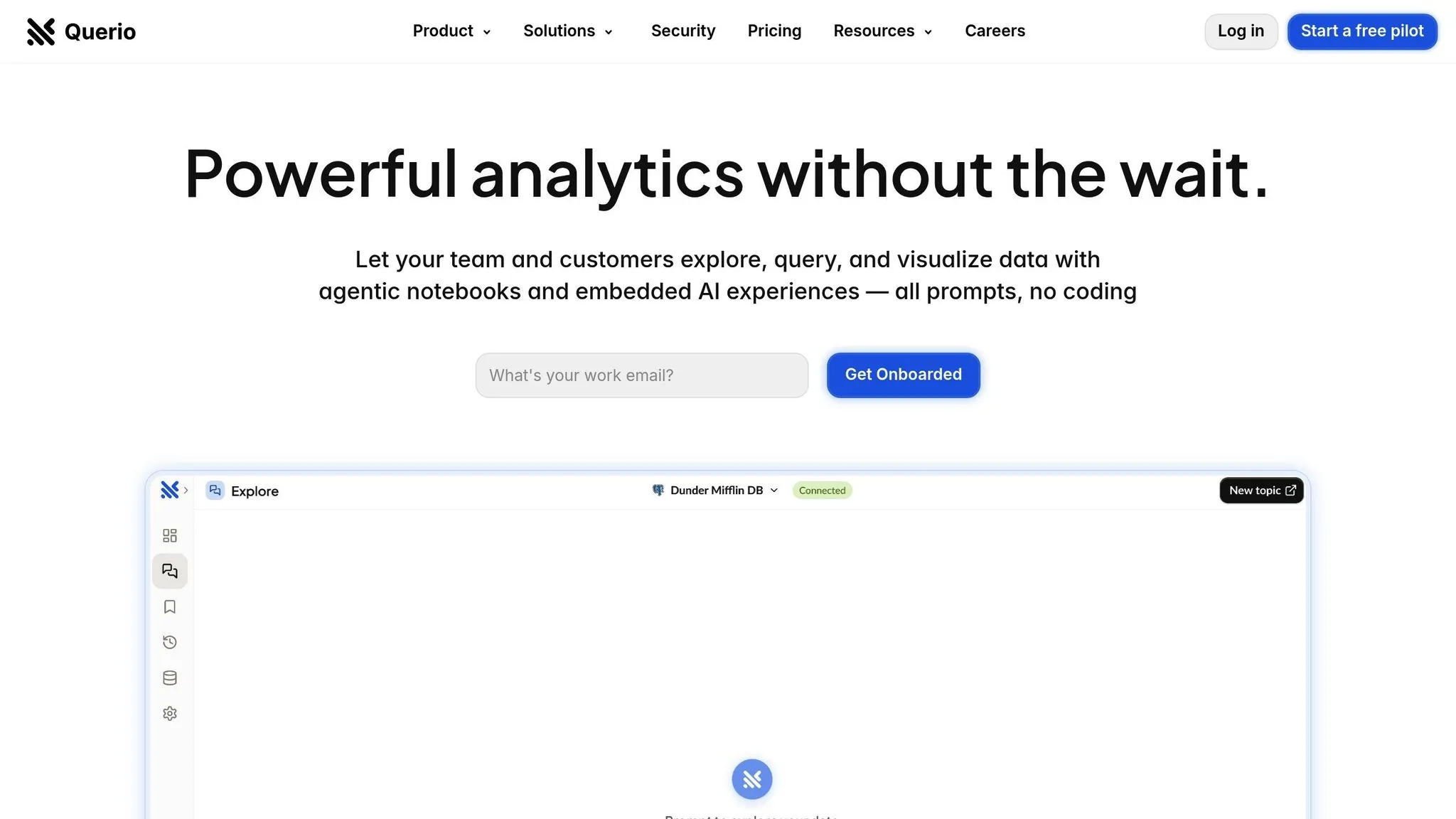
Querio is git-native analytics for data teams and their AI agents. Anyone, from product managers to finance teams, asks questions about live warehouse data in plain English, and Querio's agent answers with SQL and Python in a notebook analysts can open, check and rerun. The definitions behind those answers live as files in a git repo your team owns. Here's a closer look at its standout features.
Natural Language Querying Capabilities
Querio’s natural language processing engine turns everyday business questions into SQL and Python you can read. For instance, users can ask, "What was our revenue growth in Q4 2024?" or "Show me customer acquisition costs by region for the past six months" in the app or in Slack, and the agent answers in a reactive notebook. Claude and ChatGPT can ask the same questions through Querio's MCP server, seeing only what their user may see. Querio has a free plan, and Core is $2,499 per month ($25,000 a year billed annually), with 10,000 AI credits a month. There's no per-seat pricing; only AI model calls are metered, as credits.
Integration with Data Warehouses and Tools
Querio connects directly to data platforms like Snowflake, BigQuery, and Postgres, so there are no data copies or migrations. Queries run on live warehouse data. On Snowflake and BigQuery, per-user OAuth means each query runs as the person asking, so the warehouse's access rules apply. Its context layer lets data teams define table joins, glossaries and metric definitions as files in a git repo, and changes go through pull requests. Every plan includes unlimited users and data connections, and Core adds cross-source analysis.
Real-Time Analytics and Insights
The platform turns query results into easy-to-understand charts and graphs. Teams can save a result as a dashboard tile, and promoting a dashboard opens a pull request your reviewers approve. Automations send scheduled prompts or SQL results to email or Slack, so leadership stays informed without extra tools.
Compliance and Security Features
Querio is SOC 2 Type II, HIPAA and GDPR compliant. An agent sees only what its user sees, and every query, agent action and promotion is logged. For organizations requiring greater control, Querio Enterprise offers single-tenant hosting, with on-prem deployment as an add-on.
2. ThoughtSpot
ThoughtSpot stands out in conversational analytics by prioritizing data security and compliance. Its Sage AI ensures strict adherence to security protocols with a range of essential features of modern business intelligence tools like administrative controls and audit tools.
The platform uses governed worksheets and user roles to manage access while giving administrators the ability to decide what data - such as metadata or sample values - can be shared with the GPT layer [1]. To maintain transparency, ThoughtSpot logs all Sage interactions, enabling thorough audits. Additionally, it prevents prompt persistence and model retraining, reducing the risk of data leakage [1]. These measures underline ThoughtSpot's commitment to secure and responsible data management as AI-powered conversational analytics continue to evolve.
3. Tableau GPT
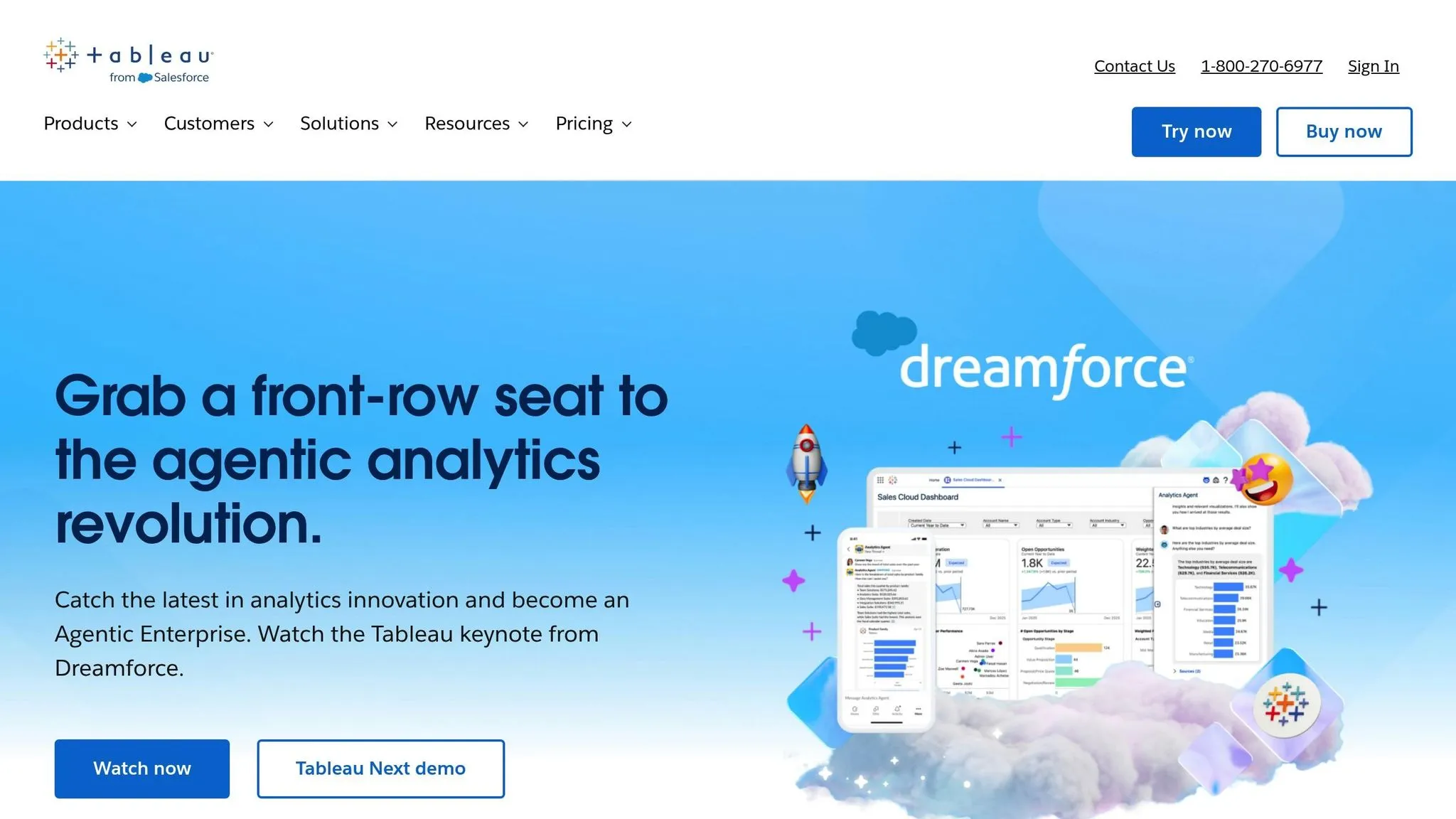
Tableau GPT brings conversational AI directly into Tableau, allowing users to interact with their data using natural language. This integration simplifies data exploration, making it more intuitive and accessible. By combining natural language queries with real-time insights, Tableau GPT opens up a range of practical possibilities for users.
Natural Language Querying Capabilities
With Tableau GPT, you can ask questions about your data in plain, everyday language - no need to master complex query syntax. For example, you might ask, "What are the sales trends for the last quarter?" or "Which products are underperforming this month?" The system processes these queries, understands the context and business-specific terms, and quickly generates visualizations or suggests deeper analyses.
Real-Time Analytics and Insights
Tableau GPT doesn’t stop at answering questions. It powers Tableau Pulse, which offers robust real-time monitoring features. Tableau Pulse keeps an eye on key metrics, spotting anomalies and highlighting emerging trends as they happen.
"Tableau Pulse introduces real-time data monitoring and alerting within the Tableau platform. This capability ensures users stay updated on emerging trends or anomalies, unleashing the full potential of metrics and KPIs for timely decision-making." [2]
The system also includes an Inspector feature, which tracks critical business metrics and sends alerts when thresholds are crossed or unexpected patterns emerge. This ensures teams can focus on strategic tasks rather than constantly monitoring dashboards.
Tableau Pulse integrates seamlessly with tools like Slack, Microsoft Teams, and email, delivering instant notifications without requiring users to leave their current workflow.
In real-world scenarios, sales leaders can use Tableau GPT to visualize sales performance in real time, while service teams can monitor customer satisfaction metrics and address issues proactively. For example, Tableau Pulse has helped identify inventory problems affecting product sales, enabling teams to take corrective action swiftly [3].
Additionally, the platform doesn’t just show what’s happening - it provides context and explanations. Users gain insights into why trends occur and receive actionable suggestions for what to do next, making data-driven decision-making faster and more effective.
4. Power BI Copilot
Power BI Copilot transforms how users interact with data by allowing them to ask straightforward questions in plain English and receive instant visual responses. This simplifies accessing data and helps speed up decision-making processes.
### Generative BI and Natural Language Querying Capabilities
You can type queries like "Show me revenue by region for Q3" or "Which customers have the highest lifetime value?" and instantly see tailored visualizations based on your request. This feature makes it easier for everyone - regardless of technical expertise - to analyze data and uncover insights with ease.
5. Sisense Fusion
Sisense Fusion is a business intelligence tool powered by AI that makes exploring data as easy as having a conversation. Like other advanced BI platforms, it simplifies how non-technical users access and understand data by leveraging AI.
Natural Language Querying Capabilities
With Sisense Fusion, you can ask business questions in plain language and get answers presented as clear, visual insights. No need for complex commands or technical know-how - just ask, and the tool delivers.
Integration with Data Sources and Applications
The platform connects seamlessly to a wide range of data sources and business applications, bringing all your information together in one place. This integration ensures you can analyze data in real time without interruptions.
Real-time Analytics and Insights
Sisense Fusion provides up-to-the-minute insights, helping you monitor performance and spot trends as they happen.
Security and Compliance
Built with enterprise-level security, Sisense Fusion ensures your data stays protected while adhering to strict compliance standards.
Feature Comparison Table
When evaluating AI-powered BI tools, it's essential to compare criteria such as features, integration options, pricing, and security certifications. Here's a breakdown of some leading tools:
| Tool Name | Key Features | Integration Options | Pricing (USD) | Security Certifications |
|---|---|---|---|---|
| Querio | Plain-English questions answered with SQL and Python, live data connections, definitions and dashboards in a git repo, changes by pull request, MCP server and CLI for agents, no per-seat pricing: unlimited users on every plan | Snowflake, BigQuery, Postgres, Databricks, Redshift and more (direct connections, no data copies) | Free plan; Core $2,499/mo; Enterprise custom | SOC 2 Type II, HIPAA, GDPR compliant |
| ThoughtSpot | Search-driven analytics, natural language processing, automated insights, mobile-first design | 200+ data sources, including cloud warehouses, databases, and SaaS applications | Custom pricing (typically $95-$125 per user/month) | SOC 2 Type II, ISO 27001, GDPR compliant |
| Tableau GPT | Conversational interface, automated chart generation, smart recommendations, advanced visualizations | Native Salesforce integration, 100+ connectors including AWS, Azure, and Google Cloud | $70-$150 per user/month depending on plan | SOC 2, ISO 27001, FedRAMP authorized |
| Power BI Copilot | Microsoft ecosystem integration, natural language Q&A, automated report generation, real-time collaboration | Seamless Microsoft 365 integration, Azure services, 500+ data connectors | $10-$20 per user/month (part of Microsoft 365 plans) | ISO 27001, SOC 1 & 2, HIPAA compliant |
| Sisense Fusion | Plain language querying, visual insights generation, real-time analytics, embedded analytics tools | Wide range of databases, cloud services, and business applications | Custom pricing (enterprise-focused) | Enterprise-level security and compliance standards |
Key Insights
Pricing: Power BI Copilot stands out as the most cost-effective option, especially for small and medium businesses already using Microsoft tools. On the other hand, Querio has no per-seat pricing and unlimited users on every plan, which makes it a strong choice for organizations aiming to democratize data access across larger teams.
Integration: The best tool for your needs depends on your existing tech stack. Power BI Copilot is ideal for businesses deeply embedded in the Microsoft ecosystem, while Querio's direct connections to modern cloud data warehouses like Snowflake and BigQuery run on live data and avoid data duplication.
Security: All tools meet enterprise-grade security standards, but specific certifications may matter more depending on your industry. For instance, healthcare organizations may prioritize Power BI Copilot’s HIPAA compliance, while Tableau GPT’s FedRAMP authorization could be a deciding factor for government contractors.
Use Cases: Each platform brings something unique to the table. Querio keeps its context layer in a git repo, so changes to a definition go through pull requests, which suits teams that want self-service analytics with real control. Meanwhile, ThoughtSpot’s search-driven interface offers an intuitive way for users to explore data quickly.
This comparison highlights the strengths and trade-offs of each tool, helping you choose the one that aligns best with your business needs and goals.
Conclusion
Conversational analytics is changing how teams interact with data, making it possible to ask straightforward questions in plain English and get instant, visual answers. This approach breaks down technical barriers, enabling everyone - from marketing managers to executives - to make smarter, data-driven decisions.
Among the tools reviewed, each brings something different to the table. Querio stands out with its free plan and no per-seat pricing (unlimited users on every plan). It also connects directly to cloud data warehouses like Snowflake and BigQuery. Its metric definitions live as files in a git repo your team owns, and people in the app, Slack, Claude and ChatGPT all answer from the same ones.
While Querio has a strong offering, other tools also bring valuable features to the mix. From intuitive search capabilities to advanced visualizations and embedded analytics, these solutions offer options to suit various tech stacks, budgets, and user requirements.
Together, these tools are shaping a future where data-driven decision-making is easier and more accessible than ever. With AI-powered conversational tools leading the way, the future of business intelligence is already here.
FAQs
How does conversational analytics make data-driven decisions easier for non-technical users?
Conversational analytics makes decision-making easier by letting anyone interact with data using natural language. There's no need for complicated queries or advanced technical know-how - users can simply ask clear, straightforward questions and get instant answers, complete with visualizations and explanations.
This method opens up data access to everyone in the organization, cutting down on the need for analysts and speeding up how quickly decisions are made. By giving users the tools to explore data more naturally, businesses can build a stronger data-focused mindset and make decisions faster and with greater confidence.
How does Querio protect my data and ensure its security?
Querio is SOC 2 Type II, HIPAA compliant (it signs BAAs) and GDPR compliant. For data security, the key rule is that an agent sees only what its user sees. On Snowflake, BigQuery and Databricks, per-user OAuth means queries run as the person, so the warehouse's own access rules apply. On Postgres, Redshift and ClickHouse, Querio uses a service account plus its own policies.
Roles come on every plan, and Core and Enterprise add groups, datasource permissions, SSO (Okta, Google) and SCIM. Every query, agent action and promotion is logged, and Enterprise adds audit export and single-tenant hosting, with on-prem deployment as an add-on.
How does Querio's pricing support large teams in making data more accessible?
Querio has no per-seat pricing. Its Free, Core and Enterprise plans all include unlimited users and data connections, so organizations can give access across departments without paying per head. Only AI model calls are metered, as credits. This setup supports a self-service analytics approach, where team members ask questions in plain English instead of relying solely on specialized analysts.
By making it easier for more users to directly engage with data, Querio supports faster, smarter decision-making while keeping costs under control.