Business Intelligence
How AI Analytics Helps Companies Predict the Future
How AI predictive analytics uses machine learning and real-time data to improve forecasts, reduce supply chain errors, and boost ROI.

AI analytics is transforming how businesses plan and make decisions by predicting future trends and challenges. Unlike older methods that rely on limited past data, AI-powered predictive analytics uses machine learning to analyze massive datasets, uncover patterns, and forecast outcomes with higher accuracy. This approach helps businesses reduce errors, optimize resources, and stay ahead of disruptions.
Key Takeaways:
- Improved Forecasting: AI reduces supply chain errors by 20%-50% and product unavailability by up to 65%.
- Real Business Impact: Companies using predictive analytics report an 86% ROI boost within two years.
- Industry Examples: Retailers optimize inventory, finance teams detect fraud, and healthcare providers improve patient outcomes using AI predictions.
- Core Technologies: Machine learning models, natural language processing (NLP), and real-time data connections drive these advancements.
- Data Quality Matters: Clean, unified data is essential for accurate predictions.
AI analytics is no longer optional; it’s a powerful tool for businesses looking to make smarter, faster, and more informed decisions.
::: @figure 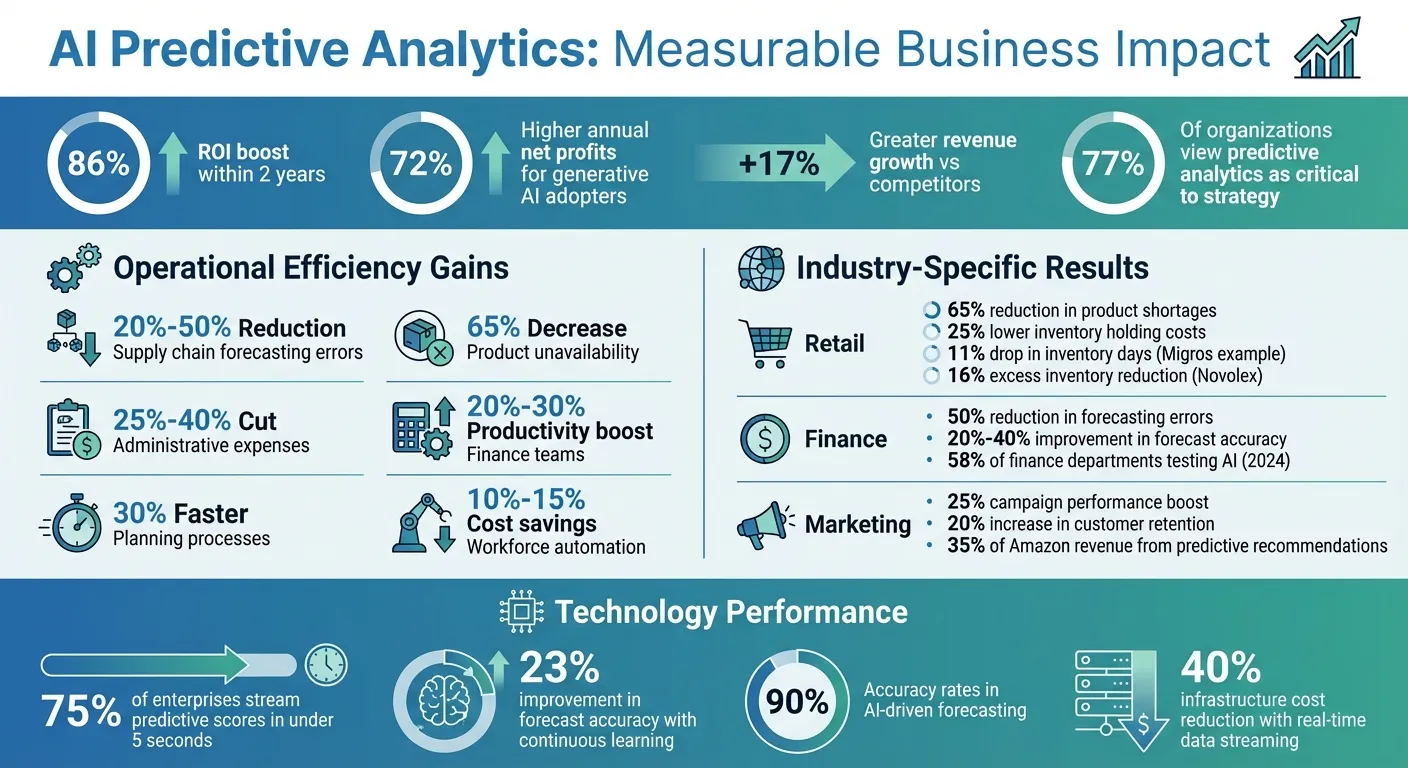 {AI Predictive Analytics Impact: Key Statistics and ROI Across Industries}
:::
{AI Predictive Analytics Impact: Key Statistics and ROI Across Industries}
:::
Analytics Advantage: Unlocking the Power of Predictive Analytics
::: @iframe https://www.youtube.com/embed/DRhhdIipIZ0 :::
What is AI-Powered Predictive Analytics?
Predictive analytics is a sophisticated branch of data science that leverages historical data, statistical models, and machine learning to forecast future events. While descriptive, predictive, and prescriptive analytics offer different levels of insight, predictive analytics specifically looks ahead to anticipate what’s coming next.
The main difference between traditional forecasting and AI-powered predictions lies in their scale, speed, and precision. Traditional methods might analyze a handful of variables over a limited dataset, but AI systems can process thousands of factors across decades of data all at once. These models also improve over time, continuously refining their predictions as new data becomes available.
"Predictive AI technology speeds up statistical data analysis and can make it more accurate due to the sheer volume of data that machine learning algorithms have at their disposal."
– IBM [3]
AI techniques, such as neural networks, are particularly effective at uncovering non-linear relationships and complex patterns that traditional regression models often miss. For example, modern systems like Google’s TimesFM can generate forecasts using minimal setup - processing up to 512 historical data points without requiring manual training. This eliminates the need for tedious statistical modeling, like ARIMA, saving both time and effort [7].
| Analytics Type | Primary Question | Nature | Key Techniques |
|---|---|---|---|
| Descriptive | What happened? | Historical/Reactive | Data aggregation, data mining [10] |
| Diagnostic | Why did it happen? | Reactive/Root Cause | Data correlation, drill-downs [10] |
| Predictive | What will happen? | Proactive/Forward-looking | Machine learning, regression, neural networks [2][10] |
| Prescriptive | What should we do? | Strategic/Optimization | AI-driven recommendations, simulation [10] |
This evolution from reactive to proactive analytics is why predictive models are now central to business planning. Companies can anticipate challenges, allocate resources efficiently, and seize opportunities instead of merely reacting to disruptions [10].
How AI Predictive Analytics Works
AI predictive analytics starts with feeding historical data into algorithms that identify hidden patterns and correlations. These algorithms analyze structured data - like sales figures or inventory levels - alongside other relevant inputs to create mathematical models that predict future outcomes [2].
The process begins with data cleaning, which removes anomalies, missing values, and outliers that could skew results. Once the data is prepped, algorithms apply techniques such as:
- Regression: For predicting continuous values (e.g., sales figures).
- Classification: For categorizing outcomes (e.g., detecting fraud).
- Clustering: For grouping similar patterns or behaviors.
AI models excel at handling massive datasets by converting information into mathematical vectors, enabling them to uncover relationships and patterns far beyond the reach of traditional methods [3].
Transformer-based models, like Google’s TimesFM, simplify forecasting even further. Pre-trained on extensive datasets, these models can produce accurate predictions with just a single function call - no custom training required. This drastically reduces the time it takes to deploy forecasting systems [7].
Another key advantage is their ability to learn and adapt. As new data becomes available, the models refine their predictions by identifying which factors are gaining or losing influence over time [10][3].
However, even the most advanced AI systems rely heavily on clean, high-quality data to deliver reliable results.
Why Data Quality Matters for Predictions
AI models are only as reliable as the data they’re trained on. Incomplete or inaccurate data can lead to flawed predictions, leaving gaps or biases in the analysis [9].
"Accurate predictive insights depend on the completeness and accuracy of the data going into the predictive model. If you aren't looking at data that addresses all the potential factors impacting an issue, you will end up with an analysis with holes in it."
– Snowflake [9]
Centralized data warehouses, like Snowflake or BigQuery, play a crucial role in predictive analytics. By consolidating data from various systems - such as CRM, ERP, and supply chain platforms - these warehouses provide a unified view that helps uncover subtle correlations across departments and time periods [2][8].
Before deploying any predictive model, it’s essential to clean the data thoroughly. For instance, a retailer’s sales data might show a spike due to a one-time promotional event or a dip caused by an unexpected store closure. Such anomalies need to be smoothed out to prevent misleading forecasts [6].
The efficiency of predictive modeling also depends on proper infrastructure. Training a model on a dataset with 100,000 rows might take 400 seconds on a small virtual warehouse, while a dataset with 1,000,000 rows could take around 850 seconds [11]. Achieving this performance requires modern cloud infrastructure capable of handling large-scale parallel processing. Organizations relying on scattered spreadsheets or outdated databases may struggle with the data volume and speed needed for accurate predictions.
Technologies That Power Predictive AI
Every accurate prediction relies on a network of technologies that work together to transform raw data into actionable insights. These tools are the backbone of AI-powered decision-making, enabling businesses to anticipate changes with confidence. While machine learning algorithms are at the core, they don’t operate in a vacuum. Natural language processing (NLP) simplifies access to insights for non-technical users, and direct warehouse connections ensure the predictions are based on real-time, reliable data - not outdated snapshots.
By understanding how these technologies interact, businesses can select the modern analytics stack to support their predictive analytics efforts. Let’s dive into the key technologies behind this predictive capability, starting with machine learning models.
Machine Learning and AI Models
Machine learning (ML) models are the driving force behind predictive analytics. These algorithms sift through historical data to uncover patterns and correlations that would be nearly impossible for humans to identify manually. By analyzing past data - such as sales figures, customer interactions, sensor readings, and website activity - ML models can reveal relationships between variables that signal future trends.
One of ML’s standout features is its ability to process both structured data (like transaction records) and unstructured data (like customer reviews or social media posts) simultaneously. For example, it can combine sales data with online sentiment to predict demand spikes. Neural networks, in particular, excel at identifying complex, non-linear relationships - where the influence of one factor depends on the state of others. Take seasonal pricing, for instance: a price drop might boost sales during the holidays but have little impact during slower months, a nuance traditional regression models often miss.
What’s more, these models improve over time. As they process fresh data, they refine their understanding of which factors are most influential and adjust to changing conditions, ensuring predictions remain accurate.
Natural Language Processing for Data Queries
Natural language processing (NLP) breaks down the technical barriers that often limit access to predictive insights. Instead of relying on analysts to write essential SQL queries for analytics or navigate complex dashboards, business users can simply ask questions in plain English and receive instant, data-driven answers.
Platforms like Querio illustrate how NLP reshapes analytics workflows. Users can type questions like, "Which products are expected to see the highest demand next quarter?" and receive precise forecasts based on live data. Behind the scenes, the system translates these plain-English queries into SQL or Python code, ensuring results are transparent and governed. This approach not only makes insights more accessible to a broader audience - executives, managers, and customer success teams - but also keeps predictions grounded in real data.
The real benefit isn’t just ease of use. By tying every answer back to verifiable queries and live data, NLP ensures predictions remain connected to reality. This is far more reliable than relying on opaque AI outputs that can’t be validated.
However, user-friendly tools alone aren’t enough. Keeping data up-to-date is equally critical.
Connecting to Data Warehouses
Predictive analytics loses its edge when models rely on outdated information. Live warehouse connections replace traditional batch processing with real-time streaming, ensuring systems can identify trends as they emerge.
Companies that implement continuous learning pipelines see a 23% improvement in forecast accuracy [12]. Real-time data captures shifts in markets, customer behavior, and operations before they become historical records. In fact, 75% of global enterprises now stream predictive scores in under five seconds, enabling swift, informed decisions [12].
Take Picnic, a grocery delivery service, as an example. By integrating Confluent’s streaming platform into their supply chain, they processed data from automated fulfillment centers and delivery networks in real time. This allowed them to optimize inventory and delivery routes dynamically, cutting infrastructure costs by 40% [13].
Direct connections to data warehouses like Snowflake, BigQuery, or Redshift also maintain high data quality. Predictive tools query these warehouses using encrypted, read-only credentials, avoiding data duplication and delays caused by extract, transform, and load (ETL) processes. This ensures the models work with the same trusted data that powers operational systems, keeping analytics consistent across the board.
How Industries Use Predictive Analytics
Predictive analytics is reshaping industries by transforming raw data into actionable insights. Whether it's financial institutions spotting fraudulent activity or retailers ensuring shelves are stocked with what customers want, these tools are driving measurable gains in both efficiency and profitability. Building on earlier advancements, industries are now harnessing AI-driven predictions to gain a competitive edge. Let’s take a closer look at how predictive AI is making waves across key sectors.
Finance: Risk Management and Fraud Detection
In the finance world, predictive models are game-changers for tasks like forecasting cash flow, assessing credit risk, and detecting fraud. Advanced machine learning algorithms, such as neural networks and random forests, excel at identifying patterns in massive datasets - patterns that traditional methods might overlook. These tools can cut forecasting errors by as much as 50% compared to manual approaches [14].
AI also enhances scenario analysis through techniques like Monte Carlo simulations, which generate thousands of potential outcomes based on historical data and current market trends [14]. This helps financial teams anticipate risks like currency fluctuations or customer defaults before they occur [15]. By 2024, 58% of finance departments were testing AI tools, a notable jump from 37% the previous year [15]. Companies using AI in their planning processes report improvements in forecast accuracy ranging from 20% to 40% [16].
"AI-driven cash flow forecasting puts us in a new era of corporate treasury function." – Alberto Hernandez-Martinez, Executive Director, Industry Solutions, J.P. Morgan [14]
However, the real power lies in combining automation with human expertise. While AI excels at crunching numbers and spotting trends, finance professionals bring the strategic insights and qualitative judgment that machines can’t replicate [15].
Predictive analytics is just as transformative in other sectors, especially retail.
Retail: Demand Forecasting and Personalization
Retailers face constant pressure to stock the right products at the right time. Predictive analytics steps in by analyzing historical sales data, weather patterns, social media trends, and even competitor activity to optimize inventory levels. These AI-driven systems can slash product shortages by up to 65% and reduce inventory holding costs by 25% [4][18].
A real-world example is Migros, a grocery retailer that adopted the invent.ai platform in 2025. This platform automated 20 million inventory decisions daily across its network, leading to an 11% drop in inventory days and a 1.7% boost in product availability [18]. Similarly, Novolex, a packaging manufacturer, used AI forecasting to cut excess inventory by 16% and shorten planning cycles from weeks to just days [17].
Retailers also use predictive tools for dynamic pricing and hyper-personalized customer experiences. By analyzing loyalty program data and point-of-sale systems, AI creates detailed customer profiles, enabling tailored product recommendations and location-specific marketing. Large Language Models (LLMs) even process unstructured data - like social media chatter - to spot trends before they show up in sales reports [17]. By 2026, 90% of retail executives anticipate that AI assistants and automation will play a central role in supply chain management [17].
Marketing: Customer Behavior and Campaign Performance
Predictive analytics is also revolutionizing marketing by helping teams anticipate customer behavior. Marketers use these tools to identify at-risk customers, fine-tune campaigns, and improve return on investment (ROI). By analyzing browsing habits, social media activity, and purchase history, predictive models can forecast customer needs and preferences [19]. This is especially useful for churn prediction, as it flags early warning signs like reduced engagement or negative sentiment, giving teams time to implement retention strategies [20].
AI doesn’t just predict - it adapts. It can dynamically adjust campaign parameters to optimize performance. Marketers can also simulate different strategies before launch, testing various messages and targeting options without committing their entire budget upfront [20]. These insights can boost campaign performance by 25% and increase customer retention by 20% [20].
Lead scoring is another area where predictive analytics shines. By analyzing demographic and behavioral data, predictive models rank prospects based on their likelihood to convert, allowing sales teams to focus on high-value leads [20]. Tools like Customer Data Platforms (CDPs) consolidate data from websites, social media, and CRM systems, creating a unified view of each customer and maximizing the impact of these insights [19].
sbb-itb-284a532
Business Benefits of Predictive Analytics
Predictive analytics delivers measurable improvements in profits, operational efficiency, and customer loyalty. Companies at the forefront of generative AI adoption report 72% higher annual net profits and 17% greater revenue growth compared to their competitors [21]. These aren't just incremental gains - they represent a transformative shift in business operations.
Better Decision-Making
Predictive analytics replaces guesswork with data-driven insights, enabling leaders to make confident decisions even in rapidly changing markets. Traditional forecasting methods often rely on limited historical data and can take weeks to produce results - by which time, the information may already be outdated [4][17]. AI changes the game by analyzing massive datasets through real-time AI insight generation, pulling from internal sources like ERP systems and IoT sensors, as well as external inputs such as weather patterns, social media trends, and economic indicators [4][17].
For finance teams, this shift has led to 20% to 40% more accurate forecasts [16]. One example: a global industrial goods manufacturer implemented an AI-integrated system that improved forecasting accuracy by 50%, optimizing plant scheduling and achieving significant savings in procurement [16].
AI also enables scenario modeling, allowing businesses to simulate potential outcomes before committing resources. Rather than relying on static annual plans that take months to prepare, companies can use AI to predict how events like raw material shortages or climate disruptions might affect operations [21][6]. This dynamic approach transforms planning from reactive to proactive, giving organizations the agility to adapt to uncertainty [16][21].
These advancements not only improve strategic decision-making but also streamline everyday operations.
More Efficient Operations
Predictive analytics brings automation to routine tasks, slashing time and costs. AI-driven forecasting systems can automate up to 50% of workforce-management activities, leading to 10% to 15% cost savings [6]. Planning cycles that once took weeks now take days - or even hours.
For instance, Idaho Forest Group reduced its forecasting time from over 80 hours to under 15 hours by implementing AI-enhanced demand planning [17]. Similarly, Novolex, a packaging manufacturer, used AI to integrate historical sales data with external market trends, cutting excess inventory by 16% and reducing planning cycles from weeks to days [17]. In finance, AI adoption has sped up planning processes by 30% while boosting productivity by 20% to 30% [16].
These efficiency gains extend across supply chains as well. AI-powered forecasting can reduce product shortages by up to 65%, lower warehousing costs by 5% to 10%, and cut administrative expenses by 25% to 40% [6]. IBM’s decade-long use of a cognitive supply chain advisor saved the company $388 million through reduced inventory costs, optimized shipping, and faster decision-making [21]. Additionally, businesses using AI-driven Integrated Business Planning (IBP) platforms typically see 2% to 4% annual revenue growth and 2% to 3% cost reductions [23].
Improved Customer Experiences
Predictive analytics doesn’t just streamline internal processes - it also enhances how businesses engage with their customers. By analyzing customer behavior, AI can identify churn risks, pinpoint upselling opportunities, and enable more personalized interactions [24]. This proactive approach helps companies tailor their messaging and timing for maximum impact.
The results are striking. AI-powered tools can increase customer satisfaction by 15% to 20%, grow revenue by 5% to 8%, and cut service costs by 20% to 30% [24]. A European telecommunications company, for example, improved its Net Promoter Scores and reduced churn by pausing marketing campaigns for customers with unresolved complaints [24]. Amazon also attributes up to 35% of its revenue to predictive recommendations that drive cross-selling and upselling [22].
How to Implement Predictive Analytics
Start by identifying a clear goal - whether it’s detecting fraud, optimizing inventory, or predicting customer churn. Consolidate your data into a centralized, clean repository using tools like BigQuery, Snowflake, or Redshift. This ensures you have a single, dependable data source. Next, choose and train models that align with your objectives, such as classification, regression, or neural networks. Once your models are ready, integrate AI-generated forecasts into dashboards and workflows. Validate these predictions by comparing them to your sales projections and financial plans. According to McKinsey, using AI-driven forecasting in supply chain management can reduce errors by 20% to 50% [6]. These steps help translate predictive analytics from theory into actionable solutions.
Ensuring Data Quality and Governance
Reliable predictions depend on high-quality data and strong governance practices.
"Treat Data As A Product - Standardize definitions, clean outliers, and ensure reliable pipelines from your CRM, marketing platforms, finance systems, and product analytics." - Pedowitz Group [25]
To ensure consistency, organizations must standardize definitions across systems like CRM, marketing, and finance platforms. A governed semantic layer can simplify complex data into familiar business terms, helping teams maintain consistency for key metrics like revenue. Running AI models within your organization’s security framework protects sensitive data, while governance efforts should include documenting data sources, monitoring for model drift or bias, and refreshing models regularly. Collaboration between domain experts and data professionals is crucial to prevent siloed data practices and ensure actionable insights.
Preparing Your Team
Implementing predictive analytics often requires a shift in mindset. Teams need to be equipped with the skills to interpret AI insights and apply them strategically. This means blending algorithmic forecasts with market context and avoiding over-reliance on historical patterns. Involve domain experts in model creation and validation, and adopt a human-in-the-loop approach that enhances, rather than replaces, human judgment.
"AI is most effective when it augments human judgment rather than replacing it. Models excel at finding patterns in large datasets, while humans provide strategic context." - Pedowitz Group [25]
Encourage the use of confidence ranges and scenario planning to better assess risks and opportunities. Interactive interfaces can help business users adjust parameters - like volume or pricing - and observe how changes impact outcomes. Regularly retrain models as new data becomes available to prevent them from becoming outdated.
Using Inspectable Outputs for Trust
Transparency is key to building trust in predictive analytics. Platforms that produce inspectable SQL and Python code, instead of opaque "black box" predictions, allow technical teams to verify the logic behind forecasts. This is especially important for regulatory compliance and gaining stakeholder confidence. AI systems should also include mechanisms to self-correct by measuring outputs against quality standards. Maintaining a global state of reasoning makes the system more transparent and easier to debug.
For instance, Querio's AI-native analytics workspace connects directly to your data warehouse, generating transparent SQL and Python code. This ensures that every prediction is both explainable and reliable, giving teams the confidence to act on data-driven insights.
The Future of Predictive Analytics
Predictive Analytics Trends for 2026 and Beyond
The year 2026 signals a major evolution in predictive analytics, as the focus shifts from simply forecasting outcomes to taking actionable steps. A key driver of this change is Agentic AI - systems that independently plan, execute, and refine tasks. These systems are already reshaping industries by handling multi-step processes like demand sensing, hyper-personalization, and financial reconciliation [26][30]. This development paves the way for deeper integration of autonomous capabilities within enterprise systems.
As of late 2024, nearly 70% of organizations have moved only a fraction - 30% or less - of their generative AI experiments into production [27]. This trend shows a transition from experimental pilots to a more structured approach aimed at achieving measurable value. Businesses now prioritize proven ROI and financial impact before scaling their predictive models [29][30]. These models are no longer experimental tools but critical business assets, undergoing regular reviews by data science, finance, and risk teams in a process often referred to as "Model P&L" [30].
"The central question won't be what AI can do; it will be how people and AI work together. In other words, how roles evolve, how decisions are shared and how leaders build trust and clarity in an environment where autonomy increases."
– Anahita Tafvizi, Snowflake [26]
Responsible AI practices have shifted from theory to necessity. Companies are implementing strict measures like automated red teaming, deepfake detection, and ongoing bias monitoring before scaling their models [29][30]. These efforts are paying off - organizations adopting such practices report a 60% improvement in ROI and efficiency, with 55% also seeing better customer experiences and innovation [29]. To maintain control over high-risk autonomous tasks, human checkpoints and kill switches are now mandatory [30].
As AI agents increasingly handle tasks like coding and invoice processing, there's a growing demand for AI generalists - professionals who oversee these agents and ensure their outputs align with larger business objectives [29]. At the same time, data strategies are evolving to make unified, high-quality, and well-governed data "AI-ready" for autonomous systems [28]. These advancements are transforming decision-making from reactive to proactive, allowing businesses to anticipate and act on opportunities more effectively.
How Platforms Like Querio Are Evolving
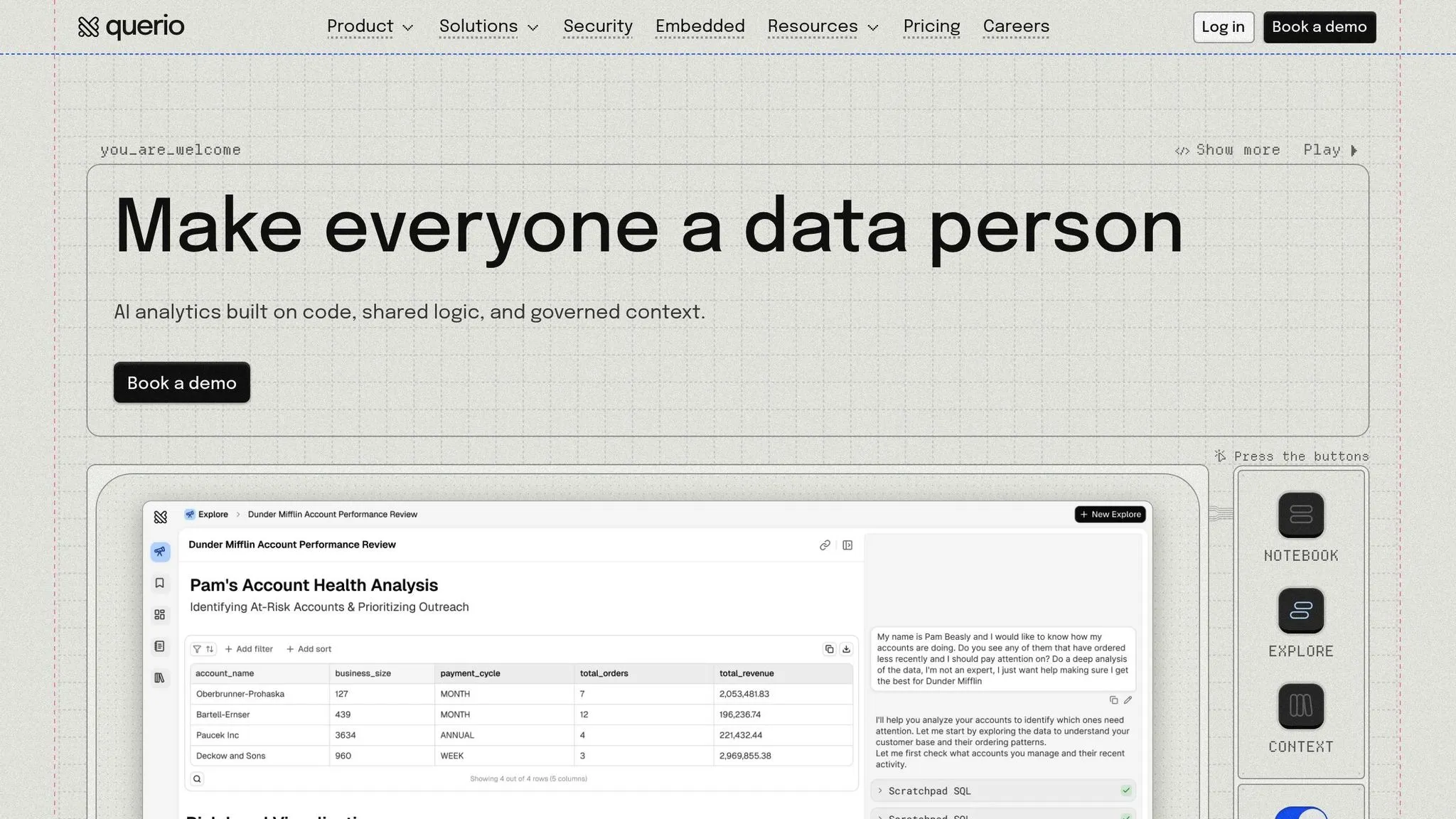
Analytics platforms are adapting to these trends by merging transparency with autonomous capabilities. Modern platforms emphasize generating inspectable SQL and Python code rather than relying on opaque, black-box predictions. This transparency allows teams to audit the logic behind every forecast, fostering trust and accountability.
"AI models will have a deep understanding of your data. But you'll still have to know when to doubt, when to ask deep follow-up questions before taking action."
– Chris Child, VP of Product, Snowflake [26]
Querio's AI-native analytics workspace is a prime example of this evolution. It connects directly to data warehouses like Snowflake, BigQuery, and Redshift, producing transparent, context-aware SQL code for every analysis. This ensures that predictions are not only reliable but also explainable, aligning with the agentic workflows that define predictive analytics in 2026. Additionally, Querio's shared context layer guarantees consistent definitions across analyses and dashboards - an essential feature for autonomous systems that depend on trustworthy data to make informed decisions.
Another game-changer is edge computing, which is revolutionizing predictive analytics. By shifting inference to the edge with compact models and local fallback options [30], businesses can achieve real-time predictions in industries like manufacturing, logistics, and IoT. With 77% of organizations now viewing predictive analytics as critical to their strategy [31], platforms must strike a balance between autonomy and transparency, speed and accuracy, and innovation and governance. This balancing act will be key to shaping the future of predictive analytics.
Conclusion
AI-powered predictive analytics is changing the game for businesses, shifting them from constantly reacting to problems toward proactive, strategic planning. By adopting these tools, companies can minimize supply chain disruptions, avoid product shortages, and improve financial planning efficiency [4][6][16]. This shift is especially important in a world where 80% of business leaders believe generative AI will reshape industries by 2027 [27]. The real advantage lies in combining real-time insights with forward-looking strategies.
But here’s the catch: data quality matters more than ever. Companies relying on fragmented systems or outdated data risk falling behind as competitors embrace integrated, real-time analytics [5]. AI-driven forecasting tools, with accuracy rates nearing 90% in supported markets [1], highlight the importance of breaking down data silos. Success will belong to those who invest in clean, structured data and combine AI's power with human expertise to navigate complex scenarios.
"Companies that embrace [AI] will be ready for a future where data-driven AI insights define success."
– NielsenIQ [1]
Platforms like Querio are paving the way by offering a transparent approach to predictive analytics. Querio connects directly to your data warehouse, generating clear SQL and Python code that eliminates the mystery of black-box predictions. With consistent definitions and a shared context layer, it ensures reliable data governance and reusable analytics. This transparency not only builds trust but also enables autonomous workflows that can give businesses a competitive edge.
The real question is: how soon can you integrate AI-driven predictive analytics into your processes? Start small with a focused pilot, prioritize data readiness for AI, and choose tools that balance automation with transparency. The companies that act decisively today will be the ones shaping tomorrow’s AI-driven economy, leading the charge rather than playing catch-up. By aligning precise data with strategic insight, businesses can position themselves at the forefront of this transformation.
FAQs
::: faq
How can businesses ensure their data is accurate for reliable AI predictions?
To make AI predictions dependable, businesses must emphasize data accuracy and quality. This starts with combining information from multiple reliable sources to build a consistent and well-rounded dataset, reducing gaps and inconsistencies. After that, prioritize data cleaning - eliminate duplicates, correct errors, and confirm the accuracy of the data before diving into analysis.
Implementing automated quality checks and setting up clear data governance policies are essential for maintaining long-term standards. AI tools can also play a role by spotting anomalies or inconsistencies, allowing businesses to address potential problems early. By sticking to strict data quality practices, companies can ensure their AI models produce precise, actionable insights. :::
::: faq
Which industries gain the most from AI-powered predictive analytics?
AI-powered predictive analytics is reshaping industries that depend on massive amounts of data and require accurate, real-time insights to make critical choices. Some of the key players benefiting from this technology include financial services, healthcare, technology, and retail.
Take financial services, for example. Banks and other institutions are using predictive models to spot fraudulent activities and evaluate risks more effectively. In healthcare, providers are anticipating patient needs and streamlining resources to deliver better care. Retailers are tapping into AI to forecast customer demand, ensuring shelves are stocked with the right products while avoiding overstock. Meanwhile, tech companies are using these tools to fine-tune product development and enhance user experiences.
What ties these industries together is their reliance on data-driven insights to stay ahead. AI-driven analytics empowers them to make smarter decisions, cut costs, and achieve better results - all of which are crucial in today’s competitive, fast-moving world. :::
::: faq
How can AI predictive analytics help businesses make better decisions?
AI predictive analytics equips businesses with the tools to make quicker, more informed decisions by processing vast amounts of historical and real-time data. Through machine learning models and statistical algorithms, it uncovers patterns and trends that might go unnoticed by human analysis. This capability enables companies to better predict future outcomes, understand customer behaviors, and adapt to market changes with improved accuracy.
By streamlining data analysis, predictive analytics not only saves valuable time but also boosts the accuracy of decision-making. Companies can take proactive steps to address market changes, allocate resources more effectively, and refine their strategic planning. In an era driven by data, this technology offers a clear advantage, empowering organizations to stay ahead of the curve. :::