Guide
Analytics Modernization: A 2026 Guide
Discover the 2026 analytics modernization roadmap: drivers, maturity models, migration patterns, KPIs, and vendor criteria from legacy BI to warehouse-native.
The worst advice in analytics modernization is still the same. Tear out the old BI stack, buy a shiny new platform, and call it transformation. That playbook burns time, breaks trust, and usually leaves the same metric mess in a newer interface.
Real modernization is narrower and harder. It's a governance-first rewrite of the parts that matter, with the rest left alone until there's a reason to touch them. If your team still treats modernization like a dashboard shopping exercise, you're missing the actual operating problem.
Table of Contents
- What Analytics Modernization Actually Means in 2026
- The Business Drivers and ROI Behind Modernization
- A Practical Maturity Model for Self-Assessment
- Three Migration Patterns Worth Knowing
- A Pragmatic Roadmap With Milestones and KPIs
- Real-World Use Cases and Vendor Selection Criteria
- Pitfalls, Governance Shifts, and a Buyer's Checklist
What Analytics Modernization Actually Means in 2026
Analytics modernization does not mean ripping out every legacy dashboard and replacing it with a newer logo. It means moving the logic, ownership, and access rules closer to the warehouse, then letting more people work with governed data without turning your analysts into a ticket queue.
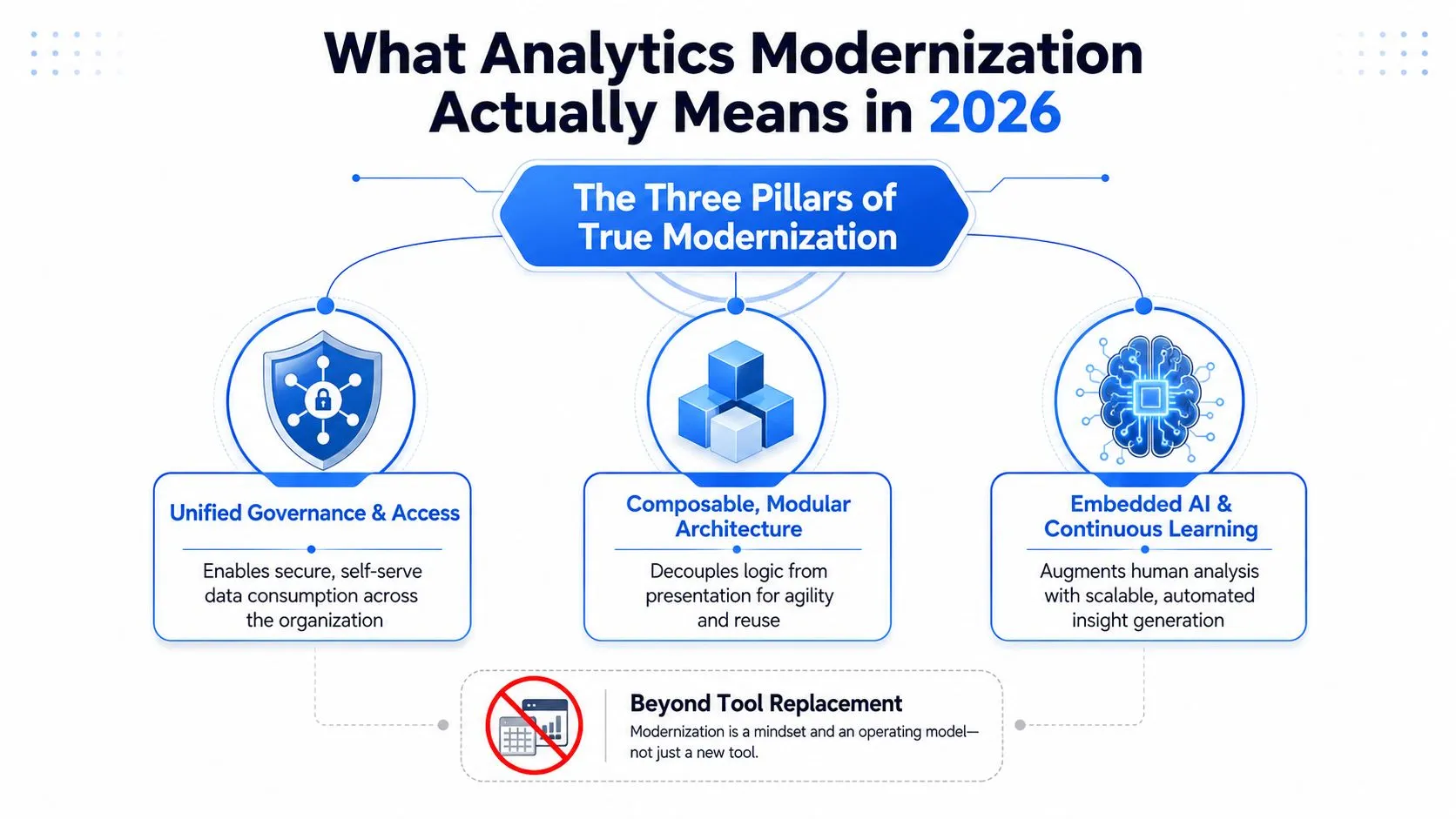
The shift is structural. Legacy analytics often traps business logic inside report definitions, metadata layers, and downstream tools, which makes migration risky and trust fragile because teams have to reconcile duplicate calculations and hidden dependencies before they can move anything safely (LeapLogic on BI modernization). That's why modernization is really an information architecture problem, not just a tooling upgrade, and why governance sits at the center of the program instead of at the end (ECSENET on analytics democratization and governance).
A better working definition is simple. Keep stable reporting where it is, move reusable logic into the warehouse when it creates advantage, and open governed self-serve access where the business can safely consume it. For a broader transformation lens that pairs well with this view, the enterprise transformation roadmap insights from DataLunix are useful because they treat change as sequencing, not as a one-time replacement event.
What changed and what didn't
What changed in 2026 is the economics. Enterprises are under pressure to reduce license drag, simplify maintenance, and give non-technical teams faster access to data they can use. What didn't change is the need for trust, access control, and precise metric definitions.
Practical rule: if the modernization plan starts with a vendor demo instead of a governance map, it's backwards.
The right question is not “Which platform do we replace?” It's “Which calculations belong in the warehouse, which reports can stay, and which users should be able to work without analyst mediation?” That's the frame that keeps modernization selective instead of theatrical.
The Business Drivers and ROI Behind Modernization
Executives don't fund analytics modernization because it sounds modern. They fund it when the current stack leaks money, slows decisions, or creates avoidable risk. Those are the only three levers that matter.
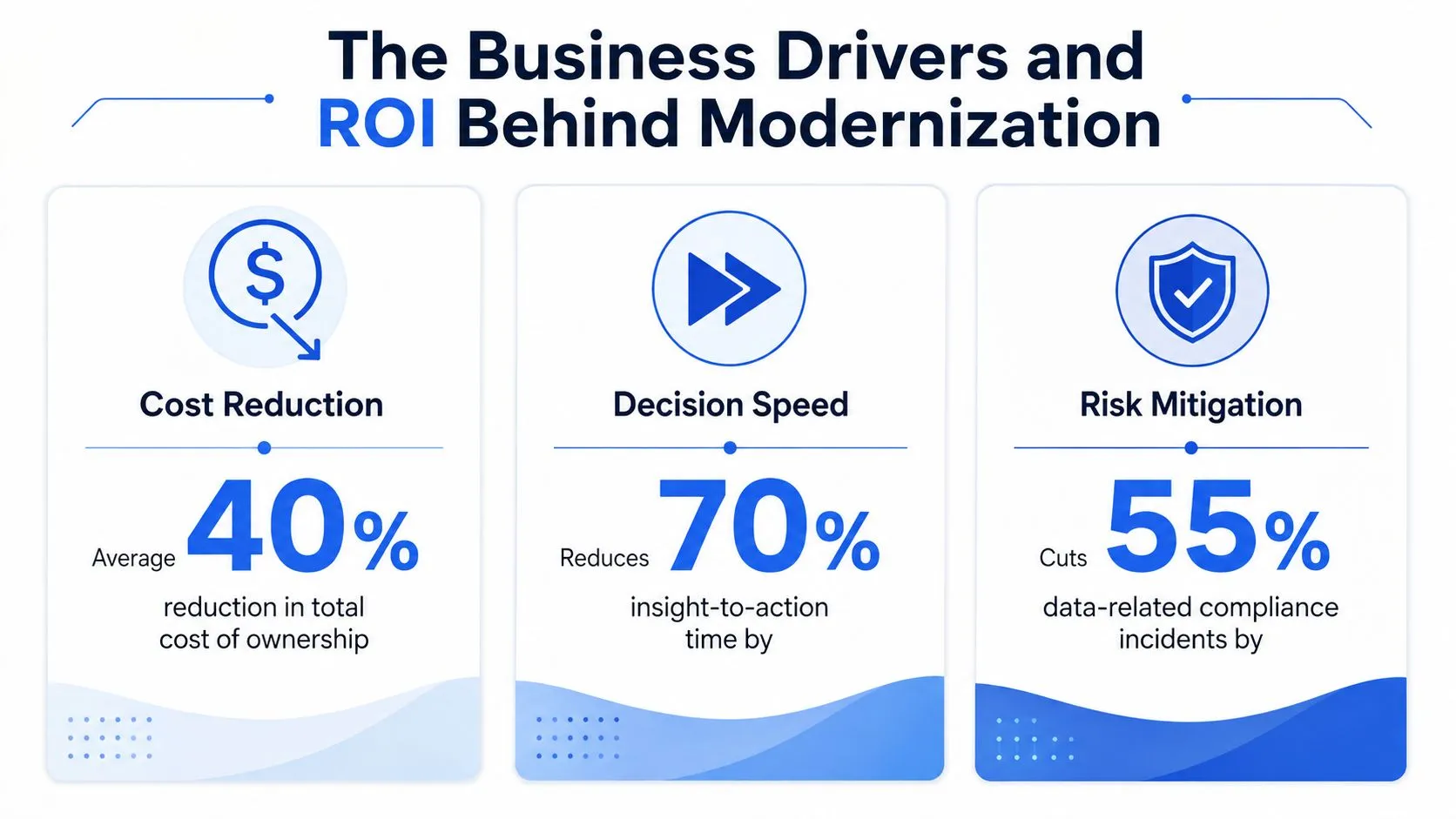
Cost is the easiest case to defend
Legacy analytics stacks inflate cost through licenses, manual maintenance, and analyst bottlenecks. A 2026 industry compilation says 91.9% of organizations gained measurable value from data and analytics investments, 80% of companies have already integrated big data analytics into operations, and the global data analytics market is projected to reach $83.79 billion by the end of 2026 with a 28.35% CAGR (data.folio3.com). Those are broad adoption signals, but the local lesson is sharper, analytics is no longer a discretionary layer on top of the business.
The same source says 60% of data leaders prioritize data governance, and poor data quality costs companies 12% of revenue annually (data.folio3.com). That's the silent tax modernization removes. If your dashboards are pretty but the underlying definitions are inconsistent, you're paying for appearance, not decision support.
Speed and risk are the real executive arguments
A second report says 82.8% of organizations see an urgent need to migrate to modern systems because they support real-time analysis and more dynamic reporting, with an average 33% reduction in annual operational costs after migration and expected productivity improvements of 26% to 50% for most organizations (AIM Research). Use those numbers carefully. They're not a promise, but they do show why this is now a margin and velocity program, not a cosmetic refresh.
The risk case is equally blunt. Democratized analytics without governance increases the attack surface, creates shadow analytics, and gives you inconsistent access patterns that security teams can't see cleanly (ECSENET). That's why modernization should be sold as controlled self-service, not uncontrolled access.
Bottom line: if leadership can't explain how modernization lowers cost, shortens time to answer, and reduces governance risk, the business case isn't finished.
For teams evaluating AI-assisted analytics and automation on top of this foundation, the ROI framing in this analysis of AI-powered analytics tools is a useful companion, because it keeps the conversation tied to operating efficiency instead of feature checklists.
A Practical Maturity Model for Self-Assessment
Vendor maturity models love to imply everyone is still stuck in spreadsheets. That's lazy. The more useful test is whether your current stack already supports governed reuse, or whether each new report forces another round of manual work.
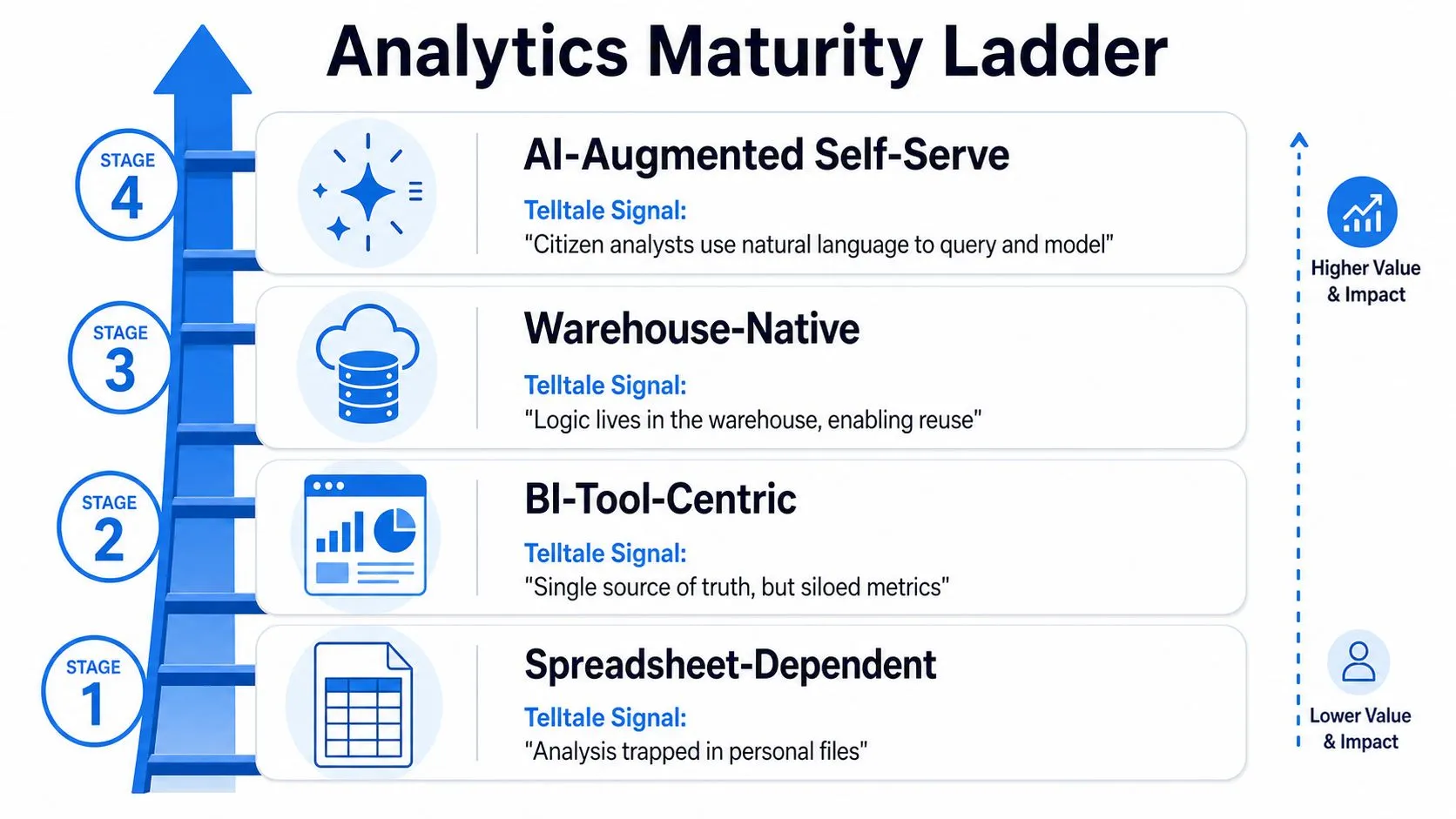
Stage one is spreadsheet-dependent
This is the stage where analysis lives in personal files, copied tabs, and someone's memory. If one person leaves and a critical workbook disappears with them, you're here.
The diagnostic question is direct. Can the business reproduce a key metric without asking the original author? If the answer is no, modernization should start with governance and documentation, not with platform shopping.
Stage two is BI-tool-centric
This is better, but not enough. You have dashboards, a supposed single source of truth, and still too many metrics that only exist inside the BI layer.
The diagnostic question here is: Are you governing the numbers, or just the visuals? Teams often stay here longer than they should because the dashboards look mature while the logic underneath remains brittle.
Stage three is warehouse-native
At this point, logic lives in the warehouse and gets reused across tools. That's where analytics starts to feel like a shared system instead of a collection of reports.
The key signal is whether the team can change one calculation in one place without hunting through downstream tools. If you can do that, you've reduced duplication and made governance real rather than decorative. The self-service analytics guide for US teams is helpful here because it treats self-serve as an operating model, not a dashboard feature.
Stage four is AI-augmented self-serve
This is the stage where citizen analysts can query and model data with natural language, but only after governance and warehouse logic are already in place. The mistake is to start here. If your definitions are unstable, adding AI only makes the mess faster.
Useful check: if a non-technical user can get an answer quickly but the data team can't defend the logic, you're not modernized, you're just faster at making bad decisions.
Three Migration Patterns Worth Knowing
There isn't one correct migration path. There are three patterns that work when the sequencing matches your starting point, and fail when teams pretend the starting point doesn't matter.
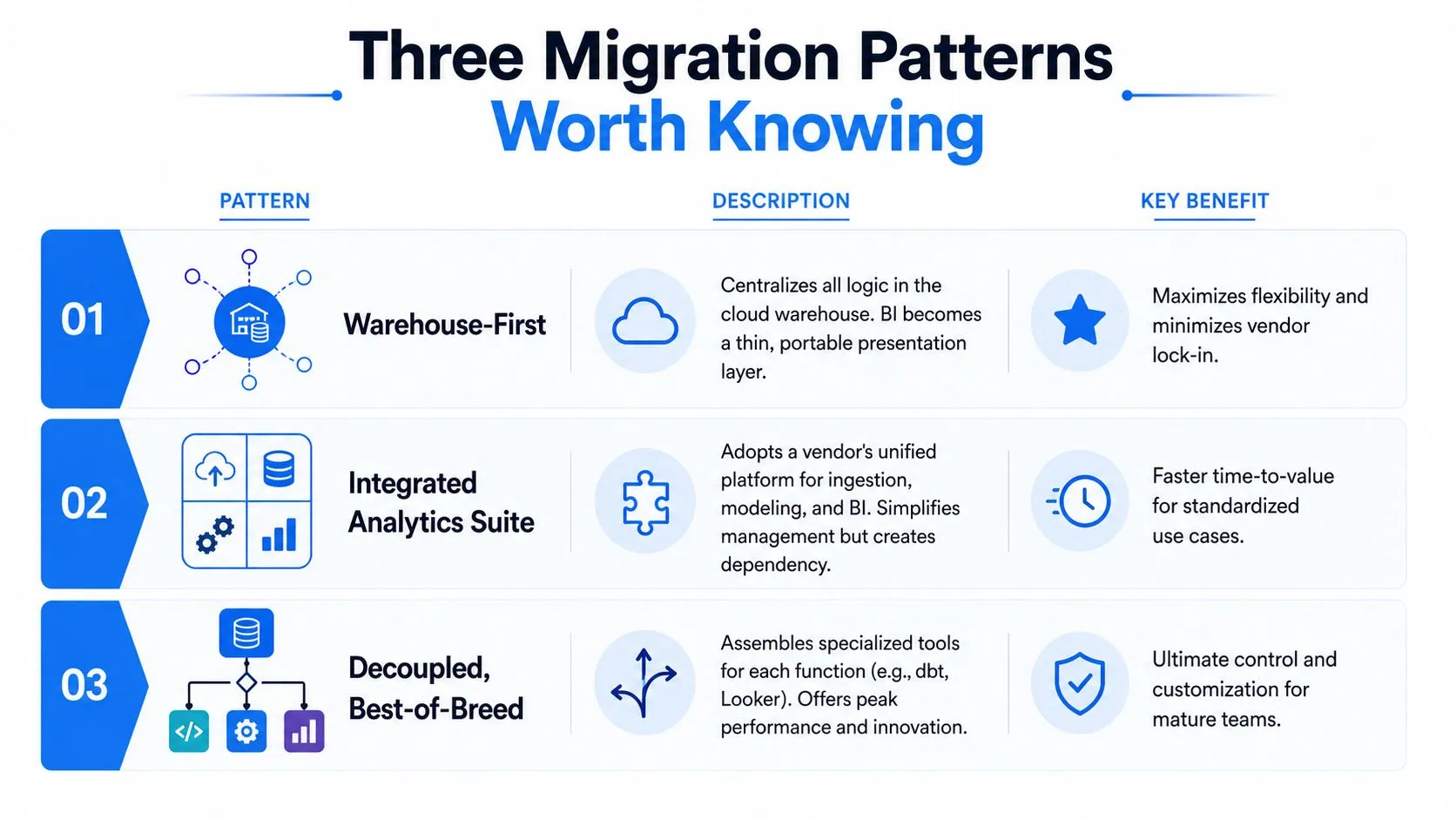
Warehouse-first
Warehouse-first means centralizing logic in the cloud warehouse and keeping BI as a thin presentation layer. This is the cleanest path when you already have a strong data engineering team and a warehouse that people trust.
It usually fails when the team assumes every report can be rewritten at once. It can't. You need to isolate stable, high-value metrics first, then move the reusable calculations that create the most duplication. The warehouse modernization perspective is relevant here because it treats the warehouse as the system of record for logic, not just storage.
Self-serve-first
Self-serve-first prioritizes governed analyst independence through notebooks, file-system workflows, and clear access rules. This works when the bottleneck is analyst availability, not warehouse readiness.
It fails when governance is weak or when business users are handed flexibility without shared definitions. That's how shadow analytics spreads. The point isn't to let everyone do everything, it's to let the right users move faster inside guardrails.
CI/CD-first
CI/CD-first treats analytics like software, with version control, tests, and promotion paths. This pattern suits teams with enough engineering maturity to manage changes as code rather than as ad hoc edits.
It fails when the organization over-engineers every report. Not every workflow needs a software lifecycle. Use this pattern where change risk is high, logic is complex, and traceability matters enough to justify the overhead. If you're comparing platforms for this kind of workflow, the criteria for choosing a self-service analytics platform gives you a clean way to evaluate trade-offs without vendor theater.
The honest answer is that most companies blend two patterns. Warehouse-first for shared metrics, self-serve-first for exploratory analysis, and CI/CD discipline for high-risk logic. That mix is usually right.
Decision heuristic: start with warehouse-first if trust and reuse are the problem, self-serve-first if analyst bottlenecks are the problem, and CI/CD-first if change control is the problem.
A Pragmatic Roadmap With Milestones and KPIs
Most modernization programs fail because they try to migrate everything before they prove anything. Don't do that. Start with one high-volume workflow, prove the new operating model, and only then expand into higher-risk domains like finance.
Phase one, discover and cut scope
Inventory the reports, models, and downstream dependencies. Identify what is stable, what is redundant, and what nobody uses anymore. You're not trying to admire the mess, you're trying to avoid replatforming dead weight.
Checkpoint one is simple. Can you name the workflows worth modernizing first, and the ones you should leave alone for now? If not, stop and assess again.
Phase two, govern before you migrate
Define ownership, metric definitions, access rules, and approval paths before any rebuild starts. Most teams underinvest because governance feels slow. It isn't slow. It's the only thing preventing rework later.
Phase three, pilot one workflow
Pick a workflow with enough volume to matter and enough structure to be measurable. Build it in the target pattern, then compare trust, latency, and maintenance burden against the old version. Do not choose the smallest use case just because it's easy.
Phase four, migrate stable flows
Move the stable workflows that already have clear definitions and low change frequency. Leave volatile logic alone until the patterns are proven. That's how you protect time-to-value.
Phase five, scale by reuse
Expand only where the same logic can serve multiple teams. If a rebuild doesn't reduce duplication or improve self-service, it's probably vanity work. Use a short executive update template with three questions, what moved, what broke, what's next, and keep it one page so nobody hides behind prose.
Phase six, optimize and stop when the math says stop
Every quarter, review whether the next migration is worth the effort. Some systems should stay where they are. Selective modernization beats heroic rewrites because it respects both cost and risk.
A useful KPI set stays boring. Track adoption of the new workflow, maintenance effort, and the number of repeated metric disputes. If those numbers don't move, the modernization isn't real.
Real-World Use Cases and Vendor Selection Criteria
The right modernization pattern depends on the mess you're starting with. Two companies can buy similar tools and still need opposite sequencing.
A mid-market SaaS company with product analytics spread across Looker dashboards and warehouse tables usually has a trust problem. The data team spends too much time reconciling metric drift, and product managers still need analyst help for every non-standard question. In that case, a warehouse-native move makes sense because it standardizes the metric layer, reduces duplicate logic, and gives product teams a cleaner path to self-serve without rebuilding every visualization from scratch.
A Series B startup replacing spreadsheets has a different problem. It doesn't need an expensive dashboard empire, it needs repeatable analysis with light governance and enough structure that founders, product managers, and analysts can work from the same source of truth. That's where a file-system and notebook-driven stack can help, because it lets the team ship analyses without waiting for a central BI process to catch up.
What to evaluate in a vendor
Don't start with logos. Start with criteria.
- Warehouse-native fit: Can the platform work directly against your warehouse or lakehouse without forcing duplicate storage?
- Governance model: Does it support shared definitions, access control, and auditability without turning every change into a manual exception?
- Self-serve depth: Can non-technical users query and reuse governed data without escalating every request?
- Developer workflow: Can analysts and engineers version, test, and promote logic without fighting the tool?
- Migration realism: Does it support partial modernization, or does it pressure you into a full rewrite?
If you want a concrete example of a platform category to assess against those criteria, Querio's selection framework for self-service analytics platforms is one place to start because it forces the buyer to think in terms of ownership, reuse, and workflow fit rather than feature density. For teams that also need practical monitoring comparisons around adjacent infrastructure decisions, the context in Monro Cloud's affordable monitoring options can help separate commodity tooling from strategic architecture.
The buyer's question is not whether a platform can make charts. It's whether it helps your team stop rebuilding the same answers over and over.
Pitfalls, Governance Shifts, and a Buyer's Checklist
The most common failure modes are boring and predictable. Shadow analytics appears when teams bypass the official stack. Metric drift shows up when definitions aren't shared. Over-customized semantic layers become fragile fast. Change management stalls when people are asked to adopt new tools without a better working model.
Governance should remove friction, not add it. Shared metric definitions, version-controlled logic, named owners, and a feedback loop between analysts and business users are what make self-serve safe. Without those, every promise of democratization turns into more cleanup for the data team.
Use this checklist before you buy or rebuild
- Shared definitions: Are the core business metrics defined once and reused everywhere?
- Access discipline: Can users get what they need without creating invisible copies of the data?
- Change control: Are important transformations versioned and reviewable?
- Partial migration support: Can the platform handle a selective rewrite, or does it force a big bang?
- Business fit: Does the tool reduce analyst bottlenecks, or just move them around?
If the answer to any of those is vague, the problem isn't the stack alone. It's the operating model around it.
Analytics modernization works when governance, architecture, and self-serve economics line up. If one of those is missing, you'll just get a more expensive version of the same confusion.
If you're ready to modernize without turning the project into a full rewrite, start by looking at where governance and self-serve are breaking down. Querio supports warehouse-native analytics with a file-system workflow and AI coding agents that help teams query, analyze, and build on company data without making the data team a human API. Visit it if you want a modernization path that's selective, governed, and built around reuse instead of report sprawl.