Business Intelligence
SQL in Context-Aware AI Analytics: How It Works
SQL-driven, context-aware AI ties live schema access to a shared semantic layer for transparent, governed, and accurate analytics.

When you ask an AI analytics tool a question in plain English, AI can auto-generate SQL to turn your words into actionable database queries. Unlike basic tools, context-aware platforms like Querio use a shared context layer to ensure accuracy by embedding your business rules, definitions, and logic into every query. This approach ensures consistent, governed, and transparent results directly from your live data.
Key Takeaways:
- SQL bridges natural language and data by generating queries based on your database's schema and your team's rules.
- A shared context layer standardizes metrics, joins, and terminology, ensuring queries align with your organization’s logic.
- Transparency is critical: these platforms show the full SQL code for every query, allowing users to validate results.
- Live connections to data warehouses ensure the AI works with up-to-date schemas, avoiding outdated or incorrect queries.
By grounding AI insight generation in SQL, context-aware tools provide reliable results, maintain governance, and save time for data teams.
AI & Text to SQL: How LLMs & Schema Power Data Analytics
::: @iframe https://www.youtube.com/embed/S5ezVVJhQmE :::
How SQL Powers Context-Aware AI Analytics
SQL has a unique ability to transform plain English questions into live, actionable queries. When you input a question, the system generates an SQL query that interacts directly with your live data. This ensures every answer is rooted in real database operations.
The distinction between best text-to-SQL tools for analytics and context-aware platforms lies in how well the system understands your business. A simple tool might translate "show me Q1 revenue" into a basic SELECT statement, but it won’t know which tables to connect, how to handle refunds, or how your team defines "revenue." Let’s delve into how this translation process ensures precision and builds trust.
How SQL Translates Natural Language Questions
When you ask a question, the AI system maps your words to the database schema. It identifies relevant tables and columns, then constructs an SQL query using the necessary joins and filters based on your organization’s shared context. Context-aware platforms, like Querio, rely on a shared context layer that stores your company’s specific business rules, metrics, and joins. This ensures that every query aligns with your predefined standards.
For example, if you ask, "What’s our average order value this month?" the system generates a query that joins the orders and payments tables, applies the appropriate date filter, and calculates the average based on your team’s logic. You can see the exact query executed, so there’s no ambiguity about where the data comes from. This level of transparency is essential for building trust, especially when critical decisions rely on accurate data.
This precise mapping not only ensures correct query generation but also supports strong governance.
How SQL Ensures Accuracy and Governance
SQL enables consistent and reliable results through the shared context layer. Every query adheres to the same business rules, so metrics like "revenue" are defined and calculated the same way across all analyses, whether for quick queries or dashboards. As Micah Horner, Product Marketing Manager at TimeXtender, explains:
"AI can produce an answer to an analytics question faster than any dashboard or ticket queue. The problem is that speed is not the hard part in enterprise analytics. Reliability is." [1]
Governance is further strengthened through version-controlled, inspectable logic. Your data team defines metrics once, and those definitions are applied universally across queries. If any definition changes, it’s updated in one central location and automatically reflected in all queries. This prevents teams from working with conflicting definitions or outdated calculations. Additionally, robust security measures such as read-only access, audit logs, and encryption (TLS 1.2/1.3 and AES-256) ensure that AI-generated SQL doesn’t accidentally modify or expose sensitive data. This approach delivers trustworthy, governed insights your organization can rely on.
What Is a Shared Context Layer?
::: @figure 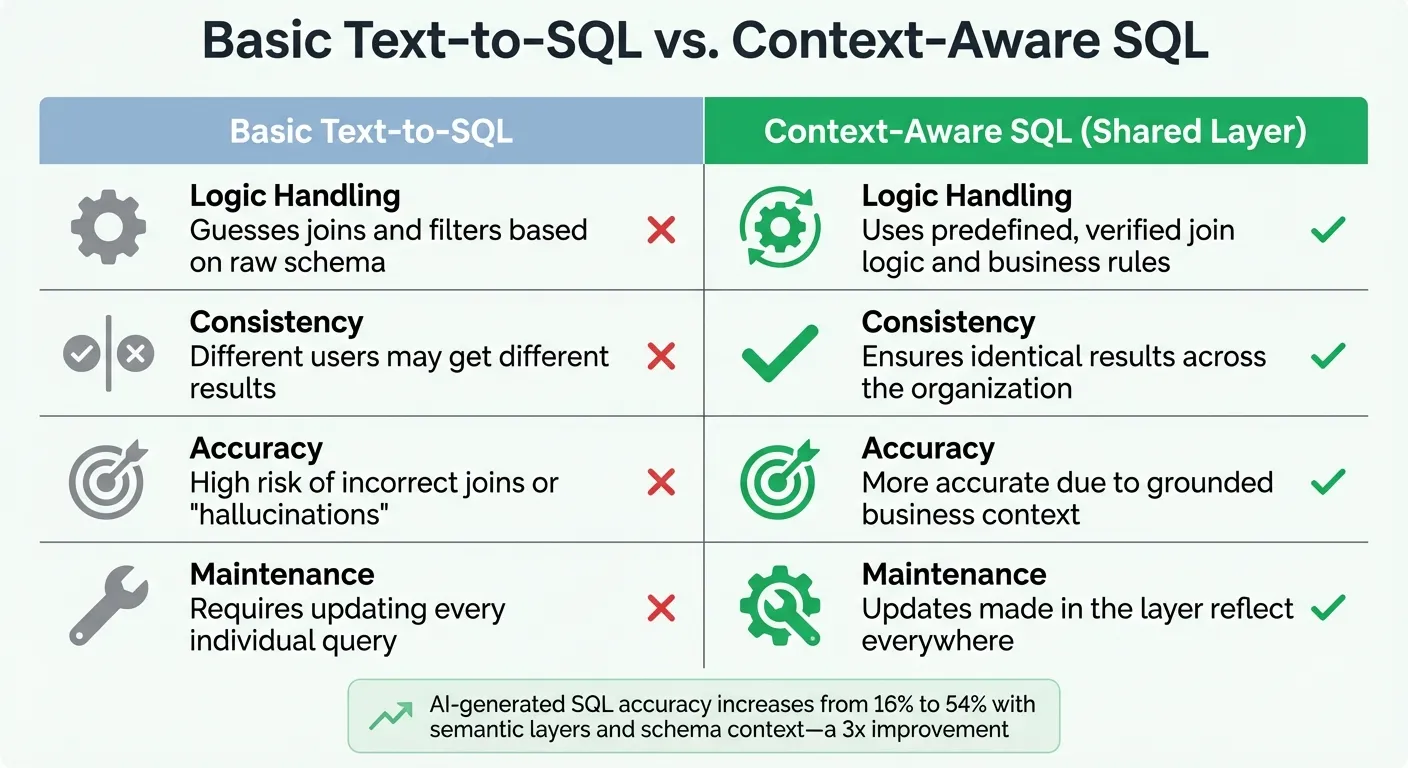 {Context-Aware SQL vs Basic Text-to-SQL Comparison}
:::
{Context-Aware SQL vs Basic Text-to-SQL Comparison}
:::
A shared context layer bridges the gap between your raw database and the AI generating SQL queries. Think of it as a business dictionary - it translates cryptic database names like rev_amt_usd into understandable terms such as "Revenue." Beyond that, it centralizes your business logic, including metric definitions, table relationships, and terminology.
Without this layer, AI tools might produce SQL queries that are technically correct but fail to align with your business needs. Misinterpretations can arise due to unclear naming conventions or fragmented data. The shared context layer solves this by providing the AI with a structured map of your data and the business rules that govern it.
Defining Metrics and Joins in One Place
The shared context layer introduces a "define once, use everywhere" model for your data team. This means your team can establish how tables connect, how metrics are calculated, and what business terms mean - all in one place. For instance, if someone asks, "What’s our Monthly Recurring Revenue?" the AI doesn’t need to guess the calculation or table joins. It references the definition set in the shared context layer.
This centralized system eliminates inconsistencies. For example, if both the sales and finance teams generate reports on "customer acquisition cost", they’ll get the same results because the calculation is standardized. Plus, if a metric definition changes, every query, dashboard, and report using it updates automatically, saving time and avoiding manual edits.
In Querio, the shared context layer allows data teams to define joins, metrics, and business terms that the AI relies on when creating SQL. It also enforces security policies like role-based access control, ensuring users only see data they’re authorized to access.
This approach differs significantly from basic text-to-SQL tools, which depend solely on raw schema analysis and lack this structured layer.
Context-Aware SQL vs. Basic Text-to-SQL
Basic text-to-SQL tools work by analyzing the raw database schema to translate user queries into SQL. They rely on column names to guess table relationships and filters, which often results in incorrect joins, missing filters, or even references to non-existent tables. Additionally, users asking the same question might get different answers depending on how they phrase their query.
Context-aware SQL platforms avoid these pitfalls by anchoring every query in verified business logic through the shared context layer. Instead of guessing, the AI knows exactly which tables to join, which filters to apply, and how to calculate metrics - because your data team has already defined these rules. As dbt explains:
"With dbt's Semantic Layer, you can resolve the tension between accuracy and flexibility that has hampered analytics tools for years, empowering everybody in your organization to explore a shared reality of metrics" [3].
| Feature | Basic Text-to-SQL | Context-Aware SQL (Shared Layer) |
|---|---|---|
| Logic Handling | Guesses joins and filters based on raw schema | Uses predefined, verified join logic and business rules |
| Consistency | Different users may get different results | Ensures identical results across the organization |
| Accuracy | High risk of incorrect joins or "hallucinations" | More accurate due to grounded business context |
| Maintenance | Requires updating every individual query | Updates made in the layer reflect everywhere |
This side-by-side comparison highlights why context-aware AI analytics deliver consistent and reliable insights aligned with your business logic.
How Schema Awareness Improves SQL Generation
Schema awareness takes the precise business rules from your semantic layer as the data interface and applies them to SQL generation, aligning queries with your database's actual structure. This means the AI understands your database's tables, columns, data types, and foreign keys, ensuring the queries it generates are accurate reflections of your design. Without this understanding, AI tools risk creating invalid queries, which can erode user trust.
For example, if you ask, "What's our revenue by region?", schema awareness allows the AI to identify the right tables for revenue data, pinpoint the columns representing regions, and use foreign keys to connect the tables correctly. This avoids the errors that can arise from simple mapping approaches, like incorrect joins or filters.
The results speak for themselves. Research shows that incorporating semantic layers and schema context can increase AI-generated SQL accuracy from 16% to 54% - a threefold improvement [2]. This leap happens because the AI reasons based on where data actually resides, rather than relying on column names alone. It's a clear demonstration of how combining business logic with structural understanding leads to more reliable insights.
Using Live Connections for Schema Accuracy
Platforms like Querio maintain live, read-only connections to data warehouses such as Snowflake, BigQuery, and PostgreSQL. This ensures the AI always works with up-to-date schema information, avoiding issues caused by outdated snapshots. For instance, if your data team adds a new customer_segments table on March 3, 2026, the system can reference it in queries by March 4.
These live connections are secured with AES-256 encryption and TLS 1.3, while role-based access controls ensure users only interact with authorized tables and columns. This combination of real-time schema accuracy and robust security ensures that generated SQL queries align with both your current database structure and your governance policies.
With this real-time schema awareness, the system can accurately locate the data needed to answer your queries.
Finding the Right Tables and Columns
In large databases, schema-aware platforms leverage vector search and semantic matching to map user terms to the correct tables and columns. For example, if someone asks about "customer churn", the system analyzes metadata, column descriptions, and sample data to determine whether churn_date, cancellation_reason, or subscription_status is the most relevant.
To resolve ambiguities, the platform uses entity linking and metadata to choose, for instance, net_revenue over gross_revenue. Additionally, foreign key graph traversal ensures that multi-table queries follow valid join paths [2]. This approach guarantees that the resulting queries are not only accurate but also logically sound, reflecting the structure of your database.
Making SQL Transparent and Governed
Once query accuracy is ensured through live schema awareness, the next step is creating transparency in SQL, which lays the groundwork for governed analytics. Transparency fosters trust. Tools like Querio make this possible by displaying the full SQL code for every answer generated by its AI agents. This allows users to audit and validate the SQL logic themselves. Features like showsql and explainsql make it easier for both technical and non-technical users to grasp how specific numbers are calculated. The explainsql feature is particularly helpful for breaking down complex SQL logic into simpler terms for those without a technical background. On top of that, audit trails keep detailed logs of every natural language input and its corresponding SQL output, offering a transparent record that security and compliance teams can rely on.
But governance doesn't stop at visibility. Context definitions stored in Git ensure that updates are version-controlled and synchronized across all analyses [4]. Whether the query is used in a dashboard, notebook, or embedded application, the same governed rules apply. This approach creates a seamless and reproducible environment for collaborative analytics.
Building on the principle of live, verifiable SQL, every AI-generated query is presented as explicit code within a reactive notebook environment. This setup lets users edit, duplicate, and expand on the AI's work, eliminating the reliance on a hidden or one-shot process. Teams can iterate, share, and even integrate these queries into production workflows, making the analytics process more dynamic and collaborative.
Conclusion
SQL continues to be the backbone of precise analytics in context-aware AI platforms. By translating natural language questions into real SQL, Querio provides answers that can be verified. This shifts the focus from opaque, black-box AI to transparent, inspectable code that queries live data directly.
With reliable SQL generation at its core, shared definitions ensure consistency across all queries. Features like schema awareness, shared context definitions, and version-controlled logic guarantee that every query aligns with current business rules and data structures. By defining metrics and joins once, data teams can ensure uniformity across notebooks, dashboards, and embedded tools, reducing the risk of errors caused by inconsistent definitions.
Transparency is another key advantage. The ability to inspect calculation details builds trust and confidence in decision-making. Audit trails and Git-backed versioning not only enhance accountability but also simplify compliance and troubleshooting. This white-box approach emphasizes that governance and clarity are essential pillars of modern analytics.
By relying on SQL, this method accelerates insights and minimizes errors, freeing analysts to focus on uncovering meaningful trends. At the same time, business users gain embedded self-service analytics access without compromising quality or control.
The result is a system where AI enhances productivity while maintaining oversight, with every answer grounded in verifiable SQL. This context-aware, governed approach sets Querio apart, ensuring that every insight is both accurate and actionable.
FAQs
::: faq
What is a shared context layer?
A shared context layer acts as a centralized framework that organizes and standardizes data. By defining business terms, metrics, joins, and data definitions in a single location, it ensures everyone - whether individuals or systems - accesses and interprets data the same way. This setup helps maintain consistency, boosts accuracy, and keeps teams aligned. :::
::: faq
How does the AI avoid wrong joins or made-up SQL?
Querio helps eliminate errors and unauthorized SQL by enforcing strict validation and governance. It ensures queries are built using the correct tables, columns, and relationships, reducing mistakes. A semantic layer simplifies the process by standardizing joins, metrics, and terms, keeping queries aligned with the data schema. With role-based permissions and real-time validation, it guarantees SQL is accurate, secure, and reliable, preserving both data integrity and clarity. :::
::: faq
Can I view and audit the SQL behind each answer?
Querio lets you examine and audit the SQL behind every answer it provides. It creates clear, inspectable SQL queries that are both secure and governed, ensuring your analytics are accurate and trustworthy. :::