Business Intelligence
Hex vs Deepnote: Which Data Notebook Wins in 2026?
Choose governed delivery for stakeholder-ready apps or prioritize live notebook collaboration when notebooks are the product.

If I had to give the short answer: I’d pick Hex for stakeholder-facing analytics, and I’d pick Deepnote for notebook-first team work.
Here’s the simple breakdown:
- Hex is the better fit when I need to turn SQL and Python work into polished apps, reports, and governed outputs for business teams.
- Deepnote is the better fit when I want live co-editing, lower starting cost, and support for SQL, Python, and R in one notebook.
- On price, Deepnote starts at $39/editor/month, while Hex Team is $75/editor/month.
- On governance, Hex goes deeper with semantic models, business rules, and metric control.
- On collaboration, Deepnote feels more like a shared coding workspace.
- On delivery, Hex is built more for non-technical users.
If you work at a 100–500 employee SaaS, healthcare, or finance company and use Snowflake, BigQuery, Redshift, Postgres, or dbt, this is often what decides the purchase: AI help, collaboration, SQL/Python flow, dashboarding, governance, deployment, and price.
My read: pick Hex if the end product is for business users. Pick Deepnote if the notebook itself is what your team ships. This choice is critical for any AI data notebook startup looking to optimize their internal workflows.
::: @figure 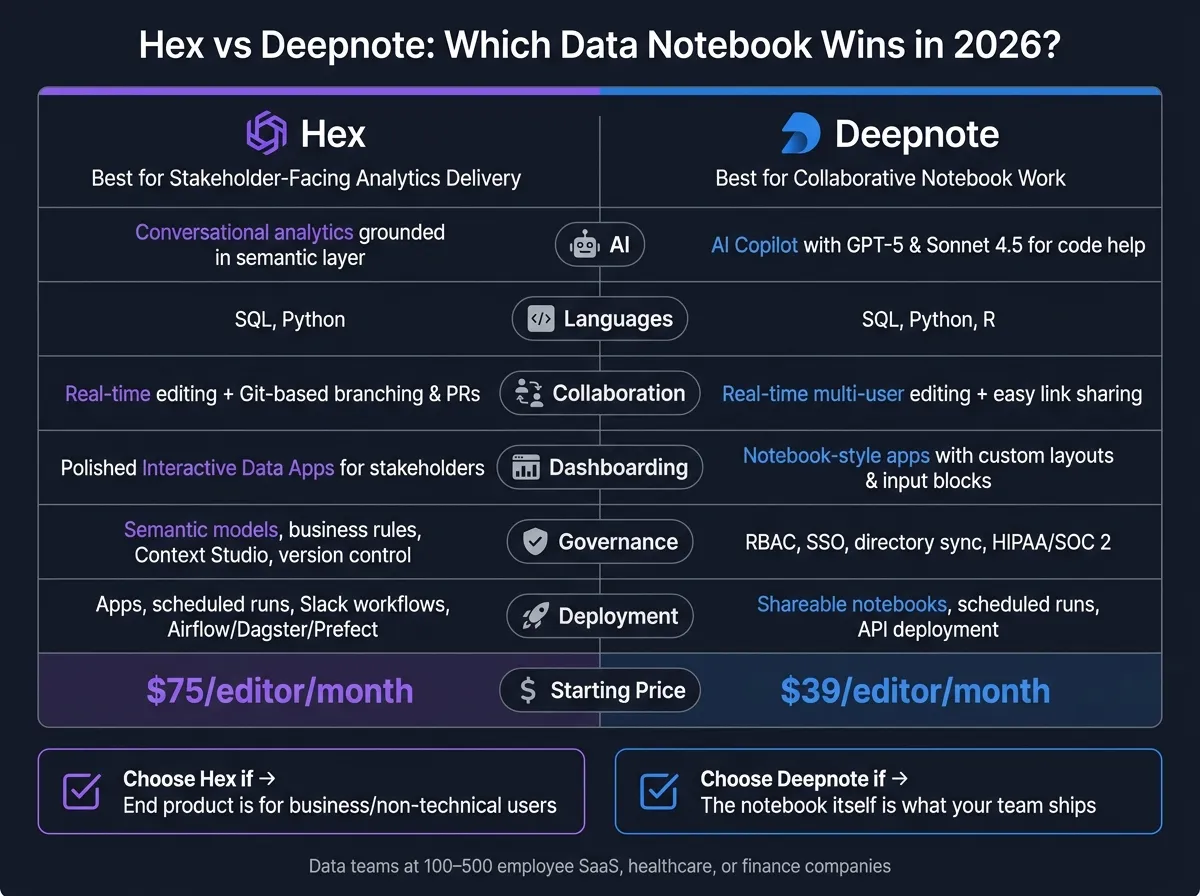 {Hex vs Deepnote: Side-by-Side Comparison for Data Teams (2026)}
:::
{Hex vs Deepnote: Side-by-Side Comparison for Data Teams (2026)}
:::
Quick Comparison
| Criteria | Hex | Deepnote |
|---|---|---|
| Best for | Governed analytics delivery | Shared notebook work |
| AI | Conversational analytics tied to semantic context | AI Copilot for code help and debugging |
| Languages | SQL, Python | SQL, Python, R |
| Collaboration | Real-time editing + Git-style review flow | Real-time multi-user editing + link sharing |
| Dashboarding | Interactive Data Apps for stakeholders | Notebook-style apps and dashboards |
| Governance | Semantic layer, business rules, version control | RBAC, SSO, directory sync, compliance |
| Deployment | Apps, scheduled runs, Slack workflows | Shareable notebooks, scheduled runs, API deployment |
| Starting team price | $75/editor/month | $39/editor/month |
So the choice is not hard: do you need governed delivery, or do you need a live code workspace? That’s the lens I’d use for the rest of this comparison.
sbb-itb-284a532
Hex vs Deepnote at a glance
Hex is the better pick for stakeholder-facing delivery. Deepnote is the better pick for collaborative notebook work. The table below turns that split into the buying criteria most data teams care about.
Comparison table: strengths, tradeoffs, and best-fit use cases
| Criterion | Hex | Deepnote | Why it matters |
|---|---|---|---|
| AI | Conversational analytics grounded in a semantic layer [1] | AI Copilot for code generation, suggestions, and debugging, with GPT-5 and Sonnet 4.5 support [2] | Hex is stronger for guided self-serve; Deepnote is better for moving faster in code-heavy analysis |
| Collaboration | Real-time editing plus Git-based branching and PRs [1] | Real-time multi-user editing, comments, and easy link sharing [2] | Hex fits teams that want Git-based review and release workflows; Deepnote is easier for ad hoc collaboration |
| SQL, Python, and R | Reactive DAG execution for reproducible notebooks [1] | Jupyter-compatible environment with SQL, Python, and R [2] | Hex is better for governed, repeatable workflows; Deepnote is more flexible if you need R |
| Dashboarding | Interactive Data Apps that feel like polished stakeholder-facing products [1] | Data Apps and dashboards with custom layouts, input blocks, and buttons [2] | Hex is stronger for finished delivery; Deepnote is better for interactive notebook-style reporting |
| Deployment | Interactive Data Apps for stakeholder delivery [1] | Shareable notebooks and API-style deployment [2] | Hex is stronger for governed delivery; Deepnote is stronger for notebook sharing |
| Governance | Context Studio for semantic models, business rules, and AI grounding, plus Git-based version control [1] | RBAC, SSO, directory sync, and HIPAA/SOC 2 compliance [2] | Hex gives teams more control over metric definitions; Deepnote leans more on standard access and security controls |
| Pricing | $75/editor/month, with Threads, semantic modeling, and unlimited apps [1] | $39/editor/month, with unlimited notebooks and GPT-5/Sonnet 4.5 access [2] | Deepnote is the lower-cost option for smaller teams or teams watching spend |
Quick recommendation by team need
Choose Hex if your main output is stakeholder-facing reports and apps. At $75/editor/month, the Team tier includes Threads, semantic modeling in Context Studio, and unlimited apps [1].
Choose Deepnote if your team is notebook-first: analysts working together in Python or R, sharing by link, and at times deploying notebooks as APIs [2]. At $39/editor/month, the Team tier includes unlimited notebooks plus GPT-5 and Sonnet 4.5 access [2].
The workflow section below shows how that choice plays out in practice.
How Hex and Deepnote perform in real workflows
The table above shows the split. This workflow makes it easier to see why that split matters day to day.
Take a weekly SaaS retention and expansion analysis on Snowflake or BigQuery. The job sounds simple on paper: query cohort data, run the math in Python, then send the output as a governed report for stakeholders. In practice, the tool you use changes how smooth that process feels.
Building the same SQL-to-Python analysis in both tools
In Hex, the workflow runs inside a reactive DAG. The big win here is reliability. If you change the SQL cell, Hex reruns downstream Python in the right order, which cuts down on manual re-execution mistakes. Hex also pushes SQL execution down to the warehouse, which matters when the dataset is too large to handle comfortably in the browser. Once the analysis is done, you can publish it as an Interactive Data App with filters and drill-downs for business users. [1]
In Deepnote, the same workflow runs in a Jupyter-style notebook with manual execution order. Deepnote's AI Copilot is one of several AI tools that write SQL and Python cells, and the platform also supports R. That means SQL, Python, and R can sit in the same notebook, which is handy for shared notebook editing when analysts are iterating together. [2]
Where Hex is stronger for delivery
Hex pulls ahead when the analysis needs to turn into a governed, repeatable output.
Threads lets business users ask follow-up questions in plain language in Slack, tied to the same semantic context the analyst set up. [1] Agent Tasks can also schedule recurring insights, like weekly retention checks, and send the results straight to Slack. [3]
Deepnote goes in another direction. The notebook stays much closer to a shared coding session than to a governed reporting layer.
Where Deepnote is stronger for collaboration
Deepnote does better when several analysts need to edit the same notebook live. Its Data Apps & Dashboards support custom layouts and input blocks for lighter sharing. Deepnote also supports scheduled runs on hourly, daily, weekly, or monthly cadences for recurring retention reports. [2]
Buying criteria that determine long-term fit
Comparison table: AI, governance, deployment, and pricing
The table below shows what each tier gets you.
| Criterion | Hex | Deepnote |
|---|---|---|
| AI assistance | Notebook Agent and Threads for conversational analytics grounded in a semantic context layer [1] | AI Copilot with GPT-5 and Sonnet 4.5 access on the Team tier [2] |
| Language support | SQL and Python-centric | SQL, Python, and R |
| Governance | Context Studio for semantic models, business rules, and endorsed tables [1] | RBAC, permission groups, and directory sync on Enterprise [2] |
| App/dashboard delivery | One-click interactive Data Apps with filters and drill-downs [1] | Dashboards with custom input blocks; notebook-first experience [2] |
| Deployment | Scheduled runs, Airflow/Dagster/Prefect integration, Slack alerts [1] | Scheduled runs; notebooks deployable as production APIs [2] |
| Audit & compliance | SOC 2 Type II, HIPAA, audit trails [1] | SOC 2 Type II, HIPAA, revision history that ranges from 7 days to unlimited depending on plan [2] |
| SSO / SAML | Enterprise tier only [1] | Enterprise tier only [2] |
| Pricing (per editor/month) | $0, $36, $75, and Custom [1] | $0, $39, and Custom [2] |
On paper, the pricing looks close. But that’s not the main divide.
The bigger split is this: Hex leans harder into delivery, while Deepnote leans harder into notebook collaboration. If your team spends most of its time building analysis and working together in notebooks, Deepnote has a clear pull. If your team needs to turn analysis into something stakeholders can use without asking an analyst every time, Hex starts to look stronger.
Which platform fits lean, growing, and mature data teams
Price is only the first screen. The better long-term fit usually comes down to team maturity and how much control the business needs.
Lean teams - roughly 1–10 analysts - can get started on Deepnote’s Free or Team tier and get strong shared notebooks with SQL, Python, and R support at a lower cost. Hex’s Community plan is free too, but for an active team, it’s often too limiting. [1][2]
Growing teams - around 10–50 people - usually start feeling a different kind of pain. It’s not just about writing queries anymore. It’s about handling more stakeholder requests without turning analysts into a help desk. That’s where Hex’s Team tier starts to matter. Published apps and Threads can take pressure off analysts by making work easier to share and use. [1]
Mature organizations with tighter control needs will usually see a sharper difference. Hex offers more structure around semantic governance. Deepnote stays more centered on the notebook itself. At that stage, editor comfort matters less than keeping definitions, rules, and access under control. [1][2]
Where Querio fits if you need governed, warehouse-native self-serve
Sometimes the notebook-vs.-notebook debate misses the real issue.
If your actual need is governed self-serve on live warehouse data, then Hex and Deepnote may not be solving the main problem. Both are notebook-first platforms. That works well for analysts. It’s a different story when non-technical teams need answers from live data without creating reporting drift or governance headaches.
That’s where Querio fits. It’s built for teams that want a governed semantic layer, inspectable SQL and Python, and live connections to Snowflake, BigQuery, or Redshift. The sweet spot is often data teams inside 100–500-employee B2B SaaS, healthcare, or finance companies that want self-serve access without losing control.
Conclusion: Which tool wins for your team
Hex comes out ahead when stakeholder delivery matters most. Deepnote is the better pick when shared notebook work sits at the center of how your team operates. In plain English, the choice comes down to this: are you building a governed app for stakeholders, or is the notebook itself what your team needs to ship?
Choose Hex when you need polished, interactive delivery for non-technical stakeholders. [1]
Choose Deepnote if your team is mostly technical and the notebook is the deliverable. Its real-time co-editing and support for Python, SQL, and R in one place make it a strong match for notebook-first teams. At $39/editor/month, it’s also the lower-cost entry point for smaller teams or teams watching spend closely. [2]
Both tools connect to live warehouse data. The main gap is who the work is for, and how your team wants to work day to day.
FAQs
::: faq
Which tool is better for business stakeholders?
Neither option is a great fit for business stakeholders.
Hex and Deepnote are built first and foremost for technical data teams that work comfortably in SQL and Python. Yes, both can turn analysis into interactive apps or dashboards. But at their core, they’re still notebook-first products.
That matters. It means a data team usually still has to build, maintain, and manage the content. So if the goal is broad, safe self-serve access for non-technical teams, either tool may feel like a less natural fit. :::
::: faq
When does Deepnote make more sense than Hex?
Deepnote makes more sense when your main goal is team-based notebook work for analyst and data science teams.
It’s a better fit if you want a free place to start and cloud team features like real-time multi-user editing, commenting, sharing, and built-in dashboards or data apps - all while still working in SQL and Python. :::
::: faq
How should team size affect this choice?
For teams with 100–500 employees, the choice usually comes down to one thing: governance or team-based research.
Hex makes more sense if you need polished data apps, version control, and tighter admin controls. It’s a strong pick for reporting that stakeholders will actually see and use.
Deepnote fits better when your team wants flexible, low-friction collaboration across no-code, SQL, and Python. And if your team is shifting toward a more governed, warehouse-native setup, Querio is another option. It gives you inspectable, consistent SQL and Python. :::