Business Intelligence
Choosing the Right AI Analytics Platform for Your Business
Compare AI analytics platforms—transparent SQL/Python, AutoML, and visualization—to choose a scalable, secure solution that fits your data and budget.

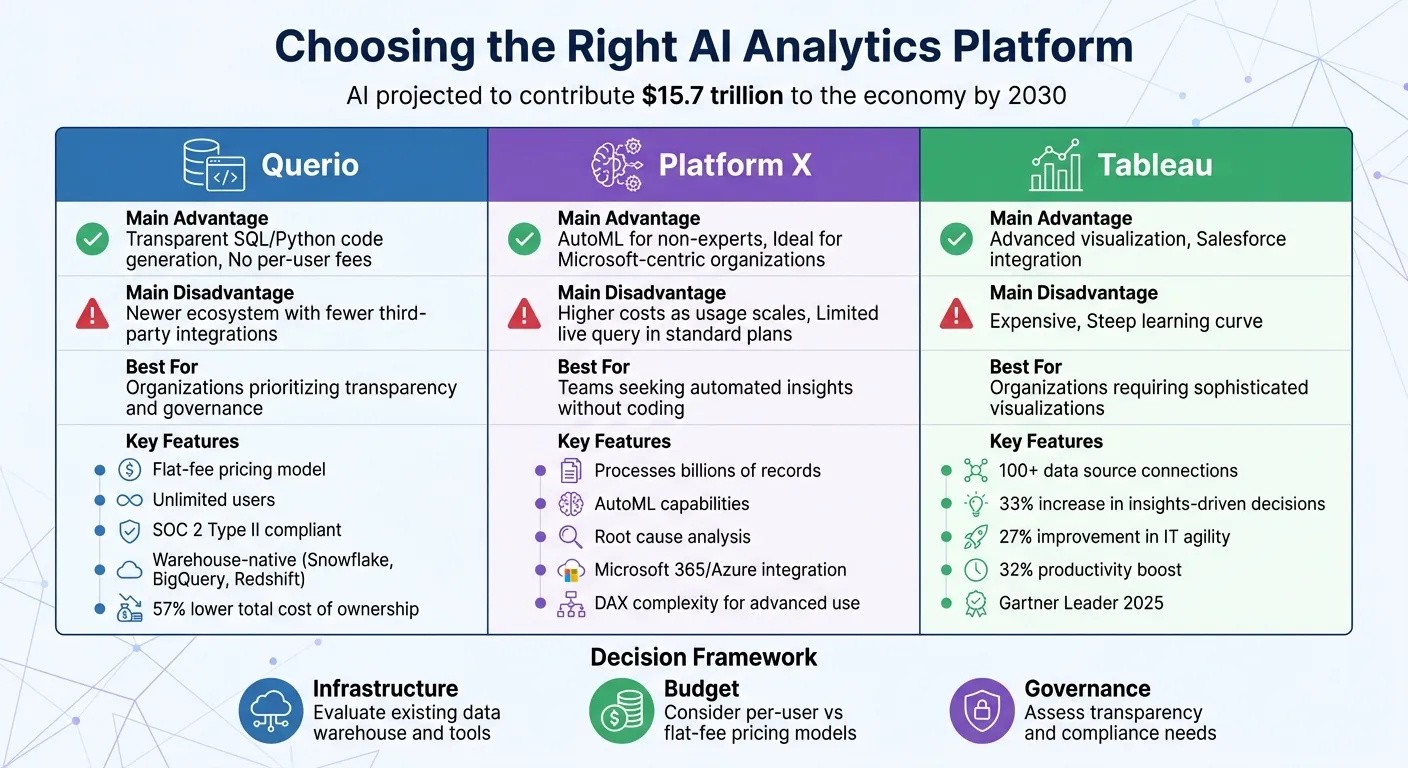
AI analytics platforms are reshaping how businesses work with data, moving from static reports to real-time, actionable insights. With AI projected to contribute $15.7 trillion to the economy by 2030, picking the right platform is essential for organizations aiming to improve productivity, decision-making, and revenue. Here's what you need to know:
- Querio: Prioritizes transparency with SQL/Python code, no per-seat pricing, and strong governance.
- Platform X: Focuses on AutoML and predictive insights but may have pricing and setup complexities.
- Tableau: Excels in visualization and integration, especially for Salesforce users, but has a steep learning curve and higher costs.
Each platform offers unique features, so aligning them with your organization's needs - like scalability, integration, and governance - is key to making the best choice. Below is a quick comparison of AI tools for data analysis to help guide your decision.
Quick Comparison
| Platform | Main Advantage | Main Disadvantage |
|---|---|---|
| Querio | Transparent analytics, no per-user fees | Fewer third-party integrations |
| Platform X | AutoML for non-experts | Higher costs as usage scales |
| Tableau | Advanced visualization, Salesforce integration | Expensive, requires expertise |
The right choice depends on your goals, infrastructure, and budget. Following best practices for integrating AI into your analytics workflow ensures long-term success.
1. Querio
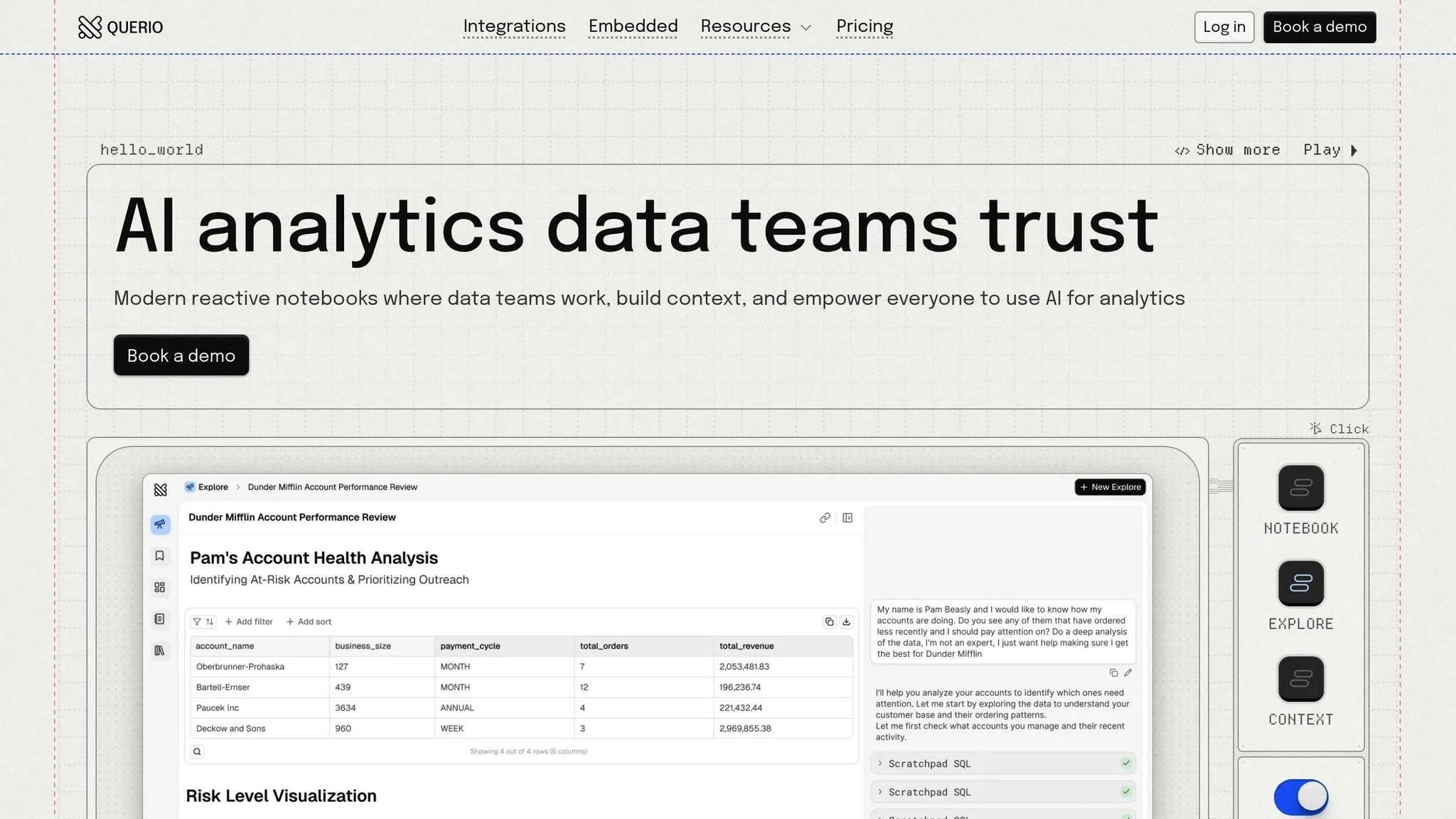
Querio is a platform that connects directly to your data warehouse, delivering real SQL and Python code for every query. This ensures that every result is transparent and rooted in your actual data, giving you confidence in the insights while maintaining complete visibility into how they’re generated.
Scalability
Querio’s design makes it easy to handle growing demands. There is no per-seat pricing: unlimited users on every plan. Unlike many traditional BI tools that charge per user, Querio allows you to extend access across your organization without worrying about additional costs. It integrates seamlessly with major data warehouses like Snowflake, BigQuery, Amazon Redshift, ClickHouse, and PostgreSQL. By querying data directly, it eliminates the need for extracts or duplicated information. This approach ensures smooth scaling while working with your existing data infrastructure.
Integration
The platform connects to your data infrastructure using encrypted, read-only warehouse connections, requiring minimal technical setup. It also offers embedded analytics tools, enabling you to reuse governed logic in customer-facing applications via APIs and iframes. With standard SSO integrations for access control and SOC 2 Type II compliance, Querio prioritizes security while providing seamless integration. These features create a strong foundation for advanced AI-driven capabilities.
AI Capabilities
Querio’s AI agents convert plain English questions into precise SQL and Python queries. Its notebook-based workspace ensures that SQL and Python analyses stay accurate as logic evolves. Beyond simple reporting, the platform supports deeper analyses, fostering collaboration among data teams, analysts, and data scientists. This setup encourages iteration and reuse, making complex analytical tasks more efficient.
Governance
To maintain consistency, Querio uses a shared context layer where data teams can define joins, metrics, and business terms once. This versioned logic is applied across all analyses, dashboards, and AI-generated answers, ensuring uniform definitions across teams. Role-based access controls manage data visibility, while the inspectable code feature allows every answer to be audited and verified. These governance tools make Querio a robust solution tailored to modern business intelligence challenges.
2. Platform X
Tellius leverages AutoML to quickly identify patterns in data and provide predictive insights that are easy for non-experts to access. This sets it apart from Querio, which focuses on data transparency and direct querying, showcasing two distinct approaches to AI-driven analytics.
Scalability
Tellius is built to handle massive datasets, capable of processing billions of records using its Live Insights feature. This tool analyzes data directly, eliminating the need for creating extracts or duplicates. The platform uses a distributed cluster manager to scale based on workload demands. However, as usage increases, so do costs, making it essential to keep an eye on pricing. These features make Tellius well-suited for tackling large-scale data challenges.
Integration
The platform supports connections to popular data sources and warehouses, along with integration options for services like Microsoft 365, Azure, and Salesforce. While these integrations are robust, setting them up requires some technical expertise to configure properly.
AI Capabilities
Tellius simplifies root cause analysis by identifying statistically significant factors behind metric changes[2]. It also includes machine learning tools that allow users to build, train, and deploy predictive models - all without writing a single line of code. The accuracy of forecasts and trend analysis depends heavily on the quality of the input data, but the AutoML features make advanced analytics accessible to a broader audience.
3. Platform Y
While Querio focuses on transparent, code-based querying, Tableau takes a different route by embedding AI-generated insights directly into everyday workflows.
Tableau integrates these insights into commonly used tools, making them accessible where work happens. For instance, Tableau Pulse sends personalized metric updates to platforms like Slack or email, accompanied by plain-language explanations. This approach aligns with the growing trend in analytics: delivering insights to users rather than requiring them to search for information.
Scalability
Tableau is designed to handle massive datasets, processing billions of records through live queries to data warehouses like Snowflake, Databricks, and AWS. This eliminates the need for data extracts, streamlining operations. Companies using Tableau have reported a 33% increase in insights-driven decision-making and a 27% improvement in IT system agility [1]. These capabilities make it easier for organizations to integrate Tableau into a wide range of systems without disruption.
Integration
The platform connects seamlessly to over 100 data sources and integrates natively with Salesforce - no coding required. It supports deployments across AWS, Azure, Google Cloud Platform, and even on-premises environments. This flexibility has led users to report a 32% boost in productivity [1], thanks to how well Tableau fits into existing workflows. Its effectiveness was recognized when it was named a "Leader" in the 2025 Gartner Magic Quadrant for Analytics and Business Intelligence Platforms [3].
AI Capabilities
Tableau enhances its integration strengths with a suite of advanced AI tools. The Tableau Agent transforms natural language queries into instant visualizations, while the Concierge skill performs root cause analysis through conversational prompts. The Inspector skill keeps track of key metrics, alerting users to significant trends or threshold breaches. For security-conscious organizations, the Einstein Trust Layer ensures business data is protected from being used to train external AI models. Additionally, the Metrics Layer allows teams to define KPIs once and have them consistently applied across the organization, ensuring everyone works from a unified set of data.
Strengths and Weaknesses
Each platform offers distinct benefits and challenges, making it essential to weigh their features against your specific needs. Here's a closer look at their strengths and limitations to help guide your decision.
Querio stands out for its transparent generation of SQL and Python code, which boosts confidence in analytics and simplifies troubleshooting. It also offers predictable costs without per-user fees. On the flip side, its newer ecosystem means fewer third-party integrations and a smaller pool of community resources.
Platform X is tailored for Microsoft-centric organizations, making it ideal for teams already invested in the Microsoft ecosystem. It simplifies data exploration for non-technical users. However, its live query capabilities are restricted in standard plans, and learning DAX (Data Analysis Expressions) for complex calculations can be time-consuming.
Tableau shines in visualization and integration, particularly with Salesforce and major data warehouses. This makes it a strong contender among warehouse-native data analysis tools. Its live query functionality enables direct, real-time analysis. That said, these advanced features come at a higher cost and require significant effort to master for more complex use cases.
| Platform | Main Advantage | Main Disadvantage |
|---|---|---|
| Querio | Transparent SQL/Python code; No per-user fees | Newer ecosystem with fewer integrations |
| Platform X | Ideal for Microsoft-centric organizations | Limited live query in standard plans; DAX complexity |
| Tableau | Excellent visualization and integrations | High cost; Steep learning curve |
These comparisons highlight the trade-offs between the platforms. The right choice will depend on your organization's infrastructure, budget, and priorities.
Conclusion
Selecting the right AI analytics platform requires careful consideration of your infrastructure, technical capabilities, and governance requirements. By evaluating the unique strengths of each option, you can avoid mismatched investments and ensure your analytics solution supports your long-term objectives. Knowing what each platform offers allows you to choose one that balances insights with operational efficiency.
Querio is an excellent choice for organizations that emphasize transparency, governance, and warehouse-native analytics. It delivers clear SQL and Python code, addressing the "black box" issue found in many AI tools. Its scalability and security features, combined with a pricing model free of per-user fees, make it a cost-effective option for growing teams. In fact, migrating to warehouse-native platforms like Querio has been shown to lower total cost of ownership by 57% [3]. The platform integrates seamlessly with live data warehouses such as Snowflake and BigQuery.
For teams seeking scalable, self-service analytics without compromising control or accuracy, Querio offers natural-language querying, centralized metric and semantic definitions, and SOC 2 Type II compliance. Its reusable, governed logic ensures consistency across all outputs - a critical feature in a world where AI could contribute up to $15.7 trillion to the global economy by 2030 [1].
The key takeaway here is the importance of aligning your analytics tool with both technical needs and business priorities. The right platform should streamline the path from data to decision-making while maintaining the trust and governance your organization requires. Querio exemplifies this by minimizing barriers between data and decision-makers, delivering on the promise of modern, AI-powered business intelligence. Take stock of your data infrastructure and team capabilities, and choose a solution that aligns with your vision for the future.
FAQs
How does Querio provide transparency in its analytics?
Querio prioritizes transparency by equipping users with governance tools, strong data security protocols, and real-time dashboards. These features make it easy to track, verify, and ensure your data aligns with industry standards.
Adding to this trust, Querio is SOC 2 Type II certified, reflecting its dedication to protecting data integrity and adhering to rigorous security benchmarks. With Querio, you gain the confidence to make informed decisions while keeping a clear view of your analytics workflow.
How does Querio's pricing model support business scalability?
Querio offers a straightforward pricing model. It has a free plan, and Core is $2,499 a month (or $25,000 a year billed annually). Every plan includes unlimited users, unlimited data connections and a monthly allowance of AI credits (500 on Free, 10,000 on Core). Usage is visible as it happens and admins can set spending caps, making it easier to plan and scale your analytics efforts.
By removing per-seat pricing, Querio allows companies to focus on growth and data-driven strategies without worrying about per-user fees. It's a practical choice for organizations looking to get the most out of their investment in AI-powered analytics.
How does Querio work with my current data systems?
Querio connects directly to live databases such as Snowflake and BigQuery, working seamlessly with your existing data setup. This means no need to duplicate data - everything stays in place, allowing you to run real-time queries and analyses effortlessly.
By aligning with your current workflows, Querio ensures integration is smooth and hassle-free, so you can focus on turning your data into meaningful insights without interruptions.