Business Intelligence
top business analytics softwares
Compare six AI-powered business analytics platforms—features, real-time warehouse connections, natural-language queries, pricing, and best use cases.

Looking for the best business analytics software? Here's a quick guide to six top platforms that help teams analyze data, streamline workflows, and make faster decisions. These tools use AI to simplify complex data, allowing users to ask questions in plain English and get instant insights. Whether you're a startup or a large enterprise, there's a solution tailored to your needs.
Key Platforms:
- Querio: AI-powered, real-time data querying for SMBs with direct connections to a data warehouse like Snowflake or BigQuery.
- ThoughtSpot: Search-driven analytics for large enterprises with distributed data environments.
- Qlik: Associative engine for uncovering hidden data relationships, ideal for deep exploration.
- Databricks: Combines data warehousing and AI/ML capabilities with a scalable lakehouse architecture.
- Snowflake: Fully managed platform with AI tools for structured/unstructured data and secure governance.
- Power BI: Microsoft-integrated tool with AI-powered Copilot for generating reports and insights.
Quick Comparison:
| Platform | Best For | Natural Language Queries | Data Connection | Pricing |
|---|---|---|---|---|
| Querio | SMBs needing quick insights | Yes | Direct to warehouse | Premium, competitive |
| ThoughtSpot | Enterprises with hybrid data | Yes | Hybrid (cloud/on-prem) | Enterprise pricing |
| Qlik | Deep data exploration | Yes | Multi-cloud/on-prem | Subscription-based |
| Databricks | AI/ML at scale | Yes | Delta Lake native | Consumption-based |
| Snowflake | High-scale analytics and AI | Yes | Multi-cloud support | Usage-based |
| Power BI | Microsoft ecosystem users | Yes | 100+ integrations | $14-$24/user/month |
These platforms cater to different needs, from real-time insights to AI-driven predictions. Define your goals, test trial versions, and pick the one that aligns with your team's expertise and budget.
::: @figure 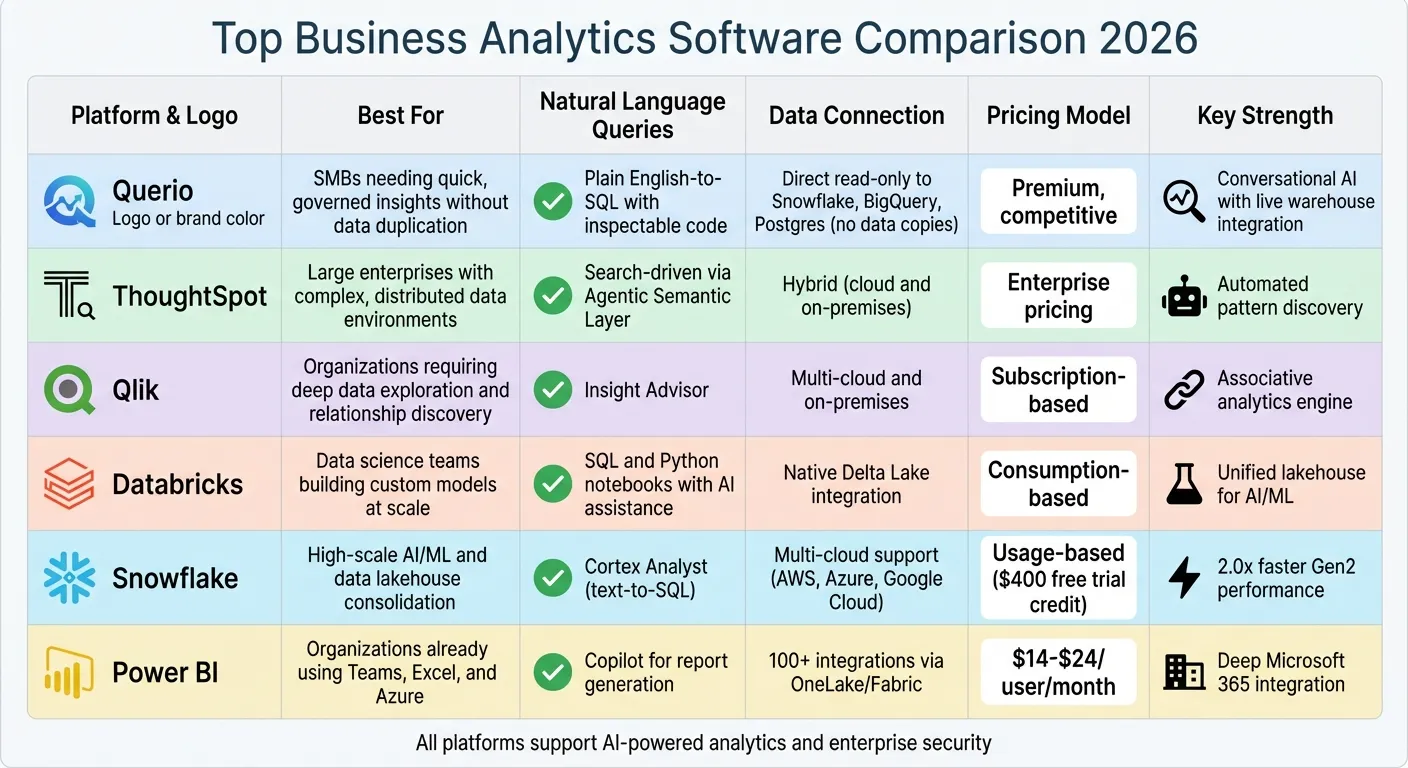 {Business Analytics Software Comparison: Features, Pricing, and Best Use Cases}
:::
{Business Analytics Software Comparison: Features, Pricing, and Best Use Cases}
:::
The Most In-Depth BI Tools Comparison
::: @iframe https://www.youtube.com/embed/1e6CZ16e4f8 :::
1. Querio
Querio is an AI-powered analytics workspace designed to simplify data access by connecting directly to your data warehouse. It lets finance teams and executives query live data in plain English - no need to wait for analysts or learn SQL. For example, you can type something like, "What was our revenue last quarter by region?" and instantly get accurate answers, powered by real SQL queries running on live data.
This user-friendly approach is made possible by advanced natural language processing.
AI-driven natural language capabilities
Querio translates plain English into SQL behind the scenes, offering a seamless, SQL-free experience. Its proprietary engine is tailored to your specific data definitions. So, when you ask about metrics like "customer churn" or "gross margin", Querio identifies the relevant tables and performs the calculations based on the rules your data team has set. The platform then generates charts and graphs immediately, transforming raw data into clear, actionable visuals.
Real-time data access
Querio connects directly to Snowflake, BigQuery, and Postgres using encrypted, read-only access. This eliminates the need for data copying or ETL processes, ensuring every query reflects up-to-the-minute data. Whether you're tracking market trends or addressing operational issues, Querio provides real-time insights you can trust. Plus, with SOC 2 Type II compliance and enterprise-grade access controls, your sensitive data stays secure even as more team members gain access.
Consistent metrics and security
With Querio, your organization benefits from a shared semantic layer that ensures consistent definitions for key metrics. Your data team sets up table joins, business logic, and a data glossary once, and the platform applies these rules to every query. This consistency eliminates confusion around metrics and ensures reliable, context-aware insights - all without requiring constant input from a central BI team.
Flexible for businesses of all sizes
Querio is built to adapt to organizations of any size, offering both cloud-hosted and self-hosted options with unlimited viewers. Its "search-first" BI approach allows users to uncover insights instantly, bypassing the delays of pre-built reports[2]. This combination of speed, reliability, and governance makes Querio a powerful tool for driving data-informed decisions across your business.
2. ThoughtSpot
ThoughtSpot is a search-driven analytics platform that brings AI-powered insights to business users through natural language queries and live data connections. It’s built to help teams in finance, operations, and leadership access real-time analytics without needing technical expertise or waiting for pre-designed dashboards. Let’s dive into how its AI-driven features make data exploration more intuitive and accessible.
AI-driven natural language support
With ThoughtSpot’s Spotter AI agent, users can ask questions in plain English and get instant, actionable answers. The platform converts these simple queries into searches, creating a seamless way to explore data without needing SQL knowledge. This capability allows teams to work independently, analyze data on their own terms, and make decisions faster.
Live data connections
ThoughtSpot’s live cloud connectors let users directly query billions of rows from platforms like Snowflake and Databricks in just seconds. Instead of relying on static reports, the platform provides Liveboards - interactive dashboards that automatically update as data changes. Its SpotIQ AI feature keeps an eye on your data, flagging anomalies and pinpointing the reasons behind KPI shifts in real time. And with mobile access, both executives and frontline workers can get detailed insights on-the-go with just a tap.
Governed insights and security
ThoughtSpot ensures data accuracy and security with a semantic model that standardizes KPIs and definitions across the organization. Role-based access controls ensure sensitive data is only available to authorized users, while live data connections keep everyone aligned with a single, trusted source of truth. This eliminates duplicate data and stale reports, even as your business expands.
Scalability for different business sizes
Thanks to its cloud-native architecture, ThoughtSpot can handle massive datasets while maintaining strong security protocols from major cloud providers. As your user base grows, its consistent semantic layer supports self-service analytics without compromising governance or placing extra demands on IT teams. This makes it a flexible solution for both mid-sized businesses and large enterprises managing complex data environments.
3. Qlik
Qlik takes a different approach to self-service analytics with its Associative Analytics Engine. Unlike traditional query tools that rely on predefined paths, this engine discovers hidden connections in your data that standard SQL queries might overlook. It empowers users to explore data across multiple dimensions without restrictions, aligning perfectly with the growing trend of AI-driven analytics.
AI-Powered Features for Everyday Users
With Qlik Answers®, generative AI becomes part of your workflow, allowing you to ask questions in plain English. Whether you're working with structured databases or unstructured documents, it makes data exploration more intuitive. Additionally, Qlik Predict™ uses built-in machine learning to forecast trends and predict outcomes - no data science expertise required. To ensure ethical AI practices, Qlik established a global AI Council in January 2024 [4].
Trusted for Security and Governance
Qlik's commitment to security and governed insights has earned it a spot as a Leader in the Gartner Magic Quadrant for Analytics and Business Intelligence Platforms for 15 years straight, as of 2025 [4]. Users echo this confidence, giving the platform a 4.5/5 rating on Gartner Peer Insights from over 1,300 reviews [5].
Built for Businesses of All Sizes
Thanks to its cloud-native architecture, Qlik caters to everyone - from non-technical employees to seasoned data scientists [3]. The platform handles billions of rows of data with ease, offering both multi-cloud and on-premise deployment options. With mobile access and offline capabilities, teams can analyze data anywhere, making Qlik an excellent choice for mid-sized businesses and large enterprises alike.
4. Databricks
Databricks combines the high performance of a data warehouse with the flexibility of a data lake through its lakehouse architecture. With its AI/BI Genie, the platform offers conversational analytics, acting as a conversational AI data analyst chatbot that enables business users to ask questions in plain English and receive real-time insights. This makes it easier for everyone in an organization to uncover insights using natural language [6].
Let’s explore how Databricks' features translate into practical advantages.
AI-Powered Natural Language Support
The Data Intelligence Engine adapts to your organization’s specific language and terminology, ensuring accurate queries and simplifying technical troubleshooting [8]. For instance, adidas leveraged Databricks to analyze over 2 million product reviews from more than 150 countries, reducing latency by 60% and boosting efficiency by 30–40% when turning customer feedback into actionable strategies [6]. Similarly, FOX Sports used Databricks to create an in-app chatbot capable of handling hundreds of thousands of fan requests during live games [6].
Secure and Governed Data Insights
With Unity Catalog, Databricks provides a unified permission model and detailed lineage tracking to ensure robust data governance [10]. The platform also includes a Security Analysis Tool (SAT) that scans for 37 different security best practices, identifying potential configuration issues automatically [9]. For example, Mastercard uses Databricks to securely manage over 159 billion transactions annually across 210+ countries, demonstrating its ability to handle sensitive data at scale [6].
Scalable for Businesses of All Sizes
Databricks removes the need for per-seat licensing fees, giving startups and large enterprises alike immediate access to organization-wide data [7]. Its serverless architecture automatically adjusts infrastructure based on demand, scaling up during busy periods and scaling down when demand decreases. Unilever streamlined its global data architecture using Databricks, cutting infrastructure costs by 25% [6]. With a 4.7/5 rating on Gartner Peer Insights and recognition as a 2025 Customers’ Choice, Databricks is especially popular among companies with revenues between $50 million and $1 billion [5].
sbb-itb-284a532
5. Snowflake
Snowflake is reshaping the world of analytics by eliminating traditional hurdles that often slow down data processing. It's a fully managed, serverless platform that takes care of scaling and infrastructure, allowing businesses to concentrate on analytics instead of database management [20]. Operating seamlessly across AWS, Azure, and Google Cloud, Snowflake supports data processing for 751 of the Forbes Global 2000 companies as of July 31, 2025 [19]. Its pay-as-you-go pricing model ensures flexibility, making it an appealing choice for both startups and large enterprises [1]. On top of its solid infrastructure, Snowflake integrates AI to make data queries more user-friendly.
AI-Driven Natural Language Support
With Snowflake Intelligence, users can query both structured and unstructured data in plain English through a conversational interface [11][12]. The platform's Cortex Analyst boasts an impressive 90% accuracy in converting text to SQL, enabling even non-technical users to retrieve AI-generated insights without needing to write code [14]. For example, Fanatics uses Snowflake Intelligence to analyze over 100 million fan attributes and 2 billion daily signals. This has allowed them to segment customers effectively and identify cross-selling opportunities.
"With Snowflake Intelligence, we're empowering business users across Fanatics to unlock easy and highly accurate segmentation, accelerate enterprise cross-sell opportunities, and fuel our advertising business." - Maddy Want, VP of Data, Fanatics [11]
Penske Logistics leveraged Snowflake’s AI capabilities to deploy a summarization model in less than 15 days. Vishwa Ram, Vice President of Data Science and Analytics, emphasized the ease of use: "The game-changer in Snowflake Cortex AI is its simplicity and ease of implementation. Our data already sits in Snowflake, so we can make use of the LLMs without needing to use anything external" [15]. Similarly, TS Imagine, a financial services firm, used Snowflake's generative AI at scale to cut costs by 30% and save about 4,000 hours of manual effort across over 500 clients [13][15].
Governed Insights and Security
Snowflake’s Horizon Catalog offers a centralized governance system for managing data across your entire architecture, including open table formats like Apache Iceberg [1][18]. It includes robust features like data masking and row-access policies to safeguard sensitive information [18][19]. All AI interactions are confined within Snowflake's secure environment, ensuring that customer data isn’t used to train AI models for other clients [16]. Additionally, Cortex Guard reviews AI-generated insights to ensure they remain secure and compliant [18][16]. With these measures, Snowflake delivers both safety and scalability for businesses of all sizes.
Scalability for Different Business Sizes
Snowflake’s Standard Warehouse Generation 2 doubles the performance of core analytics workloads [1][20]. BlackRock, for instance, uses Snowflake to power its Aladdin Data Cloud, processing over 116 billion data points and generating more than 1.5 million reports on demand as of 2026 [17]. KFC reduced its database operational costs by 70% after migrating to Snowflake, handling over 500,000 order transactions daily and slashing data-sharing times from days to mere seconds [20]. Similarly, NYC Health + Hospitals manages over 100 billion rows of healthcare data, cutting the time required to update membership data from five days to just five minutes [20].
6. Power BI
Power BI is transforming how businesses interact with data, making analytics accessible to everyone. With Copilot, a generative AI assistant, users can engage with their data using plain English natural language queries - no need for complex queries[27,28]. This tool allows report authors to create complete reports, visuals, and DAX queries simply by describing their requirements[27,31]. Microsoft’s leadership in analytics was highlighted in the June 2025 Gartner Magic Quadrant for Analytics and Business Intelligence Platforms, where it ranked highest in "Ability to Execute" and furthest in "Completeness of Vision"[28,31]. Here’s what makes Power BI a standout choice.
AI-Driven Natural Language Support
Copilot in Power BI operates in two modes. The standalone experience lets users explore and analyze any data they have access to across the organization, while the app-scoped version ensures responses are verified by report authors for accuracy and consistency[22]. At Lumen, this automation saved nearly 10,000 manual hours in just one year.
"In the last year alone, we've eliminated almost 10,000 manual hours through Microsoft-powered automation. That's time we now spend creating business value." - Jerod Ridge, Director of Data Engineering at Lumen[23]
Copilot also delivers quick insights by summarizing key points from reports or semantic models in seconds, helping teams focus on what truly matters[27,28]. Beyond natural language capabilities, Power BI shines in its ability to integrate with a wide range of data sources.
Live Data Connections
Power BI connects seamlessly to hundreds of data sources, including Dynamics 365, Salesforce, Azure SQL Database, Excel, and SharePoint[21]. With its Direct Lake Mode, users can query data directly in OneLake without needing to import or cache it, ensuring smooth performance even with massive datasets[26]. Automated incremental refreshes keep both cloud-based and on-premises data current[21].
"At Walmart, we use a myriad of different vendors in our technology stack, so having a tool like Power BI that can bring everything together was critical." - Micah Dail, Director of Finance Data & Analytics[25]
Governed Insights and Security
Power BI incorporates Microsoft Purview to apply sensitivity labels, ensuring data remains protected even when exported to other Microsoft 365 applications[24]. It employs Row-Level Security (RLS) to control data access for specific users and supports Bring Your Own Key (BYOK) for organizations with stringent compliance needs[24]. Deutsche Börse, for example, processes 400 TB of data daily using Power BI while leveraging Microsoft Purview for secure post-trading operations.
"Post-trading processes must be fast, scalable, and secure." - Michael Girg, Chief Cloud Officer[27]
Additionally, features like Azure Private Link and Virtual Networks ensure that data traffic stays off the public internet, enhancing security[24].
Scalability for Different Business Sizes
Power BI offers flexible pricing to meet the needs of various organizations. Power BI Pro is available at $14.00 per user/month (billed annually), while Power BI Premium Per User provides enterprise-scale features for $24.00 per user/month[28,31]. There’s also a free account option for creating interactive reports for personal use[28,29]. The platform is designed to scale, supporting thousands of users and processing petabytes of data[28,31]. A Forrester study revealed that organizations using Microsoft Fabric, which includes Power BI, achieved a 379% return on investment[24]. Abercrombie & Fitch Co. leveraged Power BI to make customer insights accessible across the company.
"With the new platform and Power BI, we've democratized customer insights across the company. Insights are no longer siloed but available to all relevant teams …" - Nicole Nelson, Senior Vice President of Data and Analytics[23]
Platform Comparison
Choosing the right analytics platform depends on factors like your organization's size, technical requirements, and how your team handles data workflows. Each platform brings something distinct to the table - whether it's conversational AI for actionable insights or seamless integration with other tools.
The table below outlines key differences in natural language interfaces, data connection methods, pricing structures, and ideal use cases. One critical consideration is whether a platform duplicates your data or connects directly to your data warehouse, as this can affect both performance and governance. For teams that need transparency, the ability to inspect, audit, or customize the underlying code is also a major factor. Here's a breakdown of the platforms:
| Platform | Key Strength | Best Use Case | Natural Language Capability | Data Connection | Pricing |
|---|---|---|---|---|---|
| Querio | Conversational AI with live warehouse integration | SMBs needing quick, governed insights without data duplication | Plain English-to-SQL with inspectable code | Direct read-only to Snowflake, BigQuery, and Postgres (no data copies) | Premium, competitive |
| ThoughtSpot | Automated pattern and trend discovery | Large enterprises with complex, distributed data environments | Search-driven via Agentic Semantic Layer | Hybrid (cloud and on-premises) connecting to Snowflake, Databricks, and BigQuery | Enterprise pricing |
| Qlik | Associative analytics engine | Organizations requiring deep data exploration and relationship discovery | Insight Advisor | Multi-cloud and on-premises sources | Subscription-based |
| Databricks | Unified lakehouse for AI/ML workloads | Data science teams building custom models at scale | SQL and Python notebooks with AI assistance | Native Delta Lake integration | Consumption-based |
| Snowflake | Multimodal AI Data Cloud with 2.0x faster Gen2 performance | High-scale AI/ML and data lakehouse consolidation | Cortex Analyst (text-to-SQL for structured and unstructured data) | Native support for Iceberg, JSON, text, images, and audio | Consumption-based; $400 free trial credit (30 days) |
| Power BI | Deep Microsoft 365 ecosystem integration | Organizations already using Teams, Excel, and Azure | Copilot for report generation, DAX queries, and summaries | 100+ sources including Azure, Excel, and SharePoint via OneLake/Fabric | $14/user/month (Pro); $24/user/month (Premium Per User) |
For example, WHOOP achieved a threefold increase in forecasting speed by utilizing an AI/ML model built with Snowflake and Apache Iceberg [1]. This demonstrates how selecting the right platform - whether it’s for live warehouse integration, automation powered by AI, or compatibility with existing tools - can lead to tangible efficiency improvements.
If zero-ETL collaboration is a priority, Querio and Snowflake stand out by eliminating the need for data movement. For organizations already invested in Microsoft tools, Power BI's Pro plan at $14 per user/month, combined with Copilot integration, offers excellent value. On the other hand, large enterprises with hybrid infrastructures often lean toward ThoughtSpot's search-driven functionality, while data science teams looking to develop custom models find Databricks' lakehouse architecture particularly effective.
Conclusion
Choosing the best business analytics software boils down to finding tools that align with your team's specific needs. As highlighted in the reviews above, each platform brings a unique approach to AI-powered analytics. For small to mid-sized businesses seeking governed insights without duplicating data, direct connections to data warehouses often outweigh the appeal of pre-built dashboards. On the other hand, large enterprises managing complex, distributed data environments may prioritize search-driven automation and hybrid deployment options. Data science teams, meanwhile, benefit most from platforms offering built-in AI/ML capabilities and scalable processing power. Organizations deeply integrated into Microsoft ecosystems can take advantage of seamless compatibility within that environment.
A good starting point is to define what success looks like for your team. For instance, Lumen saved nearly 10,000 manual hours in 2024 by automating workflows with Power BI [29]. Similarly, WHOOP achieved three times faster financial forecasting by leveraging Snowflake's AI/ML capabilities [1]. Pricing models should also factor into your decision - some tools use consumption-based pricing that adjusts with usage, while others rely on user-based subscriptions or enterprise licensing designed for larger organizations. Beyond cost, consider how well the tool integrates with your current systems, as this will significantly impact long-term value.
Integration is key to maximizing ROI. For example, one major telecom company cut reporting time by 60% and improved customer response rates by 35% by unifying data from marketing, finance, and operations into a single platform [30]. With companies pulling data from an average of 400 sources [3], having native connectors to your existing infrastructure ensures the tool remains valuable over time.
Testing trial versions is a smart way to assess user interface compatibility and transparency in code. As Martijn Wieriks, Chief Data Officer at Julo, shared:
"Gemini in BigQuery has transformed our query generation process... helping boost the efficiency of our label and feature engineering" [28].
The right analytics software should streamline workflows without adding unnecessary complexity. By focusing on your team's expertise and operational goals, you can select a platform that not only meets your needs today but continues to drive your business forward in the future.
FAQs
::: faq
What are the main advantages of using AI-powered analytics in business software?
AI-powered analytics take raw data and turn it into insights that businesses can actually use, helping them make decisions faster and more effectively. With natural language processing, these tools let users ask straightforward questions like “What were last month’s sales?” and get instant answers - no technical know-how required. This means data isn’t just for analysts anymore; it’s accessible to everyone, speeding up decision-making across entire teams.
What really sets these tools apart is their ability to deliver real-time insights. Businesses can react quickly to shifts in the market or tackle operational issues as they arise. Many of these platforms also integrate effortlessly with popular data warehouses and collaboration tools, feeding insights directly into the systems teams already use. This eliminates the need to jump between apps and ensures decisions can be made on the spot. The result? Greater efficiency, happier customers, and smoother operations. It’s easy to see why AI-powered analytics are becoming essential for businesses of all sizes. :::
::: faq
How does Querio ensure data security and proper governance?
Querio places a strong emphasis on keeping data secure and well-managed by employing top-tier protections and strict governance measures. The platform holds a SOC 2 Type II certification, which ensures it meets rigorous standards for encryption, access control, and ongoing system monitoring. Plus, with 99.9% uptime, Querio safeguards sensitive information while maintaining reliability.
When connecting to data warehouses like Snowflake, BigQuery, or Postgres, Querio uses secure pipelines to encrypt data during transit. It also enforces authentication protocols to ensure that only authorized users can access data.
The platform’s AI-powered semantic layer adds another layer of governance by requiring live database connections controlled through role-based permissions and detailed audit logs. This setup centralizes business rules, enforces consistent data-access policies, and maintains compliance, allowing businesses to trust the accuracy and security of their data insights. :::
::: faq
What is the best business analytics software for small to mid-sized companies?
Querio is a smart pick for small to mid-sized companies seeking a straightforward yet powerful business analytics tool. Built to make data analysis easier, Querio helps businesses discover useful insights, make better decisions, and streamline operations.
With its AI-powered features and user-friendly design, Querio simplifies working with complex data - whether you're monitoring performance metrics, predicting trends, or spotting growth opportunities. It’s a flexible solution tailored to meet the needs of businesses across different industries, offering dependable and actionable results. :::