Business Intelligence
Sigma Computing AI natural language query 2025 2026
Overview of Sigma's AI natural-language query updates, covering Ask Sigma, AI Builder, governance, MCP integrations, live warehouse connections, and the 2026 roadmap.
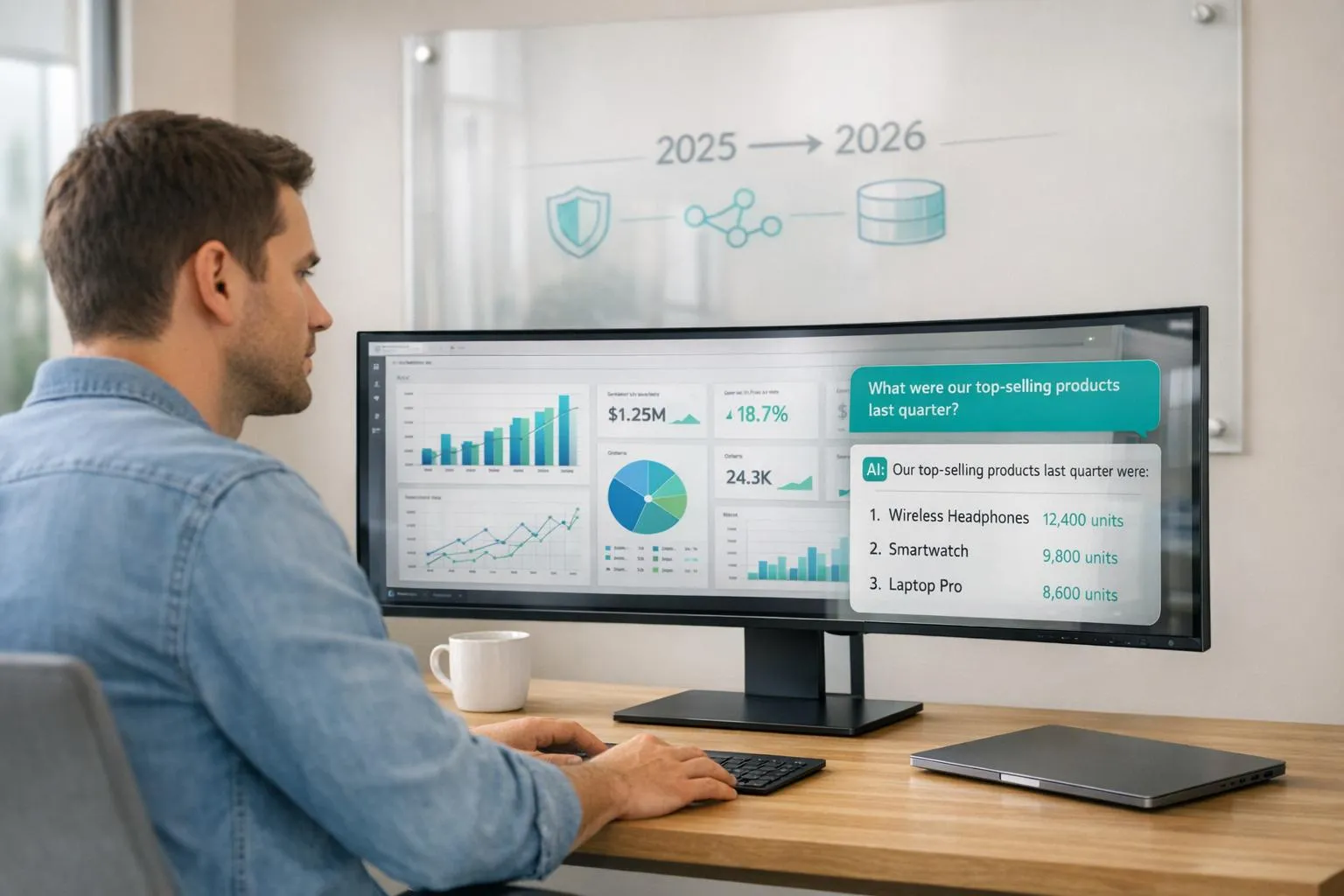
Sigma Computing has reshaped how businesses interact with data. Their AI-powered tools, particularly Ask Sigma, now allow users to query data in plain English, eliminating the need for SQL expertise. By late 2025, Sigma introduced advanced features like AI Builder for creating data applications and Model Context Protocol (MCP) for integrating external tools like Google Drive and GitHub. These updates simplify analytics and empower decision-makers with faster, more accurate insights.
Key advancements include:
- Ask Sigma: Multi-turn conversations, transparent analysis steps, and contextual data discovery.
- AI Builder: Converts natural language prompts into functional workbooks and apps.
- Governance: Ensures data accuracy with trusted metrics, Snowflake Semantic Views, and real-time validation.
- Live Data Connections: Direct access to platforms like Snowflake and BigQuery for secure, real-time analysis.
Looking ahead to 2026, Sigma plans to enhance AI-driven insights with Workbook Suggestions, better embedded analytics, and expanded MCP integrations. These tools aim to make data exploration even simpler while maintaining strong governance and security standards.
::: @figure 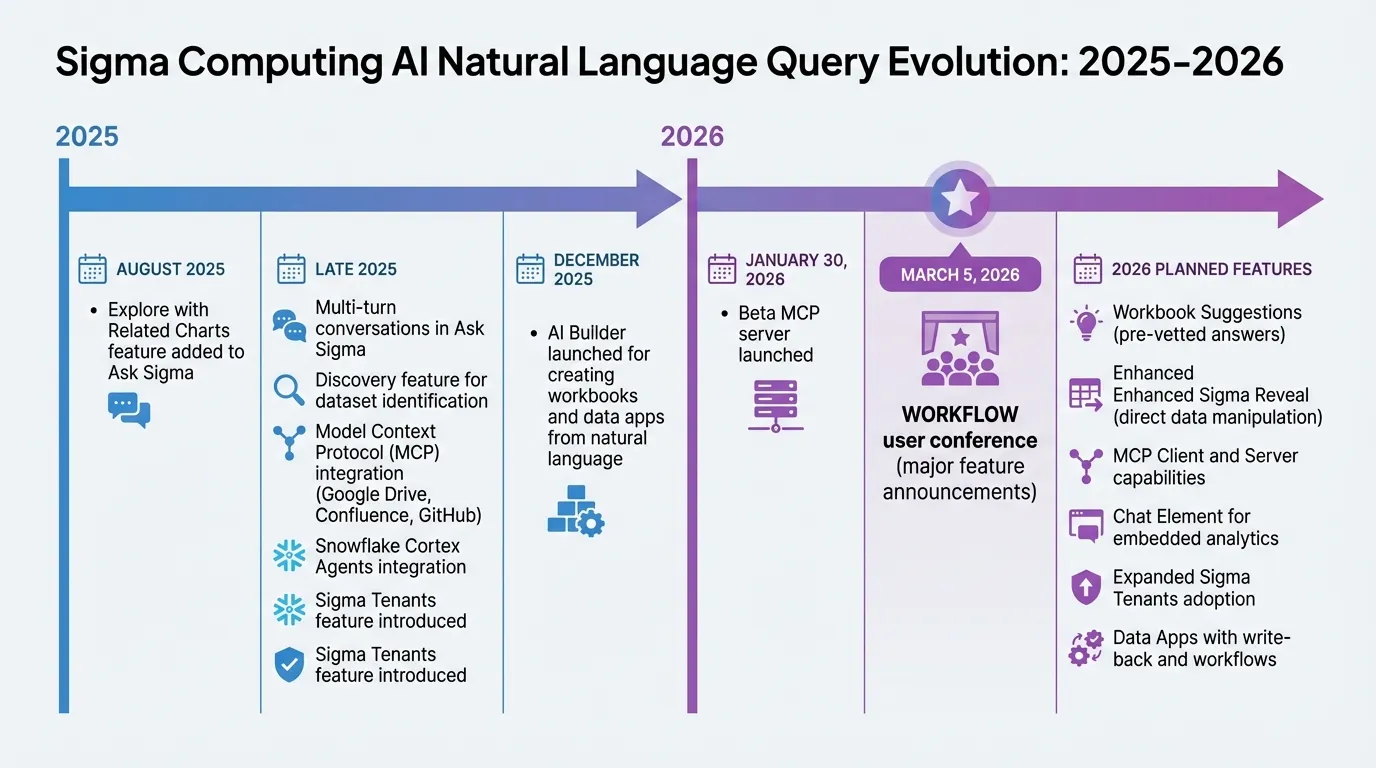 {Sigma Computing AI Evolution Timeline 2025-2026}
:::
{Sigma Computing AI Evolution Timeline 2025-2026}
:::
Sigma Product Launch | Welcome to AI Country: AI-Powered Apps and Insights
::: @iframe https://www.youtube.com/embed/Mfh9kvYq-Qs :::
sbb-itb-284a532
Core Features of Sigma Computing's AI Natural Language Query
Sigma Computing's AI tools focus on three main areas: conversational analytics with Ask Sigma, governance controls to ensure data accuracy, and live connections to cloud data warehouses. Together, these features empower users to explore data independently while maintaining enterprise-grade standards.
Ask Sigma: Advancements in Conversational Analytics
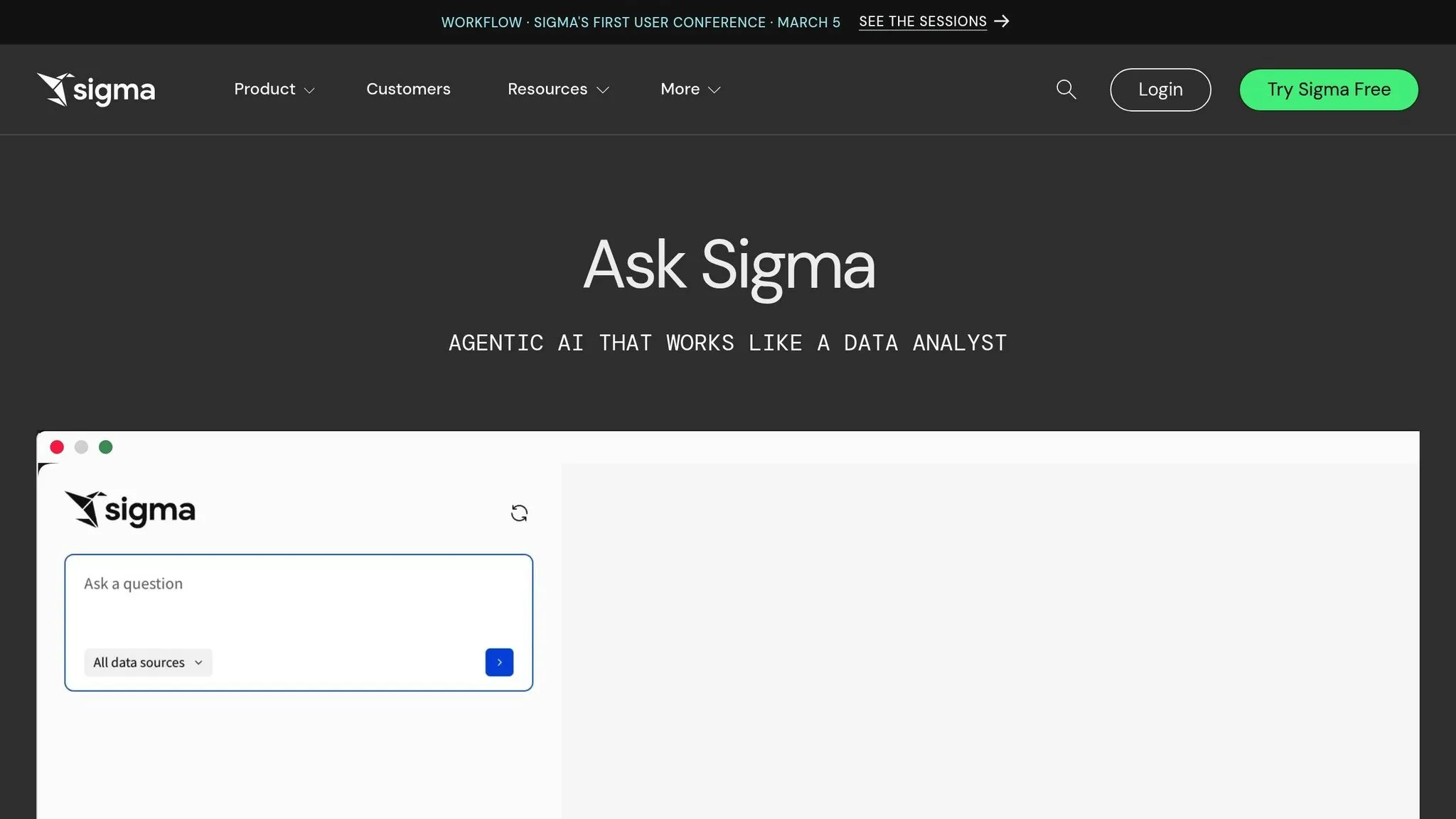
Ask Sigma took a big leap forward in late 2025. It now supports multi-turn conversations, so users can ask follow-up questions like, "What about the West region?" without repeating the full context. The Discovery feature helps users identify available datasets before they even ask a question, showing suggested datasets and vetted workbooks based on their access permissions. Instead of creating a new chart for every query, the system can provide prevalidated answers.
In August 2025, Sigma added Explore with Related Charts, which displays additional visualizations beneath the main answer. This gives users multiple perspectives without needing to type new queries. The system also reveals its analytical process - like applied filters or joins - so users can verify the logic behind the results.
Ask Sigma also integrates with external tools like Google Drive, Confluence, and GitHub via the Model Context Protocol (MCP). This boosts contextual accuracy by pulling relevant information from these platforms. Additionally, the late 2025 integration of Snowflake Cortex Agents allows users to incorporate specialized, warehouse-native agents into their workflows, enabling faster and more actionable insights. These updates lay the groundwork for robust governance controls.
Governance Controls and Query Accuracy
Sigma enhances accuracy through its integration with Snowflake Semantic Views. This feature lets organizations define key metrics, dimensions, and relationships in the warehouse, ensuring consistency across all dashboards and eliminating metric drift. The Highlight feature allows admins to prioritize trusted data sources, ensuring Ask Sigma focuses on the most reliable tables while respecting access controls like row- and column-level security.
The Content Validation tool provides real-time alerts about potential issues when data models change, helping analytics teams address problems before updates go live. With Code Representation (YAML), teams can version-control their data models using Git, enabling them to track changes over time.
Sigma's AI Builder streamlines the creation of workbooks and data applications. Users can simply describe what they need - like an expense report or deal tracker - and Sigma generates the tables, input fields, and business logic automatically. This speeds up development while maintaining security and validation standards.
Live Data Warehouse Connections and AI Model Integration
Sigma's direct connections to cloud platforms like Snowflake, Databricks, BigQuery, and Redshift ensure that data remains in the warehouse while enabling the analysis of billions of rows in seconds. These connections are built on strict governance measures.
Mike Palmer, Sigma's CEO, highlighted this approach:
"Sigma's integration with Snowflake Semantic Views isn't just compatible - it's truly native... we're giving business teams instant access to governed metrics and logic without compromise."
Sigma also allows users to apply large language model capabilities - like summarization, classification, and translation - directly within workbooks using the Prompt() function or native SQL functions. For example, teams can extract key clauses from contracts, mask sensitive information, or categorize feedback without moving data out of its secure environment.
With support for Snowflake AI SQL (Cortex), Sigma enables users to query unstructured files, such as PDFs or images, as if they were structured tables. This makes it possible to analyze "messy" data alongside traditional datasets without requiring custom engineering pipelines.
Carl Perry, Head of Analytics at Snowflake, emphasized the importance of this feature:
"This advancement helps our customers maximize the value of their data within Snowflake's AI Data Cloud through AI and BI experiences, creating more efficient and powerful workflows for their teams."
How Teams Use AI-Driven Natural Language Queries
Business users are increasingly turning to Ask Sigma for quick, accurate data insights. As one Senior Director of Data Analytics in the healthcare sector put it:
"We can query the AI engine right in the dashboard. It's a game changer! Our BI team can focus on new things rather than explaining what the data means." [1]
Self-Service Analytics for Business Users
Ask Sigma's interactive features empower business users to gain insights on their own, without needing constant support from data teams. Non-technical users can type in queries like "What were our top-performing products last quarter?" and receive instant insights from their data warehouses in the form of charts and summaries. The Ask Sigma Discovery feature goes a step further by organizing data into collections with clear descriptions, making it easier to find relevant sources.
The platform also provides transparency by showing the logic behind each answer. Users can review and tweak filters, data sources, or calculations as needed. Tools like the Formula Assistant and Explain this Chart make it simpler to build or refine complex formulas and understand visualizations. Once users identify valuable insights, they can save their progress with a single click using the "Open in workbook" feature.
Financial Planning and Operations Analytics
Finance teams have embraced AI Builder, introduced in December 2025, to turn plain-language requests into detailed forecasting tools. This feature allows teams to create input tables, forms, and result views without any coding. They can simulate scenarios by adjusting margins, costs, and prices while comparing them to actual data. Real-time tracking of department-level spending is also made possible through business drivers.
James Dorado, VP of Data at Bilt, shared:
"Finance moved from Google Sheets to Sigma's robust input tables and writeback functions." [8]
Similarly, Josh Cho, a Compensation Analyst at Affirm, highlighted:
"The custom-built comment and sign-off history transformed a business intelligence tool into an active approval system." [8]
AI prompt boxes can even be embedded directly into financial dashboards, enabling stakeholders to summarize findings or dive into specific data points without ever leaving the interface.
Sales and Marketing Analytics
Sales and marketing teams are also leveraging AI-driven queries to uncover valuable performance insights. They often start with broad questions and use follow-up queries to drill down into specific campaigns or regions. For example, Snowflake Cortex functions allow teams to run sentiment analysis on customer call transcripts, assigning scores of –1, 0, or 1 to measure sentiment. Similarly, website data can be classified to reveal engagement trends.
Explain this Chart provides instant summaries of campaign visuals for non-technical team members, while AI Builder supports the creation of custom data apps with simple descriptions.
| AI Function | Sales/Marketing Application | Example Use Case |
|---|---|---|
| Sentiment | Customer Feedback Analysis | Identifying positive or negative sentiment in call transcripts |
| Classify | Lead/Content Categorization | Sorting website pages by content type |
| Summarize | Campaign Reporting | Creating summaries of campaign notes or feedback |
| ExtractAnswer | Competitive Intelligence | Pulling specific quotes from unstructured sales call notes |
Admins can optimize Ask Sigma's performance by prioritizing verified CRM tables and ad spend datasets in the AI settings, ensuring the system pulls from the most relevant sources when answering queries.
What's Coming in 2026
After the transformative updates of 2025, Sigma's 2026 roadmap takes another step forward, focusing on delivering more accessible and governed AI-driven insights. Many of these advancements will debut at Sigma's first user conference, WORKFLOW, scheduled for March 5, 2026 [9][3]. Building on the progress made in 2025, the new features aim to make analytics even more intuitive and tightly integrated.
AI-Powered Discovery Tools for Self-Service
One of the standout updates for 2026 is how Ask Sigma will evolve to automatically surface key insights - before users even think to ask the right questions. This innovation addresses a common challenge in data discovery, making it easier to identify what data exists and how to explore it confidently.
Users will benefit from Workbook Suggestions, offering pre-vetted answers based on trusted business logic instead of raw AI-generated responses [3]. Additionally, the updated Sigma Reveal will allow users to directly manipulate data to uncover drivers of changes, such as revenue fluctuations or customer churn, all without needing to write SQL [3][6].
The AI Builder will also see significant improvements, enabling users to create complete dashboards and applications through simple natural language inputs. This includes advanced features like input tables, multi-step forms, and complex result views [4][2]. Moreover, deeper integration with Snowflake Cortex Agents will bring warehouse-native AI capabilities directly into Ask Sigma workflows [4][2].
Model Context Protocol (MCP) and Custom Integrations
Sigma is expanding its AI capabilities in 2026 by functioning as both an MCP Client and Server, building on its live data warehouse connections and governance framework. This means tools like Google Drive, Confluence, and GitHub can provide context for natural language queries within Ask Sigma [4][2]. At the same time, Sigma's own assets will be accessible to external AI agents like Claude and ChatGPT, enabling these tools to interact with live Sigma content [4].
As of January 30, 2026, Sigma has launched a Beta MCP server at https://help.sigmacomputing.com/mcp, allowing AI agents to access officially supported Sigma functionality and documentation [10]. Technical teams can also create their own MCP servers to integrate proprietary internal data into Sigma's AI Builder, enabling highly customized and automated workbook generation [4].
Embedded Analytics with AI-Generated Insights
Sigma is pushing the boundaries of embedded analytics in 2026, enabling businesses to integrate Ask Sigma directly into their products. This allows end-users to perform ad-hoc data analysis without leaving the host application [2][5]. A new Chat Element feature will let developers embed custom AI agents within workbooks, offering real-time, context-aware guidance to help users interpret complex metrics [3][6].
The Sigma Tenants feature, introduced in late 2025, will see broader adoption in 2026. This allows organizations to manage multiple isolated and secure environments for different customers or business units under a single parent organization [3][10]. Administrators can quickly set up these environments programmatically through APIs [3]. Mike Palmer, Sigma's CEO, shared his perspective:
"Sigma makes it easy to pave a path from analytics to apps, serving as the unified UI for your warehouse. We bring live analytics, AI, and data apps together in a single, governed workspace." [3]
These embedded analytics are shifting from static dashboards to Data Apps, where users can not only view data but also edit it, upload files (like PDFs or Excel), and trigger workflows - such as Slack alerts or approval processes - directly within the interface [2][6][10]. Sigma has also introduced beta audit logs and usage dashboards for Sigma Tenants, giving parent organizations the ability to monitor embed activity and query volumes across all sub-organizations [10].
Conclusion
Sigma Computing has transformed its natural language query capabilities into a comprehensive AI analytics platform over the span of 2025 to 2026. Ask Sigma now incorporates transparent "chain-of-thought" logic, while AI Builder empowers users to create full workbooks and data applications through simple conversational prompts. This approach eliminates delays caused by technical bottlenecks and makes advanced analytics more accessible.
The integration of the Model Context Protocol allows Sigma to act as both a client and server, enabling its content to be utilized by AI tools like Claude and ChatGPT. Paired with warehouse-native AI processing through Snowflake Cortex and major cloud providers, Sigma ensures that data remains secure and governed while benefiting from cutting-edge large language model functionalities.
In December 2024, Clay adopted Ask Sigma to enable self-service analytics platforms. According to founding data scientist Josh Hanson, the transparency provided by the platform boosted business stakeholders' confidence in the results and significantly reduced the workload for the data team by enabling users to independently identify trends [7]. These outcomes highlight the growing impact of AI-powered analytics.
Expanding on these advancements, the transition from static dashboards to interactive Data Apps introduces features like write-back capabilities, automated workflows, and embedded AI agents, redefining the future of business intelligence. Tools like Sigma Reveal remove the need for SQL expertise, while Sigma Tenants offer scalable infrastructure to extend AI-driven analytics across large organizations with robust governance. These innovations are breaking down barriers, making analytics accessible to everyone, regardless of their technical background.
FAQs
::: faq
How does Ask Sigma make data analysis easier for non-technical users?
Ask Sigma makes data analysis straightforward by letting users interact with their data using plain language. You don’t need to be a technical expert or understand complex query languages - just ask your question in everyday terms, and the tool delivers clear results. These results come in the form of charts, summaries, and insights that are easy to understand and act on.
What sets Ask Sigma apart is its interactive nature. Users can dig deeper by asking follow-up questions, refining their analysis in real time. Plus, it doesn’t just give you answers - it shows you how those answers were generated. This transparency means you can review, tweak, and trust the process.
Whether you're a data pro or just starting out, Ask Sigma gives you the confidence to explore your data and make decisions faster, without leaning heavily on specialized data teams. :::
::: faq
What are the main advantages of the Model Context Protocol (MCP) in Sigma's AI platform?
The Model Context Protocol (MCP) in Sigma's AI platform brings some exciting possibilities to the table. It enables AI agents to move beyond simple chat functions by linking them to external services. This means they can tackle more complex tasks and tap into a broader range of data sources, streamlining workflows and helping teams uncover deeper insights.
What’s more, MCP offers a standardized framework for expanding agent capabilities. This simplifies the process for developers to create advanced, integrated AI solutions. As its adoption grows, MCP is becoming a key player in shaping AI ecosystems, pushing boundaries and boosting the capabilities of analytics tools. :::
::: faq
How does Sigma Computing maintain data accuracy and governance in its AI-powered analytics tools?
Sigma Computing takes a thoughtful approach to data accuracy and governance by seamlessly connecting its AI models with the data sources users select. This setup allows teams to query data directly from their data warehouse, ensuring that every output adheres to company policies and governance requirements. By keeping everything within a controlled framework, Sigma reduces the chances of data being misinterpreted and helps maintain regulatory compliance.
To strengthen governance further, Sigma offers tools like the Admin Dashboard, which lets users monitor data quality and usage. Features such as secure access management and scalable content controls - like Sigma Tenants - help organizations manage permissions across different scenarios. These safeguards ensure analytics remain reliable, secure, and aligned with organizational standards. :::