Business Intelligence
Gartner Magic Quadrant Analytics and Business Intelligence Platforms 2024 2025
Summary of Gartner's 2024–2025 Magic Quadrant: leaders, AI trends, and vendor strengths to help choose the right analytics and BI platform.

Choosing the right BI platform? Here’s the key takeaway:
The 2024 and 2025 Gartner Magic Quadrant reports spotlighted Microsoft, Salesforce (Tableau), Google, Qlik, Oracle, and ThoughtSpot as Leaders in analytics and business intelligence (BI). These platforms excel in AI-driven features, cloud integration, and conversational analytics, helping businesses make faster, data-driven decisions.
Key Trends and Insights:
- 2024: AI-powered tools like automated insights and natural language queries became standard. Google, Oracle, and ThoughtSpot entered the Leaders quadrant.
- 2025: Focus shifted to "Agentic AI" and proactive analytics. Leaders maintained their positions, with Microsoft extending its dominance for 18 years.
Highlights from Top Vendors:
- Microsoft Power BI: Seamless integration with Microsoft Fabric, AI-powered Copilot, and cost-efficiency for Office 365 users.
- Salesforce (Tableau): Strong visual analytics, predictive insights, and a large user community.
- Google Looker: Gemini AI integration and cross-cloud deployment capabilities.
- Sigma Computing (2025 debut): Excel-like interface and AI-driven analysis for non-technical users.
Key Considerations:
When selecting a BI platform, prioritize AI capabilities, governance, and compatibility with your cloud ecosystem (e.g., Microsoft Fabric, Google Cloud, Snowflake). Leaders in this space are reshaping analytics with conversational AI and real-time insights, making it easier to act on data.
Quick Comparison Table:
| Platform | Strengths | Challenges |
|---|---|---|
| Microsoft Power BI | Unified data ecosystem, AI tools, cost-effective | Requires commitment to Microsoft stack |
| Salesforce (Tableau) | Visual analytics, predictive AI, large community | Licensing complexity |
| Google Looker | Gemini AI, cross-cloud support | Setup requires LookML expertise |
| Sigma Computing | Excel-like interface, warehouse-native approach | Smaller ecosystem |
| Qlik | Data quality automation, Talend integration | Integration challenges |
| ThoughtSpot | Search-based analytics, GenAI-powered Sage | Shift from dashboards may be difficult |
Bottom Line:
The BI landscape is evolving rapidly with AI-driven tools and conversational analytics. Choose a platform that aligns with your technology stack and analytics goals.
::: @figure 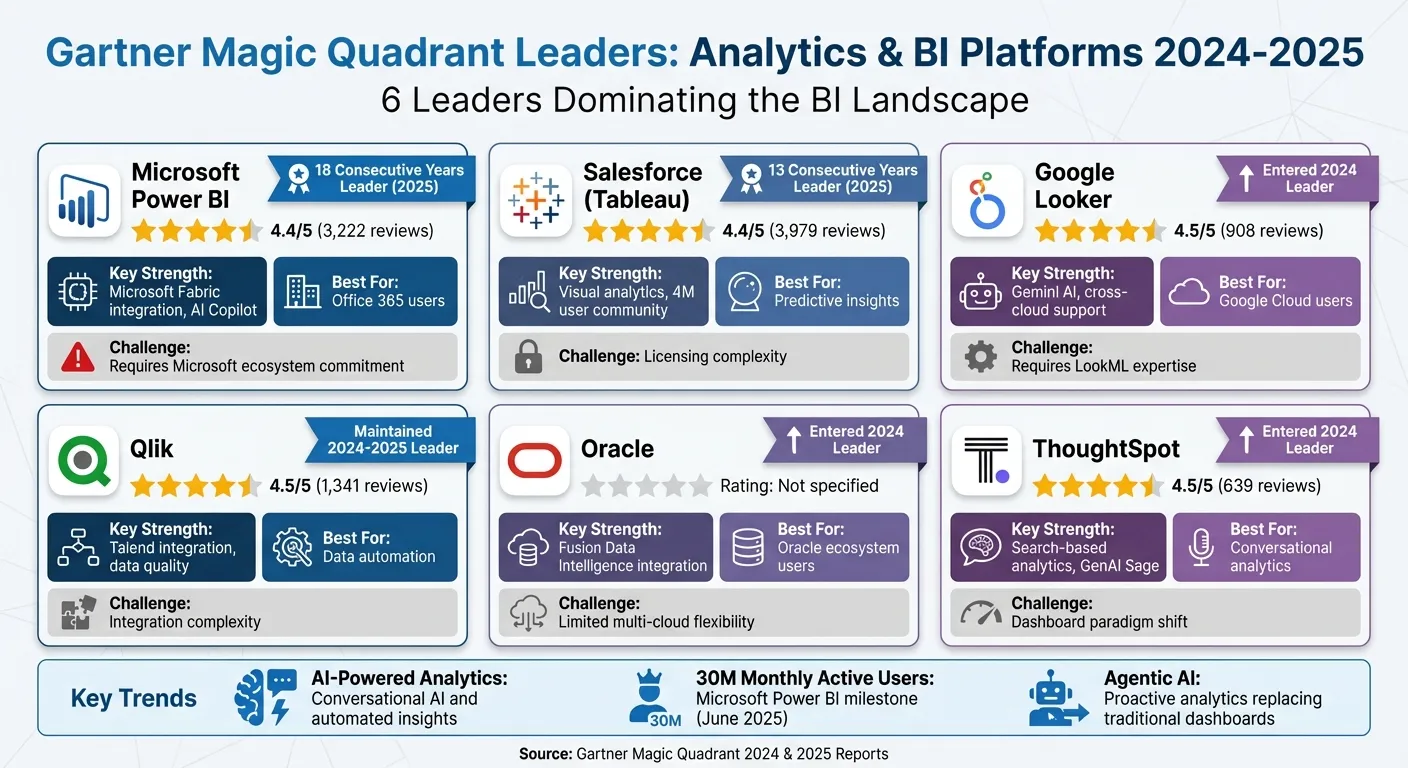 {Gartner Magic Quadrant 2024-2025 BI Platform Leaders Comparison}
:::
{Gartner Magic Quadrant 2024-2025 BI Platform Leaders Comparison}
:::
Gartner Magic Quadrant for Business Intelligence 2025 reveal and analysis
::: @iframe https://www.youtube.com/embed/JtjzjzTnTZM :::
1. Gartner Magic Quadrant 2024
The 2024 Gartner Magic Quadrant for analytics and business intelligence, published on June 20, 2024, highlights the rapid evolution of vendor strategies as AI continues to reshape the landscape. This year, 20 providers were evaluated based on their ability to empower nontechnical users to model, analyze, and share data, all while integrating IT support and AI capabilities [4]. These criteria reflect the ongoing transformation within the data analytics industry.
Leader Positioning
The Leaders quadrant expanded in 2024, with Microsoft, Salesforce (Tableau), Qlik, Google, Oracle, and ThoughtSpot claiming top spots [4]. Microsoft led the pack for the sixth consecutive year in both execution and vision, marking its 17th straight year as a Leader [7]. Meanwhile, Salesforce (Tableau) celebrated its 12th consecutive year in the Leaders quadrant, delivering over 140 new features across its product suite, including Server, Cloud, and Desktop offerings, within the past year [6].
"Microsoft has also been positioned furthest to the right for Completeness of Vision and highest in the Ability to Execute in the Magic Quadrant for the sixth consecutive year." - Kim Manis, CVP of Product, Microsoft Fabric & Power BI [7]
Vendor Strengths
The standout vendors excelled by combining unified data ecosystems with generative AI capabilities, fundamentally changing how users interact with and interpret analytics. Microsoft's dominance was driven by innovations like Microsoft Fabric, Copilot in Fabric, OneLake, and Direct Lake mode, which enables high-performance analysis directly on data lakes without requiring data movement [7]. Similarly, Salesforce leveraged tools like Tableau Pulse, Einstein Copilot, and its extensive 4 million-member user community to maintain its leadership [6]. The integration of AI assistants that can generate reports, interpret queries, and summarize data became a hallmark of the top-performing platforms [6][7].
"AI has changed how users consume data and insights. More and more people want access to data, including people who aren't analysts." - Ryan Aytay, President & CEO, Tableau [6]
Year-Over-Year Movements
This year saw Google, Oracle, and ThoughtSpot advance into the Leaders quadrant, while Qlik improved its execution ranking following significant AI investments [4]. AWS, Domo, and MicroStrategy retained their positions as Challengers, with AWS edging closer to the Leaders quadrant [4]. These shifts were largely driven by the adoption of conversational analytics and AI-enhanced tools like Microsoft Copilot, Qlik Staige, and ThoughtSpot Sage [7][4]. These developments underscore the growing importance of AI-driven features, setting the stage for even more advancements in 2025 as organizations increasingly prioritize these capabilities when selecting business intelligence platforms.
2. Gartner Magic Quadrant 2025
The 2025 Magic Quadrant, released in early 2025, showcased a consistent lineup of top vendors despite the rapid pace of AI advancements. Stability defined the year, with the same six companies - Microsoft, Salesforce (Tableau), Google, Qlik, Oracle, and ThoughtSpot - holding their spots in the Leaders quadrant [8]. Microsoft extended its dominance to an impressive 18 years [9], while Salesforce (Tableau) celebrated 13 consecutive years as a Leader [3]. Microsoft Power BI also reached a significant milestone, reporting 30 million monthly active users by June 2025. Additionally, over 30,000 individuals earned the Microsoft Fabric Analytics Engineer certification, making it Microsoft's fastest-growing advanced certification to date [9].
Leader Positioning
In 2025, Leaders set themselves apart through seamless ecosystem integration rather than focusing solely on standalone features. Microsoft led the way, ranking highest in both "Completeness of Vision" and "Ability to Execute" for the seventh straight year. This success was driven by innovations like Power BI Copilot and the unified data foundation provided by Microsoft Fabric [9]. Google Looker gained recognition for its strong governance capabilities and support for both on-premise and cross-cloud deployments - areas where Microsoft and AWS still lag behind [8]. Oracle also stood out, thanks to its advanced data preparation tools and tight integration with Fusion Data Intelligence, which proved especially valuable for organizations already using Oracle's ecosystem [8].
Vendor Strengths
The top vendors excelled by moving away from traditional dashboards and embracing conversational data interaction. Users increasingly expect to ask questions in plain English and receive dynamic insights without needing prebuilt reports [8]. For example, Lumen Technologies leveraged Microsoft Fabric and Power BI to eliminate 10,000 hours of manual work. Senior Business Intelligence Developer William Whittenton praised the solution, saying, "There are no refresh cycles, no latency. It just works" [9]. Similarly, the Make-A-Wish Foundation adopted Power BI and Microsoft Fabric to create real-time report cards for local chapters, enhancing visibility into wish granting and budgeting processes under the guidance of CIO Russ Goodwin [9].
Year-Over-Year Movements
While the Leaders quadrant remained steady, there were notable shifts among other vendors. Alibaba Cloud edged closer to the Leaders quadrant by enhancing its AI agents and offering features tailored to the Chinese market [8]. Sigma made its first appearance in 2025, standing out with a spreadsheet-style interface designed to attract Excel users transitioning to more advanced tools [8]. On the other hand, Sisense continued its decline into the Niche Player category, reflecting its focus on embedded business intelligence [8]. Meanwhile, AWS and Domo maintained their positions as Challengers, with AWS offering competitive pricing starting at just $3 per user per month [8].
Pros and Cons
The 2024 and 2025 Magic Quadrant reports highlight the strengths and challenges of leading BI platforms, offering a closer look at what each brings to the table.
Microsoft Power BI stands out for its seamless integration with Microsoft Fabric and its cost-effectiveness for Office 365 users. Its Copilot generative AI feature simplifies report creation, earning it a solid 4.4/5 rating based on 3,222 Gartner Peer Insights reviews [1]. However, fully leveraging its potential often requires a broader commitment to the Microsoft ecosystem, which may limit flexibility in multi-cloud setups.
Salesforce (Tableau) has maintained its Leader status for an impressive 13 years [3]. Known for its strong visual analytics and new AI capabilities, it provides predictive and generative insights while benefiting from a highly active user community. Despite these strengths, users often encounter licensing complexities and challenges when integrating Tableau outside the Salesforce environment. It holds a 4.4/5 rating from 3,979 reviews [1].
Google Looker integrates Gemini-powered AI and benefits from its deep connection with Google Cloud, earning a 4.5/5 rating from 908 reviews [1]. Its semantic modeling capabilities help create a single source of truth for analytics teams. However, it performs best with BigQuery, and its reliance on LookML expertise can be a hurdle for non-technical users during setup. This is why some platforms focus on bringing generative BI to non-technical teams to lower the barrier to entry.
Sigma Computing made its debut in the 2025 report with a warehouse-native approach and an Excel-like interface that appeals to spreadsheet users. Its "Ask Sigma" AI feature has been well-received, earning the platform an impressive 4.9/5 rating and a 95% recommendation rate from 214 Gartner Peer Insights reviews as of February 2026 [2]. Sigma emphasizes its warehouse-centric approach, stating, "The warehouse is the heart - limitless size and speed, trusted, governed AI, and flexible data models" [2]. However, its smaller ecosystem may limit its overall reach.
Qlik sets itself apart with Talend integration, which enhances data quality and automation through AI. It has a strong 4.5/5 rating from 1,341 reviews [1]. On the downside, its multiple acquisitions have introduced integration challenges.
Lastly, ThoughtSpot focuses on search-driven analytics with its GenAI-powered "Sage" feature, earning a 4.5/5 rating from 639 reviews [1]. While its search-based approach is innovative, it requires users to shift away from traditional dashboards.
These evaluations highlight the diverse factors decision-makers must weigh when choosing the best AI business intelligence platforms for their needs. Each platform offers distinct advantages, but understanding their trade-offs is key to making an informed choice.
Conclusion
The 2024 and 2025 Magic Quadrant reports highlight a market increasingly influenced by generative BI and warehouse-centric architectures. Microsoft continues to lead the pack, while Sigma Computing's 2025 debut underscores a growing focus on "Next Gen BI" platforms that emphasize spreadsheet-like interfaces and AI-driven analysis [2].
One of the most notable shifts is the move from simple natural language queries to fully interactive conversational AI. These platforms now combine analytics with transactional capabilities, offering direct, actionable insights. This shortens the path from decision to action, making analytics more practical and impactful. These advancements are reshaping how organizations align their tools with cloud strategies.
When choosing an AI-driven BI platform, consider how it fits within your cloud ecosystem. For example, organizations leveraging Google Cloud should explore Looker's Gemini-powered features [5], while those using Microsoft 365 can take advantage of Power BI's integration with Microsoft Fabric. Case studies show that unified data platforms can significantly reduce manual tasks and resolve latency challenges [10].
Focus on platforms that excel in governance, interoperability, and AI capabilities, while ensuring seamless integration with your data warehouse - be it Snowflake, BigQuery, or Databricks.
Ultimately, your choice will hinge on whether your team needs basic visualizations or tools for autonomous data exploration. Recognizing the difference between traditional dashboard-based BI and the emerging conversational AI analytics tools - will help you select a solution that aligns with your analytics goals and future growth.
FAQs
::: faq
What AI features make top analytics and BI platforms stand out?
Leading analytics and BI platforms stand out by integrating AI-powered tools that streamline decision-making and make data analysis more intuitive. Features like predictive analytics help forecast future trends, generative AI transforms raw data into actionable insights, and agentic AI takes over repetitive tasks, freeing up time for more strategic work. Together, these tools deliver real-time insights, enabling users to respond quickly and effectively.
What’s more, many platforms now include low-code or no-code options, making it easier for non-technical users to create dashboards, automate workflows, and explore data independently. This approach broadens access to analytics, ensuring that data-driven decisions are no longer limited to specialized teams but embraced across entire organizations.
By combining smart AI features, automation, and user-friendly design, these platforms help businesses harness their data’s potential like never before. :::
::: faq
How does Microsoft’s ecosystem integration make Power BI more effective?
Microsoft has designed Power BI to work seamlessly across its ecosystem, offering tight integration with tools like Excel, Teams, and Azure. This interconnected approach allows for smooth collaboration, simplified data sharing, and better governance - all within platforms users already know and rely on.
Power BI also leverages Microsoft’s cloud infrastructure, making it easier to scale analytics, ensure secure data management, and uncover insights faster. By staying within a unified, user-friendly environment, organizations can streamline workflows and make smarter, data-driven decisions with less friction. :::
::: faq
What should I look for in a BI platform for my cloud environment?
When selecting a BI platform for your cloud setup, it's important to focus on factors that align with your organization's goals and needs. Start by ensuring integration capabilities - your platform should work effortlessly with existing cloud services, databases, and external data sources to maintain a connected and efficient data ecosystem.
Another key area is governance and security. Protecting sensitive data, maintaining compliance, and managing access are critical to building trust and ensuring proper data usage. Strong security measures should be non-negotiable.
Consider platforms that leverage AI-driven automation to simplify analytics processes and speed up insights. This can save time and help teams focus on interpreting data rather than wrestling with it. Scalability is equally important - your platform should grow alongside your business and adapt to changing data requirements.
Finally, a user-friendly interface can make a world of difference. When the platform is easy to navigate and includes collaboration tools, it becomes accessible for both technical experts and non-technical team members. This kind of accessibility can encourage widespread adoption and help establish a data-centric approach within your organization. By focusing on these factors, you can make the most of your cloud investments and drive smarter, faster decisions. :::