Business Intelligence
Best AI-powered analytics platform
Explore how AI-powered analytics platforms enhance data accessibility, speed, and security, transforming business intelligence for modern organizations.

AI-powered analytics platforms are transforming how businesses use data. They simplify complex tasks, enabling users to extract insights quickly without technical skills. Querio stands out as a leading option, offering:
- Natural language querying: Ask questions in plain English without needing SQL knowledge.
- Real-time insights: Connect directly to data warehouses like Snowflake and BigQuery.
- Governance and security: SOC 2 Type II compliance and 99.9% uptime SLA.
- Affordable scalability: A free plan with unlimited users, and Core at $2,499/month with 10,000 AI credits a month.
Querio eliminates the delays and complexities of AI BI and traditional BI tools, letting teams make faster, smarter decisions while maintaining strong data governance. Its intuitive interface and cost-effective model make it a top choice for modern businesses.
I tried every AI DATA ANALYSIS tool. Here's the BEST
::: @iframe https://www.youtube.com/embed/BcHB7bBcN2I :::
1. Querio
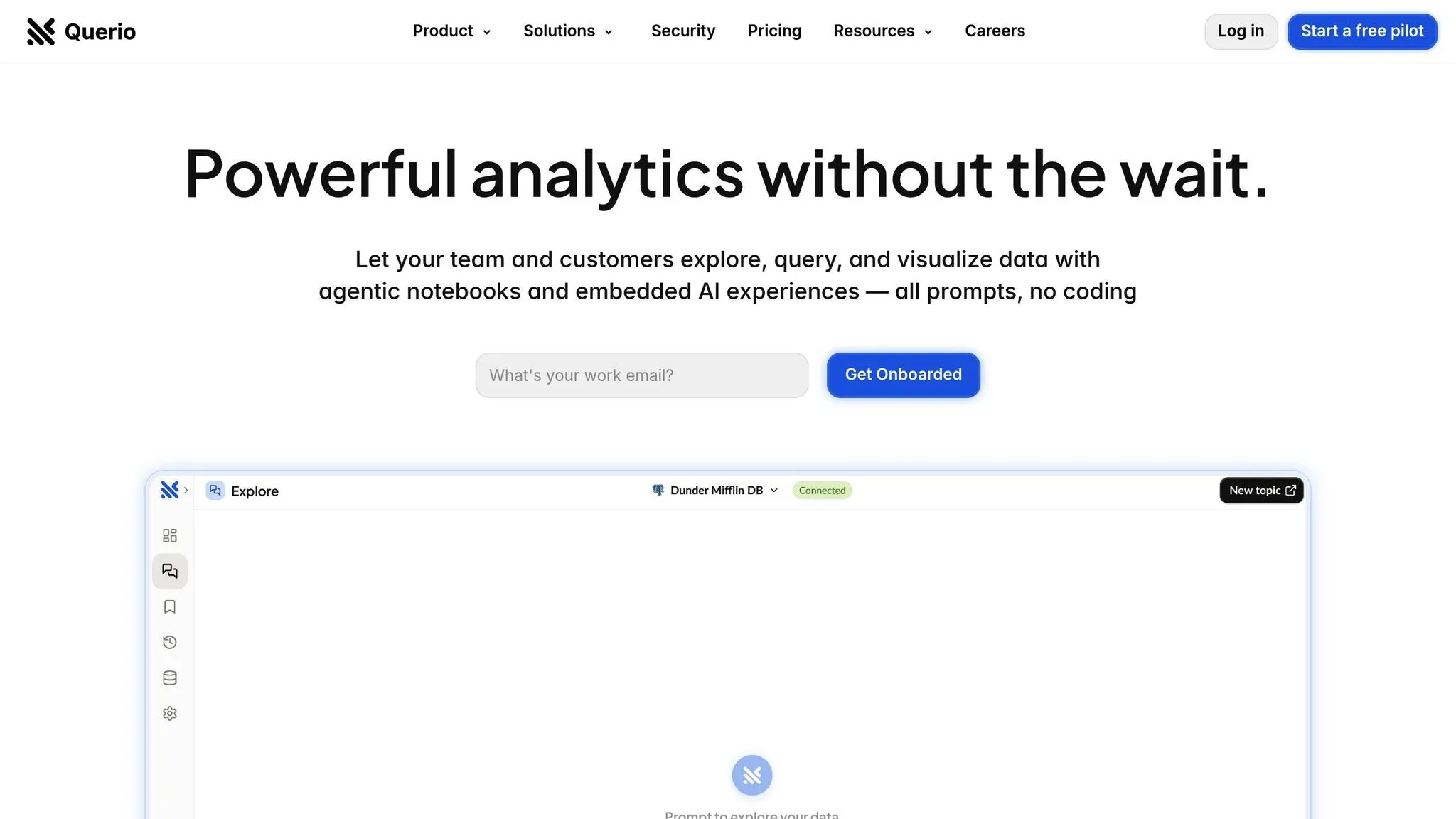
Querio is an AI-powered business intelligence (BI) workspace that allows users to query live data using plain English, delivering instant and accurate visualizations.
AI-Driven Design
Querio is built on an AI-driven architecture that connects directly to major data warehouses like Snowflake, BigQuery, and Postgres. This setup eliminates the need for duplicating data, ensuring users work with live, up-to-date information.
The platform's AI engine is among the best text to SQL query tools, translating natural language queries into SQL, producing results as clear visualizations in real time. A standout feature is Querio's context layer, which allows data teams to define table relationships, business metrics, and glossary terms once. The AI then uses this context for all future queries, ensuring consistent insights across the organization while still allowing flexibility for on-the-spot analysis.
Conversational Queries Made Simple
Querio enables conversational analytics, allowing users to ask follow-up questions like "Show last year's data" or "Break by region." The AI retains the context of previous queries, refining results as the conversation progresses.
The platform encourages exploration with unlimited, fee-free queries, making it easier to uncover insights. Users can also create drag-and-drop dashboards to track KPIs or tell data-driven stories. By saving key queries as dashboard components, users can build visual narratives that automatically refresh with live data. These dashboards are versatile enough to support both day-to-day operational monitoring and high-level executive reporting, eliminating the need for additional tools.
Security and Governance You Can Trust
Querio prioritizes security and governance. The platform is SOC 2 Type II compliant and offers a 99.9% uptime SLA, ensuring businesses have reliable access to their critical data. All database connections are read-only and use encrypted credentials, adding an extra layer of protection against accidental data changes.
"At Querio, your data's integrity is our top priority. We bring together advanced technology, comprehensive policies, and a team dedicated to security to ensure your data remains protected." - Querio Ltd. [1]
The governance framework strikes a balance between control and accessibility. Data teams can manage definitions and permissions, while business users enjoy self-service analytics platforms. This ensures insights are both easy to access and consistently accurate.
Pricing Details
Querio has a free plan, and Core is $2,499 a month (or $25,000 a year billed annually). Every plan includes unlimited users, unlimited data connections, and dashboards:
- Free: 500 AI credits a month, notebooks, and a Slack agent
- Core: 10,000 AI credits a month, SSO, API access, and unlimited automations
- Enterprise: custom pricing, single-tenant hosting, and on-prem deployment as an add-on
For businesses looking to extend insights into their own products, Querio also offers embedded analytics capabilities.
Next, we'll compare Querio to traditional BI tools.
2. Traditional BI Tools
Traditional BI tools, while once pivotal for organizations, often feel stuck in the past compared to newer, user-friendly platforms like Querio. Designed before the rise of advanced AI, these systems rely on static data models and scheduled processes to generate insights. While they’ve played a role in shaping the data-driven decision-making process, their design reveals several limitations when stacked against modern analytics solutions.
Legacy Architecture
Most traditional BI systems were built during a time when advanced AI was still a thing of the future. Because of this, they operate on fixed data models and rely on scheduled updates instead of dynamic, real-time processing. This older architecture can make adapting to new business demands a time-consuming and complex task.
Data Management and Governance
These platforms typically use centralized control and compliance frameworks to maintain data integrity. While this structured approach ensures reliability, it often lacks the flexibility offered by newer, decentralized methods.
User Interaction and Querying
Accessing insights through traditional BI tools often involves using specific query languages or navigating structured interfaces. While some of these tools now support natural language data querying tools, the functionality remains limited compared to the more conversational and intuitive capabilities of modern systems.
Cost Challenges
Cost is another hurdle with traditional BI platforms. They often use licensing models tied to the number of users and may charge extra for additional features. On top of that, organizations face expenses for IT management, specialized support, and user training, all of which add to the overall cost of ownership.
sbb-itb-284a532
Pros and Cons
Choosing the right analytics platform means balancing its benefits with potential challenges to make an informed decision.
Querio: Strengths and Considerations
Querio's AI-native design stands out by removing the need for SQL expertise. This means anyone - from product managers to finance teams - can query data using plain English. With a 4.8 out of 5 rating from 13 users, many praise its ease of use and efficiency [3]. Its pricing model, offering unlimited users on every plan, including the free plan, is attractive for organizations aiming to expand data access without worrying about per-user fees.
The platform connects directly to Snowflake, BigQuery, and Postgres, enabling real-time insights without duplicating data. It also meets enterprise standards with SOC 2 Type II compliance and a 99.9% uptime SLA, ensuring both security and reliability. Governance is simplified with a one-time context setup, reducing ongoing management efforts.
On the flip side, some advanced customizations might require technical expertise [2]. Additionally, like any AI-driven tool, it comes with challenges such as initial setup costs and the need for regular maintenance to keep models running smoothly [4].
Traditional BI Tools: Pros and Cons
AI BI tools vs. traditional BI platforms differ significantly, as traditional systems are known for their reliability and well-established frameworks, making them a solid choice for organizations with strict regulatory requirements.
However, these systems often come with higher costs, thanks to user-based licensing and extra charges for premium features. They also demand significant IT resources for management, support, and training. Scaling these tools can be cumbersome, especially in areas like governance and workspace management [2]. Another limitation is their reliance on scheduled updates, which can delay decision-making compared to real-time processing.
Key Differences Comparison
| Aspect | Querio | Traditional BI Tools |
|---|---|---|
| User Access | Natural language querying | Structured querying only |
| Pricing Model | Unlimited users; Free plan; Core $2,499/mo | Per-user licensing with extra costs |
| Data Processing | Real-time AI-driven insights | Scheduled updates, static reporting |
| Setup Complexity | Minimal technical setup for basic use | Extensive IT involvement required |
| Governance | Automated, context-driven | Manual governance management |
| Customization | Some features need developer input | Fully customizable but technically demanding |
The choice between these options depends on factors like technical expertise, budget, and user needs. Companies that prioritize speed and ease of access often lean toward AI-powered tools like Querio. Meanwhile, those with large technical teams and complex compliance requirements might stick with traditional platforms, despite their limitations. This comparison highlights Querio as a strong option for organizations seeking efficient, accessible, and secure analytics.
Conclusion
Querio is redefining how businesses approach data-driven decision-making by breaking down technical barriers. With its AI-first design, the platform delivers insights 60% faster, enables users to create reports up to 20 times faster, and frees up as much as 8 hours of data-related work per week. This efficiency translates into potential savings of up to $31,000 annually per product manager [5][6][7]. And it doesn’t stop there - these time-saving insights are paired with strong governance, reducing the need for ongoing oversight.
By leveraging natural language querying, Querio removes the need for SQL expertise, making data exploration accessible to everyone. Its direct integrations with Snowflake, BigQuery, and Postgres ensure real-time insights without the hassle of duplicating data. Plus, enterprise-grade features like SOC 2 Type II compliance and a 99.9% uptime SLA provide the reliability businesses demand.
The platform’s governance model is a game-changer for data teams, allowing them to apply context once and manage it effortlessly moving forward. This creates a scalable solution for analytics across the organization, requiring minimal IT involvement.
For companies focused on making faster, safer decisions, Querio transforms traditional business intelligence into a tool that’s accessible, secure, and cost-effective. Its AI-powered analytics insights, simplified governance, and unlimited viewer access make it an ideal choice for organizations looking to democratize data access while maintaining control and efficiency.
FAQs
::: faq
How does Querio make data more accessible for non-technical users with natural language querying?
Querio makes data analysis straightforward by enabling users to ask questions in plain English - no coding or technical know-how required. This means anyone, no matter their technical skills, can dive into data and uncover valuable insights effortlessly.
By turning complex data tools into something accessible and easy to use, Querio helps teams make faster, smarter decisions. It creates a more inclusive approach to analytics, where everyone can contribute and feel confident in their findings. :::
::: faq
How does Querio's AI-driven architecture improve data governance and security?
Querio leverages its AI-powered architecture to streamline data governance and security. By automating tasks like real-time error detection, data validation, and format standardization, the platform ensures your data stays accurate, consistent, and dependable across all sources.
On top of that, Querio reduces risks by spotting potential anomalies early and enforcing compliance with governance policies. This forward-thinking approach allows businesses to make smarter, safer decisions while trusting the integrity of their data. :::
::: faq
What makes Querio's pricing model scalable and cost-effective for businesses expanding their data access?
Querio offers a pricing model that balances scalability and affordability, making it a great fit for businesses aiming to expand data access without breaking the bank. Querio has a free plan, and Core is $2,499 a month (or $25,000 a year billed annually), with unlimited users and unlimited data connections on every plan.
For businesses needing more, Core includes 10,000 AI credits a month, and extra credits on Core cost $0.25 each. This straightforward pricing approach ensures companies can enhance their data capabilities while keeping costs manageable. :::