Business Intelligence
Mode Analytics alternatives for teams that have outgrown SQL notebooks
Alternatives to Mode Analytics that cut SQL work: natural-language queries, consistent metrics, live warehouse access, and no per-seat pricing.

Looking for a better solution than SQL notebooks? If your team is struggling with Mode Analytics due to inconsistent metrics, manual SQL tasks, or high costs, there are alternatives that may better fit your needs.
Key Takeaways:
- Mode Analytics: Powerful for technical users but heavily reliant on SQL and Python. Challenges include inconsistent KPIs, manual workflows, and high per-seat costs. Pricing can range from $6,000 to $50,000+ annually.
- Querio: Offers AI-driven analytics with natural language querying, centralized metric definitions, and no per-seat pricing (a free plan, and Core at $2,499 a month, with unlimited users on every plan). Designed for non-technical users with live data access and strong governance features.
Quick Comparison:
| Feature | Querio | Mode Analytics |
|---|---|---|
| Interface | AI-powered natural language | SQL, Python, and R notebooks |
| Technical Barrier | Low; no coding needed | High; requires SQL/Python expertise |
| Collaboration | Centralized metric definitions | Shared notebooks |
| Pricing | Free plan; Core $2,499/mo ($25,000/yr) | Per-seat (varies, $6k–$50k+) |
| AI Features | Full SQL/Python generation | Limited AI (Mode Assist) |
| Data Handling | Live queries; no data movement | SaaS-based; connects to 20+ databases |
Bottom Line: Querio simplifies analytics for teams of all sizes, while Mode Analytics is better suited for highly technical teams comfortable with coding. For faster workflows, consistent metrics, and predictable costs, Querio is a strong alternative.
::: @figure 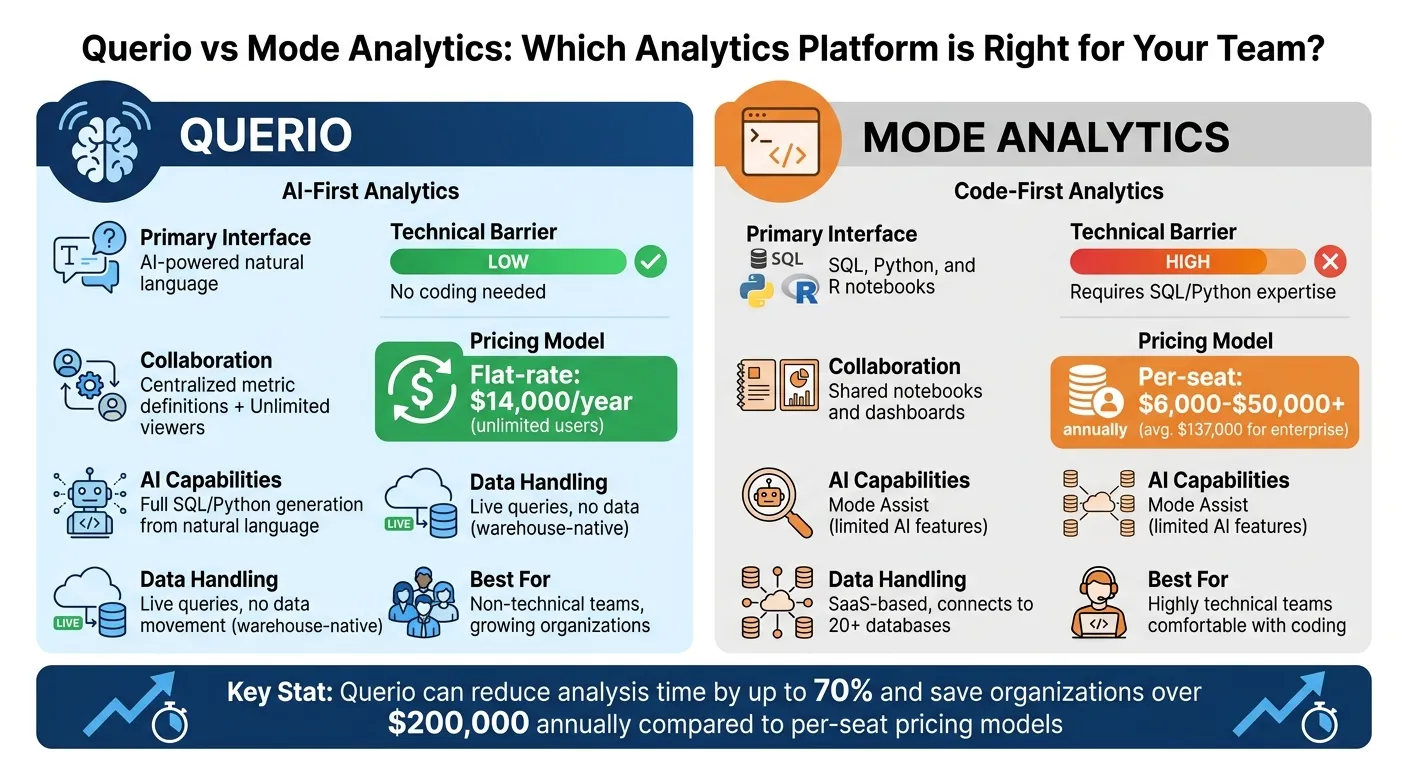 {Querio vs Mode Analytics: Feature Comparison for Data Teams}
:::
{Querio vs Mode Analytics: Feature Comparison for Data Teams}
:::
1. Querio
AI-driven analytics
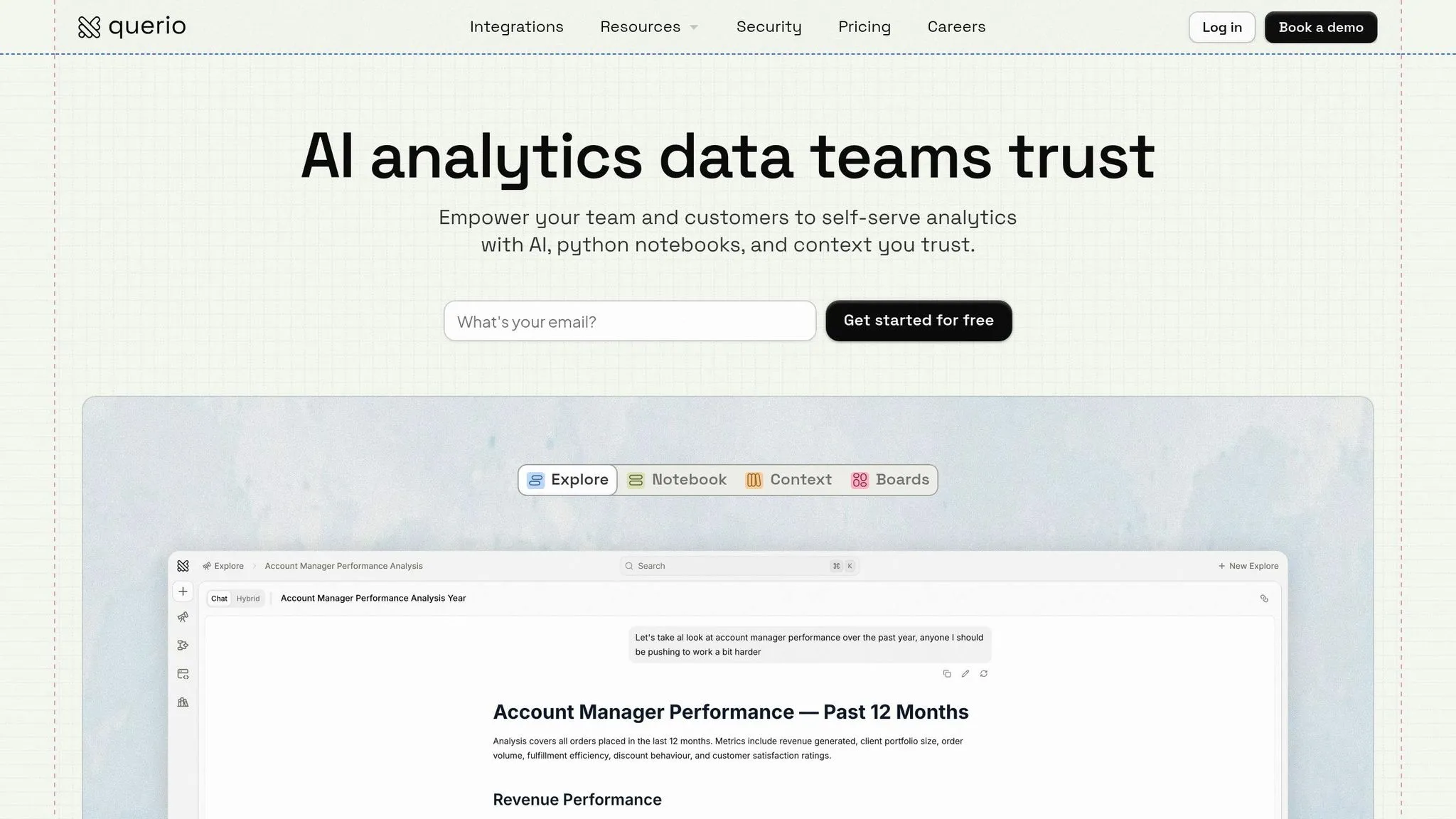
Querio simplifies the process of analyzing data by replacing complex SQL queries with natural-language inputs. Instead of writing code, teams can ask questions in plain English and get precise answers generated through actual SQL and Python scripts. This ensures both transparency and the ability to verify the code behind the results.
The platform also includes a reactive notebook environment for SQL and Python, which automatically updates whenever the underlying logic changes. This ensures results stay up-to-date without manual intervention, streamlining workflows and improving efficiency.
This setup naturally aligns with data governance best practices by maintaining clarity and accountability throughout the process.
Collaboration and governance
Querio's shared context layer allows data teams to define key elements like joins, metrics, and business terms just once, ensuring consistency across all analytics outputs. This centralized system helps maintain uniformity in key metrics across reports.
The platform also supports robust security features, including role-based access controls and SSO integrations. With SOC 2 Type II compliance, it meets high standards for data governance and enterprise security.
Scalability and integrations
Querio’s collaborative design ensures it can handle growing data demands with ease.
The platform connects directly to major data warehouses like Snowflake, BigQuery, Amazon Redshift, ClickHouse, and PostgreSQL using encrypted, read-only credentials. By running queries directly against live data, Querio eliminates the need for data extracts or duplication, making it efficient and scalable as data volumes increase.
Querio has no per-seat pricing and unlimited users on every plan: there is a free plan, and Core is $2,499 a month (or $25,000 a year billed annually). Each plan includes AI credits, and admins can set a spending cap, so costs stay predictable. Additionally, analytics can be embedded into customer-facing applications via APIs and iframes, reusing the same governed logic for both internal and external purposes.
sbb-itb-284a532
2. Mode Analytics
Code-first environment
Mode Analytics provides a SQL-focused workbench combined with Python and R notebooks for deeper statistical analysis [2]. While this setup is powerful for technical users, it creates challenges for non-technical team members. The heavy reliance on SQL means analysts often spend a significant chunk of their time - estimated at 60%–80% - debugging queries and addressing ad-hoc data requests [4]. On top of that, the lack of built-in AI features means all tasks require manual coding, which can slow down workflows [4][5].
This emphasis on a code-first approach also shapes how the platform handles collaboration and governance.
Collaboration and governance
Mode fosters teamwork with features like shared notebooks, commenting, and version history. It also integrates with the dbt Semantic Layer, enabling analysts to work with dbt-defined metrics directly within the platform [2]. For governance, Mode offers "Definitions", a basic semantic layer to define metrics and dimensions. While helpful, this feature is considered less robust compared to what larger enterprise tools provide [6].
But governance isn't the only factor affecting Mode's scalability - its infrastructure and pricing model also play a role.
Scalability and integrations
Mode supports connections to over 20 databases but operates exclusively as a SaaS platform, meaning all queries are routed through its infrastructure [1][6]. For organizations with strict data residency needs, Mode offers hosting within the EU [6]. However, its pricing model is less transparent, requiring custom contracts. Costs can range from $6,000 to over $50,000 annually, with the average enterprise spending around $137,000 [3][4].
Mode Review: Top Features, Pros & Cons, and Alternatives
::: @iframe https://www.youtube.com/embed/h-ikFQCfzLo :::
Strengths and Weaknesses
Querio simplifies analytics by converting plain-English questions into accurate SQL or Python code using its AI-powered interface. This eliminates the need for technical expertise, making data analysis accessible to a broader audience. Additionally, Querio uses a centralized context layer to ensure consistent business definitions across analyses and offers warehouse-native functionality with no per-seat pricing as your team grows.
On the other hand, Mode Analytics caters primarily to technical users, requiring manual SQL or Python coding. This creates a steep learning curve for non-technical team members. Mode's per-seat pricing can quickly become costly as teams expand, and its reliance on manual coding often results in more time spent troubleshooting queries compared to Querio's automated approach.
Here's how they compare across essential features of modern business intelligence tools:
| Feature | Querio | Mode Analytics |
|---|---|---|
| Primary Interface | AI-powered natural language | SQL, Python, and R notebooks |
| Technical Barrier | Low; ideal for non-technical users | High; requires SQL/Python expertise |
| Collaboration | Unlimited viewers; shared context layer | Shared notebooks and dashboards |
| Scalability | No per-seat pricing; warehouse-native | Per-seat pricing; enterprise-focused |
| AI Capabilities | Full SQL/Python generation from text | Mode Assist (limited AI features) |
| Data Movement | None (live, read-only connections) | Connects to 20+ databases |
For teams looking to move beyond SQL notebooks, Querio offers a scalable and user-friendly alternative. Its design focuses on reducing technical barriers, making it easier for non-technical teams to adopt. In contrast, Mode Analytics' reliance on heavy coding and its pricing structure may limit its appeal for broader team use.
Conclusion
For teams moving beyond SQL notebooks, Querio offers a powerful solution with AI-driven analytics, live data access, and enterprise-level governance. It enables automated insights, real-time querying, and streamlined analysis - all without requiring extensive coding expertise.
With features like natural language querying and transparent, inspectable code, Querio can reduce analysis time by up to 70%. It supports live warehouse queries with sub-second latency, eliminating the delays caused by scheduled materializations[8]. Plus, its centralized context layer ensures consistent definitions for key business metrics, putting an end to metric drift.
Querio also stands out with no per-seat pricing.
For teams with strict governance needs - such as row-level security, audit logs, or workflow approvals - Querio delivers advanced controls essential for industries like finance and compliance, particularly under regulations like GDPR or SOC 2.
Curious to see how Querio can transform your analytics workflows? Start on the free plan today and take the next step in optimizing your data operations.
FAQs
::: faq
How does Querio keep metrics consistent across teams?
Querio’s governance-first design and centralized semantic layer are game changers for ensuring consistent metrics across teams. By standardizing metric definitions, this layer eliminates discrepancies and ensures everyone is working from the same playbook. No more metric drift or conflicting interpretations - every team stays aligned.
On top of that, governance features like audit logs and role-based access controls reinforce consistency. These tools ensure metrics are not only reliable but also reproducible, giving teams confidence in their analytics.
The result? A unified understanding of key metrics that supports trustworthy, consistent analytics across the entire organization. :::
::: faq
Will Querio work with my data warehouse without moving data?
Querio connects directly to your data warehouse through live data connections. This means you can analyze your data in real time without needing to transfer or duplicate it. The result? Efficient workflows and instant access to insights. :::
::: faq
What security and governance controls does Querio support?
Querio offers a strong set of security and governance tools to keep your data safe and compliant. Here's what you can expect:
- Role-Based Access Control (RBAC): Assign specific permissions to users based on their roles, ensuring only authorized individuals access sensitive information.
- SOC 2 Type II Compliance: Querio meets strict standards for data security, availability, and confidentiality, giving you peace of mind.
- Automated Compliance Checks: Stay ahead of regulatory requirements with built-in checks that help maintain compliance effortlessly.
- Detailed Audit Trails: Track every action and change with comprehensive logs, making it easier to monitor and review activity.
- Encrypted Data Connections: Protect your data in transit with advanced encryption methods.
- Real-Time Activity Monitoring: Keep an eye on user activity as it happens, helping you detect and address issues quickly.
These features work together to ensure your data stays secure, private, and aligned with regulatory standards. :::