Business Intelligence
25 best Ai analytics tools in 2026: The complete guide
Compare 25 top AI analytics tools in 2026—features, scalability, integrations, and real-world use cases for smarter decisions.

By 2026, AI analytics tools have shifted from static dashboards to smart, decision-making platforms. These tools don’t just present data - they explain patterns, predict outcomes, and recommend actions. With the AI analytics market expected to reach $68 billion this year and data volumes growing 10x from 2020 to 2030, businesses are under pressure to choose tools that deliver fast, actionable insights.
Here’s what makes today’s AI analytics tools stand out:
- Agentic Analytics: AI agents autonomously investigate trends and provide detailed reports.
- Automated Insights: Root cause analysis ranks key factors driving changes in metrics.
- Proactive Monitoring: Tools detect anomalies and trends in real time.
- Context Memory: AI retains previous queries and business rules for continuity.
- Large Context Windows: Enables processing of entire datasets at once for deeper analysis.
These features make AI analytics faster, smarter, and more scalable than ever. Whether it’s predicting customer churn, improving forecasting, or detecting fraud, businesses are using these tools to gain a competitive edge.
::: @figure 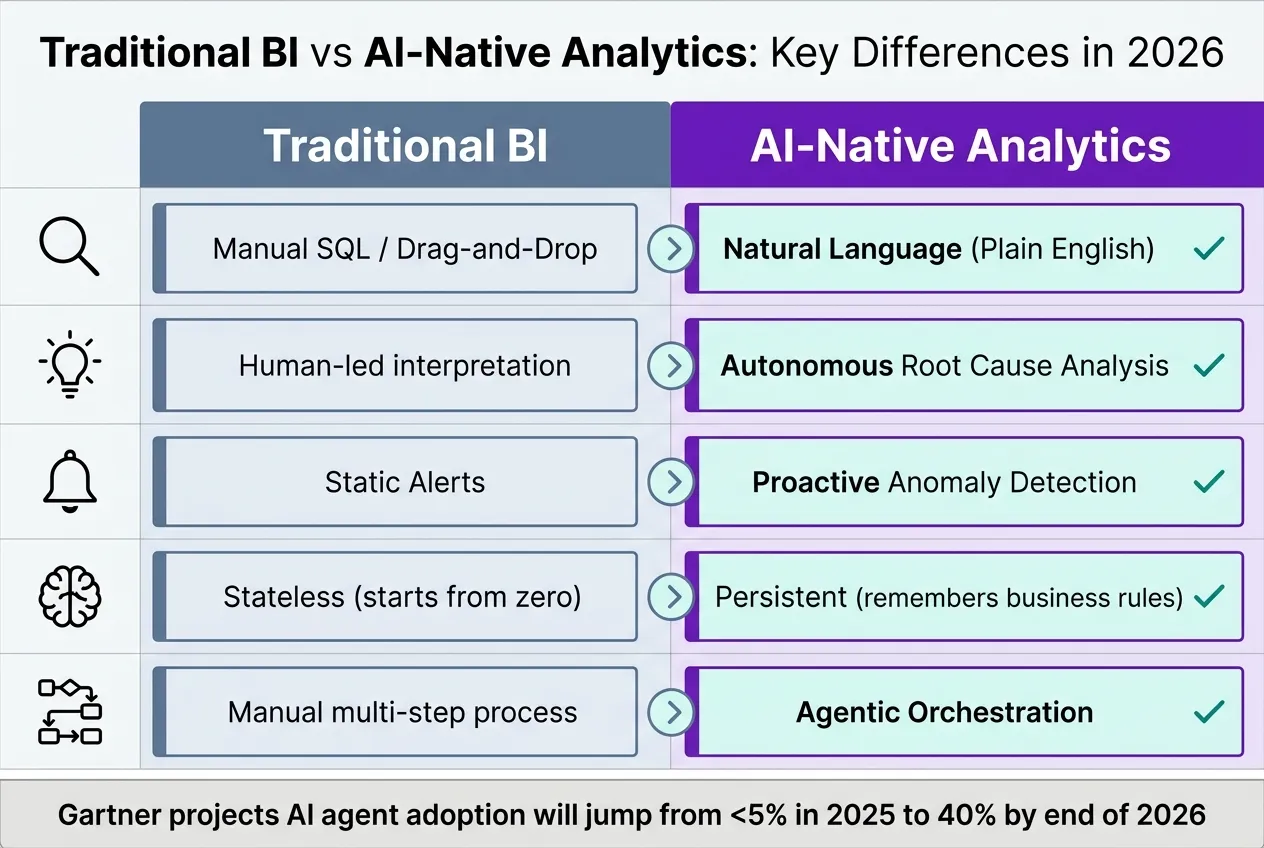 {Traditional BI vs AI-Native Analytics: Key Differences in 2026}
:::
{Traditional BI vs AI-Native Analytics: Key Differences in 2026}
:::
What are Best AI Analytics Tools and Strategies for 2026?
::: @iframe https://www.youtube.com/embed/BQSPLf7z2pw :::
1. Key AI Features
By 2026, the most advanced AI analytics tools will stand out thanks to six essential capabilities that replace manual querying with fully autonomous analysis. These features set AI-powered analytics apart from traditional business intelligence (BI) methods.
Agentic Analytics represents a major leap forward. Instead of addressing one query at a time, AI agents can autonomously plan and execute multi-step workflows. For instance, if a sales KPI drops, an AI agent doesn’t just report the decline - it investigates. It segments data by region and product, identifies patterns, and delivers a detailed report. According to Gartner, the adoption of task-specific AI agents in enterprise applications will jump from under 5% in 2025 to 40% by the end of 2026 [6].
Automated Deep Insights dig deeper than simply showing a drop in revenue. These systems conduct root cause analyses, ranking the factors contributing to the change. This means you can pinpoint the customer segments, channels, or time periods that had the biggest impact.
Proactive Monitoring keeps an eye on your data continuously. Instead of waiting for you to ask, it flags anomalies and trends as they emerge, enabling real-time responses to critical shifts in business metrics [1].
Governed Semantic Layers ensure consistency across teams by centralizing business logic. Whether marketing or finance queries “revenue,” the AI delivers the same result, thanks to a shared, unified definition.
Persistent Context and Memory allows the AI to retain information across sessions. It remembers previous queries, business rules, and analysis, creating continuity between past and present data explorations [6][7].
Lastly, Large Context Windows enable AI models to process vast amounts of data - over 1 million tokens - in a single pass. This capability allows the AI to analyze entire datasets at once, providing a comprehensive view [7].
| Feature | Traditional BI | AI-Native Analytics |
|---|---|---|
| Query Method | Manual SQL / Drag-and-Drop | Natural Language (Plain English) |
| Insight Generation | Human-led interpretation | Autonomous Root Cause Analysis |
| Monitoring | Static Alerts | Proactive Anomaly Detection |
| Context | Stateless (starts from zero) | Persistent (remembers business rules) |
| Workflow | Manual multi-step process | Agentic Orchestration |
These features not only redefine how insights are generated but also pave the way for better scalability and seamless integration in analytics workflows.
2. Scalability
Scalability is a key factor in unlocking AI's potential, especially as data volumes are expected to grow more than tenfold between 2020 and 2030 [2]. The most effective AI analytics tools must handle this surge without causing budget overruns or slowing down workflows. Six features stand out as essential for scalable tools.
Independent Compute and Storage Scaling allows you to increase processing power or storage separately, so you don’t pay for resources you don’t use. For example, in 2026, Pfizer cut its total cost of ownership by 57% after transitioning from legacy systems to Snowflake’s cloud-native setup [3]. This approach ensures efficiency by avoiding unnecessary expenses.
In-Database Processing eliminates the need to duplicate datasets, reducing latency and improving security. Wolt, a delivery platform, demonstrated this in 2026 by cutting data wrangling time by 80% through built-in geospatial analytics that processed data directly within its system [3].
Real-Time Data Updates keep analytics aligned with the fast pace of business. A great example is WHOOP, a wearable tech company, which achieved three times faster financial forecasting in 2026 by leveraging Snowflake’s Snowpark to build AI/ML models. This allowed teams to focus on future challenges instead of being stuck analyzing outdated data [3].
Flat-Rate Pricing Models offer predictable costs as your usage grows. Unlike traditional pricing, which can skyrocket with increased usage, models like Querio’s unlimited user setup enable widespread data access without surprise bills. In 2026, Petco adopted Snowflake’s unified platform, boosting data processing speeds by 50% and improving data science productivity by 20% [3].
Governed Semantic Layers ensure that as teams expand, metrics remain consistent and reliable across the organization.
Agentic Workflow Orchestration automates the monitoring of thousands of KPIs simultaneously, allowing AI agents to investigate anomalies across multiple dimensions at once. With the use of task-specific AI agents projected to rise from under 5% in 2025 to 40% by the end of 2026 [6], this feature turns scalability into a competitive edge rather than a technical hurdle.
Each of these capabilities not only addresses the challenges of managing increasing data but also supports real-time, informed decision-making, showcasing the practical value of AI analytics in business operations.
3. Ease of Integration
The best AI analytics tools are designed to work with your existing data stack and workflows, sparing you the hassle of starting from scratch. These tools focus on integrating smoothly, allowing you to gain AI-driven insights without disrupting current processes. Let's look at how features like pre-built connectors, semantic alignment, security measures, communication hubs, and API-first designs simplify integration.
Pre-Built Warehouse Connectors save time by cutting out the need for lengthy custom development. For example, QuantumLayers connects to SQL databases, REST APIs, SFTP, and Google Sheets within minutes using its QL-Agent, which generates API pull requests with just one prompt [9]. Similarly, MindsDB supports over 200 data sources and offers autonomous BI agents that integrate directly into Slack, delivering conversational analytics on operational data [10].
Semantic Layer Alignment ensures consistent metrics and logic across all platforms. Using a governed semantic layer - like dbt Semantic Layer, LookML, or Snowflake Semantic Views - helps teams define metrics once and maintain uniformity [6][2]. Before deploying conversational search tools, it’s crucial to ensure your data models are well-structured, as this "semantic-layer hygiene" is essential for smooth AI integration [8][4].
Security Inheritance allows AI tools to adopt your existing security permissions rather than requiring a separate security setup. Leading platforms integrate with systems like Entra ID, SSO, and RBAC, ensuring they inherit warehouse permissions seamlessly [2]. For industries with strict regulations, verifying certifications such as SOC 2 Type II, HIPAA, and GDPR is a must before initiating a pilot [2]. This focus on security aligns with the broader goal of seamless integration.
Communication Hub Integration delivers insights directly where teams collaborate, keeping intelligence actionable and accessible. Datapad, for instance, connects with over 200 tools - including BigQuery, Snowflake, and various social media platforms - and features a Slack bot to share insights within team workflows [11]. MindsDB offers conversational analytics with a free tier (bring your own LLM) and a Pro tier starting at $35 per month [10]. On the higher end, Microsoft Power BI Copilot requires Fabric F64+ capacity, which starts at around $5,000 per month [6].
API-First Architecture makes it easy to embed analytics into customer-facing apps. Cloud-native, API-driven platforms empower SaaS companies to integrate analytics without adding extra infrastructure [4]. This approach ensures your analytics grow alongside your business needs [6][2].
4. Best Use Cases
AI analytics tools are transforming how businesses solve problems across industries. With over 40% of enterprises now using agentic analytics for tasks like proactive insight generation and anomaly detection, these tools are proving their worth in driving actionable decisions across various sectors [1].
Customer Churn and Lifetime Value Prediction helps marketing teams predict churn and calculate lifetime value (LTV) in just days. Tools like Pecan AI (starting at $950/month) and Akkio make these insights accessible, automating complex modeling that used to require specialized expertise [1]. Marketing agencies leverage these tools to score leads and understand customer behavior more effectively.
Sales and Revenue Forecasting equips sales teams with real-time lead scoring and revenue projections, drawn directly from CRM data. These AI-native solutions allow teams to focus on high-value opportunities and quickly adapt their strategies [1].
Automated Executive Reporting eliminates the need for manually building dashboards by generating concise, natural language reports. Platforms like AnswerRocket save analysts hours of work while delivering insights in a format that executives are more likely to engage with [1].
Enterprise Financial Planning introduces real-time, collaborative tools for financial planning and analysis. Companies such as Coca-Cola, Snowflake, and Unilever rely on AI-driven platforms like Pigment to move beyond static spreadsheets and embrace dynamic planning [1].
Fraud Prevention in Fintech enhances accuracy in detecting fraudulent transactions while reducing false positives. Fintech companies use AI analytics to safeguard both their customers and their revenue streams.
Embedded User Analytics for SaaS enables SaaS companies to integrate AI-powered analytics directly into their products. This provides users with self-service reporting capabilities, eliminating the need for custom-built infrastructure [1].
Here’s a quick overview of how AI analytics tools are applied across industries:
| Industry | Primary AI Use Case | Key Benefit |
|---|---|---|
| Marketing | Lead scoring & churn prediction | Automated LTV modeling without data scientists [1] |
| SaaS | Embedded user analytics | Native product insights via AI agents [1] |
Conclusion
AI-powered analytics tools have transformed the way businesses function in 2026. The evolution from static dashboards to decision-focused platforms means companies are no longer just monitoring data - they’re using it to take action. Businesses adopting AI-native strategies are experiencing a 4.2x productivity advantage compared to traditional approaches [15]. This shift highlights the growing demand for tools that not only analyze but also enable swift, informed decisions.
Over 90% of small and medium-sized enterprises (SMEs) using generative AI have reported measurable improvements in operational efficiency [14]. By 2027, it’s projected that half of all business decisions will be supported or automated by AI-driven decision intelligence [12]. The key is finding tools that align with your workflow and technical capabilities.
When assessing platforms, focus on semantic grounding to avoid tools that generate misleading or inaccurate metrics [13]. Begin with a specific business challenge - whether it’s reducing churn, improving pipeline velocity, or detecting fraud - before selecting a solution [12]. Match the platform to your team’s expertise: no-code options like Akkio (starting at $49/month) work well for non-technical teams, while analyst-assist tools are better suited for data scientists [1][3]. Look for AI systems that use a governed semantic layer and offer actionable explainability, allowing users to understand the logic behind recommendations [5][13].
The tools discussed in this guide represent the forefront of AI analytics in 2026, tailored to various industries, scales, and technical needs. Use the comparison tables and real-world examples provided to identify the solutions that address your most pressing challenges. On average, enterprise AI investments in 2026 deliver a 3.7x return on investment [15], but success depends on aligning tools with clear business objectives rather than adopting them without a strategy. Leverage the insights from this guide to choose the platform that aligns with your operational and strategic goals.
FAQs
::: faq
What is agentic analytics?
Agentic analytics refers to the use of autonomous AI agents that independently analyze data, identify insights, make decisions, and take actions - all without requiring human intervention. These agents work on their own to assist businesses in reaching their objectives with greater efficiency. :::
::: faq
How do I avoid wrong metrics from AI analytics?
Getting accurate metrics from AI analytics requires careful management and attention to detail. Here’s how you can ensure your data stays reliable:
- Establish Strong Governance: Set up clear rules and systems to oversee how metrics are defined and measured. This helps maintain consistency and prevents confusion.
- Continuously Monitor AI Systems: Keep a close eye on your AI models. Regular checks can catch errors or inconsistencies before they turn into bigger problems.
- Use Reliable Systems: Trustworthy tools and platforms reduce the risk of inaccuracies in your analytics.
Transparency is also key. Make sure query logic is clear and easy to follow, and stick to consistent definitions for all metrics. This avoids misunderstandings and ensures everyone interprets the data the same way.
Finally, don’t underestimate the value of human oversight. While AI can process massive amounts of data, it can still make mistakes or produce misleading results. Humans are essential for spotting errors, validating outputs, and ensuring data sources and model parameters are tightly controlled. By prioritizing data quality and maintaining these practices, you can significantly reduce inaccuracies in your AI metrics. :::
::: faq
What should I pilot first with an AI analytics tool?
When trying out an AI analytics tool, it’s smart to begin with a straightforward use case that delivers clear, immediate benefits. A great example is using natural language processing (NLP) to query data or create insights through plain English prompts. This method is user-friendly and allows you to test the tool’s accuracy, speed, and ease of use while concentrating on critical areas such as sales performance or customer behavior trends. :::