Business Intelligence
What Is a Governed Context Layer for AI Analytics?
A governed context layer gives AI a single source of approved metrics, joins, lineage, and access rules so analytics stay accurate and secure.

AI can write SQL fast. That does not mean the answer is right. A governed context layer gives AI one approved place for metrics, joins, lineage, and access rules so answers stay in line across dashboards, notebooks, and chat. Without it, AI may return valid SQL with the wrong business meaning.
Here’s the short version:
- I’d define a governed context layer as the shared business logic that sits between your warehouse and your BI or AI tools
- It gives AI:
- approved metric definitions
- set join paths
- lineage
- role-based access rules
- plain-language business rules
- It helps fix three common AI analytics problems:
- wrong joins and made-up logic
- metric drift across tools
- self-serve access that lacks control
- It works with tools many teams already use, like dbt, Snowflake, BigQuery, Redshift, and Postgres
- It should be tied to live, versioned logic instead of static docs
Two numbers from the article stand out:
- LLM-generated queries were 66% less accurate on raw tables than when they used a semantic or context layer
- 40%+ of agentic AI projects may be canceled by 2027 because of weak risk controls
In other words: if you want AI answers people can use, you need more than warehouse access. You need a layer that tells AI what each metric means, how tables connect, and what each user is allowed to see.
Below, I break down what that layer includes, what problems it solves, and how I’d use it in a modern data stack.
How to Make AI Analytics Reliable: Semantics, Context, Governance
::: @iframe https://www.youtube.com/embed/kANtic9XniU :::
sbb-itb-284a532
What a governed context layer is made of
A governed context layer is runtime, versioned logic that AI reads at query time. It is not a wiki or a Confluence page.
That difference matters more than it sounds. Static docs drift fast. People forget to update them, teams change how metrics work, and before long the documentation says one thing while the analytics stack does another. A governed layer stays tied to the logic that is actually running.
Semantic models for business entities, joins, and trusted data paths
The first layer of context is structure.
At the base is a shared set of business entities like accounts, users, subscriptions, invoices, and opportunities. These models define approved join paths, join keys, and cardinality, so AI connects data based on rules instead of guesswork.
Without a semantic model, AI can join tables the wrong way. That’s where bad outputs start. One loose join can create fan-out errors and distort the answer. The model keeps AI on trusted, modeled surfaces instead of pushing it into raw event data where things get messy fast.
This setup also works across warehouses like Snowflake, BigQuery, Redshift, and Postgres.
Standard KPI definitions and reusable SQL or Python logic
Then comes the metric logic.
Define ARR, MRR, churn, NRR, and pipeline coverage once in SQL or dbt, and reuse those definitions everywhere. That gives the team one source for each metric instead of five slightly different versions scattered across dashboards, notebooks, and ad hoc queries.
It also helps to keep that logic inspectable in Git. Analysts can trace where a number came from and update downstream answers when business rules change. And this is where tribal rules need to be written down plainly, such as excluding internal test accounts or filtering is_deleted = false.
Metadata, lineage, and role-based access rules
The third building block tells AI which data to trust and who can see what.
That includes table and column descriptions, data owners, quality signals, and lineage graphs that show how a metric like revenue traces back to stripe_payments minus refunds.
Lineage gives AI a map. Instead of pulling from raw event data just because it exists, AI can lean toward trusted modeled tables. At the same time, sensitivity labels and role-based access control set hard boundaries at the layer itself, so PII, compensation data, and financial records stay protected.
| Component | What it gives AI | Why it matters for SaaS teams |
|---|---|---|
| Semantic models | Valid join paths, entity relationships | Prevents fan-out errors and incorrect data connections |
| KPI definitions | Governed formulas in versioned SQL or dbt | Stops metric drift across dashboards and AI answers |
| Lineage | Data provenance | Helps AI prefer trusted modeled tables over raw event data |
| RBAC & masking | Row-level security and column-level masking | Keeps PII and sensitive financial data protected |
| Domain knowledge | Tribal rules and business logic | Reduces hallucinations by capturing unwritten rules |
With these pieces in place, AI can query governed data instead of improvising from raw tables.
What problems a governed context layer solves in AI-driven BI
::: @figure 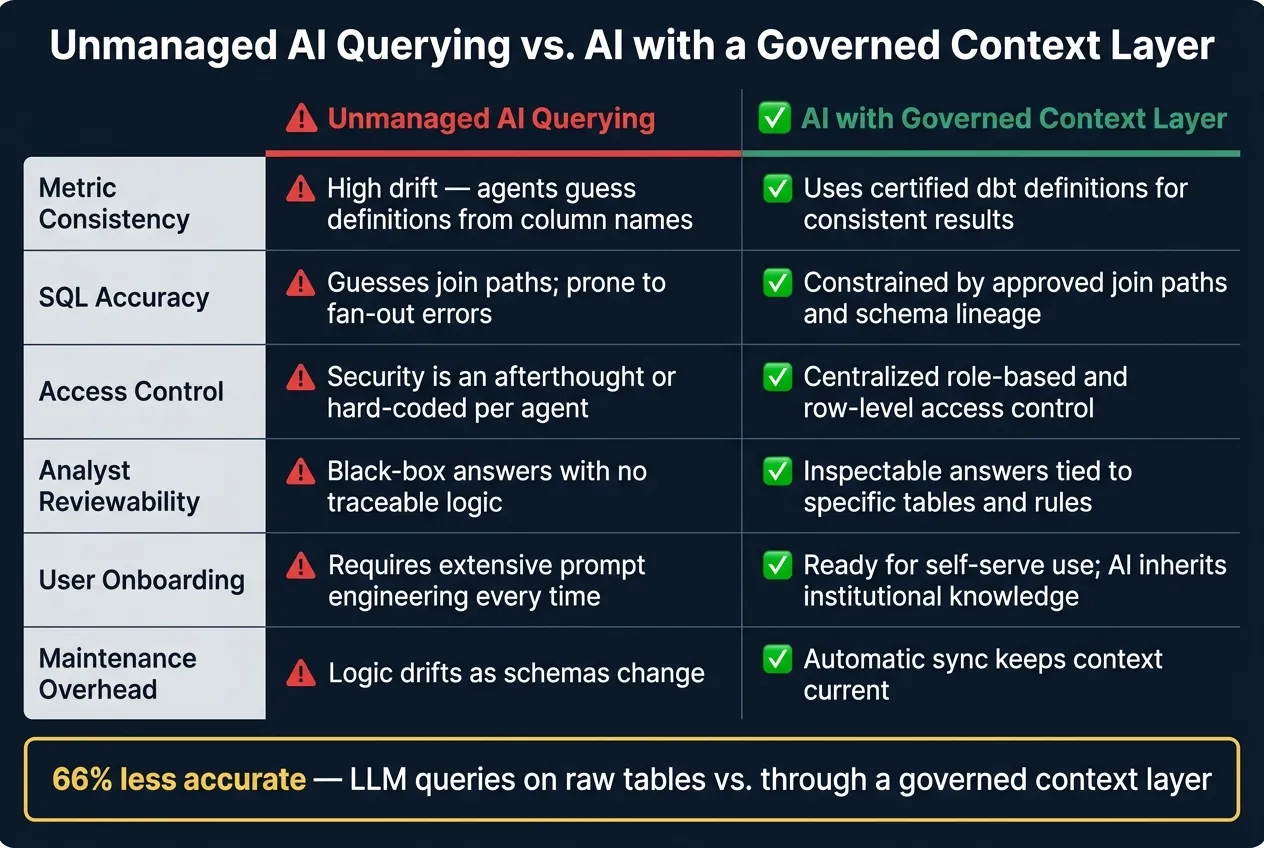 {Unmanaged AI Querying vs. AI with a Governed Context Layer}
:::
{Unmanaged AI Querying vs. AI with a Governed Context Layer}
:::
Without a governed context layer, AI can write valid SQL and still give you the wrong business answer. That's the core problem.
A governed context layer is built from semantic models, KPI definitions, lineage, and access rules. Together, those pieces cut down the AI BI mistakes that show up most often. In practice, they solve three problems that hit hardest in AI-driven BI.
### Fewer hallucinations, bad joins, and unsafe SQL queries
The most common AI failure isn't broken SQL. It's a believable answer that's wrong.
An AI working from a raw Snowflake or BigQuery schema might choose total_revenue instead of net_revenue because the name looks right. It might join an events table to an accounts table on a shared user ID and create fan-out, which inflates counts. It might also skip a business rule that exists only in someone's head, like filtering is_deleted = false.
A governed context layer fixes that by limiting the AI to approved tables, set join paths, and canonical metric formulas. In plain terms, the AI isn't guessing its way through the warehouse. It follows the tables, joins, and formulas your team has already approved.
Research supports this: LLM-generated queries are 66% less accurate when run against raw tables compared to running through a semantic or context layer [2].
Stopping metric drift across dashboards, notebooks, and AI answers
The next problem is harder to spot, but it can do just as much damage: different tools give different answers to the same question.
The sales team pulls one number from a Looker dashboard. The finance team runs the same metric in a Hex notebook. An AI assistant creates its own analysis. All three come back with different numbers because each one is using a different definition.
A governed context layer fixes that at the source. It defines "active user" once, in versioned SQL or dbt, and makes that definition the default across every tool. So when the business changes "active user" from a 7-day window to a 28-day window, the team updates it in one place and that change flows everywhere.
Faster self-serve without losing trust or control
Once people can trust the answers, speed starts to matter.
Lean data teams at 100–500-person SaaS companies get hit with the same questions again and again:
- What's our churn rate?
- Can you break it out by segment?
- Why does this number differ from the dashboard?
Every manual reply pulls time away from work that needs deeper analysis.
A governed context layer lets non-technical users - a VP of Sales, a product manager, a customer success lead - ask those questions in plain English and get answers they can trust, because the AI assistants are working inside enforced business context. Access rules stay tied to the definitions, so PII stays protected and sensitive financial data stays limited to the right roles.
The goal isn't to replace analysts. It's to get routine questions out of their queue without giving up control over access.
How a governed context layer works in practice with dbt, warehouses, and Querio
A practical setup for Snowflake, BigQuery, Redshift, or Postgres teams
Here’s what this looks like in a live warehouse setup.
Most mid-market B2B SaaS teams already have the core pieces in place: a warehouse, dbt, and defined metrics. The problem usually isn’t missing data. It’s that AI doesn’t automatically use the logic analysts have already set up.
A governed context layer fixes that gap without forcing the team to rebuild its analytics stack. dbt remains the source for metric logic. The context layer reads warehouse schemas, joins, and column types through read-only access, then maps that structure to business terms. So when an AI agent gets a question like, "What's our net revenue by segment this quarter?" it queries the warehouse through that governed layer. That means it uses approved join paths, the metric formula from dbt, and the access rules tied to the user’s role.
The part that matters day to day is automatic sync. When schemas change in Snowflake, BigQuery, Redshift, or Postgres, the context layer updates with them. In plain terms, the layer gives AI the business meaning behind the model, not just the model itself.
Don’t build a second definition layer just for AI. Sync approved dbt definitions into the context layer, then add business synonyms and default filters there so you keep one source of truth.
Unmanaged AI querying vs. AI with a governed context layer
This is where the difference becomes obvious in daily query quality.
| Feature | Unmanaged AI Querying | AI with Governed Context Layer |
|---|---|---|
| Metric consistency | High drift; agents guess definitions from column names | Uses certified dbt definitions for consistent results |
| SQL accuracy | Guesses join paths; prone to fan-out errors | Constrained by approved join paths and schema lineage |
| Access control | Security is an afterthought or hard-coded per agent | Centralized role-based and row-level access control |
| Analyst reviewability | Black-box answers with no traceable logic | Inspectable answers tied to specific tables and rules |
| User onboarding | Requires extensive prompt engineering every time | Ready for self-serve use; AI inherits institutional knowledge |
| Maintenance overhead | Logic drifts as schemas change | Automatic sync keeps context current |
Reviewability is a big deal. AI output needs to be traceable back to the tables, joins, and formulas behind it. That’s what makes AI analytics defensible inside a real company.
Where Querio adds value for governed self-serve analytics
For teams using Querio, the governed layer stays connected to the live warehouse and to the same business definitions used across the company.
Querio connects directly to Snowflake, BigQuery, Redshift, ClickHouse, and Postgres with encrypted, read-only credentials. There are no extracts, no data movement, and no stale copies. Data teams define joins, metrics, and business terminology once in the shared context layer, and that logic carries across ad hoc questions, reactive notebooks, dashboards, and AI-generated answers.
Every answer Querio generates includes inspectable, editable SQL and Python. There’s no black box. If an analyst wants to check the logic, extend it, or pass it into a notebook for deeper analysis, the code is already there. Querio lets teams keep governance on live warehouse data while giving users inspectable SQL and Python.
Conclusion: Key takeaways for data teams
AI can write SQL fast, but speed alone doesn’t make the output right. It still needs governed context. That’s the missing layer: schema, lineage, semantic models, metrics, and access rules working together so AI answers stay consistent and governed across Snowflake, BigQuery, Redshift, or Postgres.
In practice, start where inconsistency hurts the business most. For B2B SaaS data teams in the U.S., that’s usually the Revenue domain. Gartner predicts that over 40% of agentic AI projects will be canceled by 2027 because of inadequate risk controls [1]. Metrics like ARR, churn, and pipeline tend to get the most value from clear, approved definitions.
Once those definitions are synced into a governed context layer, AI-generated answers in notebooks and dashboards pull from one governed source of truth. That keeps them aligned with dashboard numbers across Snowflake, BigQuery, Redshift, or Postgres.
FAQs
::: faq
How is a governed context layer different from a semantic layer?
A governed context layer goes beyond a semantic layer.
A semantic layer tells you what a metric is and how to calculate it. A governed context layer adds the business and policy context AI needs to use that metric the right way.
That means it includes things like:
- ownership
- freshness
- access controls
- lineage
- business rules
So this layer doesn't just define what something means. It helps AI understand when, how, and whether to use it.
It also doesn't replace tools like dbt or Looker. Instead, it builds on top of them, using and enriching their definitions so AI stays aligned with trusted business logic and internal policies. :::
::: faq
What should we govern first for AI analytics?
Start with the business metrics that matter most: revenue, pipeline, churn, and customer health. These metrics usually carry a lot of definition baggage, come up all the time, and shape day-to-day decisions.
Begin with an inventory of what you already have in your data catalog. Then bring approved definitions from sources like dbt, LookML, or Snowflake into your context layer. Don't fork those definitions. Keep them as the source of truth, and add lineage, ownership, access policies, and documentation around them. :::
::: faq
How do you keep a context layer current as schemas change?
A governed context layer stays current by continuously syncing metadata from tools like Snowflake, BigQuery, or dbt instead of depending on manual updates.
When schemas or pipelines change, lineage shows which metrics, AI agents, and reports are affected. That gives data teams a clear way to catch drift and fix it before results start to slip.
The result is simple: the context layer stays in step with the warehouse as it changes. :::