Business Intelligence
modern BI tools with AI capabilities Splunk blog AtScale Querio analytics tools
Compare AI-powered BI platforms—Splunk, AtScale, Querio—covering AI features, data integration, governance, and real-time use cases.

Modern BI tools powered by AI are changing how businesses interact with data. Instead of waiting days for static reports, teams can now get answers in minutes using natural language queries. Key players in this space - Splunk, AtScale, and Querio - offer distinct solutions tailored to different needs:
- Splunk: Focuses on IT and security, using AI to monitor systems, detect threats, and troubleshoot efficiently.
- AtScale: Provides a semantic layer for consistent business metrics, ensuring accurate and governed analytics across platforms.
- Querio: Translates natural language into SQL/Python for live, transparent insights directly from data warehouses.
Each platform excels in specific areas: Splunk for operational monitoring, AtScale for enterprise data governance, and Querio for real-time, user-friendly analytics. Below, we delve into their unique features, use cases, and strengths to help you choose the right tool for your needs.
::: @figure 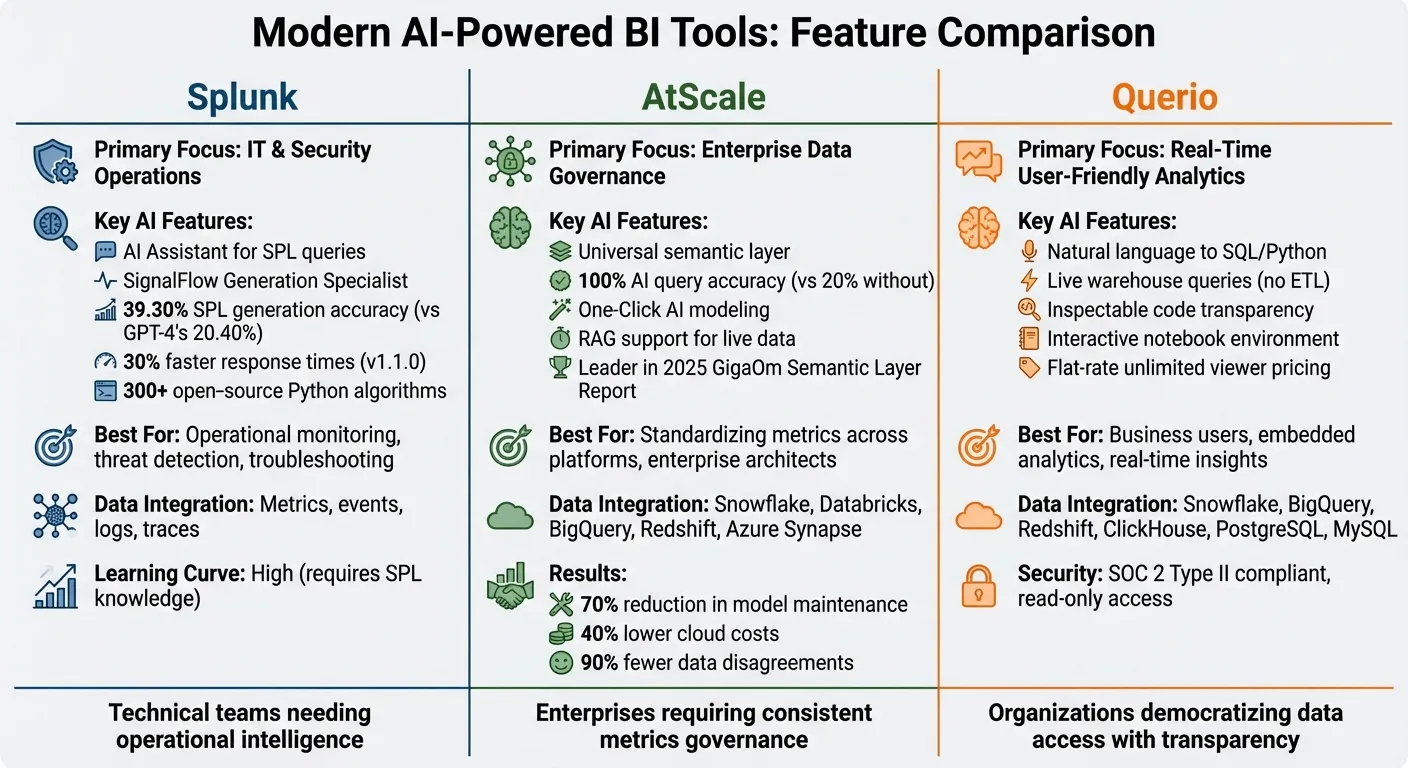 {Splunk vs AtScale vs Querio: AI-Powered BI Tools Comparison}
:::
{Splunk vs AtScale vs Querio: AI-Powered BI Tools Comparison}
:::
1. Splunk
AI Capabilities
Splunk's AI focuses on operational intelligence, helping businesses monitor IT systems, detect security threats, and troubleshoot issues before they impact users. It achieves this by employing specialized tools tailored to various workflows.
Key innovations include the AI Assistant for SPL and the SignalFlow Generation Specialist, which translate natural language into optimized SPL queries and SignalFlow programs. These tools leverage metadata specific to the user's environment, such as index and field names, as well as prior searches, to enhance performance. With version 1.1.0, response generation times improved by 30% [2]. Splunk's system also demonstrated a 39.30% accuracy rate for SPL generation, significantly outperforming GPT-4 Turbo's 20.40% [6].
In the Observability Cloud, Splunk employs an Agent Framework to chain tools for root cause analysis across metrics, events, logs, and traces. This hybrid approach combines different LLMs for various tasks, balancing quality, speed, and cost [4].
The Splunk AI Toolkit (previously known as MLTK) allows users to build custom models for tasks like outlier detection, predictive analytics, and clustering. It supports over 300 open-source Python algorithms and integrates with TensorFlow and Apache Spark to handle large-scale machine learning workloads [3].
These capabilities are tightly woven into Splunk's data management system, ensuring a seamless experience for users.
Data Integration
Splunk's robust AI features are complemented by its ability to consolidate metrics, events, logs, and more. An orchestration agent interprets user intent and manages microservices workflows. The Model Context Protocol (MCP) Server securely connects external AI tools to Splunk Cloud in real time, ensuring smooth operations [4][5].
Governance and Security
Splunk prioritizes data integrity and user-specific access through a strong governance framework. It offers flexibility in model usage: organizations can choose between Splunk-hosted models, third-party models, or a combination of both. For those concerned about data privacy, Splunk provides an option to restrict AI requests to Splunk-hosted models, ensuring data remains within its ecosystem [7].
The AI Assistant respects existing Role-Based Access Control (RBAC) settings, delivering personalized responses based only on data the user is authorized to access [2]. Additionally, organizations can opt out of having their prompts and logs used for model training (except during alpha or private preview phases) [7]. Security measures such as threat modeling, system monitoring, and third-party compliance testing further protect Splunk's AI systems from cyber threats.
Use Cases and Applications
Splunk's AI capabilities have been applied in various industries to solve real-world challenges:
-
Hyatt: Cesar Mendoza, Application Development Manager at Hyatt, used Splunk Enterprise's machine learning to predict customer service needs and reduce Mean Time to Recovery (MTTR). According to him:
"Hyatt uses machine learning in Splunk Enterprise to predict when and where we should act fast or plan differently to best serve our customers" [3].
-
TransUnion: Steve Koelpin, Lead Splunk Developer, implemented machine learning to monitor customer volume patterns. The system generates alerts when traffic deviates from expected ranges, allowing early intervention:
"Understanding customer volume patterns is important for the business. If traffic falls outside of a certain range, an alert is created. Splunk machine learning allows us to investigate early to ensure a seamless customer experience" [5].
-
New York State: Splunk AI was employed to detect and prevent benefits fraud by identifying unusual patterns in claims data, helping safeguard public funds from fraudulent activity [5].
sbb-itb-284a532
2. AtScale
AI Capabilities
AtScale offers a universal semantic layer designed to standardize business metrics and relationships, ensuring analytics remain consistent across BI platforms and AI tools. One standout feature is its MCP Server, which enhances language models by grounding them in semantic-rich metadata. This allows for precise, rule-based query generation. Dave Mariani, CTO at AtScale, highlights this capability:
"AtScale can enrich LLMs with deep metadata, query history, and semantic context that spans every BI tool and user across the business. That's how you build AI agents that act with intelligence and trust" [1].
The platform significantly improves AI query accuracy, achieving 100% accuracy compared to just 20% without its assistance [8]. Dr. Prashanth Southekal from DBP Institute underscores the importance of this consistency:
"If your AI agent can't define 'customer' the same way your business does, it's not intelligent - it's dangerous" [8].
AtScale also introduces AI-driven "One-Click Modeling", which accelerates the identification of metrics, relationships, and hierarchies, ensuring rapid semantic model creation while maintaining governance. Its support for Retrieval-Augmented Generation (RAG) allows language models to access live enterprise data through the semantic layer, grounding AI responses in accurate and governed data. Additionally, its autonomous data engineering capabilities create semantic aggregates for sub-second query performance, even on datasets containing hundreds of billions of rows. Recognized as a Leader and Fast Mover in the 2025 GigaOm Semantic Layer Radar Report, AtScale is celebrated for its performance and cost optimization [9].
Data Integration
AtScale pairs its AI capabilities with seamless integration into major cloud data platforms like Snowflake, Databricks, Google BigQuery, Amazon Redshift, and Azure Synapse. By directly querying live warehouse data, it removes the need for data movement and duplication. The platform supports a variety of industry-standard protocols, including SQL, MDX, DAX, Python, and REST, ensuring compatibility with a wide range of BI tools and AI frameworks. It also supports the Postgres wire protocol, enabling easy integration with tools like Superset, ThoughtSpot, and Sigma.
Organizations using AtScale have reported impressive outcomes, such as a 70% reduction in model maintenance, three- to fivefold improvements in query performance, and a 40% drop in cloud compute costs. Additionally, it has helped reduce data disagreements in executive meetings by 90% and eliminated inefficient full-table scans [10].
Governance and Security
AtScale places a strong emphasis on governance and security, ensuring data policies are consistently applied across all connected BI tools. Its role-based access control (RBAC) and row- and column-level security provide fine-grained control over data access. Rick Ramaker, BI and Analytics Manager at The Home Depot, highlights its impact:
"The semantic layer made self‑service safe. It gave business users autonomy while protecting the integrity of our data" [1].
The platform uses a Semantic Modeling Language (SML), allowing business logic to be managed as version-controlled, reusable code. This approach fosters collaboration and auditing across teams. AtScale's Model Context Protocol ensures AI-generated insights comply with the same rules as traditional BI systems. Full audit trails of data usage and queries support regulatory compliance, while query virtualization keeps data securely in its source warehouse, reducing the risk of data breaches.
Use Cases and Applications
AtScale has proven its value in practical applications. For instance, a global home improvement retailer reduced reconciliation time by 70% by standardizing revenue and margin definitions through its semantic layer for SaaS. This eliminated inconsistencies that had previously hindered executive decision-making. Likewise, TELUS has successfully scaled its analytics operations across multiple use cases. Adam Walker, Senior Design Specialist at TELUS, shares:
"Our semantic layer lets us scale up analytics with each new use case we add. That makes our teams more effective and creates a better experience for our customers" [1].
AtScale's consumption-based pricing model, which charges based on compute and queries rather than per-user licensing, allows organizations to align costs with actual usage - making it easier to scale analytics operations efficiently.
3. Querio
AI Capabilities
Querio focuses on delivering clear and reliable insights by turning natural language queries into precise SQL and Python code. It works directly with live data from your warehouse, ensuring that all queries align with business logic defined in a centralized context layer. This approach guarantees consistent calculations for critical metrics like customer lifetime value or monthly recurring revenue across dashboards, reports, and embedded analytics. Plus, every result comes with inspectable code, allowing teams to review and tweak it as needed. By grounding answers in real-time data rather than estimates, Querio ensures accuracy and transparency.
The platform also offers an interactive notebook environment where analysts and data scientists can refine the generated code on the fly. As definitions change, these notebooks automatically adjust, saving teams from manual updates. This seamless process highlights Querio's commitment to clarity and efficiency.
Data Integration
Querio integrates seamlessly with warehouse-native data analysis tools for Snowflake, Google BigQuery, Amazon Redshift, ClickHouse, and Motherduck. It also supports relational databases such as PostgreSQL, MySQL, MariaDB, and Microsoft SQL Server. Using encrypted, read-only access, Querio keeps your data secure within your warehouse, eliminating the need for ETL processes or data duplication.
By querying live data in real time, Querio ensures your analytics reflect the most current state of your business. Whether you're tracking today's sales, analyzing customer behavior, or reviewing historical trends, the platform provides accurate insights without relying on scheduled data refreshes.
Governance and Security
Querio's transparent analytics framework is backed by strong data governance features. A shared context layer acts as the single source of truth for joins, metrics, and business terms. This ensures consistency across all analytics workflows, with logic that can be defined, versioned, and applied automatically.
The platform is SOC 2 Type II compliant and includes role-based access controls and standard SSO integrations. Since Querio reads data directly from your warehouse without storing it, security risks are significantly reduced. This governance-driven approach allows non-technical teams to access reliable analytics without compromising accuracy or security.
Use Cases and Applications
Querio aligns with modern business intelligence needs, offering real-time insights while maintaining centralized control over business logic. It has no per-seat pricing and includes unlimited viewers on every plan, which makes scaling analytics access across an organization both simple and cost-effective. Teams can share dashboards, reports, and embedded analytics tools widely.
For companies needing embedded analytics, Querio supports integration through APIs and iframes. This allows businesses to embed analytics directly into their customer-facing applications without rebuilding data pipelines or managing separate infrastructures. For organizations leveraging modern data warehouses and expanding their self-service analytics capabilities, Querio provides a way to democratize data access while keeping business logic centralized and consistent.
Strengths and Weaknesses
This section takes a closer look at the standout features and potential drawbacks of each platform, offering insights into how well they align with today’s business intelligence (BI) demands.
Splunk is a standout for IT and security teams, thanks to its focus on operational intelligence. Its AI Toolkit includes top AI features like anomaly detection, forecasting, and clustering, which are particularly useful for monitoring and troubleshooting. However, the platform relies heavily on SPL (Search Processing Language), which can be a hurdle for teams unfamiliar with it. This learning curve, combined with its specialized focus, makes Splunk more suited for operational monitoring than for broader business analytics.
AtScale shines with its ability to create a unified semantic layer through its Cubes feature. This ensures consistent business logic across multiple data sources without the need to move data physically. Its virtualized approach is a great fit for managing complex data ecosystems, particularly for enterprise architects. AtScale also offers tools like Composer, which simplify column manipulations and basic transformations. That said, the platform requires a more technical setup and is geared toward data architects and engineers rather than casual, non-technical users.
On the other hand, Querio prioritizes simplicity and transparency. It translates natural language queries into SQL and Python code, ensuring that results are always directly tied to live warehouse data - no ETL processes required. This warehouse-native design delivers quick and transparent analytics, making it a go-to for modern data needs. Its flexible pricing model accommodates businesses of all sizes, offering a cost-effective way to bring advanced analytics to both analysts and business users.
Querio's intuitive design and focus on real-time, actionable insights set it apart. Its ability to simplify analytics while maintaining transparency makes it a strong choice for organizations looking to empower teams with fast, reliable data-driven decisions.
Conclusion
Querio takes modern business intelligence to the next level by making analytics more accessible and transparent, thanks to its real-time insights and straightforward workflows.
Transparency and accessibility are at the core of Querio's design. Its natural language interface translates user questions into inspectable SQL and Python code, pulling data directly from live warehouses without the need for ETL processes. This warehouse-native approach ensures quick responses while offering complete visibility into how results are generated.
With a free plan, no per-seat pricing, unlimited viewers on every plan and spending caps on AI credits, Querio provides an affordable and scalable solution for organizations aiming to extend analytics access to more business users without driving up costs.
For teams leveraging data warehouses like Snowflake, BigQuery, or Redshift, Querio strikes the right balance between ease of use, transparency, and governance. It empowers analysts and business users alike to access trustworthy, real-time insights while maintaining control and consistency. If your goal is to make analytics widely available while keeping your data reliable, Querio offers a practical, AI-powered solution to meet the demands of today's fast-paced decision-making.
FAQs
::: faq
How do I choose the right AI BI tool for my team?
When selecting an AI-powered BI tool, focus on key features such as transparency, scalability, ease of use, and compatibility with your existing data systems. For example, tools like Querio stand out for their natural language querying, real-time data access, and robust governance features. If your team includes members without technical expertise, Querio’s intuitive interface makes it a great choice. Be sure to pick a platform that matches your team’s size, the complexity of your data, and your budget to ensure it meets your needs over the long term. :::
::: faq
How does natural language querying stay accurate and governed?
Natural language querying ensures accuracy and governance by incorporating several key elements:
- Semantic layers: These act as a bridge between users and complex databases, translating natural language into precise queries.
- Well-defined business glossaries: These provide a standardized vocabulary, reducing ambiguity and ensuring everyone speaks the same "data language."
- Structured metadata: This organizes and describes data effectively, supporting consistent and reliable results.
- Secure access controls: These safeguards ensure that sensitive information remains protected, granting access only to authorized users.
Together, these components create a system that prioritizes consistency, precision, and strong data security at every step. :::
::: faq
Will these tools query live warehouse data or copy it?
These tools connect directly to live data warehouses, providing real-time insights without requiring data duplication or replication. This method keeps analytics current and avoids the hassle of managing redundant datasets. :::