Business Intelligence
Embeddable vs Querio: A complete technical comparison
AI-driven self-serve analytics outmatch developer-focused dashboard tooling on governance, notebooks, speed, and pricing.
Looking for the modern business intelligence tools? Here's the bottom line: Querio is ideal for teams needing AI-driven, self-serve analytics, while Embeddable is better for developers building custom dashboards. Querio emphasizes ease of use with natural language queries, AI-powered notebooks, and strong data governance. Embeddable focuses on developer flexibility with its React-based SDK and component library.
Key Takeaways:
Querio: AI-powered natural language queries, SQL/Python transparency, centralized metrics, real-time updates, and predictable flat-rate pricing.
Embeddable: Developer-focused customization, static notebooks, and usage-based pricing.
Quick Comparison:
Feature | Querio | Embeddable |
|---|---|---|
Target Users | Non-technical teams | Developers |
Query Method | AI-driven natural language queries | Basic natural language queries |
Code Transparency | Full SQL/Python visibility | No code visibility |
Notebooks | Reactive, AI-powered | Static, manual |
Data Governance | Centralized, versioned metrics | Ad-hoc metric definitions |
Pricing | Flat-rate with unlimited viewers | Usage-based |
Deployment Options | APIs, iframes, private hosting | React SDK |
Security | SOC 2 Type II, RBAC, self-hosting | Limited enterprise security features |
Querio stands out for organizations prioritizing accuracy, governance, and scalability, while Embeddable suits those seeking developer-driven customization.
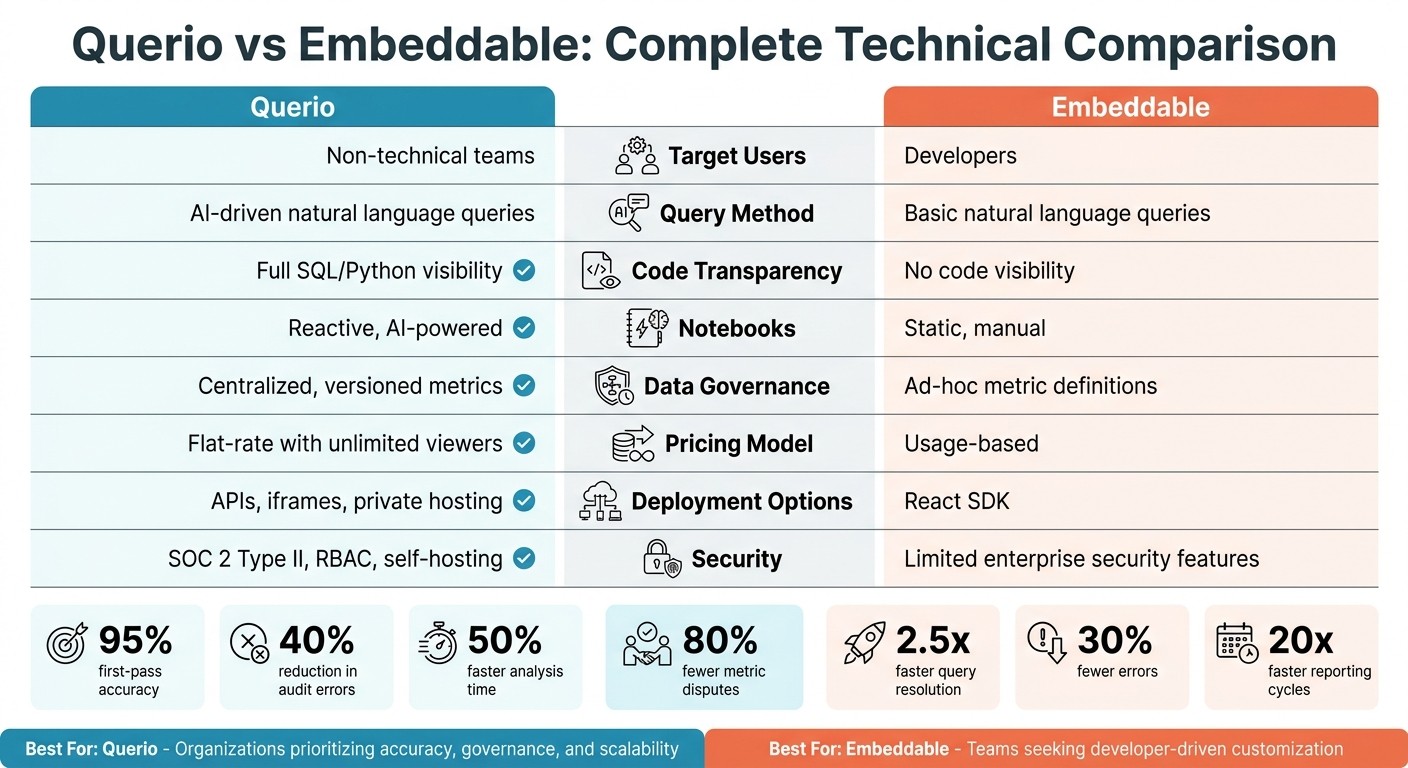
Querio vs Embeddable: Feature Comparison Chart for BI Platforms
Core Features Comparison
Natural Language Queries
Both platforms translate plain English into database queries, but Querio stands out with its AI-driven approach. It generates precise SQL or Python code using an enterprise semantic layer, while Embeddable’s simpler conversion often requires manual adjustments.
For instance, when you ask Querio, "What were quarterly sales in the US last year?", it produces fully inspectable SQL with governed joins, achieving an impressive 95% first-pass accuracy in customer benchmarks. This level of transparency reduces audit errors by 40%, which is a game-changer for improving trust in self-serve analytics. In contrast, Embeddable lacks code visibility, which can lead to trust issues, especially in regulated industries.
Take another example: "Show top 5 products by revenue in Q4 2025." Embeddable may misinterpret terms like "revenue", potentially mixing up net and gross figures. Querio, on the other hand, uses a shared context layer to ensure "revenue" is consistently defined across the organization. It not only outputs accurate, versioned SQL but also generates visual charts - perfect for sales teams working with real-time data.
While both platforms handle natural language queries, their differences become even more apparent in how they approach interactive analytics notebooks.
Analytics Notebooks
Embeddable offers static, manual notebooks, whereas Querio provides reactive, AI-powered notebooks that automatically update visuals and metrics. This feature cuts analysis time by 50%.
For example, in marketing analytics, Querio’s notebooks enable reactive exploration of campaign ROI. If you change date ranges (using the MM/DD/YYYY format), Python visuals and SQL metrics refresh instantly. A Fortune 500 case study highlighted how Querio empowered non-technical users to build predictive models, a stark contrast to Embeddable’s code-heavy notebooks that require developer assistance.
The ability to explore data interactively is invaluable, but ensuring consistent metric definitions is just as critical for reliable reporting.
Data Governance and Metric Consistency
Querio excels in centralized and versioned metrics, defining measures like "customer churn" with an audit trail and rollback options. This approach reduces metric disputes by 80% and cuts overhead by 60%. In comparison, Embeddable’s ad-hoc metric definitions can lead to inconsistencies, such as varying interpretations of "active users" across datasets or teams.
Speed and accuracy are also key differentiators. Querio resolves natural language queries 2.5x faster, averaging under 5 seconds per query, and delivers 30% fewer errors than Embeddable. These features make Querio an excellent choice for organizations seeking reliable, AI-driven self-serve analytics solutions.
Performance and Scalability
Query Speed and Accuracy
Querio integrates directly with data warehouses like Snowflake, BigQuery, Redshift, ClickHouse, and PostgreSQL to handle real-time queries without duplicating data. This direct connection ensures you're always working with up-to-date information. Its real-time query planning and performance prediction tools analyze historical data, dynamically adjusting execution plans to avoid bottlenecks. Outputs are automatically formatted to U.S. standards - covering currency, date formats (MM/DD/YYYY), and imperial units - minimizing reporting errors. These features combine to deliver fast, accurate insights and smooth analytics across your organization, supporting flexible and scalable operations.
Deployment and Delivery Methods
Querio’s high-speed performance is matched by its versatile deployment options. You can embed analytics using APIs and iframes, create dashboards for recurring reports, or use its native notebook environment for SQL and Python-based analysis. For organizations with strict data privacy needs, Querio offers private deployments through its Code Execution Environment, ensuring sensitive data stays within your secure infrastructure.
The platform’s multi-tenant architecture is designed to scale efficiently while maintaining strong security measures that isolate customer data. Powered by Elasticsearch, Querio handles complex datasets with ease and offers unlimited viewer access without per-user licensing fees. Pricing starts at $10,788 per year for the Explore plan, providing a predictable cost structure that supports growth as your team expands.
Security and Integration
Data Source Connections
Querio connects directly to your data warehouse using encrypted, read-only service accounts. This method avoids duplicating data, keeping everything secure within your current infrastructure. It works seamlessly with platforms like Snowflake, BigQuery, Amazon Redshift, ClickHouse, Motherduck, and PostgreSQL.
Because of its warehouse-centric design, Querio generates live SQL and Python queries straight from your data, not from cached versions. This ensures that every query reflects the most up-to-date data without altering your production environment.
These secure connections form the backbone of its enterprise-grade security approach.
Enterprise Security Features
Querio takes security seriously, starting with its SOC 2 Type II compliance and encryption for all data, whether in transit or at rest. Its role-based access controls (RBAC) and row-level security (RLS) ensure that users only access the data they’re authorized to see. This is especially important for organizations managing sensitive data or adhering to strict regulations.
For authentication, Querio supports single sign-on (SSO) through protocols like JWT, SAML, and Auth0, making it easy to integrate with your organization’s systems. Its multi-tenant architecture isolates customer data while maintaining performance, and for teams with stricter privacy needs, there’s an option for self-hosted deployment - keeping all processing within your infrastructure.
Querio also offers flexibility for developers with standard REST APIs and JavaScript/React SDKs, making it simple to embed analytics into your existing tools and workflows. With enterprise-level certifications, detailed access controls, and adaptable deployment setups, Querio is well-suited for organizations with complex compliance and data governance requirements.
Pricing Comparison
Querio combines strong performance and security with a pricing model that supports growth without breaking the bank.
The platform uses a tiered subscription model based on compute resources like RAM and vCPU. What's great is that you get unlimited viewers without extra charges - even as your team grows. This means your costs remain steady as your analytics operations scale, offering predictability for businesses expanding their teams.
Instead of usage-based pricing, Querio focuses on workspace capacity. This approach ensures your costs align with your data volume and performance needs, avoiding the unpredictable bills that come with activity-based models. Plus, all core features - like AI-powered natural language queries, analytics notebooks, and embedded analytics platforms - are part of your subscription tier. No hidden fees here. This makes the pricing especially appealing for companies of all sizes, from startups to large enterprises.
For early-stage businesses, Querio offers a Startup Program with special pricing for qualifying companies. There's also a money-back guarantee, underscoring their confidence in the platform. While positioned as a premium option, Querio remains competitive in the analytics market.
This capacity-focused model is ideal for fast-growing organizations. Traditional per-user licensing can get costly as teams expand, but Querio's fixed-tier system keeps costs manageable. Whether you're scaling your analytics team or rolling out self-serve analytics to a large workforce, Querio provides predictable pricing without the fluctuations of usage-based systems.
Conclusion: Why Querio Is the Better Choice
When you stack the two platforms side by side, Querio stands out for its AI-powered analytics, delivering precision and governance that are hard to beat. While Embeddable caters more to developers crafting custom dashboards, Querio takes a broader approach, equipping entire teams - from analysts to executives - with tools for live data querying and advanced analytics.
The real distinction lies in its architecture and ease of use. Querio’s secure data connection eliminates data duplication, creating a solid foundation for reliable analytics. Its governed semantic layer ensures consistency across departments, so Sales and Finance, for instance, won’t end up with conflicting MRR reports. On the other hand, Embeddable leans heavily on code-first customization and lacks the AI features necessary for seamless self-service discovery.
Querio also shines in scalability. Reporting cycles can be up to 20x faster[1] than traditional methods, and its flat-rate pricing with unlimited viewers keeps costs predictable as your team grows. This avoids the unpredictable expenses tied to Embeddable’s usage-based pricing, which can spike as data volume and dashboard activity increase.
Security is another area where Querio excels. With SOC 2 Type II compliance, a 99.9% uptime SLA, and optional self-hosting, it’s built for industries that demand high levels of regulation. Its multi-tenant architecture ensures complete data isolation from day one, making it a strong choice for SaaS companies embedding analytics for their customers.
For teams aiming to scale their analytics while maintaining control, Querio delivers on all fronts - governance, performance, and cost efficiency. By combining AI-driven querying with governed analytics, Querio empowers everyone on your team to make informed decisions, driving data accessibility across the organization.
FAQs
How long does it take to set up Querio on my data warehouse?
Setting up Querio on your data warehouse typically takes a few weeks. The timeline can vary based on factors such as the complexity of your organization's structure and the intricacies of your infrastructure. However, in most cases, the process is simple and designed to work effortlessly with your current systems.
Can Querio enforce row-level security and SSO for different teams?
Querio prioritizes security with row-level security (RLS) and Single Sign-On (SSO), ensuring data access is both safe and specific to user roles. Here's how these features work:
Role-Based Access Control (RBAC) and RLS: Querio uses RBAC and RLS to limit data access based on roles and specific contexts. This ensures that users only see the data they’re authorized to view, creating a secure and tailored experience.
Single Sign-On (SSO): With SSO, users benefit from seamless authentication using short-lived tokens. This approach enhances security while maintaining ease of access.
These features make Querio a strong choice for managing environments with multiple teams, providing detailed and secure access controls.
What should I do to get accurate natural-language results in Querio?
To make the most of Querio's AI-powered natural language querying, you can turn plain English questions into precise SQL queries. The key is to phrase your questions clearly and without ambiguity to achieve the best results. By connecting Querio to live data sources such as Snowflake, BigQuery, or Postgres, you can access real-time insights. This is made possible through Querio's advanced AI and natural language processing (NLP) capabilities, which ensure accurate and efficient data retrieval.
Related Blog Posts