Business Intelligence
The Complete Guide to White-Label BI
Deliver fully branded embedded analytics quickly: white-label BI reduces cost and time, provides multi-tenant security, and scales for SaaS and regulated industries.

White-label BI lets businesses offer analytics, dashboards, and reporting under their own branding - without building a platform from scratch. It integrates seamlessly into existing workflows, delivering a native experience for users. Here's why it matters:
- Cost & Time Savings: Building BI in-house can cost $2M+ and take 18–24 months. White-label BI is ready in 2–4 weeks at 80% lower costs.
- Improved User Retention: Embedded analytics boost SaaS retention by 23% and support premium pricing by up to 20%.
- Customization: Fully rebrandable with your logo, colors, and domain (e.g., analytics.yourcompany.com).
- Security: Features like Row-Level Security (RLS), SSO, and encryption ensure data safety and regulatory compliance.
- Scalability: Supports multi-tenant embedded analytics architecture, allowing thousands of users to securely access data from a single instance.
Key Benefits:
- Faster deployment compared to in-house development.
- Enhanced user experience through integration into existing systems.
- Reduced maintenance and predictable costs.
- Supports compliance for industries like healthcare, fintech, and government.
White-label BI is a practical solution for SaaS companies, e-commerce platforms, and industries with strict data governance needs. It helps businesses deliver analytics efficiently while maintaining their brand identity.
::: @figure 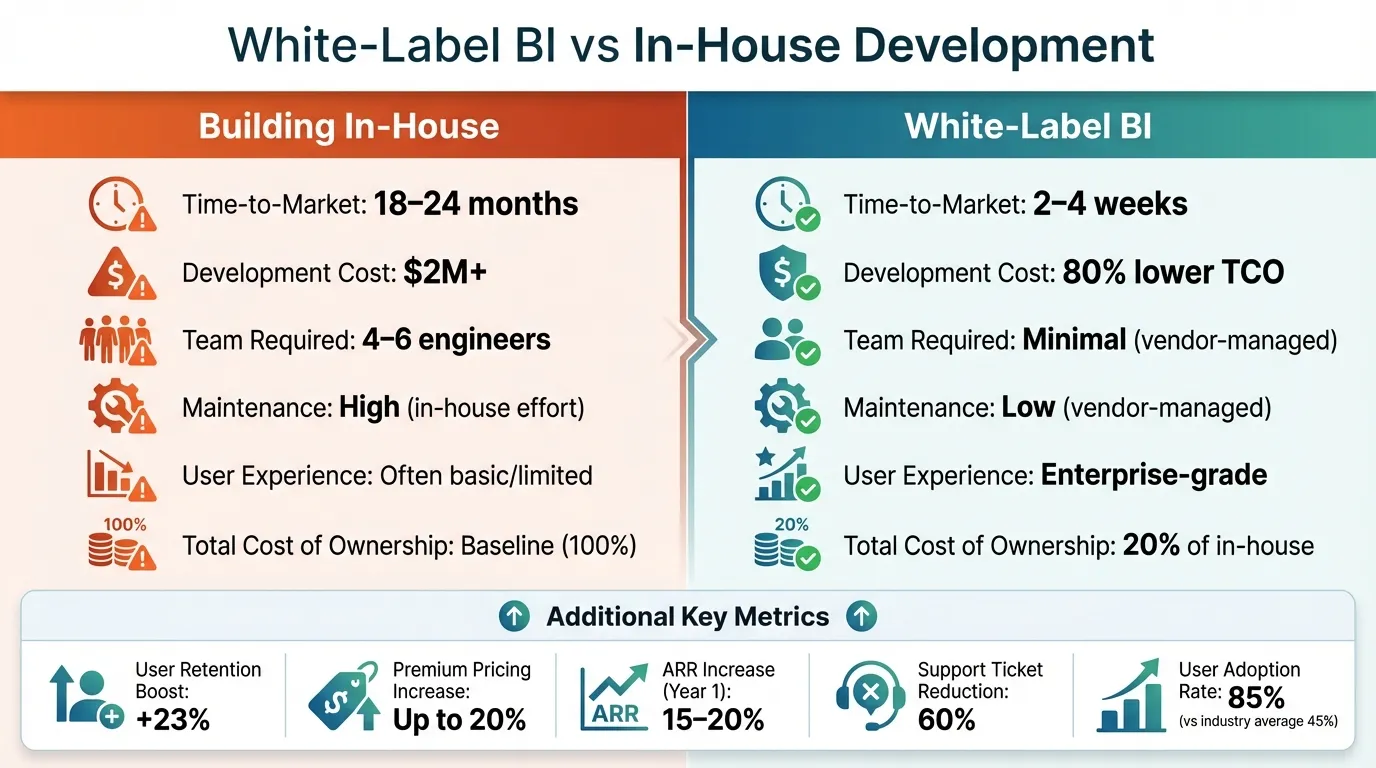 {White-Label BI vs In-House Development: Cost, Time, and Performance Comparison}
:::
{White-Label BI vs In-House Development: Cost, Time, and Performance Comparison}
:::
Reporting Hub - White Label Power BI Delivery Platform
::: @iframe https://www.youtube.com/embed/BJa7sGA6fko :::
Core Features and Technical Capabilities
White-label BI tools need to seamlessly connect to your data, align with your brand, and ensure top-notch security. To deliver a truly integrated analytics experience, these platforms must combine robust functionality with efficiency. Here's how advanced solutions stand apart from basic embedded analytics.
Data Integration and Connectivity
At the heart of any white-label BI platform lies its ability to connect to your data effectively. Modern tools offer live, read-only connections to popular data warehouses like Snowflake, BigQuery, and Postgres. This approach eliminates the need for data duplication, complex ETL processes, and outdated reports.
Support for NoSQL databases such as MongoDB and Elasticsearch allows these platforms to merge SQL, NoSQL, and API data without requiring intricate pipelines. This capability is crucial for applications where customer data is scattered across various systems.
Additionally, multi-tenancy architecture ensures that each customer has access only to their own data. This isolation safeguards sensitive information, even if queries are manipulated, creating a secure and tailored analytics environment.
Customization and Branding Options
Data connectivity is just the beginning. A true white-label BI solution offers complete control over the platform's visual and functional elements. It’s not just about adding a logo - it’s about creating an experience that feels entirely your own.
With customizable design options, you can adjust everything from color schemes and typography to themes and even custom CSS for precise styling. Advanced platforms take it further, enabling you to tailor dashboards, menus, login pages, and mobile interfaces.
Using custom domains like analytics.yourbrand.com instead of vendor-branded URLs enhances your brand’s credibility. For SaaS providers, multi-tenant branding ensures that each client can have their own logos and themes, all within a single platform instance.
Even smaller details, like system emails and error messages, should reflect your brand. As Szymon from Simple BI puts it, "Every security prompt, every error message, every access denial must reinforce the partner brand."
Security and Governance
Once your data is connected and your branding is in place, ensuring robust security and governance becomes the top priority. White-label BI platforms employ multiple layers of protection to keep analytics secure and compliant.
Start with granular access controls. With Row-Level Security (RLS), you can restrict which data rows users can view based on their role or attributes. Object-Level Security (OLS) goes a step further, controlling access to entire dashboards or reports. This is especially critical in multi-tenant environments, where customers must only see their own data.
Authentication protocols like SSO, SAML, OAuth, and multi-factor authentication (MFA) ensure seamless and secure user access. Data encryption is also essential - both in transit (using TLS 1.2+) and at rest (via AES-256). For enterprise customers, "Bring Your Own Key" (BYOK) options allow them to manage their encryption keys independently.
To meet compliance standards like GDPR, HIPAA, or SOC 2, audit logs and activity tracking are indispensable. These features provide visibility into who accessed what data and when, helping you maintain accountability and meet regulatory requirements.
| Security Feature | Function | Priority Level |
|---|---|---|
| Multi-Tenancy | Isolates data between different customers | Critical |
| Row-Level Security (RLS) | Restricts data rows based on user roles | High |
| SSO / SAML | Enables secure, seamless authentication | High |
| Audit Logs | Tracks user activity for compliance | High |
| BYOK Encryption | Lets customers manage their own encryption keys | Medium (Enterprise) |
Key Benefits of White-Label BI
Faster Time-to-Market
Building analytics from scratch can drain resources, time, and energy. With white-label BI solutions, however, you can get up and running in just 2–4 weeks - a game-changer for companies looking to gain an edge. SaaS businesses that integrate embedded analytics often see higher customer retention and can even charge premium prices. Todd Penny, Founder and CEO of GoCodes, shares his experience:
"We opted for a white-label solution after being impressed by the flexibility, ease of use, low cost, and straightforward integration capabilities... Today, our customers love it just as much." – Todd Penny, Founder and CEO, GoCodes
These platforms come packed with enterprise-level features like AI-driven natural language querying, predictive modeling, and automated compliance certifications (SOC 2, HIPAA, GDPR). Developing these capabilities internally could take years. By opting for a white-label solution, you not only fast-track your market entry but also create a seamless experience for your users.
Better User Experience and Adoption
A quick setup is just one part of the equation. White-label BI solutions also excel at making analytics easy to use. Unlike standalone tools that often require users to navigate unfamiliar interfaces, white-label BI integrates directly into your product. This means users can access insights without switching platforms or learning a new system. The result? A smoother experience that feels like a natural extension of your brand.
Modern white-label platforms also include user-friendly, no-code interfaces. These allow even non-technical users to create reports or ask questions in plain English. This self-service functionality not only empowers users but also lightens the load on your support teams.
Cost Savings and Scalability
Developing analytics in-house comes with hefty costs. White-label BI eliminates much of this expense, offering predictable pricing and scalable solutions. In fact, these platforms typically reduce total costs by 80% compared to internal development, while also removing the headaches of maintenance and infrastructure upgrades.
Scalability is another major perk. Many white-label providers offer flat-fee or server-based licensing, so your costs remain steady - even as your user base grows by the thousands. For SaaS companies, embedding analytics can lead to a 15–20% increase in Annual Recurring Revenue (ARR) within the first year.
| Aspect | Building In-House | White-Label BI |
|---|---|---|
| Time-to-Market | 18–24 months | 2–4 weeks |
| Development Cost | $2M+ | 80% lower TCO |
| Maintenance | High (in-house effort) | Low (vendor-managed) |
| User Experience | Often basic/limited | Enterprise-grade |
sbb-itb-284a532
Implementation Considerations and Best Practices
Evaluating Business Needs and Goals
Start by conducting a build-versus-buy analysis. Building an in-house solution typically requires a team of 4–6 engineers, at least 18 months of development time, and a budget exceeding $2 million. On the other hand, white-label solutions can be up and running in just 2–4 weeks. Decide how analytics will fit into your business model: Will it be a core feature, an add-on for premium users, or a tool to improve customer retention? Assess the potential impact on both revenue and user retention for your specific scenario.
Identify all necessary data sources, including SQL, NoSQL, and APIs, and choose a platform that supports them natively to avoid the hassle of setting up complex ETL pipelines. During implementation, check the depth of white-labeling options - can you create branded subdomains (e.g., analytics.yourcompany.com) and customize the CSS fully? Make sure no vendor logos appear in error messages or login screens.
Start small with a minimum viable product (MVP) approach. Launch with 5–7 essential dashboards to avoid overwhelming users and refine the solution based on their feedback. Prioritize seamless integration with your existing systems to deliver a consistent user experience.
Integration with Existing Systems
The first step in technical integration is selecting the right architectural model. If your analytics need to be deeply embedded into your application workflows, opt for component-level embedding using REST APIs and JavaScript SDKs. For quicker deployment with less customization, brand-adapted portals are a viable alternative.
Ensure the platform supports single sign-on (SSO) using SAML or OAuth protocols, so users can stay within your ecosystem without additional logins. Multi-tenant governance is another key consideration - each client should have a dedicated environment or semantic model to prevent data from mixing between accounts.
Set up system notifications, automated emails, and alerts to come from your domain, not the vendor's. Even error messages should direct users to your support team, maintaining a seamless brand experience.
"Your white-label BI best practices start with a simple principle: every touchpoint must feel native to your partner's ecosystem."
- Szymon, SimpleBI
For consistent and scalable deployment, tools like Docker or Kubernetes can be invaluable. Add naming validation to your deployment scripts to ensure that workspaces, reports, and measures align with your branding guidelines. Automate testing with tools such as DAX Studio to catch issues before they reach users. Once the technical foundation is solid, shift your focus to user training and change management to maximize adoption.
Training and Change Management
After integration, it’s critical to onboard both your internal team and end users effectively. Create training materials - like guides, videos, and documentation - that are fully aligned with your branding and language.
"The best compliment? When users thank your partner for 'their' excellent training."
- SimpleBI
Executive buy-in is essential. When leaders actively use embedded dashboards in meetings and decision-making, it highlights the solution’s importance across the organization. Identify analytics champions in each department to provide peer-to-peer support and encourage widespread adoption.
Roll out the solution in phases. Start small, gather feedback, and then expand. Focus your training efforts on self-service business intelligence features, such as interactive filters, drill-down capabilities, and natural language queries, which empower users to find answers independently. This approach can significantly reduce support tickets - by as much as 60% - and increase user adoption rates to around 85%, compared to the industry average of 45%.
Use production-like data during training sessions to make the transition feel seamless. Develop incident classification matrices using your company’s terminology, ensuring that support aligns with your business priorities. Ultimately, the goal is for the entire process to feel so natural that users never realize a third-party vendor was involved.
Use Cases for White-Label BI
Building on the earlier discussion about integration, speed, and cost advantages, let’s dive into specific scenarios where white-label BI can make a meaningful difference for businesses.
SaaS Companies Embedding Analytics
For SaaS companies, white-label BI offers a way to stand out by embedding analytics as a core feature, not an afterthought. With white-label BI, these companies can roll out analytics capabilities in just 2–4 weeks compared to the 18–24 months it typically takes to build an in-house solution. This speed matters - a faster launch means they can grab market share while competitors are still stuck in development.
The financial upside is hard to ignore. Embedded analytics can boost retention rates by 23% and allow companies to charge 20% higher prices for premium features. Even more compelling, this approach often leads to a 15–20% increase in Annual Recurring Revenue (ARR) within the first year. By introducing tiered subscriptions and paid add-ons, SaaS providers can unlock new revenue streams without burdening their engineering teams.
The technical side is just as crucial. With multi-tenant security features like row-level security and role-based access controls, each customer’s data remains isolated and secure. Complete branding control - custom domains (e.g., analytics.yourcompany.com), logos, colors, and typography - makes the analytics feel like a seamless part of the product. Users won’t even realize they’re using a third-party solution, and that’s the goal. Plus, the cost savings from faster deployment and reduced maintenance on bug fixes or scaling ensure the company can focus on growth rather than upkeep.
Fintech and E-Commerce Platforms
In fintech, the stakes for data security are incredibly high. White-label BI addresses this by creating isolated data environments for each client, ensuring users can only access their own financial data, such as transactions, account balances, or investment performance. This level of security is non-negotiable in an industry where a single breach could destroy customer trust and lead to hefty regulatory fines.
E-commerce platforms also benefit from white-label BI by consolidating data from various sources - like ad platforms, CRMs, and web analytics - into one branded portal. This eliminates the hassle of juggling multiple logins and provides a unified view of critical metrics such as sales trends, inventory levels, and customer behavior. Self-service tools, like interactive filters and drill-downs, empower merchants to answer their own questions, slashing the number of support tickets.
A usage-based pricing model, which ties costs to query volume or data capacity, is particularly effective for platforms with rapidly growing user bases. Unlike per-user licensing, which can become prohibitively expensive at scale, usage-based pricing aligns costs with actual growth. For fintech and e-commerce platforms, certifications like SOC 2, HIPAA, and GDPR compliance are essential for maintaining customer trust and meeting regulatory demands.
Organizations with Strict Data Governance Requirements
Industries with stringent regulatory requirements - such as healthcare, finance, and government - also gain significant advantages from white-label BI. These organizations need secure, customizable analytics solutions that comply with strict standards while remaining flexible. White-label BI platforms use multi-tenant architectures to ensure that data from one department or client group is never accessible to another, maintaining tight data isolation.
Single Sign-On (SSO) integration via SAML or OAuth ensures that analytics access aligns with existing security protocols. Users log in once with their corporate credentials, and the BI platform automatically inherits those permissions. This setup simplifies audits and reduces vulnerabilities by avoiding separate login systems.
The concept of "invisible" BI delivery takes branding and control a step further. Every notification, error message, and URL is fully white-labeled, even down to access-denial messages, which display internal support contact details instead of vendor branding. For organizations where trust and compliance are critical, this level of control is not just a bonus - it’s a necessity. Providers that offer on-premises or private cloud deployment options further enhance control, ensuring data residency and sovereignty requirements are met without compromise.
Conclusion
White-label BI has grown far beyond simple logo replacements. Today, it allows businesses to take full control of the user experience, creating analytics solutions that feel completely integrated and trustworthy. Whether you're a SaaS provider embedding analytics, a fintech platform prioritizing strict data governance, or an e-commerce company consolidating vast amounts of data, white-label BI delivers the speed, security, and scalability required to meet modern demands.
With technical features like secure multi-tenancy and robust APIs, these solutions ensure seamless scaling as your business grows, all while adhering to compliance standards like SOC 2. These tools ensure integration feels effortless, maintaining the native experience that defines effective white-label BI.
"In white-label work, the highest praise is when nobody knows you were there." – Simple BI
This ability to embed analytics seamlessly is crucial for creating a consistent and trusted user experience. By incorporating custom domains, branded notifications, and eliminating vendor mentions, your product offers a unified workflow that builds user trust and encourages adoption. The key lies in selecting a platform with a strong API framework, predictable pricing models like flat-fee or server-based licensing, and a central context layer that ensures consistent business logic across the board.
Querio exemplifies these principles with its AI-powered white-label BI solution. It connects directly to your data warehouse, handles SQL and Python with ease, and provides the governance, flexibility, and embedding capabilities that businesses need today. With features like natural language querying, built-in analytics notebooks, and enterprise-grade security, Querio helps transform raw data into a strategic advantage.
Choosing the right white-label BI partner can redefine how your organization and users interact with data, turning analytics into a core feature that drives meaningful business results.
FAQs
::: faq
How can white-label BI help SaaS companies increase user retention and boost revenue?
White-label BI helps keep users hooked by delivering fully branded, integrated analytics that blend effortlessly into your SaaS platform. This makes the experience smoother and more enjoyable, encouraging users to stick around and engage more deeply with your product.
It doesn’t stop there - white-label BI can also unlock fresh revenue streams. SaaS companies can package these advanced analytics as premium features or add-ons, giving you the chance to introduce higher pricing tiers. This approach appeals to businesses seeking personalized, data-driven tools, making it easier to justify the added cost. :::
::: faq
What security features make white-label BI platforms safe to use?
White-label BI platforms are designed with advanced security features to protect your data while offering a smooth, branded analytics experience. One standout feature is role-based access control (RBAC), which assigns permissions based on user roles, ensuring users only access what they need. This is often paired with row-level and column-level security, which further limits data visibility based on roles.
These platforms also utilize tenant-isolated architectures, ensuring that each client’s data remains separate and secure. To bolster protection, they include data encryption (both during transmission and storage), secure API endpoints, and multi-factor authentication for administrative access. Regular permission audits and activity monitoring with alerts for unusual behavior add another layer of security, helping organizations comply with regulations like GDPR and HIPAA. With these measures in place, your analytics stay both secure and dependable. :::
::: faq
How can businesses seamlessly integrate white-label BI into their existing systems?
To integrate a white-label BI solution effectively with your existing systems, focus on three main areas: data connectivity, user experience, and thorough testing.
Start by choosing a platform that offers pre-built connectors for widely used tools like CRMs, ERPs, and marketing platforms. These connectors ensure real-time data flow without requiring custom coding. Look for features like drag-and-drop field mapping and automated handling of tasks such as authentication and error management. These capabilities simplify the process and reduce potential headaches.
For a seamless user experience, embed BI dashboards, reports, and insights directly into your existing applications. This keeps users engaged by allowing them to access insights without jumping between platforms. Make sure the solution matches the look and feel of your current systems. Additionally, align data formats and implement security measures such as single sign-on (SSO) and role-based access control to enhance usability and maintain secure operations.
Lastly, conduct thorough testing. Simulate real-world scenarios to validate data accuracy, check for branding consistency across devices, and ensure the integration works smoothly. With careful planning and execution, your white-label BI solution can integrate seamlessly, improving decision-making without disrupting everyday workflows. :::