Business Intelligence
The Future Tech Stack for SaaS Analytics
Build an AI-ready SaaS analytics stack with semantic layers, ELT workflows, centralized metrics, and governance for faster, consistent, secure insights.

SaaS analytics is evolving fast, and staying ahead means rethinking your tech stack. Here's what matters:
- AI is transforming analytics: By 2025, natural language interfaces could boost data usage 100x, making insights accessible to everyone.
- Data quality is a big challenge: Poor data costs businesses $12.8M annually, with up to 73% of enterprise data going unused for analytics.
- Modern stacks focus on efficiency: Modern stacks focus on efficiency by using ELT workflows, semantic layers, and AI-native tools to replace outdated systems, reducing errors and saving time.
- Governance is non-negotiable: Strong policies, like role-based access control (RBAC) and data lineage tracking, are critical for compliance and trust.
Building a modern stack involves centralizing metrics, adopting AI-ready tools like semantic layers, and prioritizing governance. The goal? Faster decisions, consistent metrics, and secure, scalable systems tailored for growth.
Core Components of a Modern SaaS Analytics Stack
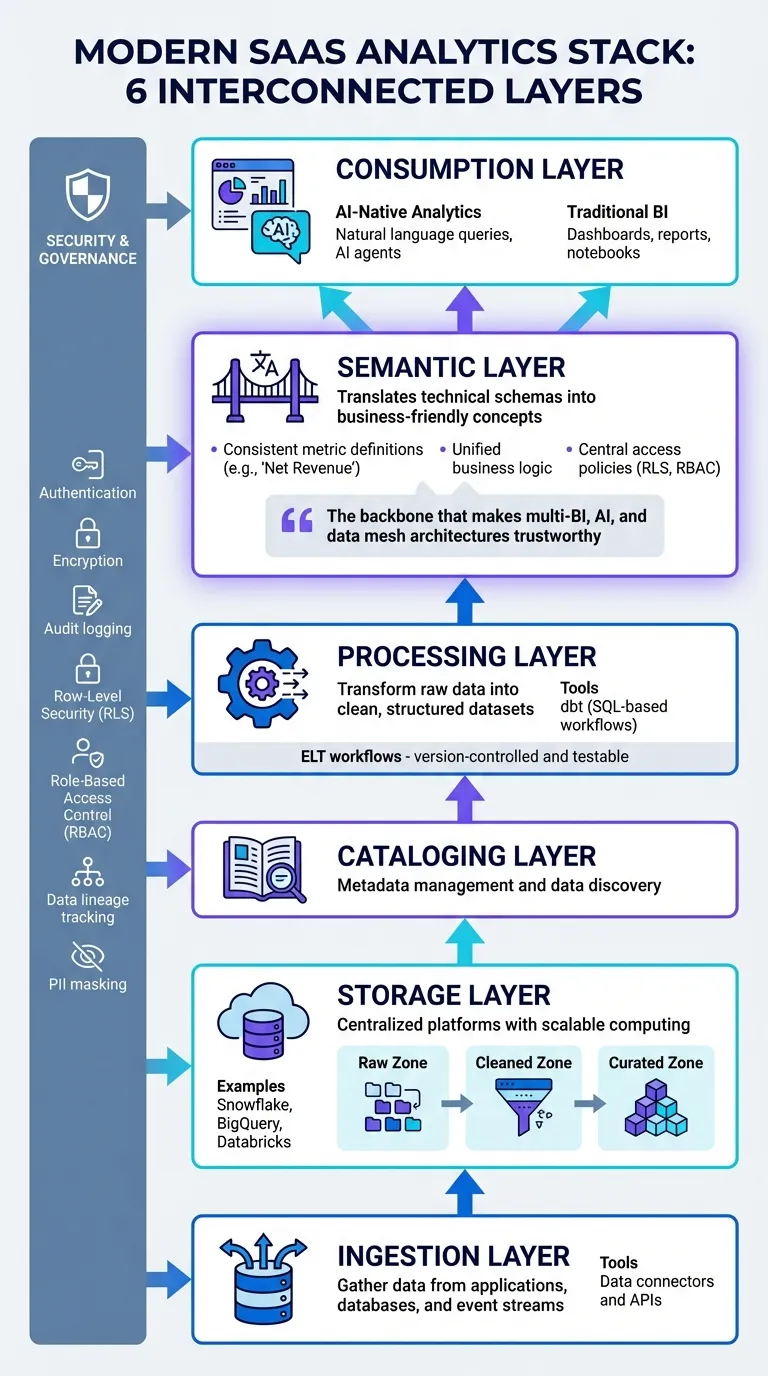
A modern SaaS analytics stack is built on six interconnected layers: ingestion, storage, cataloging, processing, consumption, and security/governance. Together, these layers transform raw data into actionable insights [8]. While each layer has a distinct role, their true power lies in how seamlessly they work together - especially when AI tools need to analyze and interpret your data.
Reference Architecture Overview
At its core, the stack begins with ingestion tools, which gather data from applications, databases, and event streams. This data is then funneled into centralized platforms like Snowflake, BigQuery, or Databricks - systems known for their scalable computing capabilities. Once the data is collected, transformation frameworks such as dbt step in to refine it. These frameworks use SQL-based workflows to convert raw data into clean, structured datasets that are version-controlled and testable [6, 16]. This structured foundation is essential for everything that follows, from storage to consumption and governance.
The semantic layer acts as a bridge between processed data and the tools that rely on it. It translates technical schemas into business-friendly concepts (e.g., defining "Net Revenue"), ensuring metrics and logic remain consistent across the board [6, 8]. As Coalesce aptly put it, "A semantic layer is not a nice-to-have; it's the backbone that makes multi-BI, AI, and data mesh architectures trustworthy." [5]
Above the semantic layer, both AI-native analytics tools and traditional BI platforms come into play. These tools allow users to ask natural-language questions, build dashboards, or conduct exploratory analyses in notebooks - all while relying on the same consistent data source. Finally, governance and security measures span every layer, ensuring access policies are enforced, sensitive data is protected, and lineage is tracked from the moment data enters the stack to when insights are delivered [6].
How Data Flows Through the Stack
The journey of data through this architecture involves moving through clearly defined storage zones. Initially, data resides in a raw zone, where it remains untouched after ingestion. From there, it progresses to a cleaned zone, where quality checks are applied, and finally to a curated zone, optimized for fast querying and analysis [8].
Modern stacks rely on ELT (Extract, Load, Transform) workflows to handle transformations efficiently. Serverless tools like AWS Glue and Athena make this possible by scaling effortlessly to meet demand [8]. The semantic layer then provides the structured context AI tools need to generate accurate SQL and Python code, ensuring reliable answers to natural-language queries [6, 8].
Governance and Security Requirements
As the data becomes ready for use, strong governance is critical to secure every layer of the stack. For U.S.-based SaaS companies, compliance frameworks such as SOC 2 mandate features like authentication, encryption, audit logging, and consistently enforced access controls [7]. Modern architectures integrate these requirements from the outset, using a "policy-as-code" approach to define access rules centrally. Policies like Row-Level Security (RLS) and Role-Based Access Control (RBAC) can then be applied uniformly across all layers, from storage to the semantic layer and AI tools [6].
The semantic layer plays a pivotal role in ensuring these access policies are consistent across platforms, whether it's a BI dashboard, a notebook, or an AI agent. This uniformity helps prevent security gaps that might arise when rules are scattered across different systems [5]. Additional features like data masking for personally identifiable information (PII) and end-to-end lineage tracking are vital for maintaining compliance. These tools allow teams to trace changes - who made them, when, and why - which is essential for audit readiness [8, 13].
"Safety: Access rules and row/column security live at the semantic layer, not scattered across tools." – Bianca Vaillants [6]
AI-Driven Analytics: Changing How Teams Work with Data
SaaS teams are moving away from static dashboards and embracing conversational interfaces, where users can ask questions in plain English and receive accurate, governed answers. According to Gartner, by 2025, natural language will likely become the primary way people interact with data systems, potentially leading to a 100x increase in data usage [1]. This shift aims to make analytics more accessible while maintaining the accuracy and security established by data experts. However, this transformation only succeeds when AI tools integrate seamlessly with existing data systems to prevent issues like hallucinations, inconsistent metrics, and security vulnerabilities. These advancements build on earlier discussions about simplifying and centralizing analytics architectures.
The global conversational AI market, valued at $13.2 billion in 2024, is projected to grow to $49.9 billion by 2031 [1]. For SaaS companies, this translates to empowering teams - like product managers and customer success departments - to explore data independently, without always relying on data teams to write SQL queries.
Natural-Language Querying and AI Agents
AI agents are taking things a step further than just translating natural language into SQL. They orchestrate multi-step workflows, including planning analyses, writing and executing code, performing data quality checks, and even suggesting updates to production pipelines [1]. For instance, if a user asks, "What's our monthly churn rate by customer segment?", the AI agent doesn't just generate a query - it identifies the right tables, applies the correct business logic for "churn", and ensures row-level security so only authorized data is displayed.
Grounding language models in structured semantic layers significantly reduces errors, cutting hallucinations by over 50% and boosting text-to-SQL accuracy to nearly 99.8% [10]. Without this grounding, AI agents might misinterpret table relationships or metric definitions, contributing to the failure of 70–80% of AI projects, often due to poor data quality or governance issues [1].
Modern AI agents also prioritize transparency. Instead of offering a black-box answer, they reveal the underlying SQL or Python code, allowing users to review and validate the logic.
How Semantic Layers Support AI Analytics
Semantic layers are the backbone of scalable AI-driven analytics, providing the structured context - like metadata, relationships, and metric definitions - that AI agents need to function effectively [1][10]. Adding a semantic layer can reduce generative AI errors by 66%, while AI accuracy in data tasks typically improves from 50–65% to 75–85% when technical metadata and relationship context are included [11].
By centralizing metric definitions, semantic layers ensure consistency across all platforms. For example, metrics like "Revenue" and "Churn" are calculated the same way, whether accessed through a dashboard or an AI chat interface [9].
"The semantic layer enforces guardrails, ensuring the AI system queries only approved, governed, and contextualized metrics" – dbt Labs [9]
Security measures, such as row-level security (RLS) and role-based access control (RBAC), are also managed at the semantic layer. This prevents AI agents from unintentionally exposing sensitive information.
Notebooks for Flexible Analysis
While AI agents excel at handling routine queries, more complex analyses still benefit from human-guided exploration. Currently, data scientists spend 60% of their time cleaning data and 19% gathering datasets, leaving only 20% for actual analysis [1]. AI-powered notebooks are helping shift this balance by automating data preparation, allowing analysts to focus on strategic insights.
These modern notebooks connect directly to warehouse-native data analysis tools like Snowflake, BigQuery, and Databricks, ensuring that results are based on live, real-time data [5][12]. They also integrate with semantic layers, enabling analysts to use trusted, standardized metric definitions while writing custom Python or SQL. This reduces the risk of metric drift in ad-hoc analyses [5][10][9].
"Data engineers are evolving from system operators to system stewards. The work now demands fluency in AI-native tools, semantic data modeling, governance strategy, and the supervision of autonomous agents" – Daniel Poppy, dbt Labs [1]
Notebooks are becoming the go-to interface for this new approach, where users define goals in natural language, and AI agents handle execution, validation, and deployment. Research shows that 70% of analytics and data professionals already use AI to assist with coding and documentation [1], making notebooks an ideal space for collaboration between humans and AI.
Types of Analytics for SaaS Companies
SaaS companies rely on three main types of analytics to address different business needs. These include internal decision analytics, which supports executives and finance teams in tracking business performance through metrics like lead funnel conversion rates, annual recurring revenue (ARR) growth, customer lifetime value (LTV), and churn analysis [13]. Then there's product analytics, which helps product managers understand user behavior and refine the product experience. Lastly, embedded analytics provides users with actionable insights directly within the application [13].
However, inconsistencies in metric definitions - such as differing interpretations of "Active Subscriber" between executive dashboards and customer-facing reports - can quickly erode trust. To avoid this, a unified semantic layer establishes consistent definitions for key performance indicators (KPIs) across all analytics [6][15]. These analytics types are built on the centralized, AI-powered framework discussed earlier.
Internal Decision Analytics
A unified semantic layer ensures that insights remain consistent across all analytics tools. Internal decision analytics is used by finance teams, executives, and revenue operations (RevOps) departments to monitor performance and guide strategic decisions. These teams track core metrics like lead funnel conversions, ARR, LTV, and churn analysis [13].
Thanks to AI-driven tools, executives can now ask straightforward questions - like, "What’s our net revenue retention by customer segment this quarter?" - and receive instant, SQL-backed answers. This reduces the time it takes to move from a question to actionable insights, allowing teams to respond more quickly when performance metrics show negative trends. For example, spikes in support tickets might signal impending customer churn, prompting proactive win-back campaigns. That said, data quality remains critical - flawed data can lead even the best AI tools to deliver inaccurate recommendations [15].
Product and Customer Analytics
Product teams require robust insights to understand how users interact with the product and what drives retention. Key metrics include feature adoption, time to first value, trial-to-paid conversion rates, and cohort retention [13][14]. Behavioral segmentation further enables personalized strategies, such as in-app nudges or re-engagement emails [16]. Additionally, tools like session replays and heatmaps help identify friction points - think "rage clicks" on non-functional buttons - that might cause users to abandon the product [16].
A growing trend in this space is warehouse-native analytics tools. Instead of relying solely on third-party event-tracking tools, product teams can run queries directly on data warehouses like Snowflake or BigQuery. This approach not only improves data accuracy but also significantly reduces costs. For instance, traditional tools like Amplitude or Mixpanel might cost around $150,000 annually for a SaaS with 1 million active users, while warehouse-native solutions can cost as little as $12,000 per year [17]. Additionally, automated experimentation platforms can speed up A/B test decisions by an average of 7 days compared to in-house solutions [14].
Embedded Analytics for SaaS Products
Embedded analytics takes insights a step further by delivering real-time, secure data directly to users within the application. SaaS companies often include features like dashboards, usage reports, and ROI benchmarks to help customers measure product usage and assess ROI [13][6]. The goal is to ensure customers see the value in the product.
Security and scalability are non-negotiable here. Row-level security (RLS) ensures that users only see data relevant to them, while role-based access control (RBAC) manages permissions for various user types. These governance measures, enforced at the semantic layer, prevent accidental data leaks when AI agents or embedded dashboards generate queries [6]. By leveraging the unified semantic layer, companies ensure consistent metric calculations, which helps eliminate confusion and build trust [6][15].
How to Build Your SaaS Analytics Stack
Creating a modern analytics stack doesn’t mean starting from scratch. Instead, it’s about identifying weak spots, choosing the right technology layers, and building trust over time. Often, the tools you already have don’t work well together. The goal here? Build a scalable, AI-ready stack that reduces manual work and grows with your business [3].
Evaluate Your Current Setup
The first step is figuring out where your current stack isn’t working. Look for common issues like slow reporting, metrics that don’t match across teams, or business logic scattered across spreadsheets instead of being centralized [2]. How much time is your team wasting on fixing scripts or dealing with job failures [3]? For example, if your finance and product teams define “Active Subscriber” differently, that’s a governance issue - and no AI tool can fix that for you.
You’ll also need to check if your stack is ready for AI. Can your data warehouse handle live queries without duplicating data? Do your BI tools allow natural-language queries, or are they stuck with drag-and-drop interfaces? According to Gartner, 80% of applications will include AI in future updates, compared to just 5% by late 2024 [4]. If your stack can’t support AI agents generating SQL in real-time, you’re already falling behind.
Start by analyzing your current capabilities and identifying the most pressing gaps.
Adopt the Right Technologies
Once you’ve pinpointed the problems, it’s time to bring in the right tools. A semantic layer is a great place to start. This acts as a bridge between your data warehouse and BI tools, defining entities like Customers or Orders and metrics like MRR or Churn once, so they’re consistent across all dashboards, notebooks, and AI systems [5]. Without this layer, teams end up with conflicting metrics, which erodes trust.
"A semantic layer is therefore not a nice-to-have; it's the backbone that makes multi-BI, AI, and data mesh architectures trustworthy." - Coalesce [5]
For SaaS companies eager to move quickly, a 90-day roadmap can be effective. Focus the first 30 days on a pilot project in one area, such as revenue operations. Over the next 60 days, expand to other metrics and reach full production with proper governance by day 90 [5]. Instead of trying to do everything at once, start small with three to five key dashboards. This approach allows for feedback and iteration before diving into more complex features.
AI-powered BI tools like Querio integrate directly with platforms like Snowflake, BigQuery, or Postgres. These tools let teams ask questions in plain English, but the answers are inspectable, accurate, and aligned with your business rules. The semantic layer ensures that every query respects your definitions and security policies.
Once you’ve implemented these tools, make it a habit to refine your stack regularly.
Maintain and Improve Over Time
Building the stack is just the beginning - it requires ongoing maintenance. Keep an eye on data health and adapt AI workflows as your business evolves. Tools for data observability track metrics like Mean Time to Detect (MTTD) and Mean Time to Resolve (MTTR), catching issues like null values or schema changes before they affect dashboards [2]. Automate data quality checks in your transformation layer using tools like dbt, and integrate these checks into your CI/CD pipeline to ensure every change is tested before it’s live.
As your stack matures, centralized governance becomes essential. Instead of managing row-level security (RLS) individually for each dashboard, shift to a “control plane” approach. This centralizes discovery, lineage, and access policies through tools like Snowflake Horizon, Unity Catalog, or a universal semantic layer [5]. This way, when AI agents generate queries, they automatically follow your security rules without extra effort.
Think of your analytics stack as a strategic investment. Leading SaaS companies continually refine their data infrastructure to make faster decisions and gain better insights [2]. Make it a habit to review your stack quarterly, retire outdated tools, and adopt new technologies as they emerge.
Conclusion
The future of SaaS analytics isn’t about gathering endless amounts of data - it’s about making smarter sense of the data you already have. With tools like AI business intelligence platforms, semantic layers, and governed self-service analytics, organizations can completely change how teams interact with information. Imagine asking a question in plain English and receiving accurate, reliable answers in seconds. This shift isn’t just theoretical; it’s backed by compelling industry trends.
For instance, Gartner predicts that by 2025, natural language interfaces will dominate data interactions, potentially increasing usage by 100 times. Meanwhile, poor data quality continues to cost organizations a staggering $12.8 million annually [1]. These figures underscore the competitive edge that intelligent, well-governed analytics can provide.
To achieve this, integrating how AI is transforming data analytics and a unified semantic layer is essential. A semantic layer ensures consistent metrics across the board, whether in executive dashboards or AI tools. Centralized governance safeguards sensitive information while giving non-technical teams the freedom to explore data independently. AI-native tools, like Querio, simplify the process even further by generating real SQL or Python code that teams can review and trust.
So, where should you begin? Start by identifying the biggest challenges in your current analytics setup. Focus on adopting tools that address real pain points and build trust within your organization over time. The goal isn’t to achieve perfection overnight - it’s about creating a scalable, AI-ready system that grows with your business and keeps you ahead in a competitive landscape.
FAQs
How does AI-driven analytics enhance decision-making for SaaS companies?
AI-powered analytics is changing the game for SaaS companies, turning overwhelming amounts of scattered data into clear, actionable insights. By pulling data from sources like CRM tools, billing systems, and usage logs, it creates a single, trustworthy view of the business. This eliminates isolated data pockets and cuts down on the time spent manually preparing data.
With real-time and predictive analytics, AI can spot trends, flag risks, and uncover opportunities as they arise, helping teams make quicker and more informed decisions. Even better, natural-language queries let anyone - whether they're in marketing, product, or finance - access insights instantly, no technical know-how required. On top of that, automated processes like generating reports or detecting anomalies free up valuable time, allowing teams to focus on big-picture strategies. It’s a smarter, more efficient way to drive growth through data.
How does a semantic layer ensure consistent and secure data in SaaS analytics?
A semantic layer serves as a link between raw data and the analytics tools that business teams rely on, converting complex technical data into straightforward business concepts like "Total Revenue" or "Customer Segments." By centralizing metrics, definitions, and relationships in one unified location, it ensures that every query - whether initiated by a user, an AI, or an application - draws from the same dependable source. This eliminates mismatched numbers across dashboards and fosters accurate, consistent decision-making.
Beyond simplifying data, the semantic layer is crucial for data security and governance. It enforces role-based permissions to control who can access sensitive metrics or dimensions, while version control tracks changes and ensures updates are implemented safely. This approach not only protects the integrity of your data but also minimizes errors or misinterpretations from AI by anchoring queries in approved logic. The outcome? A secure, reliable analytics environment that equips teams with the confidence to act while keeping your data protected.
Why is data governance important for building a modern SaaS analytics stack?
Data governance plays a key role in ensuring your data remains accurate, secure, and aligned with your business goals. It's all about having a clear framework - think policies, processes, and standards - that helps manage data effectively while maintaining compliance and trust.
When done right, data governance empowers SaaS companies to make quicker, more dependable decisions. It also minimizes risks tied to poor data quality or falling short of regulatory requirements. Plus, it sets the stage for getting the most out of advanced analytics tools and AI-driven insights.