Business Intelligence
Basedash Alternatives: Cheaper, Open Source and Git-Based
Basedash costs $1,000 a month for up to 25 users. What Querio, Metabase, Power BI, ThoughtSpot, Hex, Preset and Lightdash cost at 5, 25 and 50 users.
 Javier BonillaCo-founder & CTO
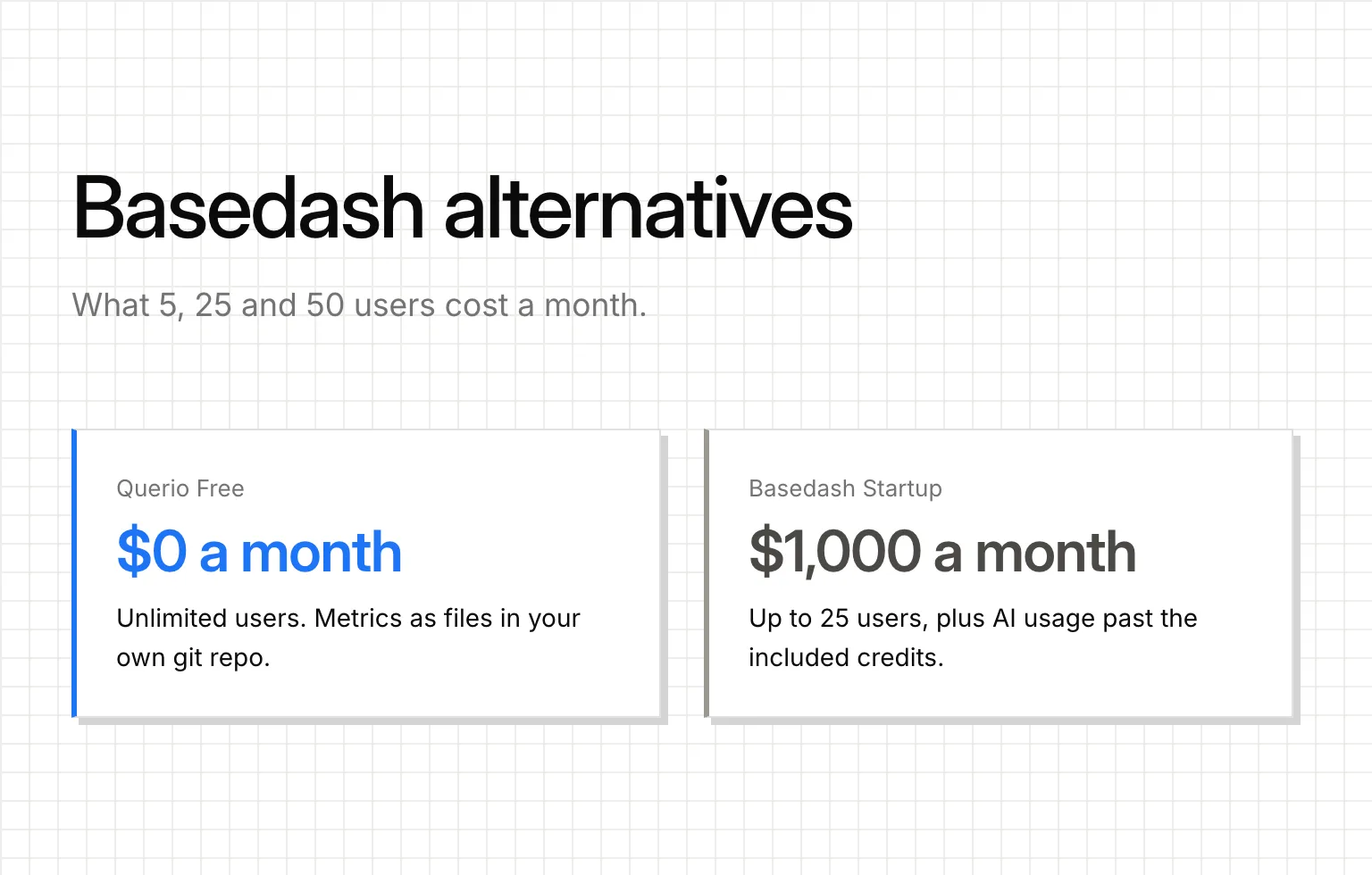
Basedash costs $1,000 a month plus AI usage for up to 25 users, and it has no free plan. Querio's Free plan costs $0 for unlimited users and keeps your metrics, dashboards and context as files in a git repo you own. Metabase and Lightdash are free if you host them yourself, and Power BI, ThoughtSpot and Hex charge per seat.
Our take: if you're switching anyway, don't move your metrics from one vendor's app into another's. Put them in files in your own repo, and every tool and every agent reads the same definitions.
What does Basedash cost?
Basedash has one self-serve plan, Startup, at $1,000 a month plus AI usage. That includes $1,000 of AI credits a month, and usage past that is billed on the next invoice. There's a 14-day trial. Past 25 users you move to Enterprise, with custom seats and a custom price, and that's also where self-hosting, embedding and SSO sit.
So a team of five pays what a team of 25 pays, and the 26th person means a sales call.
What do Basedash alternatives cost for 5, 25 and 50 users?
Monthly list prices, November 2026.
| Tool and plan | 5 users | 25 users | 50 users | AI included |
|---|---|---|---|---|
| Querio Free | $0 | $0 | $0 | 500 AI credits a month, extra credits $0.50 each |
| Querio Core | $2,499 | $2,499 | $2,499 | 10,000 AI credits a month, extra credits $0.25 each |
| Basedash Startup | $1,000 | $1,000 | Enterprise, custom price | $1,000 of AI credits a month, usage over that billed |
| Metabase open source (self-hosted) | $0 | $0 | $0 | AI on your own model API key |
| Metabase Starter (billed monthly) | $100 | $220 | $370 | Your own key, or Metabase's AI service at $3.75 per million tokens |
| Preset Starter (hosted Superset) | $0 | Up to 5 users | Up to 5 users | Not listed |
| Preset Professional (billed annually) | $100 | $500 | $1,000 | 14-day AI chatbot trial, then an add-on |
| Power BI Pro (billed annually) | $70 | $350 | $700 | Copilot needs a Fabric F2 or Premium P1 capacity on top |
| ThoughtSpot Essentials (billed annually) | $125 | $625 | $1,250 | No Spotter queries listed on this plan |
| Hex Professional (every user an editor) | $180 | $900 | $1,800 | Hex agent with "standard credits" |
| Lightdash Cloud Pro | $3,000 | $3,000 | $3,000 | AI agents and MCP, no allowance stated |
Sigma, Omni and Looker don't publish prices. Tableau's Standard edition starts at $15 per user a month billed annually, and every deployment needs at least one Creator license.
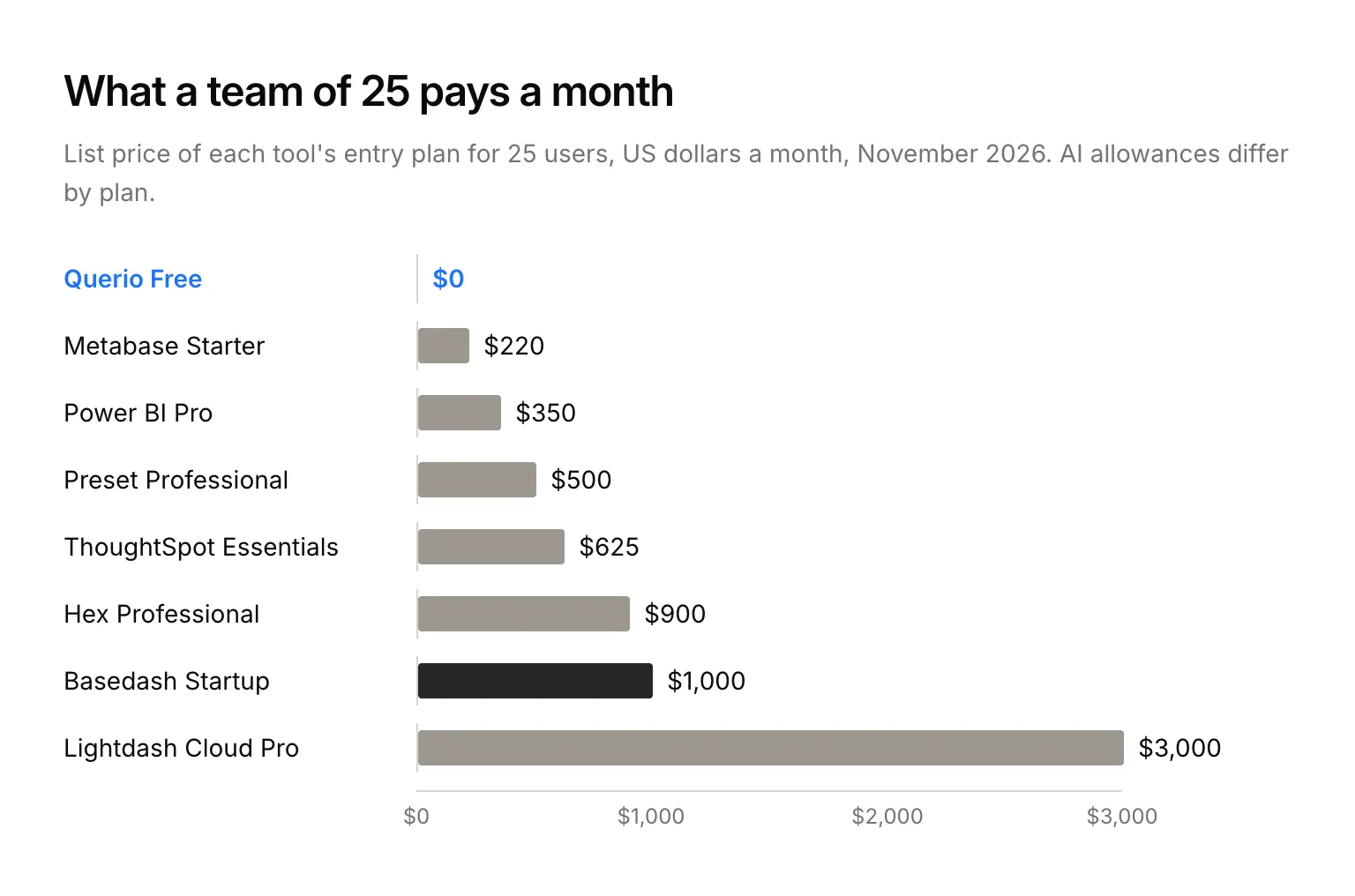
Seats are only part of the bill. AI is the rest. On Querio, one credit is one AI model call and a question takes a few. Dashboard refreshes and automations use none.
Which alternative fits a small team leaving over the price?
Querio Free. It doesn't expire, and the next person you add costs nothing. You get the AI agent, SQL and Python notebooks, dashboards, the Slack agent, and the MCP server and CLI, so Claude, ChatGPT, Claude Code and Cursor can query your data from day one. When you outgrow it, Core adds SSO and group sync, datasource permissions, audit history and API access, still with no per-seat price, and it starts with a guided four-week pilot.
Metabase. Starter includes five users, then charges $6 a month for each one after that. Our Querio vs Metabase page goes through how the two keep metrics.
Hex. The Community plan is free. Paid plans charge per editor: $36 a month on Professional and $75 on Team. Querio vs Hex covers what that means for the people who only ask questions.
Which Basedash alternatives are open source or self-hosted?
Metabase is open source with unlimited users on its free self-hosted edition. Lightdash is open source too. Apache Superset is open source under the Apache-2.0 license, and Preset sells a hosted version.
On Enterprise, Querio runs single-tenant, with on-prem and AWS GovCloud deployments as add-ons. Querio isn't open source, and it doesn't need to be for you to own your work: if you leave, you keep the repo.
Pick any of those three and you can still get your metrics out later. Our migration CLI, unshackle, is open source under Apache 2.0 and runs without a Querio account. It reads Metabase, Lightdash and Superset, among the 13 BI tools it supports, and writes their metrics out as semantic model files, with MetricFlow YAML when there's a dbt project to put them in.
Which alternative keeps your metrics in your dbt and git repo?
Querio does. Context, metric definitions, saved queries, dashboards, notebooks, automations and permission policies all sit as files in your GitHub repo and sync both ways. You can edit them in the app, in VS Code, or from Claude Code, and it's the same files either way.
Querio reads dbt's semantic_manifest.json, so your MetricFlow metrics are used as they are, with no second copy to keep in step. Querio's files can live inside your dbt repo, so a model change and the context that describes it ship in one PR. No dbt? Metrics you define in Querio are committed to the repo as MetricFlow files anyway. When someone saves context or promotes a dashboard, Querio opens a pull request, and your repo's own reviewers approve it. Rename a dbt model and CI flags every dashboard, query and context file that uses it before the PR can pass.
Agents get the same rules people do: an agent sees only what the person it works for can see.
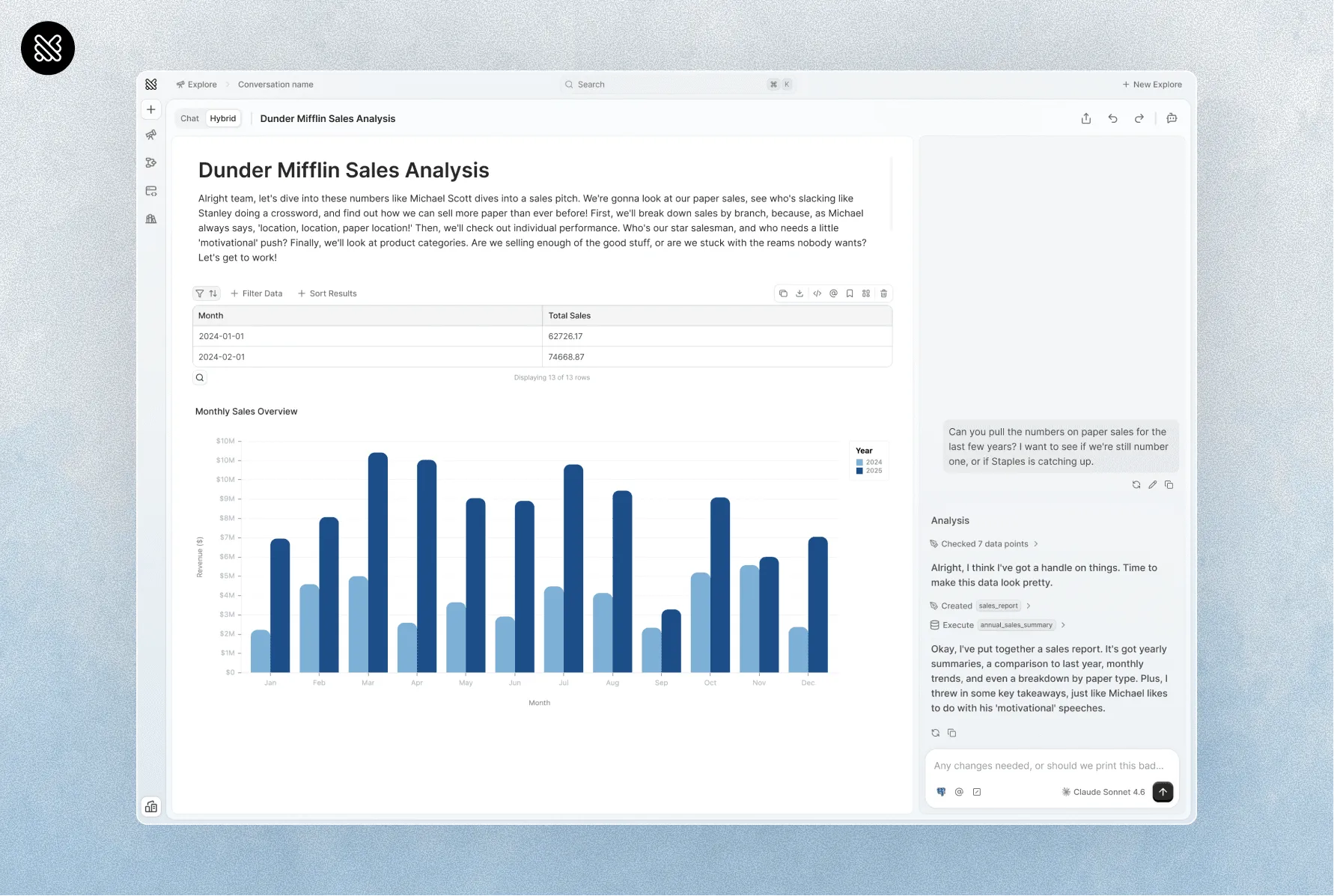
In Basedash, metrics live in models: SQL datasets with measures, segments and relationships, usually built on top of your dbt marts. Each edit saves a version inside Basedash, and admins verify the approved ones. Basedash also reads the table and column descriptions dbt writes into your warehouse.
Three other tools keep definitions as code. Looker uses LookML files in git. Lightdash reads metrics from your dbt YAML. Omni has a YAML model you can sync to a git repo, one model at a time.
Which alternative can an ops team use without writing SQL?
In Querio, an ops lead asks in Slack or in the app, in plain words, and gets an answer from the definitions the data team keeps in the repo. Every answer is real SQL or Python in a notebook, so an analyst can check it. Nobody has to write a line of SQL to ask, and nobody has to trust a number they can't open.
Of the other tools, ThoughtSpot is built around typed questions. Its Pro plan, at $50 per user a month billed annually, includes 25 Spotter AI queries for each user every month. Sigma looks like a spreadsheet on top of your warehouse. Tableau includes Pulse metrics on Standard, and Tableau Agent comes with Cloud+.
FAQ
Does Basedash have an MCP server?
Yes. Basedash has a remote MCP server with tools for asking questions and building charts and dashboards, and it's on both plans. Querio's MCP server is on every plan, Free included, and through it Claude or ChatGPT can ask for your MetricFlow metrics by name without using any Querio AI credits.
Can I take my Basedash models with me?
Basedash models are SQL datasets you can manage from CI through its REST API, so moving them means reading each one out and writing it again in the new tool. In Querio, your metrics are MetricFlow files in your own repo from day one, so there's nothing to export.
Do Basedash alternatives connect to Postgres and Snowflake?
Querio connects to PostgreSQL, MySQL, MariaDB, SQL Server, Snowflake, BigQuery, Redshift, Databricks, ClickHouse, MotherDuck, Athena, Trino, Dremio and Materialize, with unlimited connections on every plan. Basedash connects to Snowflake, BigQuery and Databricks directly, and syncs other sources into a managed DuckDB warehouse it runs for you. If Metabase is still on your list, our Basedash vs Metabase comparison puts the two side by side.