
Querio vs Metabase: a Metabase alternative
A side-by-side look at Querio and Metabase. We keep our reviews honest and fair so you can make an informed decision.
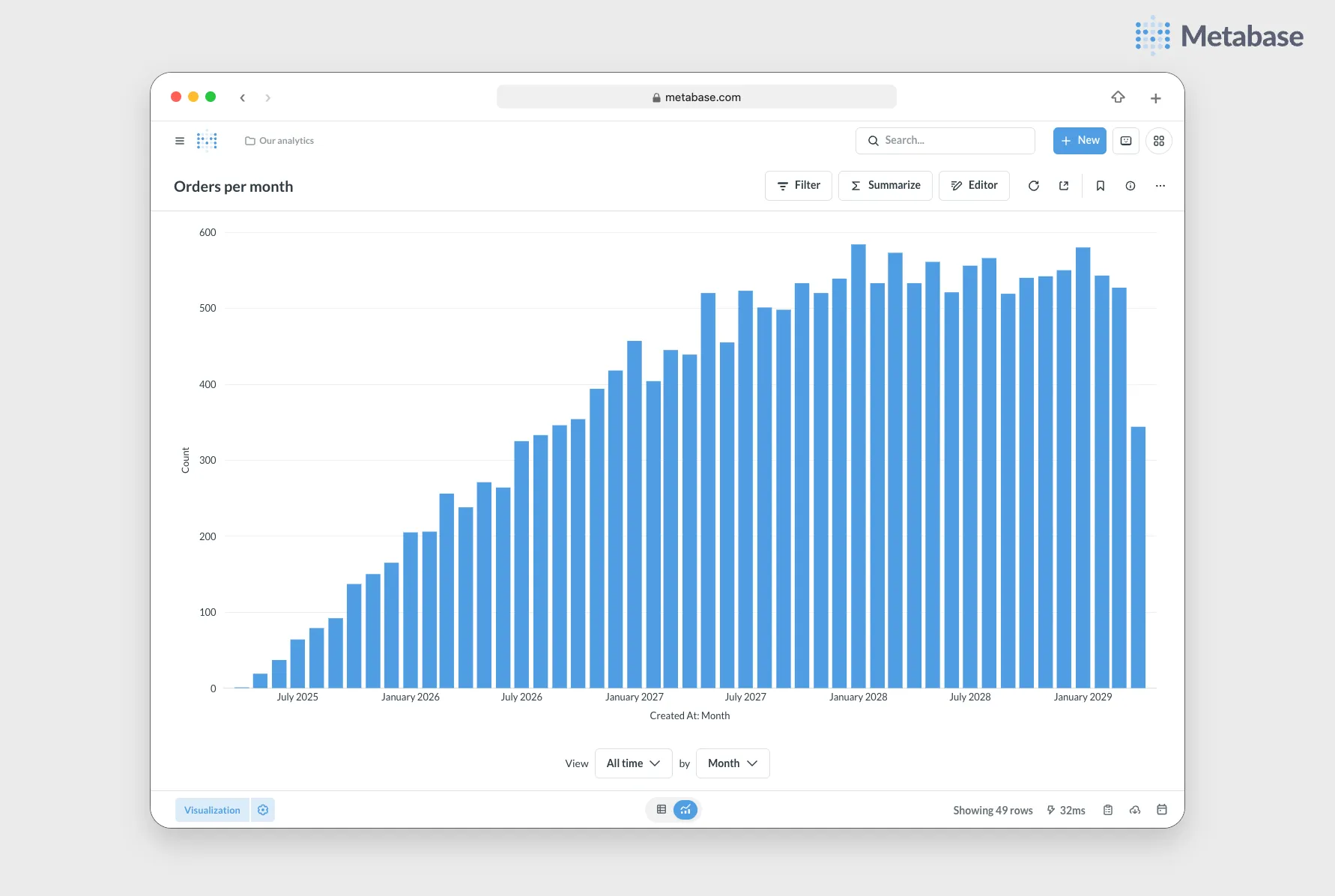
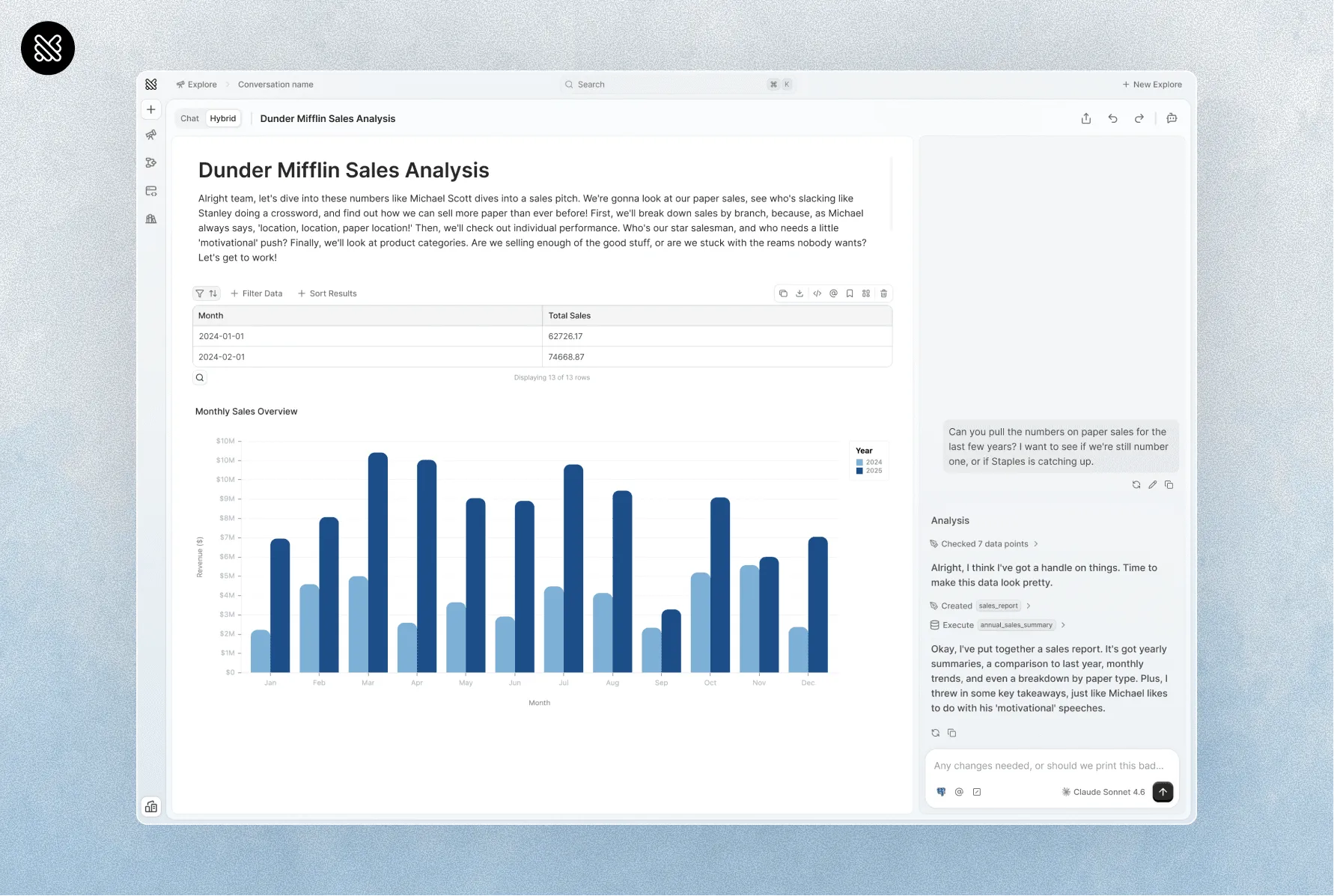
‹ QuerioDrag to compareMetabase ›
On Metabase's open-source edition, your models, metrics and segments are saved in Metabase's own database, and they stay there. The export command refuses to run: "The 'v2-dump!' command is only available in Metabase Enterprise Edition." Getting them into Git starts on the Pro plan, at $575 a month. To move them into dbt from any edition, see how to migrate Metabase questions and models into dbt.
We checked this on Metabase v0.64.1 on October 24, 2026, with a script acting as an AI agent through Metabase's MCP server. The agent did real work. All of it went into that database.
We think a metric definition is code, not a record in a BI tool's database that you pay to export. In Querio, a metric is a file from day one, in a GitHub repo you own, on the Free plan. Your team and your agents read the same files, and agents get in through our MCP server, which is on every plan.
Metabase pricing, and where your definitions live on each plan
Metabase has four plans. On every one, you build models, segments and measures inside Metabase. What changes by plan is whether they ever make it to Git.
| Plan | Price | Definitions in Git |
|---|---|---|
| Metabase Open Source | Free, self-hosted, unlimited users | No |
| Metabase Starter | $100 a month with 5 users, then $6 a user | No |
| Metabase Pro | $575 a month with 10 users, then $12 a user | Yes: Remote Sync and serialization |
| Metabase Enterprise | From $20,000 a year | Yes: Remote Sync and serialization |
| Querio Free | $0, unlimited users | Yes, from the start: your own GitHub repo |
| Querio Core | $2,499 a month or $25,000 a year, unlimited users | Yes: GitHub, GitLab or Bitbucket |
Metabase's Git feature is Remote Sync, which it describes as a way to "develop analytics content in your Metabase and automatically deploy it to a read-only production Metabase through Git." Pro and Enterprise also get agent-driven workflows, where an agent writes Metabase content as YAML files for you to import.
So Pro does get you Git and agent-written YAML. The difference is which copy is the source of truth. In Metabase, it's the object inside Metabase, and Git carries a copy to a second Metabase. In Querio, it's the file. Changes go through pull requests, and sync runs both ways: edit a metric in Querio and the file changes, edit the file in VS Code or Claude Code and Querio picks it up.
Metabase AI: what an agent did on open source
Metabase ships its MCP server on every plan, and it was switched on by default in our open-source install. It doesn't need an AI provider set up in Metabase. In Metabase's words, "Your client brings the model." Our script used a Metabase session token and tried the jobs a data team would hand an agent.
| What the agent tried | What Metabase v0.64.1 did |
|---|---|
| List its tools | Listed 22 |
| Run its own SQL (a GROUP BY on the Sample Database) | Ran it and returned 4 rows |
| Save a question, a dashboard with it, a model from SQL, a metric, a segment and a measure | Saved all six |
| Change the segment | Saved it; the reply showed only the new version |
| Run Python | No tool for it among the 22 |
Metabase keeps the old and new segment in its revision history. There's no pull request to review the change in.
One fix if you run Metabase: with a session token on a writable SQLite database, our agent's CREATE TABLE and DELETE both ran, even though the tool returned an error for them. Metabase says "AI clients start with read-only access, and you approve anything more one permission at a time," but a session token skips that approval. Give Metabase a read-only database user.
What's the best replacement for Metabase if agents write your metrics?
Querio. As our CTO, Javier Bonilla, puts it: "Your metrics live in a file, your notebook is a file and your logic is searchable, editable and runnable from a terminal."
Each data source gets a folder: catalog.json for your tables, and kb/, whose SQL, Python and Markdown entries define your metrics, rules and business logic. A Metabase metric becomes one of those files.
Agents connect to /mcp on your Querio app, sign in with OAuth and get the permissions of the person they signed in as. They upload context files, and write and run SQL and Python notebook cells. The CLI is on Free too.
If you use dbt, Querio reads your dbt and MetricFlow definitions as they are, and agents connected through the MCP server can query those metrics by name. Querio's files can sit inside your dbt repo, so a model change and the context that describes it go in one PR.
Comparing more tools? Our list of Metabase alternatives has eight, and if you're weighing a dbt-first BI tool, read Querio vs Lightdash.
Free and open source
Leaving Metabase? Take everything with you.
unshackle moves your metrics, dashboards and permissions out of Metabase and into files in a Git repo you own. Nothing changes in the tool you're leaving.
Works with








- and more

- your-analytics-repo
- semantic
- notebooks
- catalog
- policies
- knowledge
- migration
- report.md