Business Intelligence
AI in BI: Automating Workflow Optimization
AI automates BI workflows to cut costs, speed insights, and improve accuracy using natural language queries, semantic layers, and live data connections.
AI is transforming business intelligence (BI) by automating tedious workflows and enabling faster, more efficient decision-making.
Key takeaways:
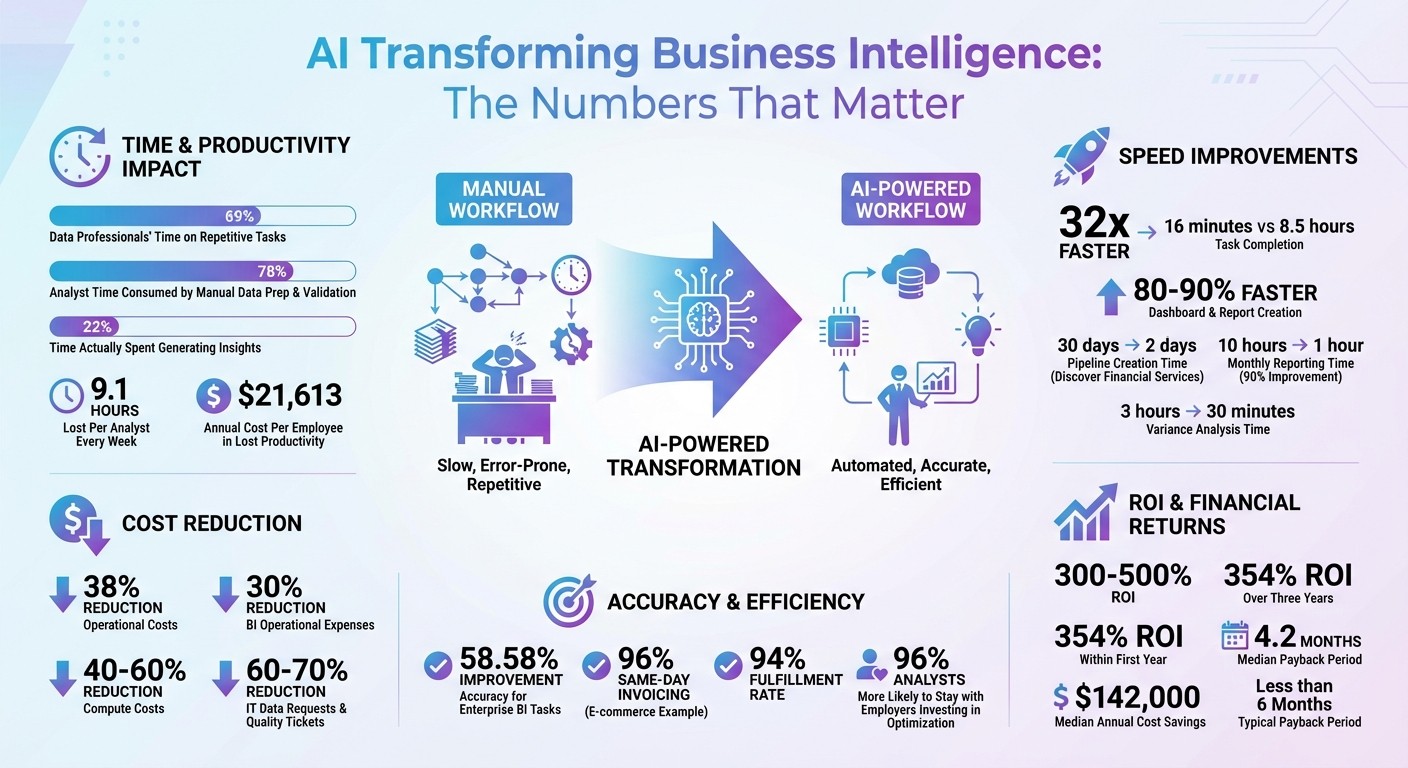
69% of a data professional's time is spent on repetitive tasks like data prep, leaving little room for analysis.
AI-driven BI reduces IT data requests and data quality tickets by 60–70%, speeding up insights delivery.
Companies like Discover Financial Services cut pipeline creation time from 30 days to just 2 days using AI.
AI tools slash operational costs by up to 38% and complete analytical tasks 32 times faster than humans.
With natural language interfaces, AI eliminates the need for SQL expertise, automates data consolidation, and monitors anomalies in real-time. Businesses are saving time, reducing costs, and improving accuracy while empowering teams to focus on strategic work.
How does this impact you? AI-powered platforms like Querio deliver real-time insights with live data connections, cutting analysis time and boosting ROI by over 300% within the first year.
AI in Business Intelligence: Key Statistics on Workflow Automation Impact
Research Findings on AI-Driven Workflow Automation
Cost and Efficiency Gains from AI
Inefficient workflows are costing organizations big time. On average, businesses lose 9.1 hours per analyst every week, resulting in $21,613 per employee annually in lost productivity [9]. Shockingly, data analysts spend only 22% of their time generating insights. The other 78%? It’s eaten up by manual tasks like preparing and validating data or switching between tools [9].
Here’s where AI steps in to change the game. Studies show that AI can slash operational costs by up to 38% [7][8]. McKinsey highlights a 30% reduction in BI operational expenses thanks to AI adoption. Real-world examples back this up: enterprise systems using unified LLM-based frameworks have seen major improvements in both accuracy and cost savings. For instance, the Data Agnostic Researcher (DAR) system completed tasks in just 16 minutes - a massive 32× speed boost compared to the 8.5 hours it takes human analysts [6]. These gains are powered by advanced AI techniques, which we’ll dive into next.
AI Techniques in Workflow Automation
The impressive cost and efficiency improvements are driven by several cutting-edge AI methods. LLM-based agents are now capable of handling full pipeline automation, from understanding natural language questions to generating SQL queries and creating visualizations using embedded analytics tools [1]. Intelligent semantic layers and AI make querying data easier by mapping raw database structures to business concepts, allowing users to ask questions in plain English - no SQL skills required [3][4]. These systems also incorporate domain knowledge automatically, pulling metadata from existing code histories instead of relying on manual documentation [1]. Additionally, cell-based context management, which uses Directed Acyclic Graphs (DAGs) to track dependencies, ensures AI agents only process relevant data. This approach significantly reduces token costs [1].
Other innovative techniques include proactive monitoring agents that keep an eye on key metrics and notify teams via Slack or email when anomalies pop up. This shifts BI operations from reactive to proactive [4]. Finite State Machines (FSMs) are also used to coordinate communication between specialized agents - for example, a SQL agent passing clean data to a visualization agent - eliminating the miscommunication issues that often plague fragmented workflows [1]. Together, these advancements highlight how AI is reshaping BI processes and speeding up decision-making.
"AI can bridge that gap if it's properly integrated into governed workflows. The companies that provide unified platforms will create a symbiotic relationship where AI reduces time-consuming work and frees analysts to deliver strategic insights." - Mark Porter, CTO of dbt Labs [9]
AI in BI Workflows: Practical Examples
Finance and E-Commerce Use Cases
Real-world examples from various industries highlight how AI is streamlining BI workflows and reshaping business decision-making processes. Take Global-Tech Manufacturing, for instance. In October 2025, the company implemented IDP to automate its accounts payable process. The results? Invoice processing time plummeted from 10 days to under 24 hours, while costs dropped dramatically - from $15.70 to $3.90 per invoice. On top of that, the system saved over 8,000 hours of manual work annually and reduced the month-end close cycle from 12 days to just 4 days [10].
E-commerce has also seen transformative outcomes. In January 2025, an e-commerce retail team used Scoop's agentic AI analytics pipeline to dive into a massive dataset of orders. The AI automated the analysis of sales, logistics, and returns, uncovering a key insight: soft toys weighing less than 0.2 kg were causing last-mile delivery issues. This automation led to a 96% same-day invoicing rate and a 94% fulfillment rate [14].
Another compelling example comes from Clarins, where Director of Data & Analytics Marie-Jeanne Freiha spearheaded a data overhaul using Snowflake Intelligence. With this system, business users could query B2C transactions using plain English analytics tools - spanning online and in-store purchases. This eliminated the need for SQL and allowed analysts to easily identify cross-channel product sales [3]. These examples show how AI is simplifying workflows, improving efficiency, and enabling smarter decision-making.
Automated Reporting and Decision-Making
AI's influence extends beyond operational workflows to reporting and decision-making. In November 2025, Tag1 employed an AI-assisted workflow to optimize monthly reporting for a healthcare client. By leveraging Claude to categorize over 800 time log entries and a Google Apps Script to automate pivot table creation, the team slashed reporting time from 10 hours to under one hour - a 90% improvement. Complex tasks, like classifying "Storybook.js updates" under "Maintenance & Stability", were handled with precision [12].
"The value for clients is clear: faster, more accurate reporting with fewer errors, increased transparency into project progress, and cost-efficient processes that free up hours for higher-value work."
– Chris Africa, Senior Project and Program Manager, Tag1 [12]
In another groundbreaking case, a global pharmaceutical company replaced 200 static dashboards with a Generative AI chatbot powered by Retrieval Augmented Generation (RAG). This tool allowed procurement professionals to conduct trend and exploratory data analysis simply by using natural language. The chatbot achieved 96% accuracy across key use cases and reduced analysis time from hours to mere seconds [11].
These examples make it clear: AI-driven automation is already delivering tangible results, helping businesses across industries save time, reduce costs, and make better decisions.
Benefits of AI-Powered Workflow Optimization
Better Accuracy and Scalability
AI brings consistency and precision to business intelligence (BI) workflows. Through schema grounding, AI systems can automatically extract table names, column types, and foreign key relationships from database metadata. This eliminates errors and ensures queries target the correct data every time [2]. A great example comes from Saint-Gobain, which automated its migration of legacy MicroStrategy reports to Snowflake between 2025 and 2026. According to Philippe Thomas, their Data Program Director, workflows that used to take 2–3 hours were reduced to under 5 minutes. Moreover, the company managed to shrink its report portfolio from 32,000 to 20,000 in just six months [3].
Scalability also sees a major boost with AI-powered semantic layers, which convert business concepts into validated SQL without requiring manual intervention. For instance, Spark New Zealand utilized Alation to catalog over 900 machine learning features, granting over 200 users access to data and speeding up Power BI report creation by 30% [5]. AI-driven platforms have shown up to a 58.58% improvement in accuracy for enterprise-specific BI tasks. Additionally, adaptive context management in BI notebooks further enhances scalability [1].
These advancements in accuracy and scalability pave the way for much quicker insights.
Faster Time-to-Insights
When business decisions depend on timely data, speed is everything. AI dramatically shortens the journey from data to decision by automating discovery, translation, and execution. Analytical processes that used to take days can now be completed in hours - or even minutes [18]. Data analysts leveraging AI-powered auto-generation tools experience 80% to 90% faster dashboard and report creation, while business users can complete analytical discovery in hours instead of days [17].
"Data analysts achieve 80 to 90 percent faster dashboard and report generation through AI-powered auto-generation features, and natural language capabilities compressing analytical discovery from days to hours."
– Nucleus Research [17]
AI also tackles the manual data preparation tasks that consume 78% of an analyst's day, freeing teams to focus on higher-value work [9]. On average, deploying augmented analytics takes just 4 days, compared to the 2–3 weeks required for traditional dashboards [3].
This acceleration in delivering insights directly contributes to significant cost savings.
Cost Savings and ROI
AI-powered workflow optimization offers substantial cost reductions and strong returns on investment (ROI). For example, Agentic AI can lower operational costs by up to 38% through the automation of tasks like report generation, data cleaning, and query writing [7]. AI BI tools equipped with intelligent caching layers prevent redundant queries, cutting Snowflake compute costs by 40–60% [13]. A Total Economic Impact study revealed that AI deployments on cloud data platforms deliver a 354% ROI over three years [16].
The first year alone can yield impressive returns: AI-powered analytics platforms typically provide 300–500% ROI within 12 months, with payback periods of less than six months [15]. Median annual cost savings from AI automation are around $142,000, with a median payback period of just 4.2 months [19].
Function | Median Annual Savings | Median ROI (Year 1) | Median Payback Period |
|---|---|---|---|
Customer Support | $168,000 | 3.7x | 3.1 months |
Finance/Accounting | $96,000 | 3.2x | 3.7 months |
Sales Pipeline | $124,000 | 2.8x | 4.8 months |
HR/Recruitment | $89,000 | 2.4x | 5.1 months |
Platforms like Querio highlight these advantages by delivering real-time insights and reducing operational overhead. Beyond direct cost savings, AI also helps retain talent by reducing burnout - 96% of analysts are more likely to stay with employers who invest in workflow optimization [9]. Additionally, organizations that transition to unified AI platforms often achieve a 20–30% reduction in total tooling costs through license consolidation and reduced integration expenses [15].
How Querio Applies AI Research Findings
Querio's design is deeply rooted in the latest findings on AI-driven workflow optimization. By blending natural language processing, a governed semantic layer, and live data warehouse connections, Querio tackles key challenges like speed, accuracy, and cost management. This alignment with cutting-edge research shapes Querio's approach to solving complex data problems.
AI-Driven Query Automation
Querio's natural language querying agents are powered by advanced natural language processing, enabling them to generate verifiable SQL and Python code instantly. This means teams across Product, Finance, and Operations can now get immediate, visualized answers to questions like "What was our net revenue by region last quarter?" - no more waiting for custom query development. The AI generates actual SQL behind the scenes, ensuring results are fully inspectable and avoiding the "black box" problem often associated with other tools.
For example, in November 2025, Eaton, a power management company, adopted AI-powered SQL under the guidance of Chief Data Officer Ross Schalmo. This transition automated query generation and connected workflows directly to live data, boosting data processing speed by 900% and saving $500,000 annually compared to their previous manual pipeline [1]. Similarly, in September 2025, Carta's strategic finance team cut their variance analysis time from three hours to just 30 minutes using AI-driven analytics. This allowed the team to focus more on strategic initiatives [1].
Governed Semantic Layer for Consistency
Beyond automating queries, Querio integrates a centralized semantic layer to maintain consistency. With its Context Layer, metrics like "Customer Lifetime Value" or "Churn Rate" are defined once and applied universally across all queries, dashboards, and AI interactions. This ensures that departments like Finance and Sales always work with the same, consistent data.
The semantic layer also enforces row-level and column-level security directly at the definition level, ensuring users only access authorized data. When metrics are updated, those changes automatically propagate across all reports and AI agents, eliminating the risk of calculation errors or version conflicts. This "Don't Repeat Yourself" (DRY) principle reduces technical debt and streamlines workflows.
Real-Time Insights with Live Data Connections
Querio connects directly to platforms like Snowflake, BigQuery, Amazon Redshift, ClickHouse, and PostgreSQL using secure, read-only credentials. By keeping data in the warehouse, Querio ensures insights always reflect the most up-to-date information. Live-connected notebooks allow dashboards and visualizations to refresh automatically whenever the underlying data or logic changes.
In 2025, Virgin Atlantic implemented AI-powered business intelligence for booking analysis. By leveraging live data connections, the airline reduced the time required for complex market shift analysis from weeks to just hours [1]. This direct connection model also enhances security by inheriting warehouse-level permissions, such as row-level security and column masking, without the need for data duplication or complicated ETL pipelines.
Conclusion: AI's Future in BI Workflow Optimization
AI is reshaping business intelligence by transitioning organizations from manual, static processes to dynamic, adaptive systems. Instead of relying on analysts to manually create queries and dashboards, AI-powered platforms now enable real-time decision-making, predictive analytics, and autonomous workflows. Studies indicate that automation can boost workflow efficiency by 70% and deliver a financial return on investment of 294%, while AI-driven systems can slash machine downtime by up to 50% [20]. This evolution paves the way for advanced technologies like agentic AI and multi-agent systems.
Agentic AI and multi-agent systems are expected to drive the next major leap in business intelligence. These technologies enable automated workflows to tackle tasks such as fraud detection and demand forecasting with minimal human oversight. According to projections from PwC and IBM, prioritizing agentic workflows and responsible innovation could unlock transformative potential. Companies that excel in orchestrating AI models and fostering multi-agent collaboration will gain a competitive edge, empowering business users to create their own AI-driven solutions.
A glimpse of this future can be seen in Querio, which combines natural language processing, a governed semantic layer, and live data warehouse connections. Its AI-powered query automation aligns with hyperautomation trends, doubling sales efficiency and reducing analysis time from hours to mere minutes. Querio integrates seamlessly with data warehouses like Snowflake, BigQuery, and PostgreSQL, ensuring precise and transparent insights.
As these innovations continue to evolve, organizations must prepare for the next phase of AI in business intelligence. Developing a strategic roadmap - from deploying personal AI tools to achieving full-scale workflow transformation - is essential. With advancements in natural language processing and predictive analytics, businesses that embed these technologies into their core BI processes will unlock faster insights, reduce costs, and gain a decisive advantage. To sustain these benefits, organizations should focus on integrating semantic consistency, real-time data connections, and strong human-AI collaboration into their BI strategies.
FAQs
Which BI tasks should we automate first with AI?
To make your business intelligence (BI) processes more efficient, start by automating tasks that are repetitive and eat up valuable time, such as data profiling, cleaning, and initial analysis. This not only speeds up workflows but also minimizes errors.
You can also automate report generation and dashboard updates using natural language queries. This makes it easier for teams to access real-time insights without jumping through hoops.
Finally, tackle BI ticket management and scheduled reporting by streamlining these processes. This reduces response times, clears backlogs, and lets your team focus on high-value, strategic work that drives results.
How do we keep AI-generated answers accurate and auditable?
To make sure AI-generated responses are both accurate and trustworthy, it's important to use strict validation methods. Maintaining semantic layers ensures that data definitions stay consistent across the board. Additionally, incorporating strategies like monitoring systems and transparency features can go a long way in building trust. These steps not only safeguard compliance but also help preserve the integrity of your data.
What data security controls are needed for AI on live warehouse data?
When working with live warehouse data in AI systems, implementing robust security measures is non-negotiable. Key controls include role-based access controls (RBAC) to restrict data access based on user roles, ensuring only authorized individuals can interact with sensitive information. Additionally, encryption is crucial for protecting data both at rest and during transit, safeguarding it from unauthorized access.
To maintain transparency and accountability, audit logging is essential. This tracks all data interactions, providing a clear record of who accessed what and when. Furthermore, using secure, read-only connections to data warehouses minimizes risks by preventing unauthorized data modifications.
Adhering to compliance standards like SOC 2 Type II, GDPR, and HIPAA is equally important. These frameworks ensure data privacy, integrity, and alignment with regulatory requirements, which are critical when handling sensitive or personal information.
Related Blog Posts