Business Intelligence
Top AI Analytics Platforms for Enterprises
Enterprise teams need AI analytics platforms that combine natural-language queries, strong governance, and seamless data integration for reliable, scalable insights.

Enterprise AI analytics platforms are transforming how businesses analyze data by enabling natural-language queries, automating tasks, and ensuring secure, governed insights. With data volumes projected to increase tenfold from 2020 to 2030, these tools address the growing complexity of data analysis. Here are six leading platforms tailored for enterprise needs:
- Querio: AI-powered analytics with natural-language querying, real-time SQL generation, and a centralized semantic layer for consistent insights.
- Microsoft Power BI: Integrates with Microsoft 365, featuring an AI assistant (Copilot) for conversational analytics and robust governance tools.
- Tableau: Renowned for its visual analytics and Salesforce integration, offering strong governance and flexible deployment options.
- Google Cloud Vertex AI: Combines AI and data engineering with seamless integration into the Google Cloud ecosystem.
- Kore.ai: Supports multi-agent orchestration with 250+ connectors and a no-code interface for designing AI workflows.
- AWS Bedrock: Serverless AI analytics with diverse model options, strong governance, and robust data integration.
These platforms vary in their strengths, from natural-language capabilities to integration with existing ecosystems. Below is a quick comparison to help you identify the right solution for your business.
::: @figure 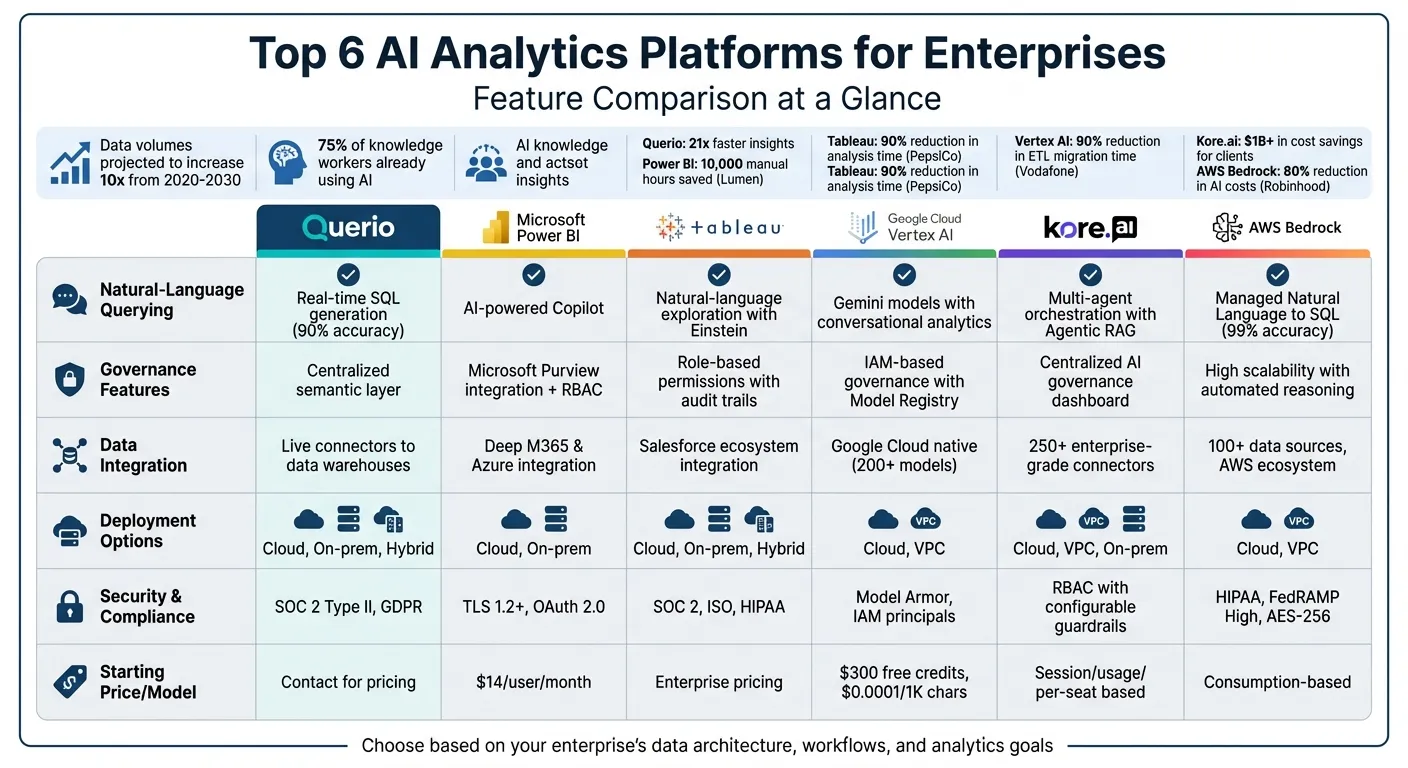 {Enterprise AI Analytics Platforms Comparison: Features and Capabilities}
:::
{Enterprise AI Analytics Platforms Comparison: Features and Capabilities}
:::
BI meets AI. Real use cases that work
::: @iframe https://www.youtube.com/embed/OHxn0-A61FA :::
sbb-itb-284a532
Quick Comparison
| Platform | Natural-language querying tools | Governance Features | Data Integration | Deployment Options |
|---|---|---|---|---|
| Querio | Real-time SQL generation | Centralized semantic layer | Live connectors to warehouses | Cloud, On-prem, Hybrid |
| Power BI | AI-powered Copilot | Microsoft Purview integration | Deep M365 & Azure integration | Cloud, On-prem |
| Tableau | Natural-language exploration | Role-based permissions | Salesforce ecosystem integration | Cloud, On-prem, Hybrid |
| Vertex AI | AI agents with Gemini models | IAM-based governance | Google Cloud native integration | Cloud, VPC |
| Kore.ai | Multi-agent orchestration | Centralized dashboard | 250+ enterprise-grade connectors | Cloud, On-prem, Hybrid |
| AWS Bedrock | Automated reasoning with RAG | High scalability, VPC routing | AWS ecosystem integration | Cloud, VPC |
Each platform is designed to meet specific organizational needs, ensuring efficient data analysis, secure governance, and integration with existing tools. Choose based on your enterprise's data architecture, workflows, and analytics goals.
1. Querio
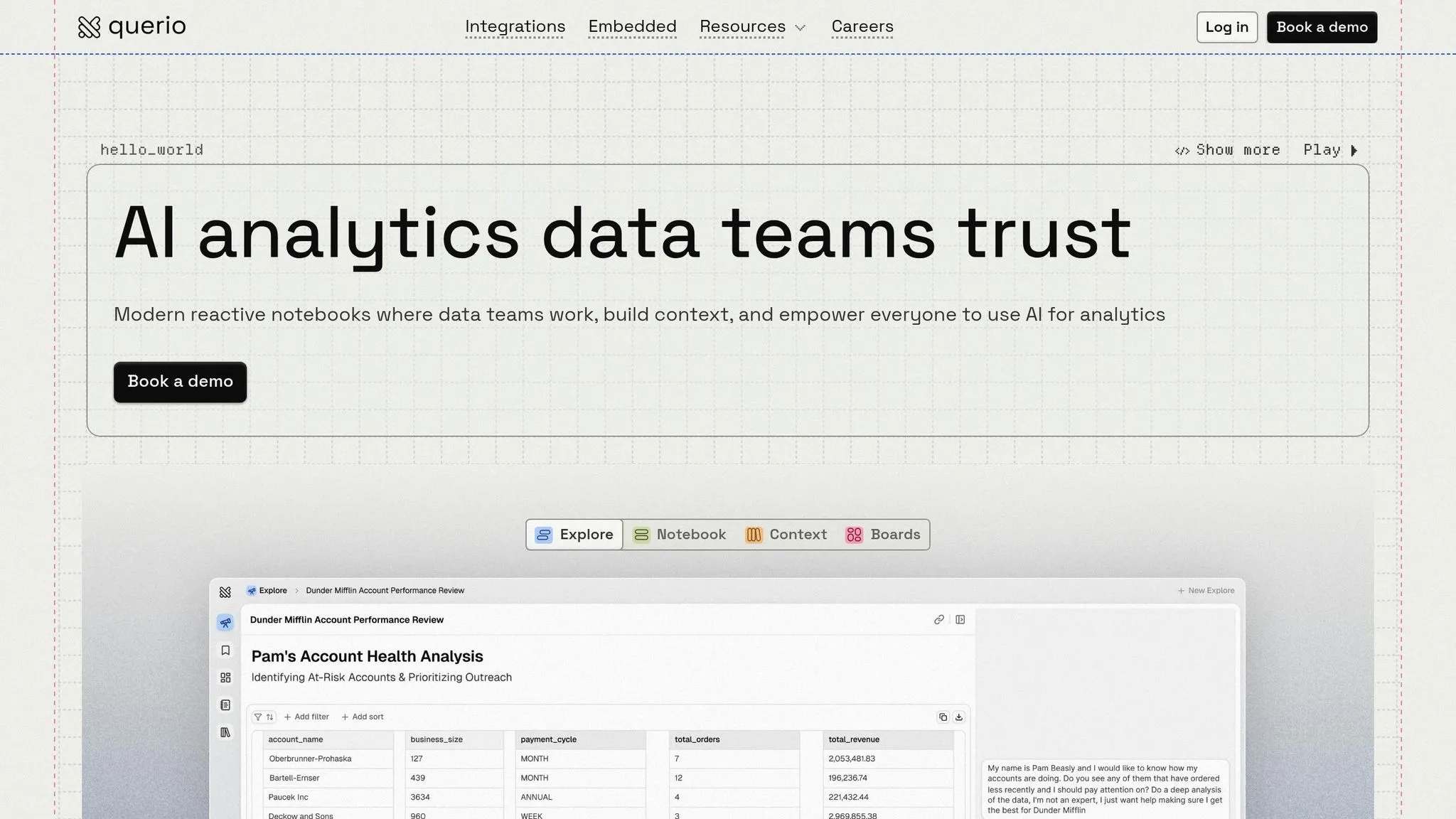
Querio is an AI-powered analytics workspace designed for teams that need quick and easy access to data. It connects directly to your existing data warehouse - whether that's Snowflake, BigQuery, Amazon Redshift, ClickHouse, or PostgreSQL - and allows users to interact with data naturally, without writing any code.
Natural-Language Querying
Querio simplifies data exploration with its natural-language querying feature. At its core is real-time SQL translation, which transforms user questions like "What were our top-selling products last quarter?" into accurate SQL code. Users can engage in multi-turn conversations, so follow-up questions like "What about North America?" are seamlessly understood without needing to restate the context. Querio also automatically selects the best visualization - be it a bar chart, line graph, or table - and generates narrative summaries to explain the results. Organizations leveraging AI-driven tools like this have reported finding insights up to 21 times faster, making it a game-changer for data exploration. Plus, the conversational interface ensures data governance remains intact across the ecosystem.
Governance Capabilities
Querio tackles enterprise governance through a centralized semantic layer. This allows data teams to define relationships, business terms, and metrics just once, ensuring consistent logic across the organization. For instance, "revenue" will always mean the same thing, no matter who’s querying the data. The platform uses encrypted, read-only credentials, so it cannot alter or delete source data. Studies show that implementing a semantic layer can boost Generative AI accuracy from 16% to 54%. To further safeguard data, Querio includes built-in parsers that validate AI-generated SQL before it’s executed, reducing the chance of errors. It also uses adaptive machine learning to monitor data quality and flag anomalies like unexpected traffic spikes.
Data Integration
Querio uses live data connectors to access information directly from your existing infrastructure, avoiding data duplication and minimizing the risk of data drift. It integrates seamlessly into collaboration tools like Slack and Microsoft Teams, enabling teams to access insights within their everyday workflows. This makes it easier to incorporate analytics into decision-making processes without switching platforms.
Security and Deployment
Querio prioritizes security with SOC 2 Type II compliance and enterprise-grade features such as Role-Based Access Control (RBAC), data masking, and lineage tracking to meet regulatory requirements like GDPR. It offers flexible deployment options, including cloud-hosted and self-hosted setups, with standard SSO integrations for secure and streamlined access. For a quick start, focus on high-value datasets to demonstrate ROI effectively.
2. Microsoft Power BI
Microsoft Power BI is a business intelligence platform that connects with over 100 data sources and integrates seamlessly with the Microsoft 365 ecosystem. Tailored for large enterprises, it leverages tools like Teams, Excel, and SharePoint to enhance data analysis and streamline workflows.
Natural-Language Querying
Power BI is transitioning from its legacy Q&A feature to the more advanced Copilot for Power BI, a generative AI assistant set to fully replace older tools by December 2026[3]. Copilot uses a chat interface to answer natural-language queries instantly. For example, you could ask, "What are the top 10 products by sales?" and it will generate visuals or apply filters as needed. It can even create new report pages or ad-hoc calculations based on conversational prompts. Copilot also writes DAX queries for advanced analytics. However, to access Copilot, you’ll need either Microsoft Fabric capacity at F2 or higher, or Power BI Premium capacity at P1 or higher[4]. This tool elevates query handling while aligning with governance needs.
Governance Capabilities
Power BI integrates with Microsoft Purview to manage governance, applying sensitivity labels to secure data across the Microsoft 365 environment. It uses Row-Level Security (RLS) and Object-Level Security (OLS) to restrict data access based on user roles. Audit logs track user activities to support compliance efforts. With over 3,500 engineers maintaining its security framework[5], Power BI also allows organizations to use "Bring Your Own Key" (BYOK) for encryption, giving them control over data security. For companies with specific data residency requirements, Multi-geo deployments enable storing data in designated regions to meet local regulations.
Data Integration
As part of the Microsoft Fabric ecosystem, Power BI uses a shared data lake called OneLake, enabling a unified source of truth across analytics services. Retail giants like Walmart leverage Power BI to consolidate data from various vendors into a single reporting system. In 2023–2024, Lumen reported saving nearly 10,000 manual hours through Power BI automation[6]. Its Direct Lake mode facilitates real-time querying without data imports, while deployment pipelines ensure smooth transitions from development to production environments.
Security and Deployment
Power BI combines robust security with flexible deployment options. Organizations can choose between cloud-hosted services or on-premises deployment via Power BI Report Server, ideal for those needing to keep data behind a firewall. All HTTP traffic is encrypted with TLS 1.2 or higher, and authentication is managed through Microsoft Entra ID (formerly Azure AD) using OAuth 2.0. For added security, deploying Power BI in an Azure Virtual Network with Private Link ensures data traffic avoids the public internet. Pricing begins at $14.00 per user per month for Power BI Pro (billed annually), with Premium Per User plans available at $24.00 per user per month for enterprise-level features[6].
3. Tableau
Tableau, a long-standing leader in Gartner's Magic Quadrant for over a decade, combines deep Salesforce integration with advanced AI tools to provide businesses with secure, actionable insights[12]. With features like the Einstein Trust Layer, it ensures enterprise-level security while delivering AI-powered analytics. This includes compliance with SOCII, ISO, and HIPAA standards, making it a trusted choice for organizations handling sensitive data[12].
Natural-Language Querying
Tableau Agent (previously known as Einstein Copilot) simplifies data preparation, visualization creation, and complex calculations by allowing users to interact with the platform through natural language queries[7][9]. Phil Cooper, Tableau's VP of Product Management, highlighted the platform's mission:
"Tableau democratized visual analytics and now we are doing the same for self-service AI. Business Science unlocks the vast potential of an army of professionals working with data every day."[8]
A standout feature is Tableau's use of the Model Context Protocol (MCP), an open-source framework that serves as a universal connection between enterprises' own large language models (LLMs) and Tableau's analytics engine[9]. This enables AI to autonomously perform tasks like multivariate analysis and causal diagnostics, ensuring results are grounded in a trusted semantic layer. The platform combines this seamless AI interaction with strong governance to maintain data integrity.
Governance Capabilities
Tableau's governance tools, available through Tableau Server and Tableau Cloud, centralize data management to create a single, reliable source of truth. This eliminates redundancy and improves data accuracy across the organization. Role-based access controls let administrators define permissions for viewing, editing, publishing, and exporting content at a user or group level. Tableau Data Management enhances this further by automating metadata generation and providing insights into data freshness, usage, and lineage.
PepsiCo's CPFR team illustrated the platform's effectiveness by achieving a 90% reduction in analysis time through the consolidation of warehouse, point-of-sale, and production data - all within Tableau's governed environment[11]. For those needing advanced security, Tableau Advanced Management offers features like managing encryption keys and moving content between sites using repeatable, governed processes.
Data Integration
Tableau excels at integrating with the Salesforce ecosystem and supports "ambient BI" by embedding contextual insights directly into workflows. These insights can be delivered through tools like Slack, Microsoft Teams, and email via Tableau Pulse[7][13]. Additionally, the platform integrates with external data catalogs, leveraging enterprise metadata to provide users with real-time context about data freshness and meaning as they consume it[12]. Forrester's Wave Report praised Tableau, stating:
"Clients often refer to Tableau as the gold standard for data visualization that other vendors aspire to reach."[13]
Security and Deployment
Tableau offers flexible deployment options, whether on-premises, in the public cloud (via AWS or Google Cloud), or as a fully managed service through Tableau Cloud on Salesforce's Hyperforce infrastructure. The Einstein Trust Layer ensures that data used in AI interactions is protected and adheres to the strict data access rules defined within Tableau Cloud or Server[1]. Jon Loyens, Chief Data Officer at data.world, shared his experience:
"It was a pleasure to use Tableau Cloud on Hyperforce. As promised, the experience was seamless. Hyperforce delivered the reliability, performance, and uptime that met and even exceeded our expectations."[10]
4. Google Cloud Vertex AI
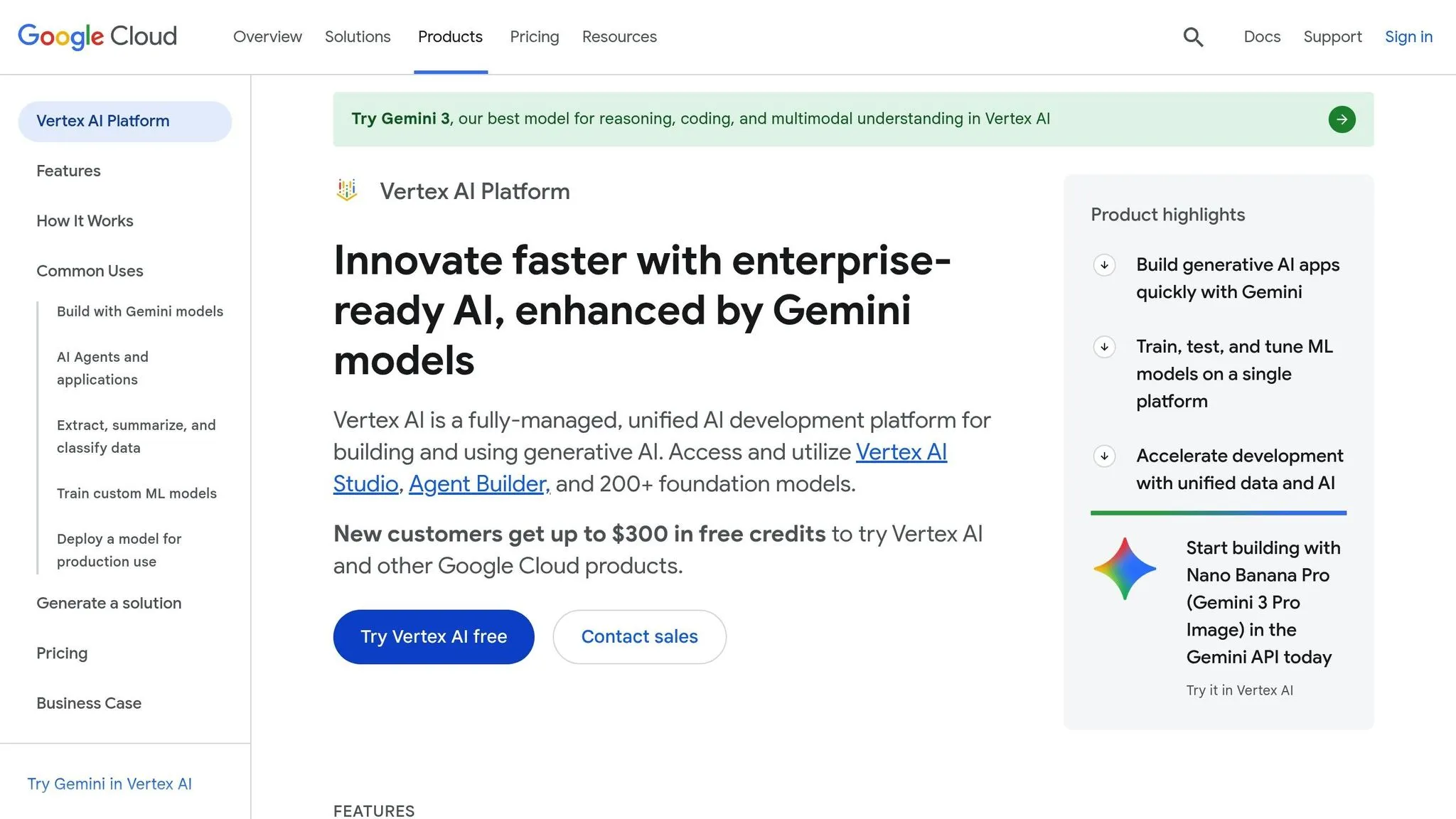
Google Cloud Vertex AI brings together data engineering and AI by seamlessly integrating with BigQuery and Cloud Storage. It offers access to over 200 foundation models, including Google's Gemini, Anthropic's Claude, and Meta's Llama, giving businesses a range of tools to meet their specific needs [14][15].
Natural-Language Querying
With Vertex AI, conversational analytics are powered by Gemini models, enabling users to ask questions in plain English within tools like BigQuery and Looker. This eliminates the need for complex SQL queries. Responses are tailored to organizational metadata, glossaries, and custom functions, ensuring they align with internal definitions [16].
Chris Benfield, Vodafone's Head of Engineering, shared his experience during a migration to a Dataform environment:
"The Data Engineer Agent successfully replicated all existing data and transformations scripts with 100% automation and zero manual intervention. This achievement resulted in a 90% reduction in the time typically required for manual ETL migration." [16]
Specialized agents simplify SQL and PySpark generation while creating comprehensive data exploration plans. Fernando Calo, PRISA's Lead Data Engineer, praised the agent's capabilities:
"The agent provides solutions that enable us to explore new development approaches, showing strong potential to address complex data engineering tasks. It demonstrates an impressive ability to correctly interpret our requirements." [16]
This efficiency is supported by strong governance measures to ensure operational reliability.
Governance Capabilities
Vertex AI includes robust governance features like the Model Registry, a centralized hub for managing the lifecycle of machine learning models, including versioning and deployment tracking [15]. Each AI agent is assigned an IAM Principal, creating an audit trail and securing access [15]. The Gemini Enterprise framework further enhances governance by allowing organizations to manage custom AI agents through a single interface [14].
Data Integration
Vertex AI excels in data integration, using Retrieval-Augmented Generation (RAG) to ground responses in live data. It connects with platforms like Looker and Dataplex and supports external sources such as Snowflake, Amazon Redshift, PostgreSQL, and MySQL [15][16]. Abdol Moabery, CEO of GA Telesis, expressed his trust in the platform's capabilities:
"The accuracy of Google Cloud's generative AI solution and practicality of the Vertex AI Platform gives us the confidence we needed to implement this cutting-edge technology into the heart of our business." [14]
Security and Deployment
Data privacy and security are central to Vertex AI, with features like Model Armor protecting against prompt injection and data leaks [15][17][19]. The platform supports various deployment options, including managed endpoints for production, serverless training for on-demand tasks, and dedicated clusters for large-scale workloads [19].
New users can explore the platform with $300 in free credits, while text and chat generation starts at just $0.0001 per 1,000 characters [14][18].
5. Kore.ai
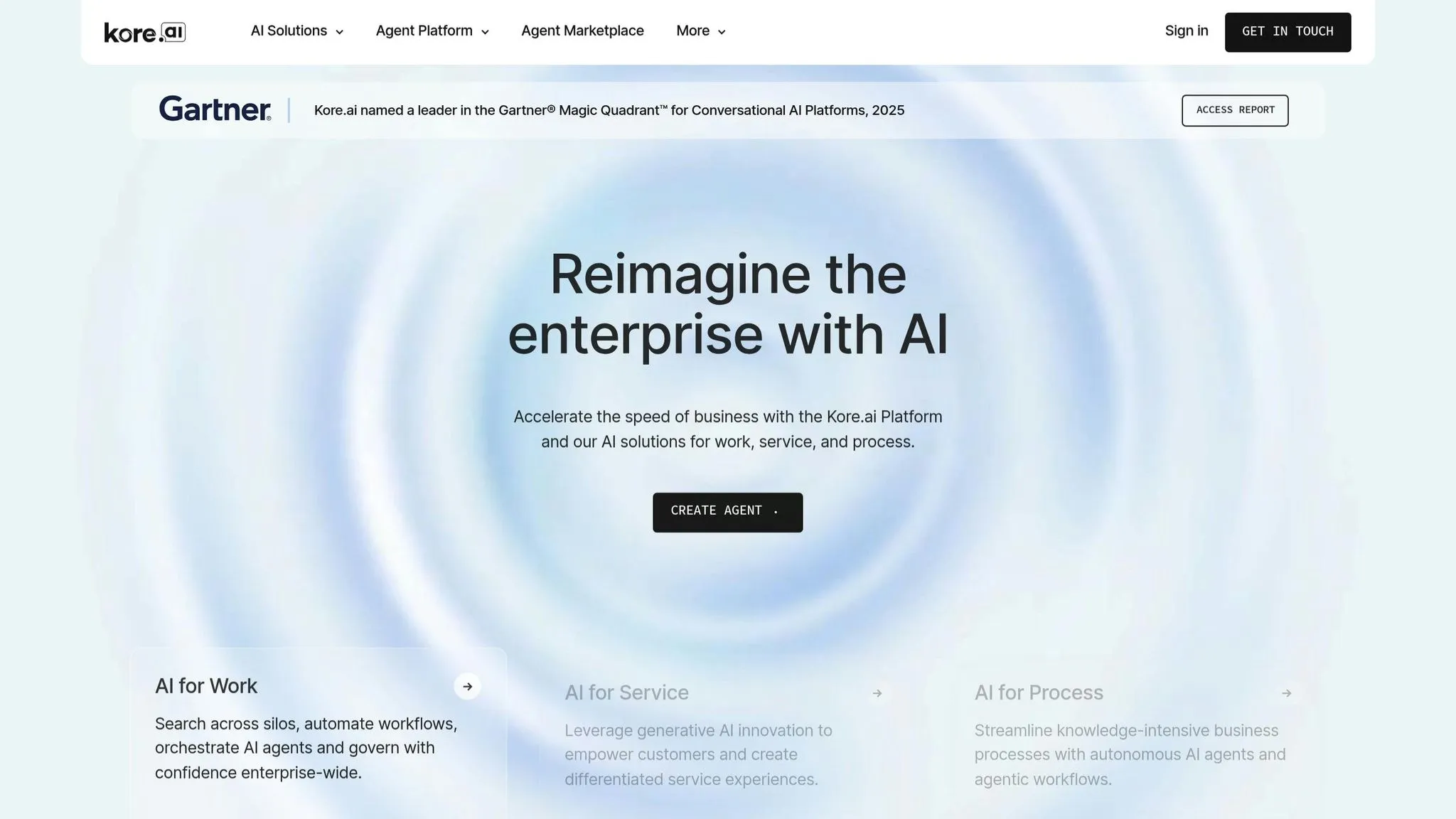
After exploring top AI tools like Vertex AI, let's dive into Kore.ai's distinctive approach to multi-agent orchestration.
Kore.ai's multi-agent orchestration engine allows AI agents to work together seamlessly, tackling complex tasks without human intervention [20]. Recognized by Gartner as a Leader in the Magic Quadrant for Conversational AI Platforms for three years running, Kore.ai supports over 400 Fortune 2000 companies and has achieved over $1 billion in cost savings for its clients [20].
Natural-Language Querying
Kore.ai uses Agentic RAG (Retrieval-Augmented Generation) to process real-time data while maintaining the flow of conversation [20]. By blending NLP, machine learning, and knowledge graphs, it ensures precise understanding of user intent [21]. Business teams can design agent logic using a no-code visual tool, while developers have the flexibility to expand features via APIs [20]. This flexibility is key when building AI agents tailored to specific enterprise workflows.
"Kore.ai enables multi-agent orchestration with features such as agent collaboration, memory retention, tool access, and intelligent delegation." - Everest Group [20]
Data Integration
The platform includes 250+ enterprise-grade connectors for systems like CRM, ERP, ITSM, and HRIS. It also uses a unified data indexing approach that integrates information from a variety of sources with adjustable levels of detail. Additionally, its Agent Marketplace offers over 300 pre-built AI agents and templates, making deployment faster and easier [20][21].
Security and Deployment
Kore.ai's architecture is adaptable, supporting deployments on the cloud, in a VPC, or on-premises [20]. A centralized AI governance dashboard provides tools for tracing, audit logs, and real-time monitoring. Features like configurable guardrails and RBAC (Role-Based Access Control) help enforce policies and minimize risks. Pricing options include session-based, usage-based, or per-seat plans, with tiered volume discounts available [20].
Kore.ai's combination of advanced querying, seamless data integration, and a strong focus on security makes it a powerful tool for enterprises looking to enhance their AI capabilities.
6. AWS Bedrock
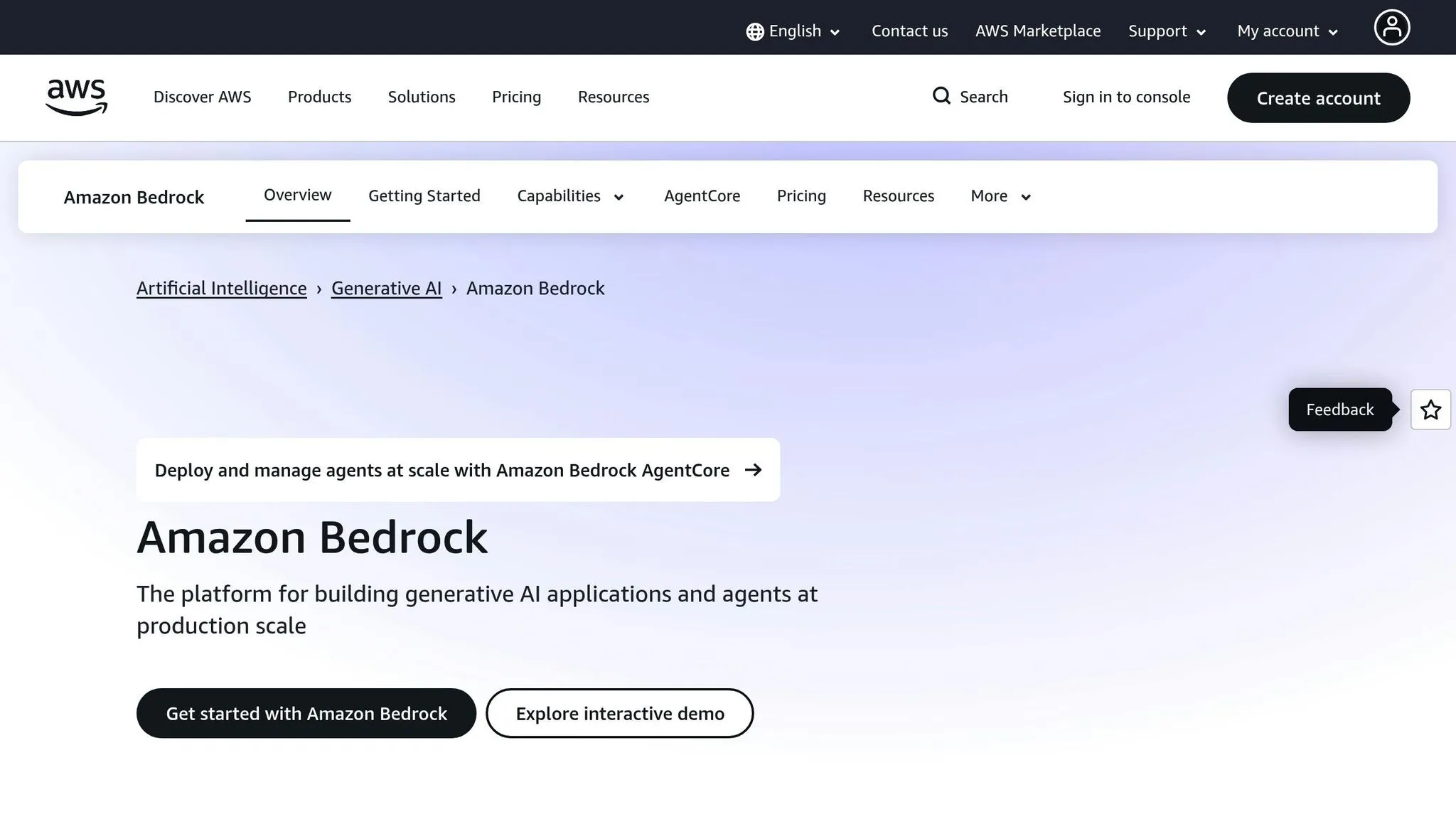
AWS Bedrock uses a serverless framework to deliver enterprise AI analytics, supporting generative AI for over 100,000 organizations globally. It provides a unified API that connects users to foundation models from providers like Anthropic, Meta, Mistral AI, Cohere, and Amazon itself [22][26]. In 2024, Robinhood leveraged Bedrock to scale from processing 500 million to 5 billion tokens daily in just six months. This move led to an 80% reduction in AI costs and slashed development time by half [22].
Natural-Language Querying
Bedrock's Knowledge Bases come equipped with managed "Natural Language to SQL tools capabilities. This feature translates conversational queries into SQL, enabling seamless data retrieval from structured sources such as Amazon Redshift and AWS Glue [26]. Managed agents within Bedrock can break down tasks, create orchestration plans, and call enterprise APIs to streamline automation [23][26]. On top of that, its Automated Reasoning system ensures accuracy, delivering correct model responses with a 99% success rate to reduce errors [22].
Data Integration
Bedrock integrates with over 100 data sources, including AWS Glue, Amazon Q, and third-party platforms like Salesforce, SharePoint, Confluence, and SAP [22]. Its Knowledge Bases handle the entire RAG (Retrieve-Augment-Generate) workflow - managing data ingestion, chunking, and embedding to keep models updated [23][25]. Through the AgentCore Gateway, users gain a single access point for tools, ensuring agents have the right permissions to interact with existing software stacks [22].
These features streamline data integration while maintaining strong security and deployment flexibility.
Security and Deployment
Customer data remains private with Bedrock - it is never used for training models. Data is encrypted both at rest (using AES-256) and in transit (via TLS 1.2) [22][24][26]. AWS PrivateLink adds an extra layer of security by enabling private connectivity between a VPC and Bedrock, keeping traffic off the public internet [27][28]. The platform meets stringent compliance standards, including HIPAA eligibility, FedRAMP High certification, and adherence to ISO, SOC, CSA STAR Level 2, and GDPR requirements [22][26].
Bedrock also incorporates Guardrails that can block up to 88% of harmful content, while its distilled models operate up to 500% faster and cost up to 75% less than base models [22].
"Amazon Bedrock's model diversity, security, and compliance features are purpose-built for regulated industries." – Dev Tagare, Head of AI, Robinhood [22]
Advantages and Disadvantages
Each platform brings a distinct set of strengths and compromises, catering to diverse enterprise demands. Let’s break down what makes each one stand out:
Querio delivers exceptional natural-language accuracy at 90% and features a semantic layer designed for consistent, conflict-free analysis. With live connections to data warehouses and flexible deployment options - whether in the cloud, on-premises, or hybrid - it integrates smoothly into various environments.
Microsoft Power BI shines within the Microsoft ecosystem, thanks to its deep Azure integration and budget-friendly pricing, starting at just $14 per user per month.
Tableau, rated 4.4/5 by 3,979 Gartner Peer Insights reviews, offers over 30 pre-built visualizations and meets stringent compliance standards like SOC 2, HIPAA, and GDPR.
Google Cloud Vertex AI and AWS Bedrock dominate their respective cloud ecosystems, delivering powerful AI capabilities. However, enterprises adopting these platforms may face challenges with vendor lock-in, particularly in multi-cloud setups.
Kore.ai impresses with its 250+ plug-and-play connectors and model-agnostic design. It has been recognized as a Leader in Gartner's Magic Quadrant for Conversational AI Platforms for three consecutive years.
Here’s a quick comparison of how these platforms perform across key enterprise requirements:
| Platform | Natural-Language Querying | Governance Capabilities | Data Integration | Security & Deployment |
|---|---|---|---|---|
| Querio | High accuracy via real-time semantic analysis | Centralized semantic layer ensures consistency | Real-time data connectors | Cloud, On-prem, or Hybrid |
| Power BI | AI-powered conversational interface | RBAC with Microsoft Purview integration | Deep M365 & Azure integration | Enterprise-scale (Azure) |
| Tableau | Natural-language driven exploration | Role-based permissions with audit trails | Strong Salesforce ecosystem | SOC 2, HIPAA, GDPR compliant |
| Vertex AI | Low-code agent builder | Managed governance with IAM principals | Google Cloud native integration | Private networking (VPC) |
| Kore.ai | Seamless agent orchestration | Governance dashboard with tracing | 250+ plug-and-play connectors | Model & Cloud agnostic |
| AWS Bedrock | AgentCore orchestration | High scalability with automated reasoning | AWS ecosystem integration | VPC routing & KMS encryption |
Pricing varies widely, from as low as $14 per user per month to consumption-based models that scale with usage. This diversity makes it crucial for businesses to align their budget and priorities with the right platform to maximize the benefits of AI-driven business intelligence.
As Matt Blumberg, CEO of Acrolinx, wisely puts it:
"Companies that embed responsible AI principles into their core strategy are best positioned to navigate future regulations and maintain a competitive edge" [2].
Conclusion
As businesses grapple with increasingly complex data landscapes, the need for adaptable and reliable analytics tools has never been greater. Querio steps in to meet this demand, offering advanced natural-language processing and strong governance capabilities. With data volumes expected to grow more than tenfold between 2020 and 2030 [2], organizations require a platform that can handle this surge without compromising on accuracy or consistency.
Querio tackles these challenges by integrating natural-language analytics, a centralized semantic layer, and multiple deployment options - whether in the cloud, on-premises, or through a hybrid setup. Governance isn't an added feature; it's baked into the platform. As Raluca Alexandru, an analyst at Forrester, explains:
"Data governance has evolved from a compliance-focused discipline into... the control plane for trust, agility, and AI at enterprise scale" [2].
Querio's transparent outputs and built-in permission controls ensure that as AI adoption continues to grow, businesses can rely on explainable and trustworthy results. Unlike opaque, black-box systems, Querio aligns with existing permissions and delivers results that data teams can confidently act on. This blend of accessibility, precision, and governance ensures your enterprise can harness AI-driven insights while maintaining the consistency needed for informed decision-making.
With 75% of knowledge workers already using AI in their roles [29], adopting Querio means equipping your business with the tools to not only meet current data challenges but also stay ahead in the evolving digital economy.
FAQs
::: faq
How do I choose the right AI analytics platform for my enterprise?
To find the right AI analytics platform, it's important to weigh factors like usability, integration capabilities, and the depth of analytics offered. Querio is a strong contender, thanks to its intuitive interface and natural language querying, making it especially useful for teams without technical expertise. Budget and infrastructure are also key considerations - Querio has a free plan, with Core at $2,499 a month, and it integrates smoothly with a range of tools. Lastly, ensure the platform aligns with your enterprise's needs by focusing on scalability, robust security features, and governance. :::
::: faq
How can AI analytics stay accurate with our business definitions and metrics?
AI analytics achieves precision by adhering to clear, standardized data practices and incorporating tools that ensure data lineage and robust security. This approach safeguards the integrity of metrics across all workflows. By linking platforms to reliable data sources - like warehouses or transformation tools - businesses can rely on accurate, real-time data, reducing the risk of discrepancies. The combination of governance, consistent definitions, and smooth integration results in dependable insights tailored to your business's unique metrics. :::
::: faq
What security and compliance controls should we require before deploying?
Before rolling out AI analytics platforms, it's important to prioritize security measures. Start by implementing role-based access controls (RBAC) to limit access to sensitive data based on user roles. Add another layer of protection with data encryption - both at rest and during transmission - and enforce multi-factor authentication (MFA) for verifying user identities.
Equally important is ensuring compliance with key standards such as SOC 2 or GDPR. These frameworks help guarantee that your platform meets essential security and privacy requirements. To further protect data, consider features like dynamic data masking, which hides sensitive information, and data loss prevention (DLP) tools to prevent unauthorized sharing or leaks. Lastly, ensure your platform has secure API integrations to maintain alignment with enterprise security policies. :::