Business Intelligence
ThoughtSpot vs Querio: Two ways to do natural language analytics
Compare enterprise search-driven BI versus fast conversational analytics with editable SQL—features, pricing, and deployment trade-offs.

Natural language analytics simplifies data querying by allowing anyone to ask plain-English questions like, "What were last quarter's top sales?" and receive instant insights - no SQL knowledge required. This article compares two platforms offering this capability: ThoughtSpot and Querio.
- ThoughtSpot: Designed for large enterprises, it uses a search-driven interface to generate visual insights. It supports complex setups and offers advanced features like anomaly detection but requires significant time and investment to deploy.
- Querio: A conversational AI tool for small to mid-sized businesses, Querio focuses on quick deployment (15 minutes), a free plan with no per-seat pricing, and editable SQL queries. It integrates seamlessly with modern data warehouses like Snowflake and BigQuery.
Key Differences:
- ThoughtSpot excels for large organizations with legacy systems and high budgets.
- Querio is ideal for smaller, agile teams seeking fast, cost-effective analytics.
Quick Comparison
| Feature | ThoughtSpot | Querio |
|---|---|---|
| Target Users | Large enterprises | SMBs and mid-market companies |
| Setup Time | Weeks to months | ~15 minutes |
| Pricing | $95+/user/month (min. 100 users) | Free plan; Core $2,499/mo |
| Query Interface | Search bar | Conversational AI |
| Code Visibility | Limited | Full SQL and Python |
| Warehouse Integrations | 10+ | 20+ |
| Deployment | Cloud, on-premises, hybrid | SaaS, self-hosted, VPC |
Choose ThoughtSpot for enterprise-scale needs. Opt for Querio if speed, affordability, and simplicity matter most.
::: @figure 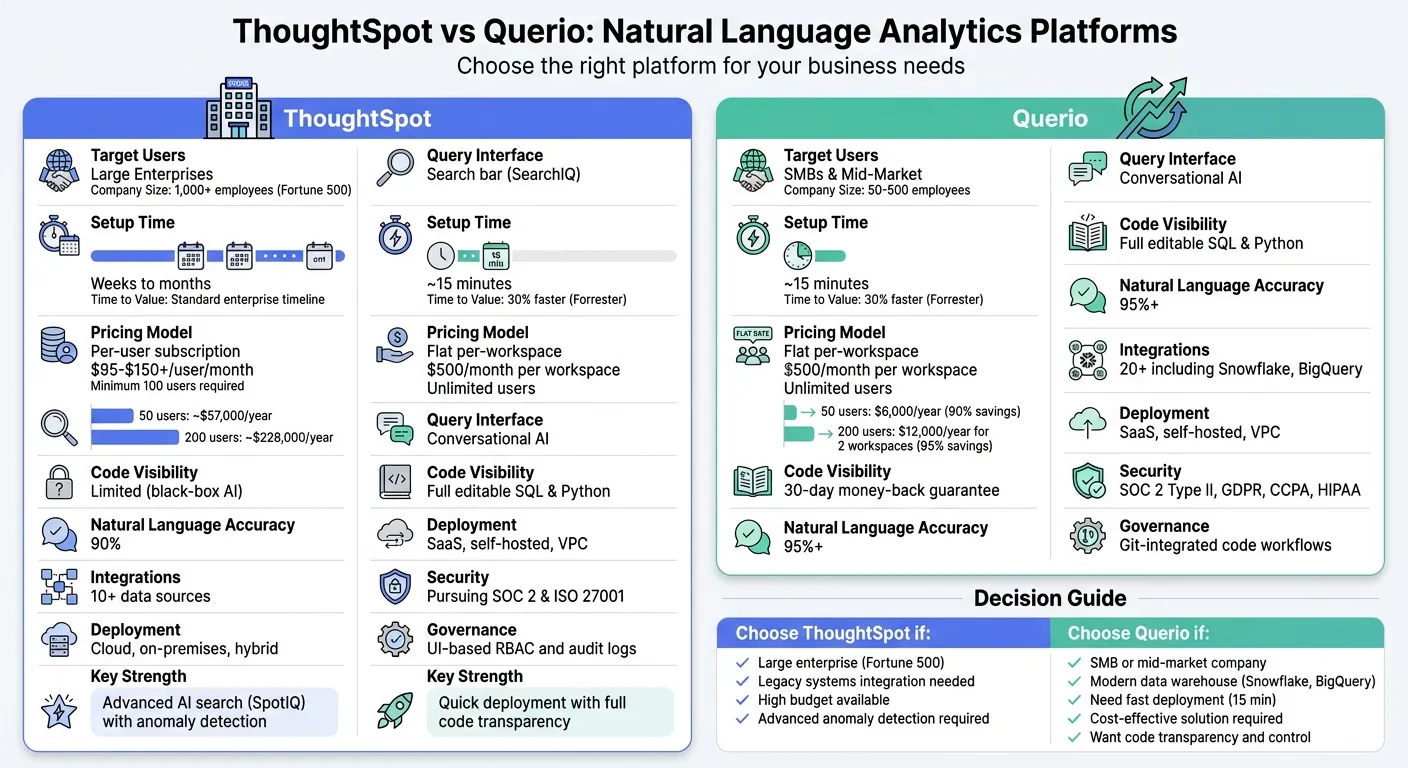 {ThoughtSpot vs Querio: Feature and Pricing Comparison for Natural Language Analytics}
:::
{ThoughtSpot vs Querio: Feature and Pricing Comparison for Natural Language Analytics}
:::
Accelerate insights with a new natural language-driven analytics experience in BigQuery
::: @iframe https://www.youtube.com/embed/yMgwMHiORHw :::
sbb-itb-284a532
What is ThoughtSpot?
ThoughtSpot is a cloud-based analytics platform that focuses on search-driven analytics. It’s designed to let users - whether they’re business analysts, executives, or non-technical professionals - type straightforward questions like "What are sales trends by region last quarter?" into a search bar and instantly receive visual insights. This makes it especially useful for industries like finance, retail, and healthcare, where quick, self-service data access is essential.
The platform’s functionality is powered by two key features: SearchIQ, which interprets natural language queries, and SpotIQ, which identifies trends and anomalies across large datasets. ThoughtSpot translates plain English questions into SQL, pulling data from over 100 sources, including major live data warehouses. It then generates real-time visualizations and interactive Liveboards, often with response times measured in seconds.
These capabilities deliver real-world advantages. Companies such as Nissan and Comcast have used ThoughtSpot to cut reporting times from days to minutes, improve analyst productivity by 40%, and achieve significant cost savings through increased efficiency.
Currently, ThoughtSpot supports over 2,000 enterprises, including a quarter of the Fortune 50. It has earned recognition from Gartner as a leader in augmented analytics and offers strong security features such as row-level controls and single sign-on.
That said, its advanced capabilities come with a learning curve. Setting up ThoughtSpot often involves configuring semantic models, and its consumption-based pricing can represent a considerable investment. Balancing these strengths against the complexity and cost is crucial when assessing whether ThoughtSpot is the right fit for an organization. This understanding is key when comparing it to other natural language analytics tools.
What is Querio?
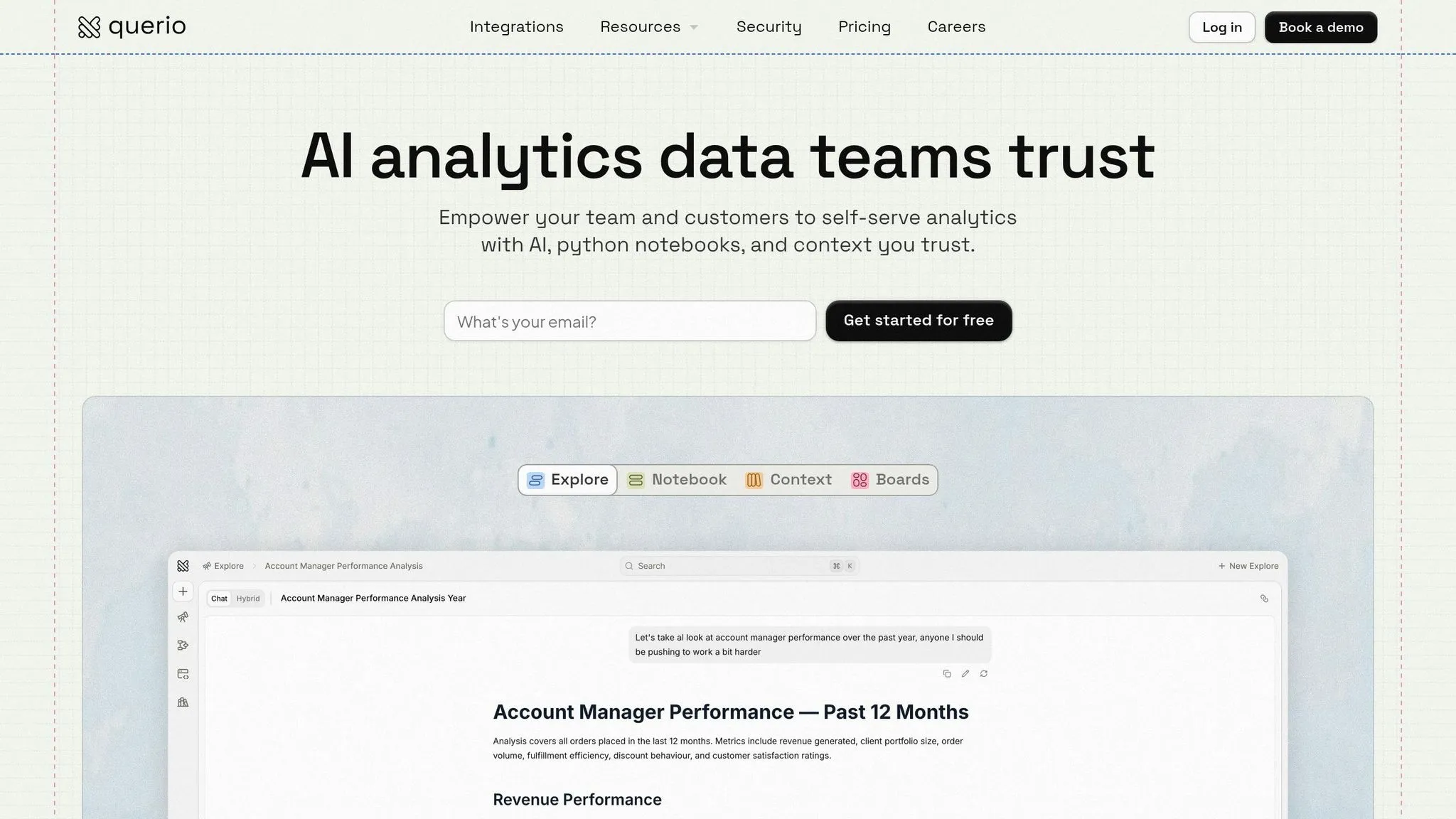
Querio is an AI-powered platform designed to help modern data teams ask questions in plain English and get answers backed by real, editable SQL and Python code. It connects directly to live data warehouses like Snowflake, BigQuery, and Postgres through secure, read-only connections. For example, if you ask, "Show me sales trends by region for Q1 2025", Querio's conversational AI engine generates the SQL query on the spot, runs it against your data warehouse, and delivers results along with the underlying code. You can review, edit, and verify every line of code, giving data teams complete control and confidence in their analytics.
One standout feature of Querio is its Context Layer, which allows data teams to define business terms, table joins, and metric calculations during a quick setup process. After this configuration, the AI consistently applies these definitions across all queries. For instance, if your finance team defines "customer acquisition cost" in a specific way, that same logic will be used whether the question comes from a marketing analyst or an executive. This eliminates the common issue of "metric drift", where different teams calculate the same KPI differently.
For security, Querio enforces permissions at the warehouse level, seamlessly integrating row-level and column-level permissions from your existing data infrastructure. The platform is SOC 2 Type II, GDPR, and CCPA compliant, offering role-based access controls and full audit trails. For organizations with strict data residency needs, Querio can even be deployed as a self-hosted solution, ensuring all data processing stays within your infrastructure.
Querio empowers non-technical users across departments like marketing, finance, and operations to generate their own insights without relying on IT, while data engineers retain control through centralized business definitions. With no per-seat pricing and unlimited viewer access on every plan, it’s easy to scale analytics across your organization. These features set the stage for a deeper dive into Querio's capabilities in the next section.
ThoughtSpot vs Querio: Feature Comparison
Both ThoughtSpot and Querio excel in natural language analytics but differ significantly in how they deliver insights, connect to data, and manage workflows. Here's a closer look at their standout features.
ThoughtSpot operates through its search-driven interface, SearchIQ, allowing users to type questions into a search bar to generate AI-driven visualizations. It connects to over 10 native data sources, supporting both legacy systems and modern cloud warehouses. A key strength is its SpotIQ engine, which identifies patterns, anomalies, and trends automatically - no manual queries required. However, deploying ThoughtSpot can take weeks or even months. For instance, a bank utilized these capabilities to manage compliance for over 10,000 users [7][5].
Querio, on the other hand, takes a conversational approach. It translates plain English queries into editable SQL and Python code that runs directly on live data. With its Context Layer, data teams can define business terms, joins, and metrics in about 15 minutes. This feature helped one finance team cut query errors by 40% by ensuring consistent application of definitions like "customer acquisition cost" [3][4].
The platforms also diverge in governance. ThoughtSpot provides row and column-level security, audit logs, and integrates with SSO providers like Okta. Querio treats queries as code, using Git-integrated workflows for versioning and approvals. A tech company implementing Querio for SOC 2 compliance reduced governance overhead by 50% by versioning queries similarly to application code [4][6].
When it comes to deployment, ThoughtSpot offers flexibility with cloud (AWS, Azure, GCP), on-premises, and hybrid options, starting at $95 per user per month. Querio provides SaaS, self-hosted (via Docker or Kubernetes), and VPC deployments with no data egress. For example, an e-commerce company self-hosted Querio on Amazon EKS to ensure low-latency analytics while keeping full control over its data [3][5].
Feature Comparison Table
| Feature | ThoughtSpot | Querio |
|---|---|---|
| Natural Language Accuracy | 90% for standard BI queries | 95%+ with context-aware AI |
| Query Interface | Search bar (SearchIQ) | Conversational AI with multi-step reasoning |
| Code Visibility | Limited (black-box AI) | Full editable SQL and Python |
| Data Warehouse Integrations | 10+ native connectors | 20+ including Snowflake, BigQuery, Postgres, MySQL |
| Setup Time | Weeks to months | ~15 minutes |
| Governance Model | UI-based RBAC and audit logs | Code-review workflows with Git integration |
| Deployment Options | Cloud, on-premises, hybrid | SaaS, self-hosted (Docker/K8s), VPC |
| Security Compliance | Pursuing SOC 2 & ISO 27001 | SOC 2 Type II, GDPR, CCPA |
| Time to Value | Standard enterprise timeline | 30% faster per Forrester analysis [2][3] |
Querio's quick setup, clear code visibility, and governance features make it a strong choice for organizations seeking fast and dependable analytics.
When to Use Each Platform
ThoughtSpot is designed for large enterprises with complex legacy systems. For example, Verizon uses it for executive dashboards, and it’s widely adopted by leaders in the Gartner Magic Quadrant [1][5]. This makes it a go-to for organizations with established, traditional setups. On the other hand, Querio takes a completely different approach, catering to agile, growth-focused businesses.
Querio is built for companies with 50–500 employees that rely on modern data warehouses like Snowflake and BigQuery. It’s especially appealing to teams in marketing, finance, and sales, thanks to its conversational AI that eliminates the need for SQL knowledge. A fintech firm, for instance, achieved a 40% faster rate of sharing insights through Querio’s shared workspaces and version control for natural language queries. Meanwhile, a retail company saw three times the adoption rate of warehouse-native queries [2][4]. These features make Querio a favorite for teams needing flexibility and speed in today’s fast-moving business environment.
Querio also shines in embedding analytics into customer-facing applications. By integrating with tools like Retool or Streamlit, it dramatically reduces setup times. SaaS companies with multi-tenant data needs have reported a 60% faster setup for embedded analytics [3]. Additionally, a healthtech firm using Querio for collaborative analytics cut its BI ticket volume by 70% because analysts could co-edit queries directly on BigQuery [7].
When it comes to handling large-scale data and ensuring compatibility with various warehouses, Querio proves its strength. It managed a logistics firm’s 20TB multi-cloud setup by automatically identifying schemas across federated sources [8]. Forrester analysts recommend Querio for teams that prioritize fast insights, noting its 90% query accuracy on warehouses without requiring training data [9]. This appeal is reflected in its growing popularity - its user base grew by 150% in 2025 among Series B and C startups seeking cost-efficient integration [5].
Use Case Comparison Table
| Scenario | ThoughtSpot | Querio |
|---|---|---|
| Enterprise BI Replacement | Tailored for very large enterprises with extensive datasets and legacy BI needs | Perfect for growing businesses needing quick deployment with modern data warehouses |
| Data Team Collaboration | Supports a more siloed, individual approach | Enables shared workspaces with Git-like versioning, leading to 40% faster insight sharing [2] |
| Embedded Analytics | Focused on internal enterprise use with heavy customization | Excels in customer-facing SaaS apps, offering 60% faster embed setup [3] |
| Self-Serve Analytics | Requires basic analytics knowledge and additional setup | Offers a zero-SQL experience, driving 3× higher adoption among nontechnical teams [4] |
| Target Company Size | Geared toward Fortune 500 and large enterprises (1,000+ employees) | Best for SMBs and mid-market companies (up to 500 employees) |
| Setup Complexity | Typically takes weeks or months with dedicated engineering teams | Simplifies setup - often completed in about 15 minutes with auto-schema discovery |
| Warehouse Compatibility | Supports around 10+ sources but struggles with schema-less data | Optimized for 20+ sources, especially Snowflake and BigQuery |
| Team Structure | Works well for centralized BI teams with advanced data maturity | Ideal for decentralized, agile teams; rated 4.8/5 for workflows compared to 4.5 [6] |
Strengths, Limitations, and Pricing
ThoughtSpot's pricing structure begins at $95 per user per month, requiring a minimum of 100 users. This can lead to significant costs - around $57,000 annually for 50 users and approximately $228,000 per year for 200 users. These escalating expenses highlight the need to carefully weigh costs and governance capabilities when selecting a platform.
On the other hand, Querio offers a more budget-friendly option. It has no per-seat pricing and a free plan. Core is $2,499 a month (or $25,000 a year billed annually), with unlimited users on every plan. This pricing model eliminates the risk of rising costs as user numbers grow. For example, while ThoughtSpot's costs for 50 and 200 users can reach $57,000 and $228,000 annually, respectively, Querio Core at $25,000 a year costs about 56% and 89% less, before any AI credits used past the 10,000 included each month.
Beyond cost, Querio excels in governance. Its per-workspace isolation, detailed role-based access controls, and comprehensive data lineage provide a more secure and flexible solution than ThoughtSpot's centralized governance. Additionally, Querio meets compliance standards such as SOC 2 Type II, HIPAA, and GDPR, making it ideal for organizations with strict regulatory needs. According to IDC analysts, Querio's workspace model is particularly suited for multi-tenant architecture compliance scenarios, allowing departments to manage their analytics independently.
While Querio's ecosystem of pre-built integrations is smaller and its AI capabilities for complex visualizations are still developing, it compensates with a quick 15-minute setup and a 30-day money-back guarantee. This reduces the labor required for implementation and speeds up the value realization process.
Strengths and Pricing Comparison Table
| Aspect | ThoughtSpot | Querio |
|---|---|---|
| Key Strengths | Scales well for enterprises; advanced AI search (Spotter IQ); 50+ integrations; ideal for large organizations | Free plan and no per-seat pricing; unlimited users; quick 15-minute setup; strong multi-tenant governance; SOC 2 Type II, HIPAA, and GDPR certified |
| Primary Limitations | High per-user costs ($95+/month); limited multi-tenant governance; slower implementation | Fewer pre-built integrations; developing AI for complex visualizations |
| Pricing Model | Per-user subscription: $95–$150+/user/month (minimum 100 users); potential setup fees | Free plan; Core $2,499/mo ($25,000/yr) with 10,000 AI credits a month; no per-seat or compute fees |
| Cost for 50 Users | ~$57,000/year | $25,000/year on Core (about 56% savings) |
| Cost for 200 Users | ~$228,000/year | $25,000/year on Core (about 89% savings) |
| Money-Back Guarantee | None | 30-day money-back guarantee |
| Best For | Large enterprises with legacy systems and high budgets | Small to mid-sized businesses (50–500 employees) needing cost-effective, compliant analytics solutions with modern data warehouses |
Which Platform Should You Choose?
The right platform depends on your team size, budget, and governance requirements. If you're part of a large enterprise with intricate deployment needs, ThoughtSpot might align better with your goals. On the other hand, Querio is a smart pick for mid-sized, growing organizations that prioritize affordability, quick implementation, and ease of use.
Querio stands out with several key advantages. With no per-seat pricing, included AI credits and spending caps, costs stay predictable no matter how large your team grows. Plus, with a setup time of just 15 minutes and a 30-day money-back guarantee, it offers a fast return on investment. Querio integrates seamlessly with popular cloud data warehouses like Snowflake, BigQuery, and Amazon Redshift.
The platform's flexible workspaces meet strict security and compliance standards, including SOC 2 Type II, HIPAA, and GDPR. This allows individual departments to manage their analytics independently while maintaining high levels of security. Querio is designed for modern, cloud-based analytics stacks that need fast, reliable insights to drive decisions.
For teams focused on agility, growth, and cost-effective solutions, Querio delivers the speed, affordability, and flexibility needed to stay ahead. It’s the ideal choice for organizations seeking secure and scalable analytics without breaking the bank.
FAQs
::: faq
How do I connect Querio to my data warehouse securely?
To connect Querio securely to your data warehouse, take advantage of its direct connection features, which use encrypted protocols like SSL/TLS. Start by configuring your warehouse credentials, allowing Querio’s IP addresses, and enabling encryption settings on both sides. Querio prioritizes security with features like SOC 2 Type II compliance, AES-256 encryption, and role-based permissions, ensuring your data analysis remains both safe and compliant. :::
::: faq
Can I review and edit the SQL that Querio generates?
Querio lets you review and edit the SQL queries it generates. By transforming natural language inputs into precise, executable SQL, it provides the flexibility to tweak and customize queries to fit your specific needs. :::
::: faq
How do I make sure KPI definitions stay consistent in Querio?
Querio's context layer feature is a powerful tool for standardizing KPI definitions across your organization. By using this feature to set business rules and metric standards upfront, you create a shared understanding of key metrics. This approach minimizes discrepancies, aligns teams, and ensures everyone is on the same page when interpreting data. Predefining these standards within Querio not only promotes clarity but also helps maintain consistency over time. :::